The Short Answer for APPIE sits on terminal
APPIE enables payment terminals to be ECR/POS-agnostic, allowing them to seamlessly integrate with any system without additional development.
APPIE is a payment interoperability platform that enables processors to integrate with diverse ECR (Electronic Cash Register) and POS (Point of Sale) environments through a single, intelligent compatibility layer.
Instead of building custom integrations for every terminal type, POS system, or merchant environment, processors deploy APPIE and gain coverage across fragmented terminal estates.
The Problem APPIE Solves
Payment processors face a persistent challenge: the merchant terminal landscape is deeply fragmented.
Merchants use dozens of different POS systems. Terminals come from multiple manufacturers. Protocols range from legacy byte-delimited formats to modern JSON APIs. Each combination potentially requires its own integration.
This fragmentation creates:
- High integration costs — One-off integrations for each POS environment
- Extended certification cycles — Each integration requires separate certification
- Slow merchant onboarding — Months of delay for unsupported environments
- Support complexity — Different behavior patterns across terminal types
- Middleware dependencies — Reliance on expensive third-party layers
APPIE addresses this fragmentation through a profile-driven interoperability approach.
How APPIE Works
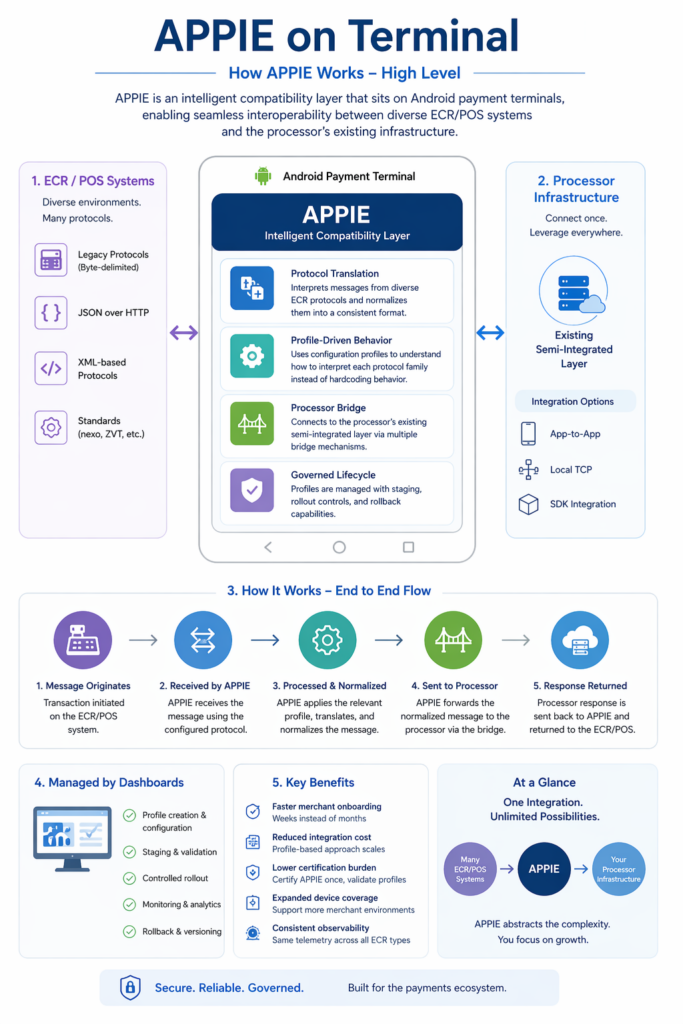
APPIE operates as an intelligent compatibility layer on Android-based payment terminals. It sits between the ECR/POS system and the processor’s existing semi-integrated infrastructure.
Core capabilities:
- Protocol Translation — APPIE interprets messages from diverse ECR protocols and normalizes them into a consistent format the processor can consume.
- Profile-Driven Behavior — Instead of hardcoding behavior for each ECR vendor, APPIE uses configuration profiles that describe how to interpret each protocol family.
- Processor Bridge — APPIE integrates with the processor’s existing semi-integrated layer through multiple bridge mechanisms (app-to-app, local TCP, SDK integration).
- Governed Lifecycle — Profiles are managed through dashboards with staging, rollout controls, and rollback capabilities.
What APPIE Is Not
Not a processor replacement. APPIE integrates with the processor’s existing infrastructure; it does not replace the acquirer connection.
Not a certification bypass. APPIE reduces certification scope but does not eliminate the need for proper validation.
Not a simple adapter. APPIE is a full platform with lifecycle management, observability, and governance, not a code snippet.
APPIE is not a reverse engineering system
Why Processors Choose APPIE on the terminal:
| Benefit | Impact |
|---|---|
| Faster merchant onboarding | Weeks instead of months |
| Reduced integration cost | Profile-based approach scales |
| Lower certification burden | Certify APPIE once, validate profiles |
| Expanded device coverage | Support more merchant environments |
| Consistent observability | Same telemetry across all ECR types |
Key Takeaway
APPIE is a patent-pending payment interoperability engine and migration platform built by the RapidCents team. APPIE is a strategic interoperability layer that transforms how processors approach terminal integration. Instead of building N integrations for M ECR environments, processors build one integration with APPIE and leverage profiles for coverage.
This software is purpose-built for enterprise processor manufacturers, terminal providers, and ISVs, as well as ECR/POS companies and enterprise-level merchants. For enterprise inquiries or to request more information, please contact [email protected] or call us at +1 844-957-2743.
FAQ
Q: What environments does APPIE support?
A: APPIE supports a broad range of protocol families including legacy byte-delimited protocols, JSON over HTTP, XML-based protocols, and standards like nexo and ZVT.
Q: How long does profile development take?
A: Profile development timelines vary by protocol complexity, but many profiles can be developed and validated within weeks.
Q: Does APPIE require cloud connectivity?
A: Core transaction processing operates on-terminal. Cloud connectivity is used for profile distribution and telemetry.