Quick Answer Rent VS Buy
Yes, you can rent a card reader instead of buying one. In many cases, renting is the smarter option, especially if you are a new business, seasonal merchant, pop-up vendor, trade show seller, retail store, or restaurant that needs flexibility.
But buying can also make sense if your business is established, you have stable cash flow, you plan to stay with the same processor for several years, and you do not mind paying more upfront.
At RapidCents, we offer both options because there is no one-size-fits-all answer. Renting is not always wasting money. Buying is not always cheaper. The right choice depends on your business stage, cash flow, operations, terminal usage, PCI/security requirements, and how long you plan to use the equipment.
The Real Question Is Not “Rent or Buy?” It Is “What Fits Your Business?”
A lot of merchants make this decision too quickly.
They ask, “Which option is cheaper?”
That is a fair question, but it is not the only question.
A better question is:
“Which option gives my business the lowest risk, best flexibility, and best long-term value?”
After working with different types of merchants at RapidCents, we have seen that renting and buying both have advantages. The mistake is choosing based only on the monthly fee or the upfront cost.
You also need to think about:
- How long you have been in business
- How predictable your sales are
- Whether you need one terminal or multiple terminals
- Whether your business is seasonal
- Whether you may switch processors later
- Whether your terminal may need replacement for hardware, software, or PCI/security reasons
- Whether you want lower upfront cost or long-term ownership
- Whether your staff or contractors will handle the device carefully
Let’s break it down in a practical way.
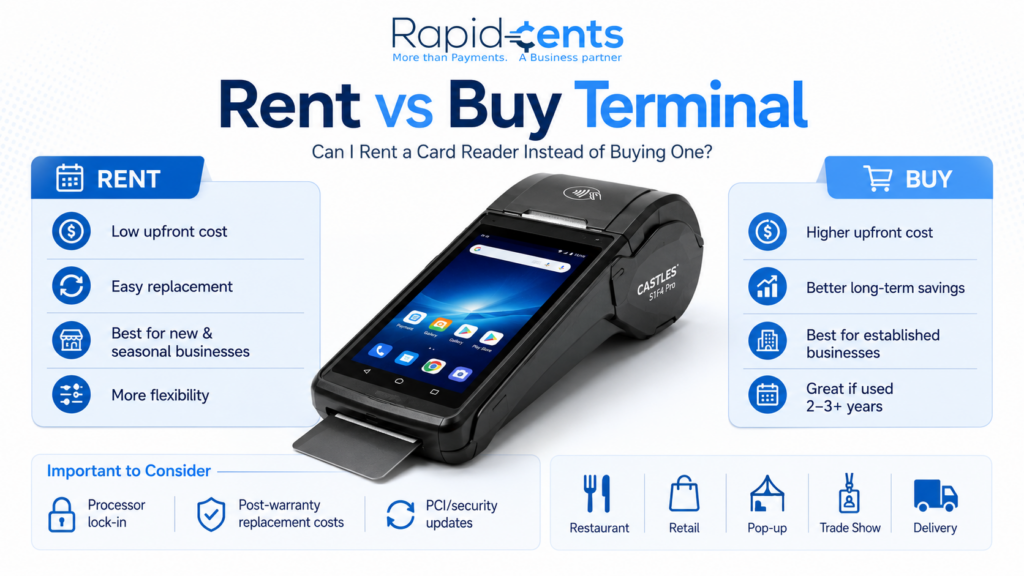
Renting a Card Reader: What It Means
When you rent a card reader or payment terminal, you pay a monthly fee to use the device instead of paying the full purchase price upfront.
At RapidCents, rental pricing depends on the terminal model. For example:
| Terminal Type | Typical RapidCents Rental Starting Price |
|---|---|
| Mobile terminal/card reader, tap and insert, no receipt printer | From $9.95/month |
| Wired terminal | From $19.95/month |
| Short-range wireless terminal | From $39.95/month |
| Long-range wireless terminal with universal SIM card | From $54.95/month |
RapidCents also provides a free online dashboard/virtual terminal with a merchant account, which can be useful for businesses that send invoices, payment links, or take payments without a physical card reader.
The biggest benefit of renting is flexibility. If the terminal stops working because of a software or hardware issue, or if it needs to be exchanged for PCI/security reasons, renting usually makes the replacement process easier and less stressful, as long as the device was not physically damaged by the merchant.
Buying a Card Reader: What It Means
When you buy a card reader or payment terminal, you pay a one-time upfront cost and own the device.
This can be a smart move if you are an established business and you know you will use the terminal every day for the next few years.
At RapidCents, purchased terminals typically include a one-year guarantee. After that warranty period, if the terminal breaks, becomes outdated, or needs to be replaced for a compliance/security reason, the merchant may need to buy a new one.
That is why buying can save money in the long run, but it can also create risk if you buy too early or choose the wrong device.
Rent vs. Buy: Simple Comparison
| Factor | Renting a Card Reader | Buying a Card Reader |
|---|---|---|
| Upfront cost | Lower | Higher |
| Monthly cost | Yes | Usually no terminal rental fee |
| Best for | New, seasonal, flexible, or multi-terminal businesses | Established businesses with stable operations |
| Replacement risk | Usually lower if not physically damaged | Merchant carries more risk after warranty |
| PCI/security-related replacement | Usually easier | May require buying a new terminal |
| Processor flexibility | More flexible | Can create processor lock-in |
| Long-term savings | May cost more over many years | Can save money if used for several years |
| Best mindset | Flexibility and lower risk | Long-term ownership and savings |
When Renting Is the Better Choice
Renting is often the better option when the business is new, uncertain, seasonal, or needs flexibility.
For example, if you are opening your first business, you may not know yet how many terminals you need, what kind of terminal works best, or how much in-person payment volume you will have. In that case, renting helps you avoid spending too much money upfront.
Renting is usually a good fit for:
1. New Businesses and First-Time Business Owners
If you are just starting out, cash flow matters. You may be paying for rent, inventory, staff, marketing, licenses, insurance, and many other startup costs.
Buying a terminal right away may not be the best use of your money.
A rented terminal gives you time to understand your real business needs before committing to a purchase.
2. Retail Stores
Many retail stores prefer renting because it is simple. They want the terminal to work, they want support, and they do not want to worry about future replacement issues.
For a store owner, the terminal is not just a piece of hardware. It is the device that keeps checkout moving.
If it fails, the business can lose sales.
3. Restaurants
Restaurants are a great example because the right answer depends on the size and model of the restaurant.
A small restaurant may rent or buy depending on its cash flow and long-term plans.
Medium, large, and multi-location restaurants often rent because they may need more than one terminal, and the upfront cost of buying several devices can be high.
Restaurants may also add or remove terminals during peak seasons. Renting gives them more flexibility.
Enterprise restaurants, such as large chains using semi-integrated or fully integrated payment systems, may purchase terminals because their business model and technical setup are different.
4. Pop-Up Shops and Trade Show Vendors
For pop-up shops and trade show merchants, renting usually makes more sense.
If you only sell a few times a year, or only need the terminal for a few days at a time, buying may not be worth it.
At RapidCents, we usually recommend renting for trade show and seasonal merchants because they can use the terminal when they need it, return it afterward, and avoid paying for equipment that sits unused most of the year.
5. Service Businesses and Contractors
Many service businesses and contractors do not even need a physical terminal every day.
Instead, they may use the RapidCents dashboard to send invoices or payment links. If they occasionally need to take in-person payments, renting can be a practical option.
6. Delivery Businesses
Delivery businesses are different because the best option depends on who handles the terminal.
If the business uses contractors, renting is often safer because devices may move between people, vehicles, and routes.
If the delivery drivers are employees, buying may make more sense because employees usually take better care of company equipment. In that case, the business may save money over time by purchasing.
When Buying Is the Better Choice
Buying can be the better option when the merchant is already established and thinking long term.
You may want to buy if:
- You have been in business for a while
- You know you will stay in business for at least the next 2–3 years
- You have strong cash flow
- You do not mind paying more upfront
- Your operation is stable
- You know exactly what kind of terminal you need
- You take good care of your equipment
- You are confident you will stay with the same payment processor for the next 3–5 years
For example, an established merchant with steady sales, good business cash flow, and daily terminal usage may benefit from buying. If they know they will stay with RapidCents for the next few years, purchasing can reduce long-term terminal rental costs.
Buying is not wrong. It just needs to be done at the right time, for the right business.
The Hidden Risk of Buying: Processor Lock-In
This is one of the biggest things merchants forget.
When you buy a payment terminal, that device is usually configured to work with a specific payment processor. That means if you later switch processors, the terminal may not work with the next company.
So even though you “own” the terminal, you may not be able to use it somewhere else.
This creates a kind of processor lock-in.
That does not mean buying is bad. It means merchants need to understand the tradeoff before making the decision.
If you are not sure whether you will stay with the same processor long term, renting may be safer.
The Other Hidden Risk: Replacement After Warranty
With RapidCents, purchased terminals typically come with a one-year guarantee.
After that, if the terminal breaks or needs to be replaced, the merchant may need to purchase a new one.
That is another reason renting can be less stressful. With rental, the terminal usually has ongoing protection as long as the issue is not caused by physical damage.
This matters because payment terminals are not like regular calculators. They involve payment security, software, hardware, and compliance requirements. Over time, older terminals may need to be replaced or updated.
A merchant who only looks at the purchase price may miss this risk.
Biggest Mistakes Merchants Make
Here are the most common mistakes we see merchants make when deciding whether to rent or buy a card reader.
Mistake 1: Only Looking at the Monthly Fee
Some merchants think, “Why should I rent when I can buy and save money?”
Sometimes they are right.
But sometimes they are ignoring replacement risk, PCI/security changes, processor lock-in, and whether they truly know their long-term business needs.
Saving money is important, but it should not be the only factor.
Mistake 2: Buying Before Knowing Their Real Business Needs
A new business may think it needs one type of terminal, then discover later that it needs a wireless model, more terminals, a virtual terminal, online payments, invoicing, or payment links.
If the business buys too early, it may end up with the wrong setup.
Mistake 3: Forgetting About Processor Lock-In
A purchased terminal may not work with another processor. If the merchant switches providers, they may need to rent or buy again.
This is one of the biggest hidden downsides of purchasing.
Mistake 4: Ignoring Replacement Costs
If the terminal breaks after the warranty period, or if it needs to be replaced for security/compliance reasons, the merchant may need to buy a new one.
That can reduce or eliminate the savings they expected from purchasing.
Real Example: When Renting Makes Sense
A seasonal merchant or trade show vendor may only need a terminal a few times per year.
In that case, buying does not make much sense. The terminal may sit unused for months.
For these merchants, RapidCents usually recommends renting because they can use the terminal during the period they need it, then return it afterward. This keeps costs lower and avoids paying for equipment that is not being used.
Real Example: When Buying Makes Sense
An established business with strong cash flow may be better off buying.
For example, a merchant that has been in business for years, uses the terminal every day, takes care of equipment, and knows they will stay with the same processor for the next 3–5 years may save money by purchasing instead of renting.
In this case, buying can be a smart long-term decision.
So, Should You Rent or Buy a Card Reader?
Here is the practical answer.
You should consider renting if:
- You are a new business
- You are a first-time business owner
- You are not sure how your business will grow
- You only need a terminal seasonally
- You sell at trade shows or pop-up events
- You need multiple terminals but want to avoid high upfront cost
- You want easier replacement if the terminal has software, hardware, or PCI/security issues
- You may switch processors later
- You want less operational headache
You should consider buying if:
- You are established
- You have stable cash flow
- You use the terminal daily
- You know what terminal model you need
- You plan to use the device for 2–3+ years
- You are confident you will stay with the same processor
- You are comfortable with replacement responsibility after the warranty period
- You want to reduce long-term rental costs
RapidCents Opinion: Do Not Decide Based on Cost Alone
Our opinion is simple:
Renting is not always wasting money. Buying is not always cheaper.
The best option depends on your business stage, cash flow, operations, equipment needs, compliance considerations, and how long you plan to use the terminal.
If you only focus on saving money, you may make the wrong decision.
A cheaper upfront choice can become expensive later. A monthly rental fee can be worth it if it gives your business flexibility, easier replacement, and less headache.
That is why RapidCents offers both rental and purchase options. We help merchants choose based on their actual business situation, not just the price of the device.
Final Answer
Yes, you can rent a card reader instead of buying one.
For many new, seasonal, mobile, retail, restaurant, contractor, and trade show businesses, renting is often the better choice because it lowers upfront cost and gives more flexibility.
For established businesses with stable cash flow and long-term plans, buying can be better because it may save money over time.
The smartest decision is not always the cheapest one. The smartest decision is the one that fits how your business actually operates.
Frequently Asked Questions
1. Can I rent a card reader instead of buying one?
Yes. Many payment processors, including RapidCents, offer rental options for card readers and payment terminals. Renting can be a good choice if you want lower upfront cost, flexibility, and easier terminal replacement.
2. Is it better to rent or buy a card reader?
It depends on your business. Renting is usually better for new businesses, seasonal businesses, trade show vendors, pop-up shops, and merchants that want flexibility. Buying is usually better for established businesses that will use the terminal daily for several years.
3. Is renting a card reader a waste of money?
Not always. Renting may cost more over a long period, but it can reduce upfront cost and lower replacement headaches. If your business is new, seasonal, or uncertain, renting may be the smarter financial decision.
4. Is buying a card reader cheaper than renting?
Buying can be cheaper in the long run if you use the same terminal for several years and do not need replacement after the warranty period. But buying is not always cheaper if the terminal breaks, becomes outdated, or cannot be used with another processor.
5. Can I use my purchased card reader with another payment processor?
Usually, payment terminals are configured for a specific processor. If you switch processors, your purchased terminal may not work with the new company. This is one of the biggest hidden risks of buying.
6. What happens if my rented card reader stops working?
With RapidCents, rented terminals usually have ongoing protection as long as the terminal was not physically damaged. If there is a hardware, software, or PCI/security-related issue, replacement is usually easier than with a purchased terminal after warranty.
7. What type of businesses should rent a card reader?
New businesses, pop-up shops, trade show vendors, seasonal businesses, contractors, service businesses, retail stores, restaurants with multiple terminals, and delivery businesses often benefit from renting.
8. What type of businesses should buy a card reader?
Established businesses with stable cash flow, daily terminal usage, careful staff, and long-term plans with the same processor may benefit from buying.
9. Does RapidCents offer a virtual terminal?
Yes. RapidCents provides an online dashboard/virtual terminal at no charge with a merchant account. This can be useful for businesses that send invoices, payment links, or take payments without a physical terminal.
10. What is the main thing to consider before renting or buying?
Do not decide based only on cost. Consider your business stage, cash flow, terminal usage, processor lock-in, replacement risk, PCI/security requirements, and how long you plan to use the terminal.