Visa Chargeback Reason Code 10.4: What Merchants Need to Know Before October 2026
Primary keyword: Visa chargeback reason code 10.4
Secondary keyword: Visa chargeback
Third focus keyword: Visa chargeback reason code 10.4 October 2026
Suggested SEO title: Visa Chargeback Reason Code 10.4: October 2026 Changes Explained
Suggested meta description: Learn what Visa chargeback reason code 10.4 means, how to fight card-not-present fraud disputes, and what changes on October 24, 2026 under Visa Compelling Evidence 3.0.
Suggested URL slug: /visa-chargeback-reason-code-10-4
If you sell online, take payments over the phone, run recurring billing, or accept any other type of card-not-present payment, there is one Visa chargeback reason code you should understand particularly well:
Visa chargeback reason code 10.4 — Other Fraud: Card-Absent Environment.
This is the dispute condition Visa uses when a cardholder says they did not authorize or participate in a card-not-present transaction.
In plain English, the customer is effectively telling their bank:
“I did not make this purchase.”
That sounds straightforward. In practice, it is not.
A Visa chargeback under reason code 10.4 can involve genuine stolen-card fraud, account takeover, a family member using a card without the primary cardholder recognizing the purchase, merchant-descriptor confusion, or what the payments industry commonly calls friendly fraud or first-party misuse.
And the rules surrounding these disputes are changing.
Starting October 24, 2026, Visa is expanding parts of its Compelling Evidence 3.0 framework for dispute condition 10.4. The update could give merchants and acquirers additional opportunities to establish that a disputed transaction is connected to legitimate historical activity—but it also introduces important requirements around the evidence being used.
For merchants, this means preventing and fighting a Visa chargeback is becoming increasingly dependent on something many businesses still underestimate:
the quality of the transaction data you collect before the chargeback ever happens.
What Is Visa Chargeback Reason Code 10.4?
Visa defines dispute condition 10.4 as “Other Fraud – Card-Absent Environment.”
It generally applies when the cardholder claims they did not authorize or participate in a transaction conducted without the physical card being presented to the merchant.
Examples include:
-
E-commerce transactions
-
Mobile-app purchases
-
Mail-order transactions
-
Telephone-order or MOTO payments
-
Certain recurring payments
-
Other remote card-not-present transactions
Visa’s merchant guidance identifies several common causes of a 10.4 dispute. A merchant may have unknowingly accepted a payment credential being used fraudulently, the cardholder’s payment credentials may have been compromised, or the cardholder may simply fail to recognize the merchant name appearing on their statement.
That last scenario matters more than many merchants realize.
Visa reports that 35% of surveyed cardholders said they had mistaken a legitimate transaction for fraud, while 70% of surveyed cardholders who had disputed a charge said they assumed an unrecognized transaction was fraudulent.
So not every Visa chargeback that says “fraud” necessarily started with a fraudster.
Sometimes it started with a confused customer.
Why Visa Chargebacks Are Becoming a Bigger Merchant Problem
Chargebacks are no longer an occasional back-office issue.
Visa reported that it processed approximately 106 million disputes globally in 2025, representing a 35% increase compared with 2019.
The broader fraud environment is also changing rapidly.
Visa reported identifying nearly $1 billion in scam-related activity between July and December 2025, with scams becoming the largest category of consumer payment fraud identified in that report.
Another Visa publication noted that U.S. consumers disputed approximately $11 billion in charges, compared with about $7.2 billion in 2019.
For a merchant, the financial impact extends beyond losing the original transaction.
A Visa chargeback can potentially mean:
-
Losing the sale
-
Losing the merchandise or service already delivered
-
Paying chargeback or dispute-handling fees
-
Spending employee time gathering evidence
-
Increasing your dispute ratio
-
Creating additional scrutiny from your processor or acquirer
-
Increasing fraud-monitoring exposure
-
Losing a legitimate long-term customer
This is why merchants should stop treating chargebacks only as something the accounting department handles after the fact.
Chargeback management starts at checkout.
Visa Chargeback Reason Code 10.4 October 2026: What Is Changing?
This is the part merchants should pay particular attention to.
Visa’s April 2026 public rules include updates to Compelling Evidence 3.0 for Dispute Condition 10.4, effective for qualifying disputes processed beginning October 24, 2026.
Compelling Evidence 3.0, often shortened to CE 3.0, is designed to help establish a relationship between a disputed card-not-present transaction and previous transactions associated with the legitimate cardholder.
This matters particularly in suspected first-party misuse cases.
Suppose a customer has purchased from a business successfully several times.
Those transactions were not reported as fraud.
Later, the same customer disputes another transaction and claims:
“That wasn’t me.”
Historical transaction information may help demonstrate that the disputed activity is consistent with legitimate prior activity.
The important October 24, 2026 expansion
For disputes processed on or after October 24, 2026, Visa’s rules expand the CE 3.0 framework so that qualifying previous transactions may involve one or more merchants, subject to Visa’s requirements.
That can potentially broaden the historical transaction evidence available to establish a legitimate relationship with the card or associated payment credential.
There is an important limitation:
An acquirer can only submit qualifying transaction data that was accepted and processed by that acquirer.
So this should not be interpreted as a universal database where a merchant can simply retrieve transaction history from every other processor in the market.
The acquiring relationship still matters.
Another Critical October 2026 Change: Device ID and Device Fingerprint
There is another detail buried in the Visa rules that merchants, payment companies and chargeback-management providers should not overlook.
Effective for disputes processed on or after October 24, 2026, Visa clarifies that:
Device ID and device fingerprint are considered similar data elements.
An acquirer cannot use both as though they were two independent qualifying data elements. Another eligible data element must be supplied.
This might sound like a technical detail.
It isn’t.
Imagine your fraud and chargeback system currently relies heavily on:
-
Device ID
-
Device fingerprint
and internally treats those as two independent pieces of evidence.
After the October 2026 rule becomes effective for the applicable CE 3.0 process, that approach may no longer provide the two distinct matching elements you thought you had.
Your payment, fraud and customer-data architecture needs to preserve additional evidence.
What Evidence Can Help With Visa Reason Code 10.4?
Fighting a Visa chargeback should never mean dumping screenshots into a dispute portal and hoping something works.
The evidence should answer a very specific question:
What information connects this disputed transaction to the legitimate cardholder or to previously undisputed activity?
Depending on the circumstances and applicable Visa rules, useful evidence may include transaction and customer data such as:
-
Customer account or login information
-
IP address
-
Device information
-
Shipping information
-
Billing information
-
Previous successful transactions
-
Order history
-
Product or service descriptions
-
Delivery or fulfillment confirmation
-
Customer communications
-
Recurring-payment history
-
Authentication information
-
Visa Secure / 3-D Secure authentication data
-
Tokens and other payment identifiers
For CE 3.0 specifically, merchants and their processors must follow Visa’s detailed matching and previous-transaction requirements rather than assuming any two pieces of customer data automatically qualify.
That distinction is critical.
Good evidence is not necessarily qualifying evidence.
The 120-Day Rule Merchants Often Misunderstand
There are two different “120-day” concepts that can appear when discussing Visa reason code 10.4, and they should not be confused.
Visa’s current rules state that an issuer may generally initiate a dispute under condition 10.4 within:
120 calendar days from the transaction processing date.
Separately, CE 3.0 has requirements involving qualifying previous transactions and their timing.
Those are different concepts.
The October 24, 2026 CE 3.0 update does not simply replace the normal 10.4 filing timeframe with a new chargeback deadline.
Merchants reading summaries online should be especially careful here because mixing these two rules can lead to incorrect operational decisions.
Can Visa Secure Help Prevent a Reason Code 10.4 Chargeback?
Potentially, yes.
Visa’s merchant dispute-management guidance specifically tells merchants receiving a 10.4 dispute to determine whether the transaction was authenticated using Visa Secure.
Visa Secure uses EMV 3-D Secure technology to help authenticate online cardholders and assess transaction risk.
Depending on how the transaction was authenticated and the circumstances of the dispute, authentication may influence liability.
For an e-commerce merchant, this is one reason a fraud strategy should not rely solely on AVS and CVV.
Modern fraud prevention is layered.
A stronger approach can combine:
Customer identity + device intelligence + transaction history + authentication + behavioral analysis + authorization data.
Friendly Fraud vs. Real Fraud: Why Reason Code 10.4 Is Difficult
Consider two transactions.
Transaction A
A fraudster steals card information and purchases $900 worth of electronics.
The actual cardholder has never interacted with the merchant.
That is a traditional fraud scenario.
Transaction B
A customer purchases a subscription for six months.
The customer logs in regularly and uses the service.
Months later, they see the charge on their statement and dispute it as unauthorized instead of cancelling through the merchant.
Both disputes could initially appear under a fraud-related reason code.
But the merchant’s defense strategy should be very different.
Visa says 18% of fraudulent disputes were identified by surveyed merchants as friendly fraud, according to research cited by Visa.
That is precisely why historical evidence matters.
The processor needs more than:
“We believe the customer made the purchase.”
It needs transaction data capable of demonstrating the relationship.
How Merchants Can Reduce Visa 10.4 Chargebacks
The strongest chargeback strategy begins before authorization.
1. Use a recognizable billing descriptor
If customers see a company name they do not recognize, some will assume fraud.
The descriptor appearing on the card statement should be recognizable and, where appropriate, supported by clear customer-service information.
Remember Visa’s statistic:
35% of surveyed cardholders report mistaking a legitimate purchase for fraud.
Sometimes preventing a chargeback is as simple as helping the customer recognize the transaction.
2. Capture meaningful transaction data
For online transactions, consider preserving appropriate data such as:
-
Customer account ID
-
Login information
-
IP address
-
Device data
-
Shipping address
-
Order details
-
Delivery confirmation
-
Communication history
-
Authentication results
-
Payment token information
Don’t start looking for evidence six months later.
Capture it when the customer checks out.
3. Use Visa Secure where appropriate
3-D Secure can add another authentication layer for e-commerce transactions and may provide important fraud and liability benefits depending on the transaction.
4. Make cancellation and refunds easy to understand
Some merchants make cancelling a service so difficult that customers discover an easier option:
calling their bank.
A chargeback should not become the customer’s preferred cancellation method.
5. Send clear receipts and order confirmations
Your receipt should make the transaction recognizable.
Include appropriate information such as:
-
Business name
-
Transaction amount
-
Date
-
Products or services purchased
-
Contact information
-
Subscription terms where applicable
6. Monitor repeat behavior
A customer who has completed several undisputed purchases should not look identical in your fraud system to someone making their first purchase.
Historical relationships matter increasingly in modern dispute management.
7. Keep your processor involved
Chargeback defense does not exist separately from payment processing.
Your payment processor, acquirer and dispute-management infrastructure determine which network tools and transaction data can actually be used.
That becomes even more important as the Visa chargeback reason code 10.4 October 2026 rules expand CE 3.0.
Why Your Payment Processor Matters More After October 2026
One of the more interesting aspects of Visa’s October 2026 change is that CE 3.0 can potentially use qualifying transaction history involving more than one merchant—but the acquirer may only submit transaction data it processed.
That creates an important strategic point for merchants.
Payment processing is no longer just about:
“Who gives me the lowest rate?”
Your payment infrastructure also influences:
-
Fraud prevention
-
Authentication
-
Transaction data
-
Tokenization
-
Dispute management
-
Chargeback evidence
-
Reporting
-
Customer recognition
-
Revenue recovery
A few basis points in processing cost can matter.
But so can losing legitimate transactions unnecessarily because your payment stack cannot produce the evidence needed to defend them.
The Cost of Doing Nothing
Visa says dispute volumes continue to increase.
In 2025 alone, Visa processed 106 million disputes globally, up 35% from 2019.
Visa also says its Order Insight solution has helped participating merchants deflect an average of approximately 40%–45% of confirmed first-party-misuse disputes, with some subscription merchants reaching significantly higher deflection levels.
The lesson is not that one product eliminates chargebacks.
It is that better transaction information can materially change dispute outcomes.
Merchants who continue treating chargebacks as an unavoidable cost of doing business may be leaving recoverable revenue on the table.
What Merchants Should Do Before October 24, 2026
You don’t need to become a Visa rules expert.
But someone inside your payments organization should be asking the right questions.
Before the October 2026 update takes effect, review:
-
What information are we currently retaining for card-not-present transactions?
-
Does our processor support Visa Compelling Evidence 3.0?
-
Are previous successful transactions being connected to customer identities?
-
Are we treating device ID and device fingerprint as separate CE 3.0 elements?
-
Are customer login IDs captured consistently?
-
Are our billing descriptors recognizable?
-
Are we using Visa Secure appropriately?
-
How are recurring transactions documented?
-
How long do we retain relevant chargeback evidence?
-
Can our processor help prevent disputes before they become chargebacks?
If your team cannot answer these questions, now is the time to review the process.
Not after the next chargeback arrives.
Frequently Asked Questions About Visa Chargeback Reason Code 10.4
What does Visa chargeback reason code 10.4 mean?
Visa chargeback reason code 10.4 means Other Fraud – Card-Absent Environment. It is generally used when a cardholder claims they did not authorize or participate in a card-not-present transaction such as an online, mail-order or telephone-order purchase.
How long does a cardholder have to file a Visa 10.4 chargeback?
Visa’s current public rules generally provide an issuer with 120 calendar days from the transaction processing date to initiate a dispute under condition 10.4. Specific dispute circumstances and network rules should always be reviewed with the merchant’s processor or acquirer.
Can a merchant fight Visa chargeback reason code 10.4?
Yes. Depending on the transaction and circumstances, merchants may be able to respond with evidence demonstrating authentication, cardholder participation, previous undisputed transaction history or other qualifying information.
What is Visa Compelling Evidence 3.0?
Compelling Evidence 3.0 is Visa’s framework within dispute condition 10.4 that can use qualifying historical transaction information to establish that certain fraud disputes are invalid when Visa’s requirements are satisfied.
It is especially relevant in cases involving suspected friendly fraud or first-party misuse.
What changes to Visa chargeback reason code 10.4 in October 2026?
Effective October 24, 2026, Visa is expanding the application of Compelling Evidence 3.0 for condition 10.4, including support for qualifying previous transactions occurring at one or more merchants, subject to acquirer and evidence requirements. Visa also clarifies that device ID and device fingerprint cannot be supplied as two separate qualifying elements because they are considered similar data elements.
Does Compelling Evidence 3.0 apply to every Visa chargeback?
No.
CE 3.0 is specifically associated with Visa dispute condition 10.4. It should not be assumed to apply automatically to every Visa dispute or every chargeback reason code.
Does device fingerprint count as evidence?
Device information can be relevant, but Visa’s October 2026 rules clarify an important point: device ID and device fingerprint cannot be treated as two separate elements for the applicable CE 3.0 submission. Another qualifying data element would be required where two distinct elements are needed.
Can a billing descriptor really cause a chargeback?
Yes.
Visa’s merchant guidance specifically identifies unclear or confusing merchant names as one reason cardholders may believe legitimate transactions are fraudulent.
Final Takeaway: Fighting a Visa Chargeback Starts Before the Dispute
The most important lesson from Visa chargeback reason code 10.4 is simple:
You cannot recreate evidence you never collected.
When a dispute arrives three months after the original transaction, your ability to respond depends largely on what happened during checkout and what your payment system retained afterward.
The October 24, 2026 changes make that even more important.
Merchants should be thinking beyond authorization rates and transaction fees.
The modern payment stack should help answer:
Who made the payment?
What evidence connects that person to the transaction?
What happened during previous transactions?
Was the customer authenticated?
Can the transaction be recognized before it turns into a chargeback?
At RapidCents, we believe payment processing should extend beyond simply accepting a card. Fraud prevention, transaction intelligence, authentication and dispute management all play a role in protecting merchant revenue.
If your business accepts card-not-present payments and you are experiencing Visa chargebacks, reviewing your payment and dispute infrastructure before October 24, 2026 is a worthwhile place to start.
Key Takeaways
-
Visa chargeback reason code 10.4 covers Other Fraud – Card-Absent Environment.
-
Visa processed approximately 106 million disputes globally in 2025, 35% more than in 2019.
-
Visa reports that 35% of surveyed cardholders have mistaken legitimate purchases for fraud.
-
Visa CE 3.0 can help address certain first-party misuse disputes when its evidence requirements are satisfied.
-
Important CE 3.0 changes become effective October 24, 2026.
-
Qualifying historical transactions can expand across one or more merchants, subject to acquirer restrictions.
-
Device ID and device fingerprint should not be counted as two separate qualifying elements under the applicable October 2026 rule.
-
Merchants should capture useful identity, transaction, authentication and fulfillment evidence before a chargeback occurs.
Sources
Visa Core Rules and Visa Product and Service Rules, April 2026 edition.
Visa Dispute Management Guidelines for Visa Merchants.
Visa Post-Purchase Solutions and Order Insight research.
Visa 2026 dispute-resolution announcement.
This article is provided for general informational purposes and is not legal advice. Visa rules, processor requirements and dispute procedures may change. Merchants should confirm requirements applicable to their specific processing environment with their payment processor or acquirer.
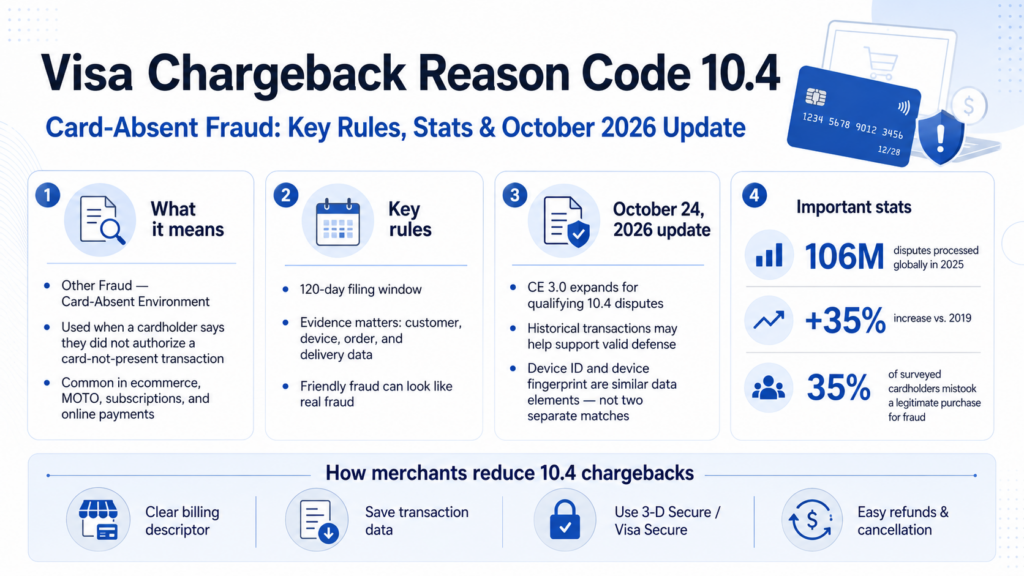
Visa chargeback reason code 10.4 means Other Fraud – Card-Absent Environment. It is used when a cardholder claims they did not authorize a card-not-present transaction, such as an online purchase, MOTO payment, subscription charge, or other remote transaction. For merchants, this usually means the dispute is tied to alleged fraud in an e-commerce or non-face-to-face payment environment.
Starting in October 2026, Visa is expanding parts of its Compelling Evidence 3.0 framework for qualifying 10.4 disputes. This means merchants and acquirers may be able to use broader historical transaction evidence to help defend against certain fraud-related chargebacks. Merchants should also note that device ID and device fingerprint are not treated as two separate matching data points, so collecting additional evidence becomes even more important.
Merchants can reduce and fight Visa chargeback reason code 10.4 by keeping strong transaction records and fraud-prevention data. The most useful steps include saving customer details, order data, device data, IP address, delivery proof, and past transaction history, while also using tools like 3-D Secure / Visa Secure. Clear billing descriptors, easy refund policies, and strong recordkeeping can also help prevent friendly fraud and improve dispute outcomes.