Advanced chargeback protection built into your payment flow.
RapidCents Chargeback Shield
RapidCents Chargeback Shield helps merchants approve more good orders, stop suspicious transactions before capture, reduce chargeback exposure, and create a clear evidence trail when a dispute happens.
It is not just a fraud score. It is connected to payment authorization, pre-auth, capture, 3D Secure, tokenization, merchant review, delivery evidence, webhooks, and post-chargeback learning.
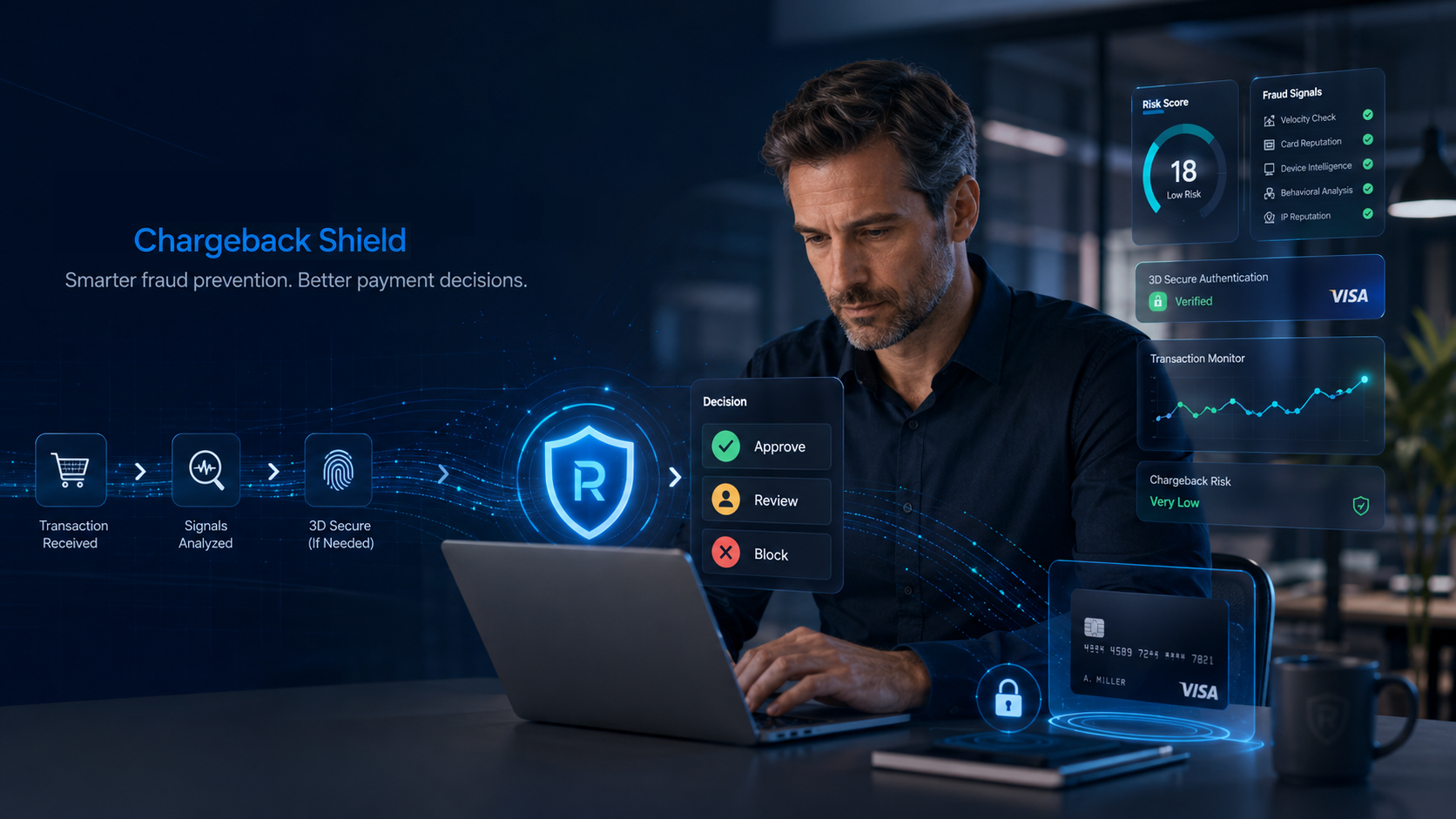
Stop Chargebacks Before They Become Losses
|
RapidCents Chargeback Shield analyzes payment, device, customer, session, and behavior signals before capture so merchants can reduce fraud exposure without slowing down every buyer. |
Problems it solves
- Fraudulent card-not-present orders that look normal at first glance.
- Friendly fraud, where a real customer later disputes a legitimate purchase.
- Repeat disputers who use the same pattern across orders, cards, emails, devices, addresses, or delivery methods.
- High-risk orders that should not be captured until merchant review is complete.
- Merchants losing disputes because evidence was not collected early enough.
- Checkout friction caused by applying the same security step to every buyer.
- Manual fraud review that lacks clear reason codes, workflow, and audit history.
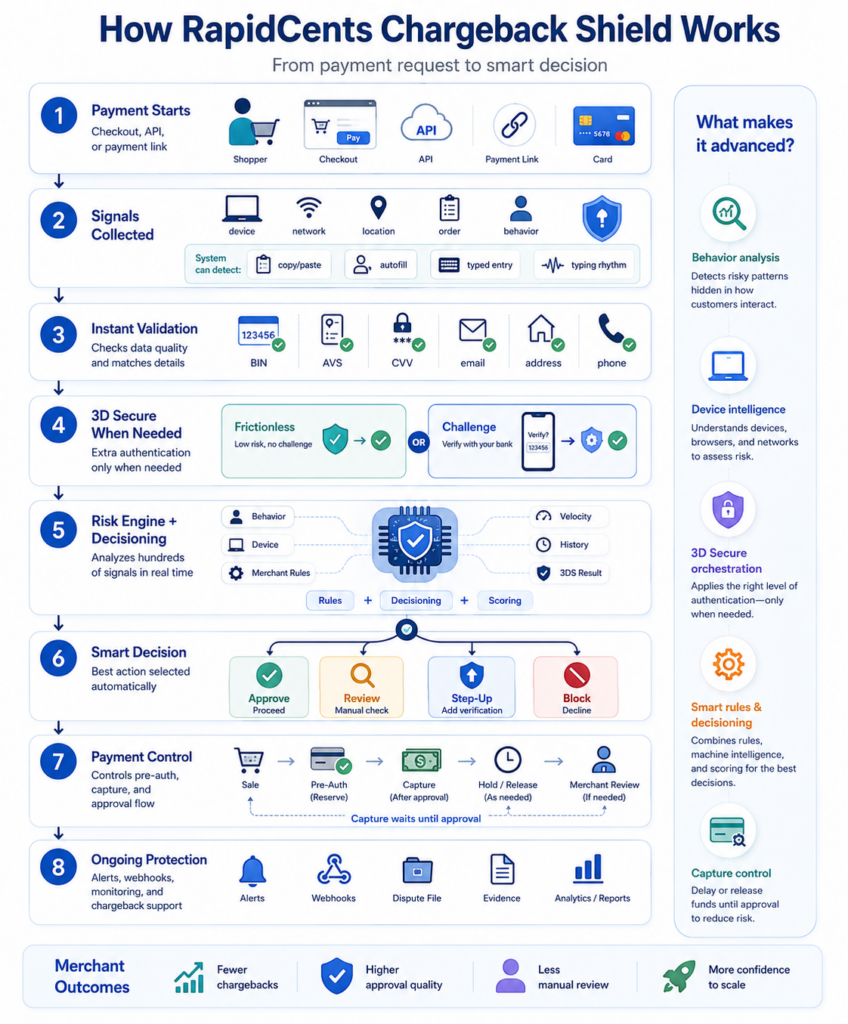
How The System Works:
Seven-Layer Protection
The system can observe signals such as copy/paste behavior, autofill usage, typing patterns, session behavior, device/network clues, and velocity patterns when the merchant uses the RapidCents collector or RapidPay.js integration. It does not need to collect or store raw card numbers or CVV inside the fraud system.
Layer 1 - Checkout session intelligence
The system creates a fraud session and connects the checkout, payment link, RapidPay.js flow, hosted checkout, or direct API transaction to one risk profile.
Layer 2 - Device and browser behavior
When enabled, the collector can observe signals such as typing rhythm, paste behavior, autofill indicators, browser environment, device consistency, session age, and abnormal checkout behavior.
3. Layer 3 - Payment and card intelligence
The system considers payment method signals, tokenization data, BIN-level indicators, card/customer consistency, 3D Secure status, authorization results, and payment lifecycle stage.
Layer 4 - Velocity and network patterns
It checks how often the same customer, device, IP, card fingerprint, email, phone, shipping address, or merchant account appears across recent attempts.
Layer 5 - Order and fulfillment context
It considers order amount, product type, shipping speed, delivery address, freight or logistics evidence, digital vs physical goods, and mismatch patterns.
Layer 6 - Decision engine
A governed rules and scoring engine chooses the right action: approve, review, require 3DS, request KYC or documents, request delivery proof, hold capture, decline, or block.
Layer 7 - Learning loop
When chargebacks, reversals, refunds, or evidence outcomes arrive later, the system stores the result so future decisions become more informed.
Think of it as a security control tower for every payment. It does not look at one signal alone. It looks at how the buyer behaves, how the device behaves, how the payment behaves, how the order looks, and what happened in similar cases before. Then it recommends the safest next step before the merchant captures the money.

RapidCents Chargeback Protection
RapidCents Chargeback Shield is an advanced fraud decisioning and chargeback protection layer built directly into the RapidCents payment ecosystem. It evaluates transactions before money is captured, combines checkout behavior with payment intelligence, and gives merchants clear actions: approve, review, challenge with 3D Secure, request verification, hold capture, decline, or block.
How it works
Chargeback Shield works behind the scenes during checkout. It studies the payment, customer, device, session, network, order, and merchant context, then gives a decision in real time. Instead of forcing every customer through extra friction, it applies the right action to the right order: approve trusted buyers, challenge risky ones, request proof when needed, and stop suspicious transactions before they become chargebacks.
Advanced technology
Built for modern ecommerce fraud. Fraudsters do not rely on one trick, so Chargeback Shield does not rely on one signal. It evaluates session behavior, copy/paste patterns, autofill indicators, typing behavior, velocity, device consistency, payment metadata, customer history, shipping risk, and dispute outcomes. The result is smarter protection that works before the chargeback happens.
Developer/API
Easy for developers. Powerful for operations. RapidCents provides APIs, SDKs, webhooks, RapidPay.js integration, hosted checkout support, payment link support, and sandbox scenarios so merchants can integrate fraud decisioning into the systems they already use.
Capture protection
Do not capture risky payments too early. With pre-auth and capture controls, merchants can authorize a payment and wait for Chargeback Shield approval, 3D Secure, document verification, or manual review before capturing funds. That means fewer expensive mistakes and a stronger dispute trail.
RapidCents Chargeback Prevantion
Most fraud tools sit beside payments. RapidCents Chargeback Shield is designed to work inside the payment lifecycle. That means risk decisions can affect what matters most: whether a transaction should be approved, challenged, reviewed, captured, voided, or investigated before it becomes a loss.
Checkout Behavior Signals: Copy/Paste, Autofill, Typing, and Session Behavior
RapidCents Chargeback Shield is designed to detect risky behavior without turning checkout into surveillance and without requiring the fraud system to store raw card numbers or CVV. The system uses safe signals, tokens, event timing, device/session context, and payment metadata to make smarter decisions while keeping sensitive payment data protected.
| Signal type | What it may indicate | How to explain it safely on the website |
|---|---|---|
|
Copied and pasted card-related fields |
The buyer may be using card data copied from another source instead of normal saved credentials or manual entry. |
Chargeback Shield can detect paste-style behavior and treat it as one risk signal, not an automatic fraud label. |
|
Browser saved card or autofill behavior |
A legitimate returning buyer may use browser autofill, Apple/Google saved payment methods, or password-manager-style saved data. |
The system can distinguish common low-friction checkout patterns from unusual behavior when the integration provides those signals. |
|
Manual typing cadence |
Human typing has timing patterns. Bot-like or scripted entry can look different. |
The collector can evaluate entry behavior patterns without needing to store the actual card number or CVV. |
|
Field focus and correction patterns |
Fraud attempts may show unusual retries, changes, or copy-replace behavior across multiple fields. |
The system looks for abnormal checkout interaction patterns that add context to the decision. |
|
Session age and flow |
Very fast checkout attempts, repeated failures, or new sessions with high-value orders can be suspicious. |
Chargeback Shield checks whether the checkout journey looks normal for the merchant and transaction type. |
|
Device and browser consistency |
Mismatch between device, account, billing/shipping behavior, and payment can increase risk. |
The system connects the device/session to the payment so decisions are based on a fuller picture. |
Decisioning: What Happens After Signals Are Collected
Chargeback Shield does not simply say “fraud” or “not fraud.” It gives operational decisions. Low-risk orders can move quickly. Medium-risk orders can be challenged or reviewed. High-risk orders can be stopped before capture. This gives merchants more control, better visibility, and fewer blind decisions.
| Decision | What it means | Merchant impact |
|---|---|---|
|
Approve |
The transaction appears low risk. |
Continue normal checkout or capture flow. |
|
Approve with warning |
The order can continue, but the merchant should be aware of mild risk. |
Useful for reporting and post-order monitoring. |
|
Review |
The transaction needs manual review before capture or fulfillment. |
Merchant or RapidCents operations can inspect reasons and evidence. |
|
Require 3D Secure |
The buyer should complete an authentication challenge or frictionless 3DS flow. |
Adds protection when risk is elevated but the order may still be legitimate. |
|
Require KYC / document / delivery proof |
The system needs stronger proof before approving or guaranteeing the transaction. |
Useful for high-value, freight, logistics, B2B, or suspicious orders. |
|
Hold capture |
The authorization exists, but capture should wait. |
Prevents risky orders from becoming settled losses too early. |
|
Hold capture |
The authorization exists, but capture should wait. |
Prevents risky orders from becoming settled losses too early. |
|
Decline |
Risk is too high for normal processing. |
Stops likely bad orders. |
|
Block |
The transaction matches strong negative signals or rules. |
Protects the merchant and platform from repeat abuse. |
Unlock More Ways to Get Paid
Use any device to accept credit card payments online without any hardware.
Set up customized subscription plans and process payments at the due date.
Get your queries answered
FAQs
This is a key RapidCents differentiator: fraud decisions are connected to authorization, pre-auth, capture, void, refund, and dispute workflows.
- Before authorization: The system can collect checkout and session context before the payment request is finalized.
- During authorization: It can connect payment results, tokenization, 3DS, card metadata, and fraud signals.
- Before capture: If pre-auth is used, Chargeback Shield can recommend holding capture until review, 3DS, documents, or delivery proof are complete.
- After capture: It tracks refunds, disputes, chargebacks, representment evidence, and outcomes.
After a chargeback: It feeds confirmed outcomes back into future rules and risk decisions.
It is designed to reduce unnecessary friction. Low-risk orders can continue normally, while suspicious orders may receive 3D Secure, review, or evidence requests.
When the collector or RapidPay.js integration provides behavior signals, the system can use paste-style behavior as one risk signal. It combines that with many other signals before deciding what action to take.
It can use available browser/session indicators to understand whether the checkout behavior looks like a normal saved-card flow or an unusual manual/scripted flow, depending on the integration and browser environment.
No. The fraud decisioning system should use safe payment metadata, tokens, fingerprints, event timing, and session signals, not raw card numbers or CVV.
Chargeback Shield is not designed only for low-risk businesses.
It is designed to adapt to different industries and risk profiles.
Examples:
- Ecommerce
- Subscription businesses
- Freight and logistics
- Electronics
- Digital products
- Luxury goods
- Marketplaces
- High-ticket sales
Merchant-specific rules and behavioral analysis help the system understand the difference between:
- A legitimate high-value customer
- A potentially fraudulent transaction
Because unnecessary friction can hurt conversion.
Instead of challenging every customer, the system can:
- Allow low-risk transactions to flow smoothly
- Apply frictionless authentication when possible
- Request additional verification only when risk justifies it
The goal is stronger security with less customer friction.
Yes.
Protection does not stop at checkout.
The platform can assist with:
- Transaction monitoring
- Review workflows
- Webhooks and alerts
- Evidence collection
- Delivery verification requirements
- Chargeback management processes
- Reporting and analytics
This helps merchants manage risk throughout the transaction lifecycle.
Not just approvals.
Not just fraud reduction.
Not just chargeback prevention.
Chargeback Shield is designed to optimize for:</br>
✅ Revenue Protection
✅ Approval Quality
✅ Fraud Reduction
✅ Chargeback Reduction
✅ Better Customer Experience
✅ Operational Efficiency
✅ Long-Term Merchant Growth
Yes.
Merchants can configure policies based on their business model.
Examples:
- Review orders above a certain amount
- Require 3D Secure for high-risk orders
- Allow trusted repeat customers
- Review first-time international orders
- Require delivery confirmation for specific products
The system provides flexibility while maintaining appropriate risk controls.
Yes. Merchants can create safe custom rules and use recommended rule modes, while RapidCents maintains platform-level protection and hard-stop rules.
The system may require 3D Secure, open review, request documents, request delivery proof, hold capture, decline, or block depending on the risk profile.
No. It improves prevention and evidence readiness before disputes, while still supporting chargeback workflows after a dispute arrives.
RapidCents collects all relevant proof—transaction data, delivery confirmation, customer communications—then prepares and submits the dispute response to the issuer, handling everything for the merchant to maximize win rates.
No. Chargeback Shield is designed to improve approval quality, not simply decline more transactions.
Many fraud systems focus on one objective: stopping fraud.
The problem is that aggressively blocking transactions often creates a second problem:
- Good customers get declined.
- Legitimate orders are lost.
- Conversion rates drop.
- Revenue decreases.
RapidCents Chargeback Shield was designed differently.
Our goal is not to decline more transactions.
No.
RapidCents uses a layered decision process.
A transaction may be:
- Approved immediately
- Sent for review
- Stepped up with 3D Secure
- Held before capture
- Approved after verification
- Declined only when risk remains unacceptable
The objective is always to preserve legitimate sales whenever possible.
Approving everything may increase sales today.
But it often creates:
- More chargebacks
- Higher fraud losses
- Processor monitoring programs
- Reserve requirements
- Account restrictions
- Higher processing costs
Over time this can reduce profitability and threaten merchant account stability.
Chargeback Shield helps merchants find a healthier balance between:
- Revenue growth
- Fraud prevention
- Operational efficiency
- Chargeback reduction
In many cases merchants see the opposite.
Because the platform can:
- Reduce unnecessary declines
- Route transactions intelligently
- Use 3D Secure only when needed
- Allow merchant review instead of automatic rejection
- Differentiate between suspicious and legitimate customers
The focus is approval quality, not approval quantity.
A lower fraud rate with strong approval quality is usually more valuable than simply approving every transaction.
Risk signals do not automatically mean fraud.
For example:
A customer may:
- Use autofill
- Travel frequently
- Ship to a different address
- Place a large order
- Use a VPN
None of these automatically results in a decline.
The system evaluates the entire transaction context.
A single signal rarely determines the outcome.