


COMPANY
Technology Partners
Technology partnerships are for companies whose product sits next to the payment: hardware makers, POS vendors, platform providers and payment technology companies needing a certified, supported path to RapidCents. Certification is the substance. A connector that authorizes a clean sale is the easy half; the test plan has to cover tip adjustment, partial refunds, void versus refund, batch close, and the timeout that leaves terminal, POS and host disagreeing. Certified plugins, RapidBridge for software that cannot be rewritten, and APPIE for processor interoperability are the three shapes available.
- Certified connectors, not custom work
- Test the states that actually break
- RapidBridge for existing software
- APPIE for processor interoperability
Try it, edit values and click buttons
API request
POST /v1/payments
{
  "amount": 24900,
  "currency": "CAD",
  "capture": true,
  "metadata": { "order_id": "4821" }
}Response
Click "Send request" to see the API response
Processing payment…
201 Created
{ "id": "pay_7xK2m", "status": "approved", "amount": 24900 }
Demonstration data only
In detail
Certified connectors, not custom work
Plugins and connectors for common platforms mean a merchant installs an integration rather than commissioning one, which is the difference between a deal that closes and a project that gets scheduled.
Test the states that actually break
Tip adjustment, partial refund, void versus refund, batch close and the timeout that leaves the terminal and the host disagreeing. Authorizing a clean sale is the easy half of a certification.
RapidBridge for existing software
Where an application cannot reasonably be rewritten, RapidBridge brings RapidCents payments to it, which matters for long-lived business software with a large installed base.
APPIE for processor interoperability
Interoperability at the terminal layer without replacing the hardware estate, or at the host layer for platforms routing across multiple processors, where crossing a processor boundary is the requirement.
Webhooks and reconciliation
Settlement and dispute outcomes arrive asynchronously. An integration that writes them back into the system of record is what removes the second reconciliation nobody budgeted for.
Go-live with support
Certification review, sandbox testing and go-live support from people who have seen the integration fail in the specific ways it fails, rather than a documentation link and good wishes.
Related pages
Partners
How the referral, software, technology and enterprise programs differ.
Explore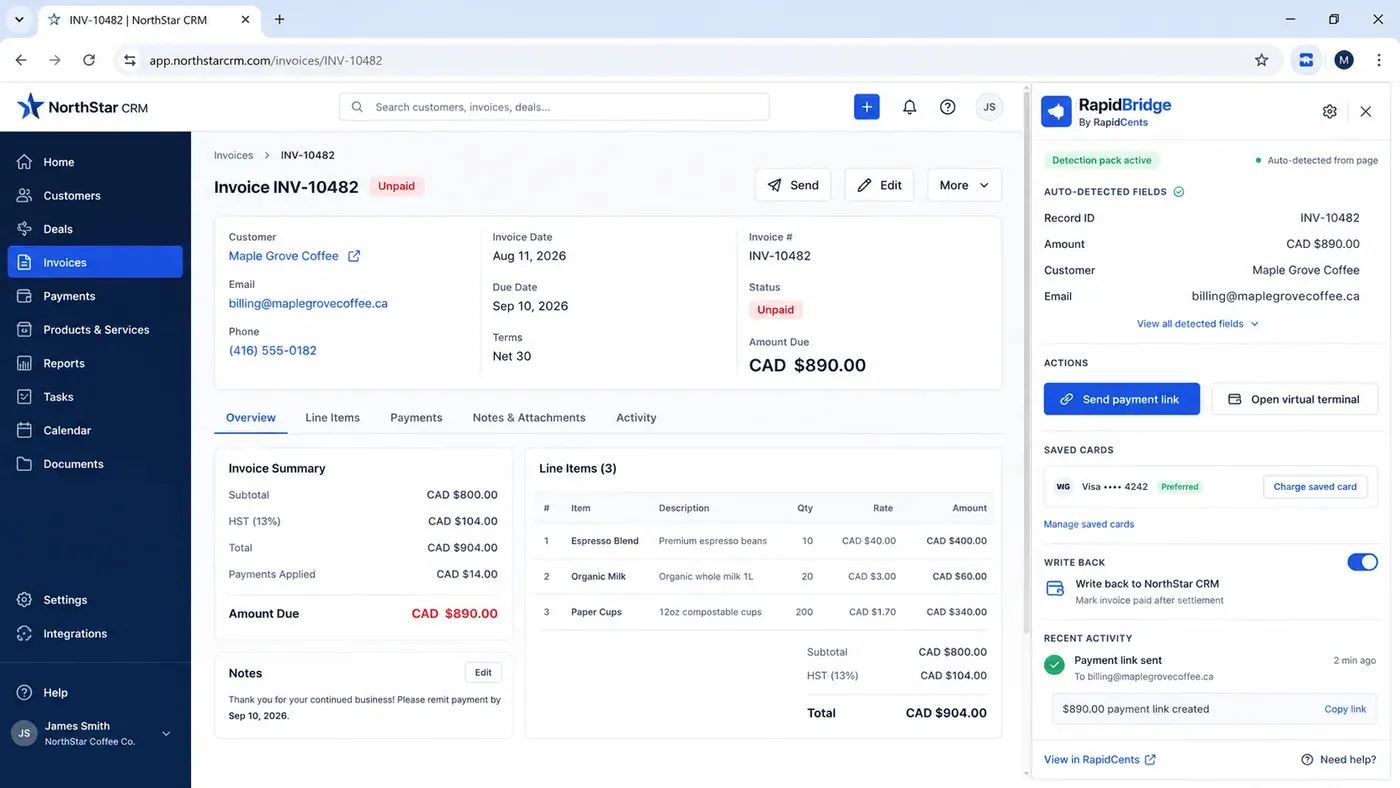
An unpaid invoice open in a third-party CRM with the RapidBridge panel beside it, showing the record number, amount, customer and email it detected from the page on its own, and buttons to send a payment link or charge a saved card. RapidBridge
Payments for software that was not built for them.
Explore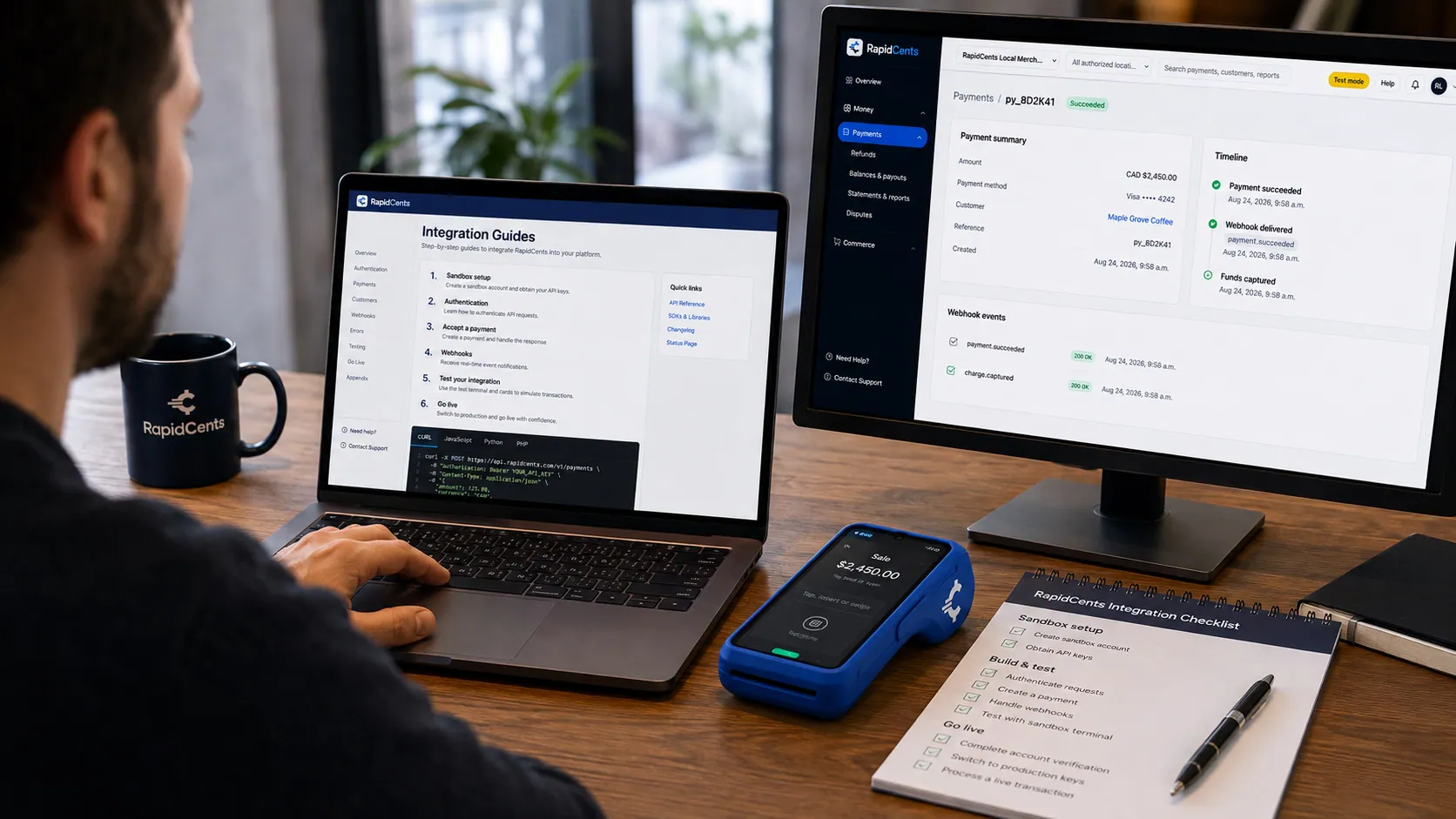
APPIE interoperability on a RapidCents desk: a terminal and host path that can work across processor boundaries. APPIE
Interoperability across processor boundaries.
Explore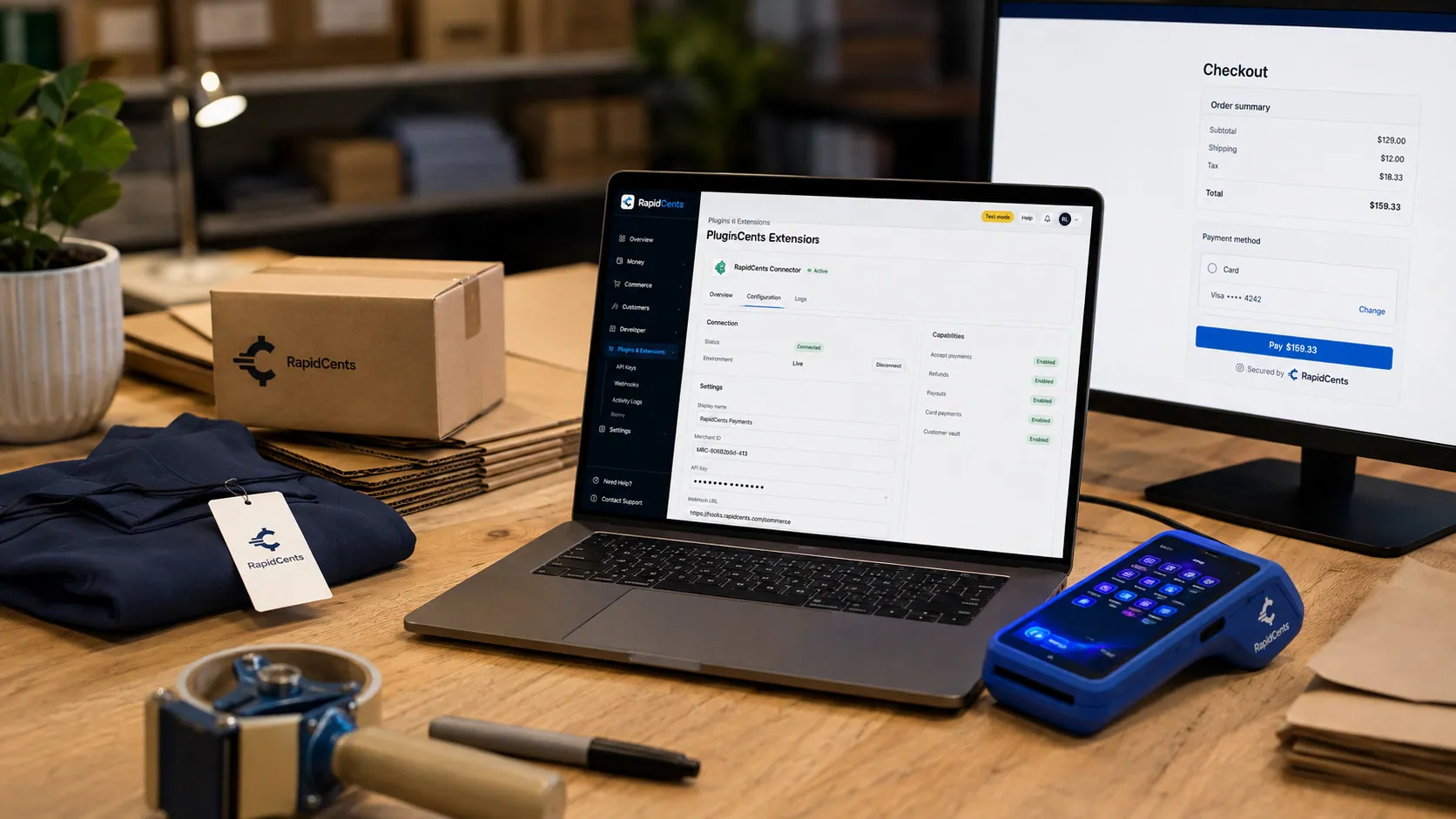
A RapidCents plugin connecting a commerce admin to checkout, so card payments work without custom gateway code. Plugins
Certified connectors for common platforms.
Explore
RapidCents connected to accounting and operations tools a business already runs, with payments landing in the same dashboard. Third-party integrations
What already connects to RapidCents today.
Explore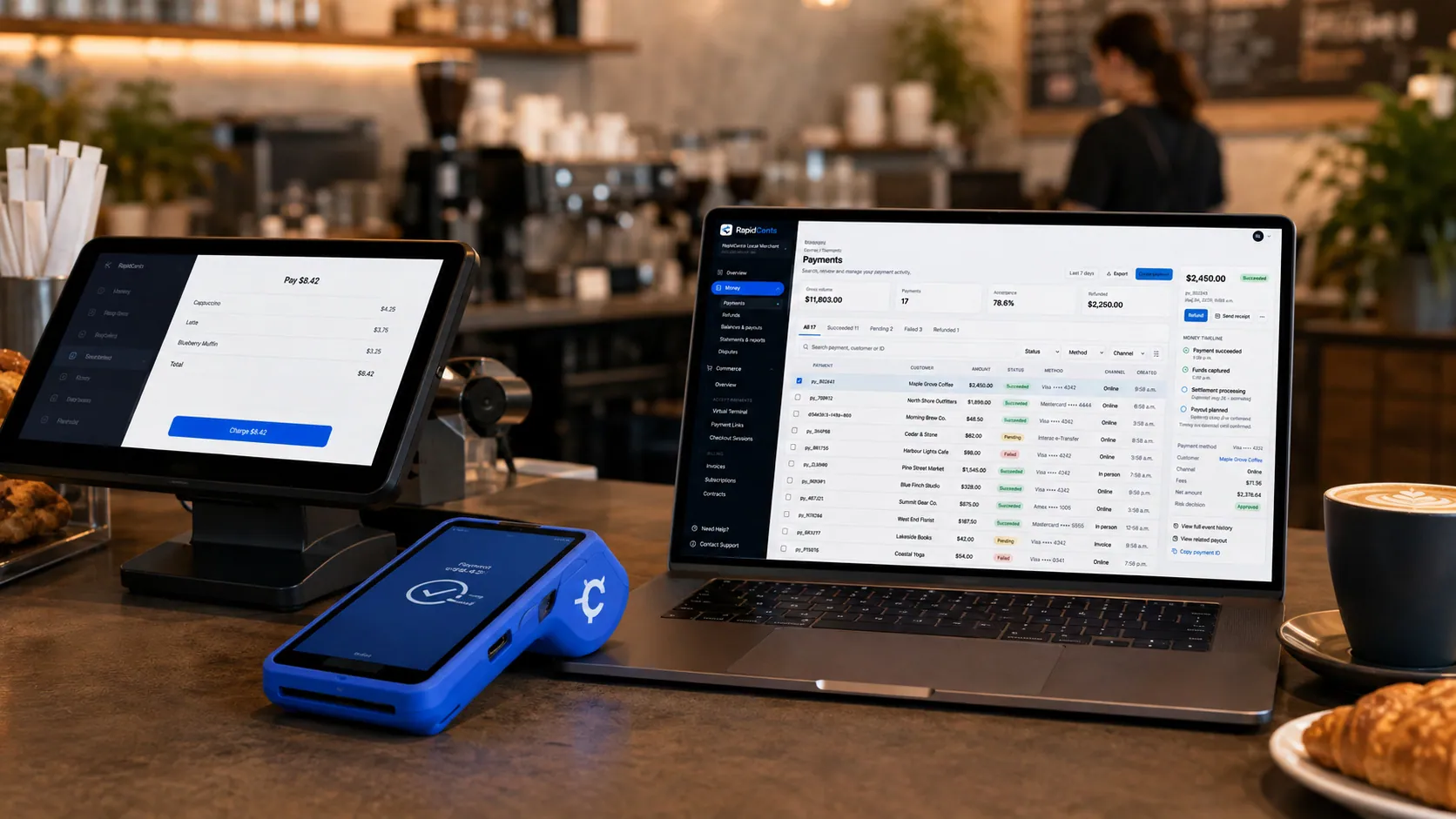
Payments taken inside existing business software through RapidCents, with the terminal and dashboard in the same workspace. Integrated payments
The merchant-side outcome: no double entry, one reconciliation.
Explore


Questions about Technology Partners
What does a device have to satisfy to be supported?
EMV and Interac certification for the acceptance itself, encrypted key injection so keys reach the device securely, remote firmware update, and remote disable from the dashboard for a device that goes missing. Those are the properties a merchant estate depends on long after the integration work is finished.
How do firmware updates reach a device a merchant depends on?
Remotely, deployed during low-traffic windows and requiring minimal action from staff at the counter. That constraint is worth designing to from the start: an update path that needs a technician on site does not survive contact with an estate spread across several locations.
What happens when a terminal is lost or stolen?
The device can be disabled remotely from the dashboard. The merchant also has an obligation with a clock on it: call +1 (844) 957-2743 and send written notice to [email protected], in each case within twenty-four hours, because liability for transactions processed through that hardware stays with the merchant until both are received.
Which TLS version must our connector or device negotiate?
TLS 1.2, with a limited set of strong ciphers. SSLv3, TLS 1.0 and TLS 1.1 are deactivated, so anything that can only negotiate one of those will simply fail to connect. Check it early against embedded stacks and older device firmware, where an outdated library is easy to miss until certification.
How do we avoid breaking merchants when the API changes?
API endpoints are versioned, and the sandbox mirrors live behaviour so a change can be tested against documented test cards before it reaches anyone. On the RapidCents side, development, quality assurance and security review the same change before it ships, and changes are recorded under change control.
What happens when a device fails in the field?
Replacement options include same-day, backed by warranty support. Worth confirming during certification rather than during an outage, because the replacement path is the part of a hardware partnership merchants notice most.
Take the next step
Talk to a RapidCents specialist
RapidCents Fee Check reads a processing statement and shows interchange separately from the markup. Upload a statement for an instant breakdown, or open a merchant account and start accepting payments on one account.
- No obligation
- Canadian payment specialists
- Secure statement upload



