DEVELOPER PLATFORM
APPIE on Host
APPIE on Host applies RapidCents interoperability at the host layer, for platforms that route payments across more than one processor. The problem is structural rather than physical: a marketplace, a software platform or a multi-region operator ends up with several acquiring relationships, and without a common layer each one is a separate integration with its own message formats, certification and failure modes. That cost is paid again for every processor added. At the host layer, adding or changing a route stops being an engineering project.
- Sandbox with documented test cards
- Signed webhooks
- Typed errors and idempotent retries
- Dedicated developer support

What crosses the wire
Where it sits
Between your platform and the processors behind it. Your application keeps one integration and one operational model; the layer beneath it is what varies by route rather than your code.
What has to be established first
Which processors you route to and why: geography, card mix, redundancy, commercial terms or a customer requirement. The routing policy is a business decision, and the integration follows it rather than the other way round.
What stays yours
Reconciliation across routes. Different processors mean different settlement timing and different fee structures, and a platform still has to present one coherent picture to its own finance team and to its customers.
When to use it
More than one acquiring relationship
Once a second processor exists, the second integration is where the cost lands, and it recurs with every change to either one.
Multi-region platforms
Different markets often require different acquirers. A common host layer keeps a single product behaviour across regions that do not share a processor.
Redundancy as a requirement
Where a customer contract or an internal standard requires an alternate route, the platform has to be able to add one without rebuilding the payment path.
How to implement APPIE on Host
Write down the routing policy before the integration: which route, for what, and why.
Map what differs per route — settlement timing, fee structure, supported methods.
Scope the host-layer work with an integration specialist against that policy.
Prove each route separately in sandbox, including its failure and refund paths.
Reconcile across routes for a full cycle before treating the routing as production behaviour.
What fails, and how you find out
Routing logic scattered through the application
A decision made in three places drifts in three directions. Keep the routing policy in one place so it can be read, changed and audited without a code archaeology exercise.
Assuming settlement is uniform
Different processors fund on different schedules with different fee structures. A finance process that assumes one shape across routes disagrees with the bank as soon as a second route carries volume.
No route-level observability
When decline rates move, the first question is which route. Without per-route metrics, a problem on one processor looks like a platform-wide degradation and gets diagnosed as one.
Treating a fallback as free
A secondary route only works if it has been exercised. A failover path that has never carried real volume is a hypothesis, and an incident is the wrong time to test it.
Sandbox versus production
Prove each route on its own
A sandbox run that only exercises the primary route tells you nothing about the second. Test each route end to end, including declines and refunds, before either carries production traffic.
Compressed settlement makes cross-route reconciliation testable
The hardest part of multi-route operation is finance, and accelerated sandbox settlement is the only way to walk several routes through a full cycle without waiting on real funding schedules.
Routing configuration is environment-scoped
A policy proven in sandbox has to be applied deliberately in production. Treat the routing configuration as part of the release rather than as a setting somebody will remember to mirror.
Questions about APPIE on Host
Who needs host-layer interoperability rather than terminal-layer?
Ask where the cost lands. If adding a provider means a second integration, a second certification and a second set of failure modes to learn, that is the host layer. If the blocker is a room full of devices that would have to be replaced, that is the terminal layer.
Does it decide which processor a payment goes to?
No. The routing policy is your business decision — geography, card mix, redundancy, commercial terms — and the layer is what stops each route from being a separate integration with its own certification.
What is the hardest part of running more than one route?
Reconciliation, not authorization. Processors fund on different schedules with different fee structures, so a platform has to normalise settlement into one coherent picture for its finance team and its customers.
Can I add a processor later without rebuilding?
Adding routes without rebuilding the payment path is what the host layer is aimed at. What each addition still involves is confirmed during scoping, because commercial and certification requirements vary by processor.
How do I detect a problem on one route?
Instrument per route. Decline rate, latency and settlement timing measured per processor turn a confusing platform-wide symptom into a specific one; without that split, route-level incidents get misdiagnosed.
Does this apply to a single-processor platform?
Not yet, and that is a reasonable place to be. It becomes relevant the moment a second acquiring relationship is likely — a new region, a redundancy requirement, or a customer contract that names one.
How does this relate to APPIE on Terminal?
Same interoperability idea at a different layer. Terminal-layer work keeps a hardware estate usable across a processor change; host-layer work keeps a platform integration usable across several processors. Some organisations need both.
Where should the routing policy live?
In one place, written down before the integration: which route, for what, and why. A routing decision made in three parts of an application drifts in three directions, and keeping it single means it can be read, changed and audited without a code archaeology exercise. Treat it as part of the release, since routing configuration is environment-scoped.
Can I rely on a failover route that has never carried traffic?
No. A secondary route only works if it has been exercised, so a failover path with no real volume behind it is a hypothesis rather than a capability, and an incident is the wrong moment to test it. Prove each route end to end in sandbox, including its decline and refund paths.
Continue the integration
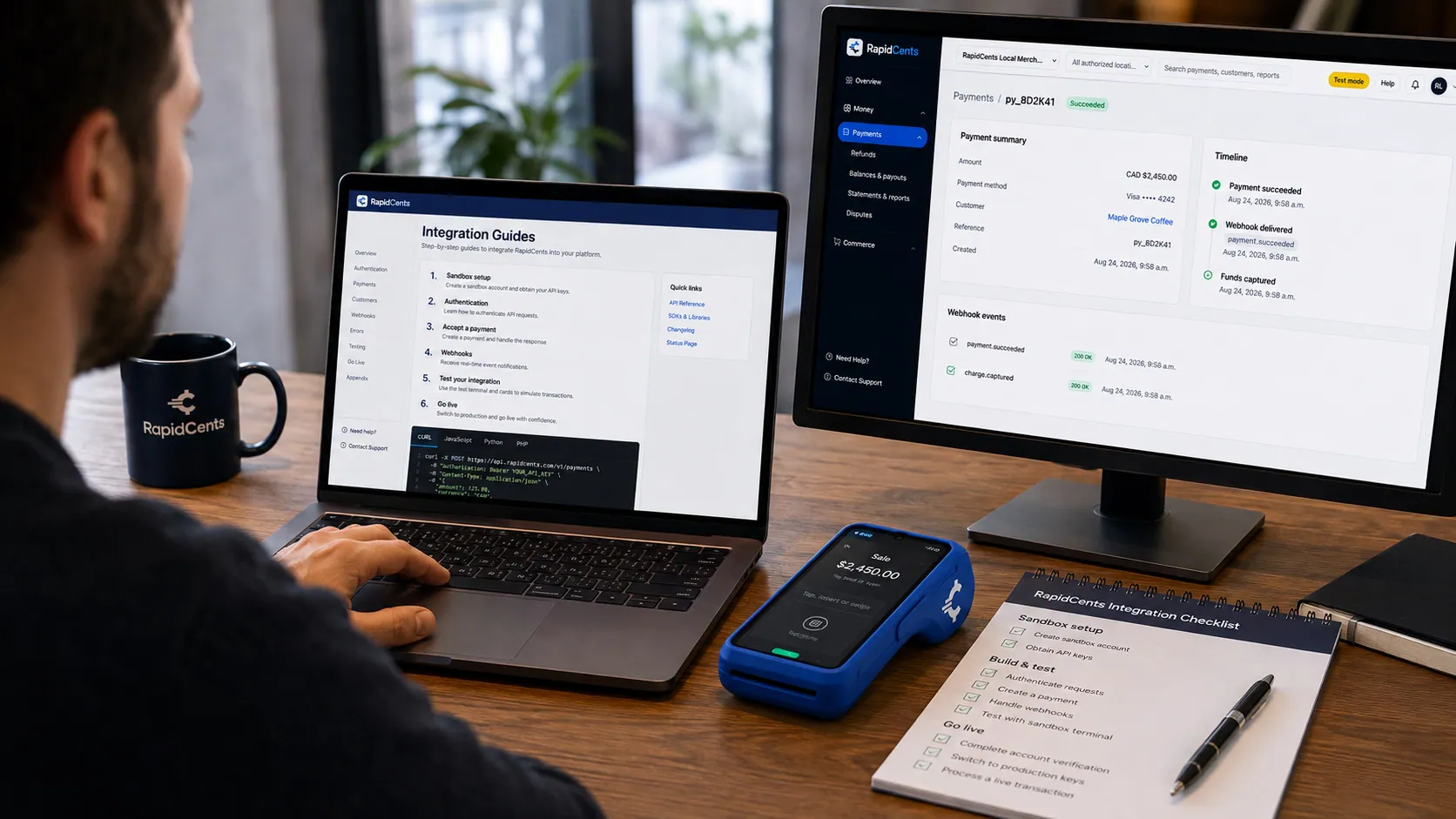
APPIE interoperability on a RapidCents desk: a terminal and host path that can work across processor boundaries. APPIE™
Payment interoperability infrastructure that lets terminals and hosts work across processor…
ExploreAPPIE at the terminal layer: processor interoperability without swapping the RapidCents hardware estate. APPIE on Terminal
Enable processor interoperability at the terminal layer, without replacing the hardware estate.
Explore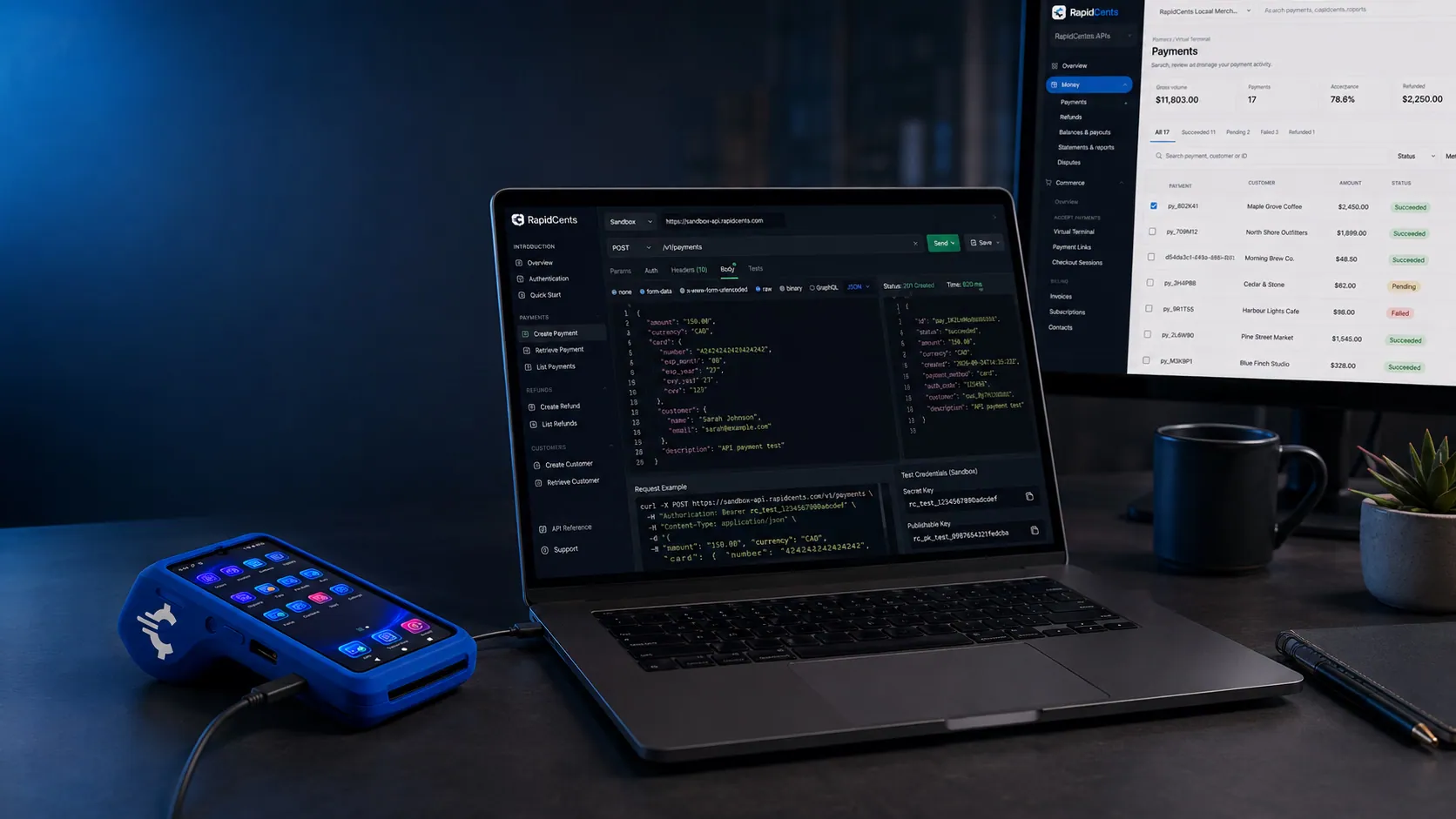
A RapidCents API request and its response on a developer workstation, with the merchant dashboard and a test terminal. RapidCents APIs
REST APIs for payments, refunds, customers, tokens and settlement, with predictable errors and…
Explore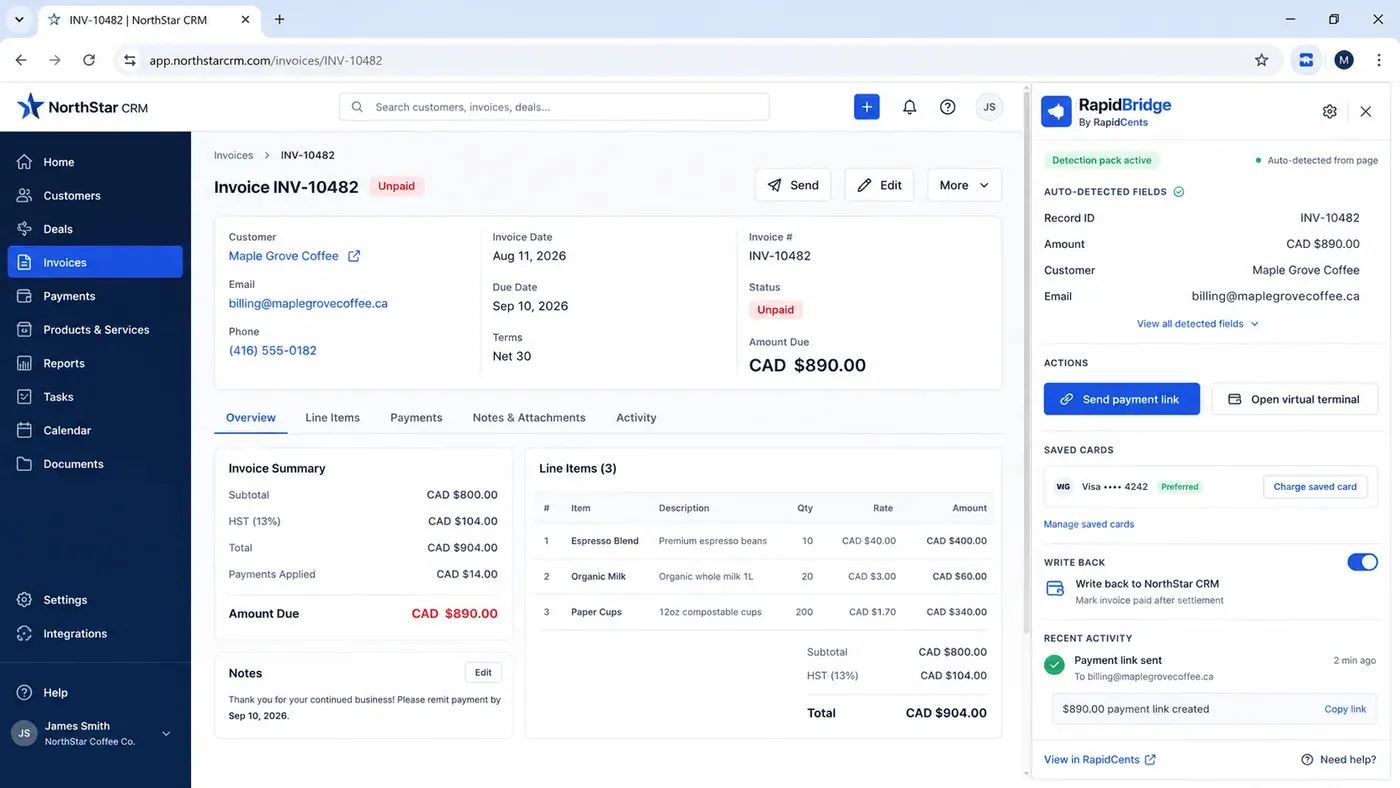
An unpaid invoice open in a third-party CRM with the RapidBridge panel beside it, showing the record number, amount, customer and email it detected from the page on its own, and buttons to send a payment link or charge a saved card. RapidBridge
Automatic payment detection in 178 business applications: RapidBridge takes payments inside…
Explore


Take the next step
Talk to a RapidCents specialist
RapidCents Fee Check reads a processing statement and shows interchange separately from the markup. Upload a statement for an instant breakdown, or open a merchant account and start accepting payments on one account.
- No obligation
- Canadian payment specialists
- Secure statement upload