


Guides, articles and payment education
The resource library is organized by what a piece of writing is, because the kinds carry different guarantees. A guide explains how something works and is written to stay true. An article is dated writing: it says what it said on the day it published, and carries the day it was last reviewed. A case study is a worked scenario by business type, not a customer reference. Comparisons run on a published scoring model, and the glossary defines the terms the rest of the library uses.
Browse by content type
Guides
Four shelves — pricing, terminals, online payments, security and compliance — and three ideas underneath all of them. Settle those first and the rest of the collection reads as variations rather than as separate subjects.
ExploreArticles
Guides explain how something works and are written to stay true. An article is dated writing: it says what it said on the day it was published, and carries the day it was last reviewed as well.
ExploreCase studies
Every case study here is a worked scenario rather than a customer reference. Read one the way you would read a worked example: the value is in the order of operations.
ExploreProcessor comparisons
Side-by-side comparisons of pricing, contract and support models, so you can decide on your own numbers rather than an advertised rate.
ExplorePayments glossary
Plain definitions for the vocabulary on a merchant statement, in a processor contract and in a card network rule.
ExplorePayment processing FAQ
Straight answers to what Canadian merchants ask before and after they start accepting cards: how pricing models differ, what actually lands in the bank account, how long a switch takes and who is liable when a payment is disputed.
ExplorePOS guides
Choosing a point-of-sale system is four decisions, not one: three follow from what your floor runs — tables, lanes or a stockroom — and the fourth is the hardware under all three. Start on the shelf that matches the floor; the questions underneath are the same on all four.
ExplorePOS comparisons
Side-by-side comparisons of the point-of-sale systems Canadian restaurants, retailers and supermarkets actually run, on software cost, payment processing and day-to-day operations.
ExploreStatement review
A merchant statement review reads your existing processing statement line by line and reduces it to one number: your effective rate. That is total fees divided by total volume, and it is the only figure that compares honestly across providers and pricing models.
Explore
Latest resources
Guides, articles and case studies for Canadian merchants.
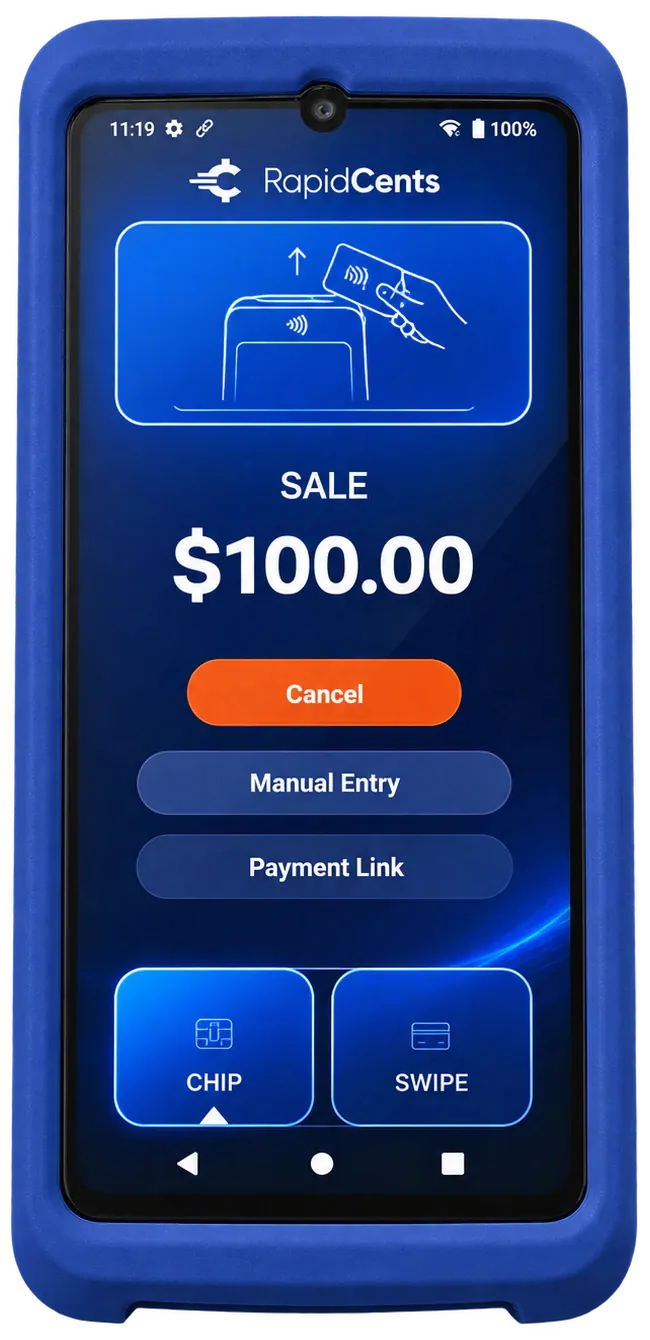
A RapidCents payment terminal, the device APPIE turns into intelligent payment infrastructure The Future of Payments Is Intelligent Payment Infrastructure
Mani Rahnama, founder of RapidCents, on why the next generation of payments needs more than another processor: infrastructure that understands, interoperates and protects, from APPIE™ interoperability at the terminal and host to security engineered into the whole transaction lifecycle and AI connected through governed access.
ExploreA RapidCents payment terminal, where fraud and chargeback protection start How RapidCents Can Guarantee Lower Chargebacks
Mani Rahnama, founder of RapidCents, explains the RapidCents Chargeback Reduction Guarantee: how a qualified merchant’s chargeback rate is measured against its own verified history, what it takes to qualify, and the in-house fraud and dispute technology that makes the promise possible.
Explore
Finance worksheets and a calculator used to compare processor costs High-Volume Merchant Account Canada
What to compare before a Canadian business processing about CAD $500,000 to $5 million a month signs a processing agreement: underwriting, Interac, interchange-plus, CAD funding and reserves.
ExploreA notebook comparing Visa Canada interchange categories before and after October 2026 Visa Canada Interchange Rates October 2026
On October 24, 2026 Visa raises the Canadian small-merchant annual Visa-volume ceiling from CAD $300,000 to CAD $750,000 and changes selected interchange categories. These are interchange rates, not all-in processing prices.
Explore
Finance team calculating an effective processing rate from a merchant statement Effective Processing Rate: Definition and Formula
The effective processing rate is total payment-processing fees divided by total processed card volume, times 100 — the one figure that compares two providers honestly.
Explore
Payment transaction data reviewed on a dashboard Payment Processing Architecture Explained
Gateway, processor, acquirer, card network and issuer each act in specific layers of a card transaction. This guide maps six layers, says who does what in each, and places tokenization and 3-D Secure where they actually sit.
Explore


Frequently asked questions
How is the resource library organised?
By what you are trying to find out. Guides explain a subject end to end; articles cover one question each and are shelved by topic; the comparison hubs put RapidCents beside a named processor or POS; the glossary defines the terms the other pages use. Each hub lists what it holds.
Are the articles written for Canada, the United States or both?
Both, and each one says which. Rules that come from Canadian law or a Canadian industry code are identified as such; rules that come from the card networks apply wherever those networks do. The site shows the edition for the country you are browsing in.
How current is the information?
Every article carries a published date, and the comparison pages carry the date their competitor claims were last checked against the public record. Pricing figures are deliberately not repeated in articles; they live on the pricing page, where they are maintained.
Can I ask a question the library does not answer?
Write to [email protected] or call +1 (844) 957-2743. Questions that come up more than once become articles, which is how most of this library was written.



