


Payment processing for wholesale distributors and B2B suppliers
Payment processing for wholesale distributors has to collect net-terms invoices by commercial card or bank payment while keeping each payment tied to its invoice and purchase order. RapidCents does that with Payment Links, invoices that carry PO numbers and the Virtual Terminal, and settled payments flow back to your ERP through Reporting and RapidBridge.

- PCI DSS Level 1
- SOC 2 Type II
- All major cards: Visa, Mastercard, Amex, Discover, UnionPay, Diners Club & Interac Debit
- Interchange-plus available
- Canadian support
Healthcare and laboratory suppliers
Find payment processing for your type of wholesale business. Each supplier page follows its own order, invoice and collection workflow, from the purchase order to reconciliation.
Dental Suppliers
From monthly consumables reorders to chair and imaging deposits, collect what clinics, dental labs and group…
Veterinary Suppliers
Get invoices, standing orders and equipment deposits paid by the veterinary practices, clinic groups and…
Medical & Surgical Suppliers
RapidCents helps medical and surgical suppliers collect hospital, clinic and practice invoices, equipment…
Laboratory & Scientific Suppliers
Collect on lab purchase orders, instrument deposits and staged deliveries, with the PO and order reference…
Pharmaceutical Wholesalers
Collect pharmacy account invoices, balances and deposits with payment links, invoicing and reporting that fit…
Foodservice and food distribution
Restaurant Suppliers
For dealers and distributors that sell kitchen equipment, smallwares and consumables to restaurants and need…
Grocery & Food Distributors
Get paid for every delivery to grocery stores, restaurants and institutional kitchens, with shorts and…
Produce Wholesalers
Collect on final weights, apply quality credits to the right delivery, and keep market-day pickup sales apart…
Meat & Seafood Wholesalers
Invoice catch-weight orders, collect on scheduled deliveries and settle freshness credits with card, link and…
Beverage Distributors
Collect route invoices, container deposits and account balances from the stores, cafes and venues you deliver…
Bakery & Ingredient Suppliers
Collect from the bakeries and food manufacturers you supply: repeat flour orders, seasonal bulk deposits and…
Business consumables and packaging
Janitorial & Sanitation Suppliers
Bill standing supply orders, collect facility and institutional invoices remotely and take payments at your…
Packaging Suppliers
Take the production deposit once a proof is approved, bill each split shipment against one order, and charge…
Paper & Disposable Suppliers
Collect case and pallet invoices from hospitality and facilities accounts with payment links, stored cards…
Industrial and trade supplies
Tool & Hardware Suppliers
Take trade-counter sales, contractor account invoices, phone orders and tool returns while keeping the job…
Industrial MRO Suppliers
Get paid by the plants, mills and maintenance contractors you supply, from a breakdown order collected at…
Safety & PPE Suppliers
Collect site-level PPE orders, bulk uniform deposits and repeat replenishment from the construction and…
Plumbing Supply Wholesalers
Collect counter sales, special-order fixture deposits and trade-account statements from plumbing contractors…
Electrical Supply Wholesalers
Collect from electrical contractors and facility buyers at the will-call counter, by phone and by invoice…
HVAC Supply Distributors
Collect furnace and condenser deposits, trade counter sales and contractor statement balances, with each…
Building materials
Building Material Suppliers
Collect contractor invoices, delivery deposits and job-level balances from the businesses you supply, with…
Lumber & Timber Wholesalers
Collect from the contractors and dealers you supply: grade-and-quantity invoices, delivered-load balances…
Roofing Material Distributors
Collect roof-package deposits, site-delivery balances and will-call sales from contractors, and credit…
Flooring & Tile Distributors
Collect lot reservations, special-order deposits, delivery balances and breakage credits from the contractors…
Concrete & Aggregate Suppliers
Collect on confirmed load tickets, dispatch deposits and site-referenced delivery charges from the…
Industrial materials
Steel & Metal Suppliers
Take deposits on cut-to-size orders, collect delivery balances once the final weight and freight are…
Industrial Chemical Suppliers
Collect plant-account invoices, deposits on drum, tote and bulk orders and returnable container charges with…
Plastics, Rubber & Resin Suppliers
Collect grade-specific deposits, call-off release invoices and out-of-spec return credits from the…
Vehicle, equipment and agriculture supply
Tire Wholesalers
Collect dealer preseason orders, staged balances and return credits from the tire shops you supply, with a…
Truck & Fleet Parts Suppliers
RapidCents helps heavy duty parts distributors collect urgent pickup orders, depot account balances and fleet…
Industrial Equipment Suppliers
Collect deposits, shipment and commissioning balances, and spare-parts reorders from the businesses you sell…
Agricultural Input Suppliers
Collect seasonal farm invoices, deposits and cooperative account balances by card, payment link or bank…
Feed & Farm Supply Wholesalers
Collect delivered-feed invoices, bulk quantity adjustments and repeat orders from farm accounts by card…
Auto Parts Retailers
Take cards at the counter and on delivery, collect trade statements on the terms you set, and refund core…
Oil & Energy
Get paid on oilfield service tickets, fuel delivery accounts, commercial card invoices and pre-dispatch…
Technology, office and merchandise
Computer & IT Distributors
RapidCents helps computer and IT hardware distributors collect approved reseller invoices, hardware deposits…
Electronic Component Distributors
Collect purchase order invoices, allocation deposits and partial-shipment balances from the manufacturers and…
Office & School Suppliers
Collect payment from schools, districts and offices that buy stationery and supplies from you, with purchase…
Commercial Furniture Suppliers
RapidCents helps commercial furniture suppliers collect fit-out deposits, delivery balances and installation…
Apparel, Textile & Uniform Wholesalers
Collect production deposits, partial seasonal shipments and size-exchange credits from the retailers and…
Beauty & Salon Suppliers
Collect reorder invoices, equipment deposits and phone orders from salon trade accounts, with references that…
Pet Product Wholesalers
Collect from pet retailers on approved invoices, trade-account reorders and credits, with every payment tied…
How wholesale distributors get paid
A wholesale distributor is usually paid on account: the buyer's accounts payable (AP) team settles net-terms invoices, often large ones, by card or bank payment and expects to quote a PO number. Around that sit prepayments, phone reorders, counter pickups and part payments. Wholesale accounts receivable payment links carry most of this work, and RapidCents covers each of the jobs below.
Net-terms invoices paid online
The buyer's AP clerk pays when the invoice falls due, usually from the email it arrived in. Your invoice goes out with a RapidCents Payment Link, or as a RapidCents invoice with reminders before the due date, carrying the invoice and PO numbers. If the buyer pays less than the full amount, the invoice stays open for the balance. Finance gets the paid time, amount and references for every invoice.
Commercial card payments on large orders
A purchasing manager or AP clerk puts a large order on a corporate or purchasing card, often because the card gives their company more time to pay. The card is entered on a Payment Link or keyed in the Virtual Terminal. If an invoice is above the card's single-transaction limit, the buyer pays the rest by bank payment. Finance gets a settled payment tied to the invoice, with card brand and type visible in Reporting.
Prepayment before goods ship
A new account waiting on credit approval, an account on credit hold, or a buyer ordering non-stock items pays before you release or place the order. Send a Payment Link with the sales order number, or use Contracts & eSignatures to get special-order terms signed and the deposit paid together. If the buyer cancels, your terms decide the refund. Finance gets a deposit to apply against the final invoice.
Phone and email reorders
A regular buyer phones or emails a reorder to inside sales. The rep keys the card in the Virtual Terminal with the order number as the reference or, for an authorized buyer on the account, charges a card saved to the customer profile with the buyer's documented authorization. If a card is declined, the rep asks for another or sends a Payment Link. Finance gets the payment, the reference and, in the audit log, the staff member who took it.
Will-call and counter pickups
Contractors and business buyers collecting at a branch counter either charge the purchase to their account or pay on the spot. Card payers tap or insert on a RapidCents Payment Terminal, or staff use Tap to Pay on a supported phone. An account on hold pays before the goods leave. Finance sees counter sales by location in the same reports as invoice payments.
Part payments on an open account
A buyer holds back a disputed line or a short-shipped item, pays partly by card and partly by bank payment, or pays down a balance spread over several invoices. A Payment Link set to accept partial amounts, or a RapidCents invoice, collects what they pay now and leaves the rest open. Finance gets each partial payment with its references, and accounts receivable (AR) applies it to the right invoices in the ERP.
B2B wholesale payment processing for large commercial card invoices
A buyer can pay a large wholesale invoice by corporate or purchasing card when three things line up: the buyer's card limit, the transaction sizes your merchant account was underwritten for, and your own terms on which invoices accept cards. Within those limits, the buyer pays through a RapidCents Payment Link or invoice, or by phone in the Virtual Terminal, and the payment carries the invoice and PO numbers into Reporting.
How the payment runs
Your ERP raises the invoice when the order ships. You send it with a Payment Link that carries the invoice and PO numbers, or the buyer's AP clerk phones and your AR desk keys the card in the Virtual Terminal. The buyer gets an emailed receipt, the payment shows as approved in the Merchant Dashboard with its references, and AR applies it to the invoice in the ERP once it settles.
What to set up before the first big invoice
Give your average and largest expected invoice and your monthly card volume accurately on the application, because underwriting looks at transaction size and volume. Then decide which invoices you accept cards on, whether links take partial amounts or full payment only, and which staff roles may key cards, refund or void in the Virtual Terminal. Print your card terms on the invoice so AP knows before it pays.
When the card is declined or the limit is too low
Companies set single-transaction and monthly limits on commercial cards, so a large invoice can be declined even when the buyer is good for it. A decline posts nothing, and the invoice stays open in the ERP. The buyer can ask their card program administrator to raise the limit, or pay up to the limit by card and the balance by bank payment. Do not split the invoice into several card charges to fit under the limit; most purchasing card programs prohibit that as a split purchase.
Disputes on delivered goods
If a buyer disputes a card payment, Disputes and Chargeback Protection alerts you, shows the response deadline and lets you submit evidence. For a wholesale order, the strongest evidence is usually the buyer's purchase order, the invoice with matching references, and proof of delivery signed at the dock. File those documents by invoice number so AR can find them before the deadline passes.
An $18,400 switchgear order on net 30
Say an electrical distributor invoices a contractor $18,400 for switchgear on net 30. The contractor's purchasing card has a $10,000 single-transaction limit, so the AP clerk pays $10,000 on a Payment Link that accepts partial amounts and the remaining $8,400 by bank payment the following week. Both payments carry the invoice and PO numbers, and AR closes the invoice when the second one settles.
How a wholesale invoice payment gateway keeps the PO with each payment
To keep a purchase order reference with each payment, put the PO and invoice numbers into the reference fields of the RapidCents Payment Link or invoice before it goes out. The buyer pays against those references, and Reporting lists them beside each settled payment. AR then applies the money in the ERP by number instead of matching amounts and guessing.
Agree on the references with each buyer's AP team
Ask your larger accounts what their accounts payable team needs to release a payment: usually the PO number, your invoice number and your customer account number, sometimes a job, site or branch name. Use the same reference fields in the same order on every link, so your AR team and their AP team always quote the same numbers.
Before and after the move to links
Before: the buyer mails a paper payment or sends a bank transfer with a separate remittance email, and AR matches amounts to invoices by hand, calling the buyer when they do not agree. After: the buyer pays a link that already carries the invoice and PO numbers, the payment record shows them, and AR applies each payment from Reporting by those numbers.
One payment for several invoices
When a buyer wants to settle several invoices at once, send one Payment Link for the combined total with every invoice number listed in the reference, or one link per invoice if your AR team prefers one-to-one matching. RapidCents records the payment and the references you set; splitting a combined payment across invoices happens in your ERP, by import or by hand.
Short payments and missing references
If the buyer pays less than the invoice, a link that accepts partial amounts records what was paid and the invoice stays open for the balance. If a link went out before the buyer issued a PO, the payment still shows against that link or invoice in the Merchant Dashboard, so AR can trace it to the order rather than parking it as unapplied cash.
Three POs from one hospital in a week
Say a janitorial supply distributor delivers to a hospital against three purchase orders in one week. The hospital's AP team will not release payment without a PO number, so AR sends three links, each carrying its invoice and PO number. AP pays two by purchasing card the next day and the third after a credit for one short-shipped case, and AR applies all three without a phone call.
RapidCents products for wholesale distributors
Payment Links and Invoicing collect net-terms invoices with the PO number attached, the Virtual Terminal takes phone reorders and AP card payments under role permissions with an audit log, and Reporting exports settlements, fees and refunds in formats suited to QuickBooks, Xero and general ledger imports.

The RapidCents payment links screen listing created links with their amount, status, click count and whether they have been paid, beside a phone showing the branded page a customer opens to pay $2,500.00. Payment Links
RapidCents payment links let staff generate branded pay-by-link URLs for invoices, deposits, balances and…
Explore
The RapidCents invoices screen: outstanding, overdue, paid and draft totals across the top, the invoice list below them, and a preview of one invoice on the right with its line items and a View & Record Payment button. Invoicing
RapidCents invoicing helps professional services, contractors and B2B suppliers create branded invoices…
Explore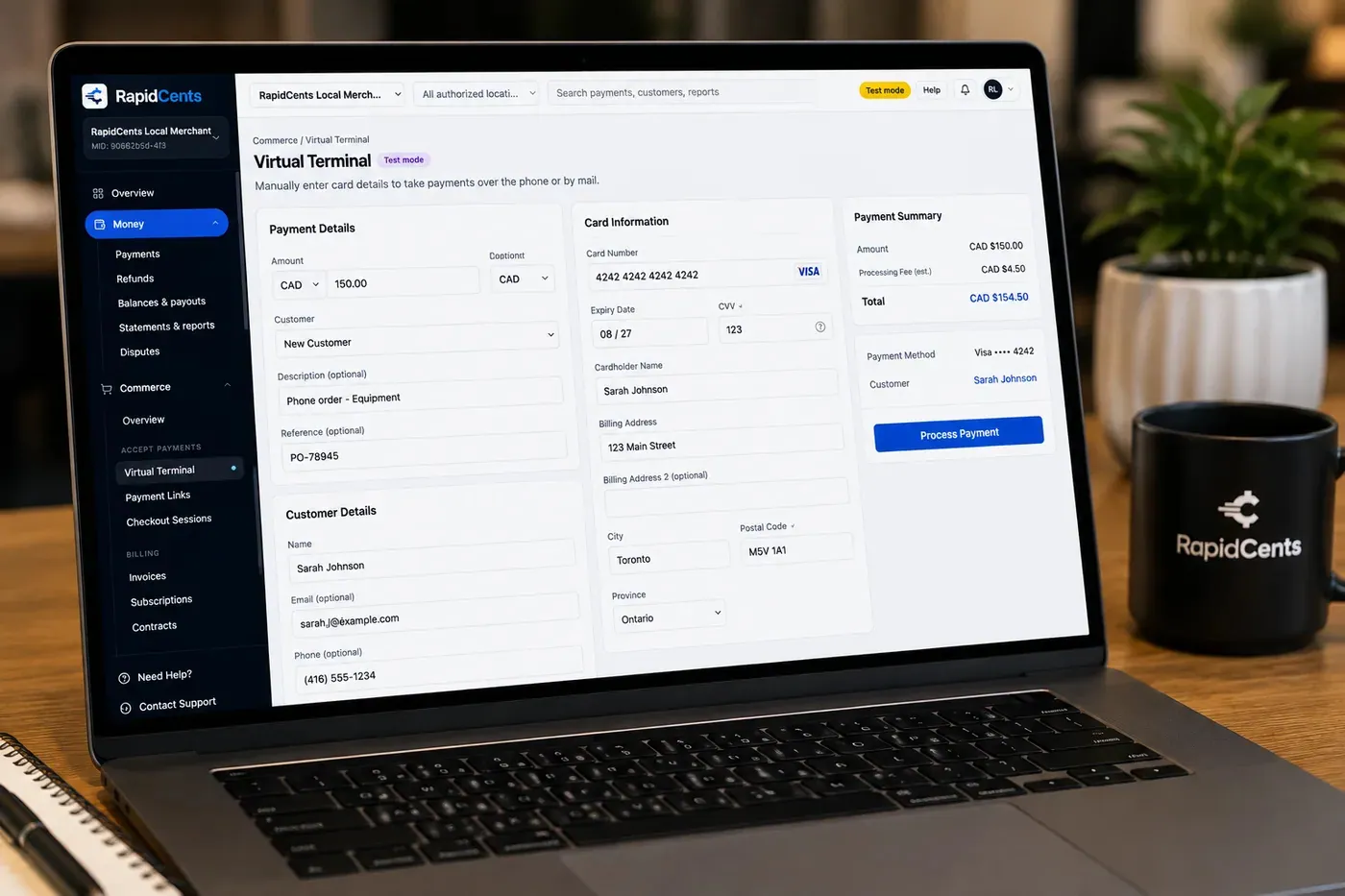
The RapidCents virtual terminal: payment details, card number, expiry and CVV keyed by hand on the left, with a payment summary on the right showing the amount, the estimated processing fee and a Process Payment button. Virtual Terminal
The RapidCents virtual terminal lets authorized staff enter mail-order and telephone-order payments through a…
Explore
A merchant reviews RapidCents reports for volume, mix and payouts, with the terminal that took the sales on the desk. Reporting
RapidCents reporting delivers customizable transaction, settlement and fee reports with CSV and PDF export…
Explore


When do buyers need B2B card processing with Level 2 and Level 3 data?
Buyers ask for Level 2 and Level 3 data when they pay with a corporate or purchasing card whose program wants more than the amount. Level 2 adds summary fields such as the tax amount and a customer code, often the PO number; Level 3 adds line items. Card networks can use that data in setting interchange on some commercial card transactions, and your RapidCents representative will tell you which fields your account and payment channel carry.
What each data level adds
Level 1 is an ordinary card sale: amount, date and merchant. Level 2 adds summary fields such as the tax amount and a customer code, often the buyer's PO number. Level 3 adds line-item detail, including product code, description, quantity, unit of measure and unit price, so the transaction carries much of what is on your invoice.
Why buyers' card programs ask for it
Companies that pay suppliers by purchasing card often reconcile spend and tax from their card program's reports instead of collecting paper invoices. When your transactions carry the data, the buyer's AP sees what was bought without asking you for copies; when they do not, some buyers ask for invoices separately or prefer suppliers who can pass it.
What it can and cannot change on cost
Interchange depends on the card type, how the card is presented, your business category and the information sent with the transaction. On some commercial card products, complete Level 2 or Level 3 data can place a transaction in a lower interchange category, depending on the network, the card and your market. It does not apply to every business card, so we never promise a lower cost from it.
Which fields your account carries
Ask your RapidCents representative which fields your account can carry on the channel you use, whether that is the Virtual Terminal, Payment Links or your own integration through the Payment Gateway, and for which card brands. An ERP that stores line items does not mean the payment carries them. After switching, check your first statements to see which interchange categories your commercial card payments landed in.
A fleet department's purchasing card
Say a maintenance, repair and operations (MRO) supplier sells filters and fittings to a municipal fleet department that pays by purchasing card. The city's card program asks for the tax amount and PO number on every charge. Before moving those payments, the supplier asks its RapidCents representative which of those fields the Virtual Terminal carries, then uploads its first statement to Fee Check to see interchange separated from markup.
What drives payment processing fees for wholesale distributors?
Payment processing fees for wholesale distributors depend most on interchange for the cards your buyers use and on how those cards are taken. RapidCents prices on interchange-plus: interchange passes through at cost, your RapidCents markup is set out in your Fee Schedule, and fees for equipment or services apply if you use them. The agreement is month to month, with no fixed term, so the useful comparison is your own card mix priced line by line.
Commercial cards and invoice size
Corporate, purchasing and business cards generally carry higher interchange than consumer debit, and on those cards interchange is charged largely in proportion to the sale. A distributor whose card volume is mostly commercial cards on five-figure invoices usually pays most of its processing cost as interchange. Separate commercial from consumer volume on your statement before comparing quotes, because that split moves your total.
Keyed and linked versus tapped at the counter
Cards keyed in the Virtual Terminal or paid through a Payment Link are card-not-present, which usually costs more in interchange than a card tapped or inserted at a will-call counter terminal. Run AVS and CVV on keyed payments, and 3-D Secure where it applies online: missing address data can push a payment into a costlier interchange category, and skipped checks leave you more exposed to fraud. Count how much of your volume comes through each channel.
Your markup and how to compare it
Your RapidCents markup is set out in your Fee Schedule. On five-figure invoices, check whether a provider's markup is charged as a share of the sale, per transaction or both, because the structure matters as much as the number. Give every provider the same facts, including your business category, average and largest invoice, monthly volume and chargeback history, and get each quote in writing before you compare it with your current statement.
Bank payments on the largest invoices
On your biggest invoices, compare the card cost with what a bank payment costs on your account, and weigh what each gives you: a card approval comes back while the buyer is paying, a bank debit can be returned days later, and either can be disputed after the goods have shipped. Your invoice terms can steer large balances to bank payment.
What to bring, and where to start
Bring three recent processing statements, your split between commercial and consumer cards, your average and largest card payment, the share taken by link, by phone and at the counter, and monthly refunds and chargebacks. Upload one statement to Fee Check to see interchange separated from markup; the markup is the part providers set, and the part to compare between written quotes.
How payment data reaches NetSuite, SAP Business One and other ERPs
RapidCents integrates with many major platforms through APPIE and RapidBridge, and the ERPs below are the ones distributors ask about most. You collect through Payment Links, invoices or the Virtual Terminal, settled transactions, fees and refunds come back through Reporting, and settlement files import into larger ERPs such as NetSuite and SAP. The right option depends on your ERP vendor and version; your RapidCents representative will walk you through it.
NetSuite
NetSuite holds the sales order, invoice, customer terms and receivables. RapidBridge works with Oracle NetSuite, so a card payment can be taken against the invoice you already have open. You can also collect with Payment Links carrying the NetSuite invoice number and bring settlements in with the settlement import template. Your RapidCents representative will show you which route fits your NetSuite edition.
SAP Business One
SAP Business One records customer payments against invoices as incoming payments. RapidBridge works with SAP Business One Web Client, and settlement import templates cover SAP systems for the rest. Your RapidCents representative will walk you through the option that fits your version, and AR matches each payment to its invoice as it does today.
Dynamics 365 Business Central
Business Central sales invoices can take online payments, and RapidBridge works with Dynamics 365 Business Central, so a RapidCents payment posts against the invoice already open. Send a Payment Link alongside the invoice where you prefer, and bring settled payments, fees and refunds in from a Reporting export through your own import or by hand.
Acumatica
RapidBridge works with Acumatica, so a card payment posts against the invoice you already have open without changing the ERP. Where you prefer to collect outside Acumatica, send a Payment Link and bring settlements in from Reporting exports. Your RapidCents representative will explain which option suits your edition.
Epicor Prophet 21
Prophet 21 runs distribution order entry and receivables. RapidCents integrates with many major platforms through APPIE and RapidBridge, and the right option depends on your Prophet 21 version and how you authorize cards in order entry today. Your RapidCents representative will walk you through it. Meanwhile, collect by Payment Link or Virtual Terminal and apply payments from Reporting exports.
QuickBooks Online and Xero
If your books are in QuickBooks Online or Xero rather than an ERP, RapidCents connects settled transactions, fees and refunds to either one, and RapidBridge works with both. Invoices raised in another system still need their payments applied there, and your RapidCents representative will show you how the two fit together.
Payment options for wholesale distributors in Canada
A wholesale distributor with a Canadian RapidCents account settles in CAD and can accept Visa, Mastercard and American Express, including corporate and purchasing cards, through invoices, Payment Links and the Virtual Terminal, plus Interac debit on a counter terminal. For large invoices, EFT and pre-authorized debit (PAD) bank payments are available on your account; a PAD also needs a signed agreement from the buyer.
Commercial cards and Interac debit at the counter
Business buyers pay invoices by Visa, Mastercard or American Express commercial card through a link or by phone. At a branch or will-call counter, contractors tap or insert a card, or pay with Interac debit by chip and PIN or contactless, on a RapidCents Payment Terminal, and counter sales appear in the same reports as invoice payments.
EFT and PAD for large invoices
Buyers can pay large invoices by EFT. A buyer who signs a pre-authorized debit (PAD) agreement authorizes you to debit their business account on the terms it sets out, such as each invoice on its due date. A bank debit can be returned after the fact, so keep the signed agreement on file and release goods under your own credit policy.
GST/HST and provincial tax on invoices
Your invoice shows GST/HST, plus PST or QST where it applies, and the payment collects the invoice total. Tax amounts, exemptions and filings stay in your ERP or accounting software; RapidCents records the payment, not the tax return.
Buyers outside Canada
Buyers in the United States or elsewhere can pay your invoices by card, and your deposits still settle in CAD. If cross-border sales are a large part of your volume, talk to your RapidCents representative about how cross-border card payments are priced in your Fee Schedule and whether International Payments suits your buyers.
How to switch payment processors without losing receivables history
Switching processors as a wholesale distributor is mostly an inventory job: list what lives at the old provider, test the new flow, run both through a month-end, then close the old account once its last refunds clear. Once your account is approved, your RapidCents representative helps you plan the move. Saved cards move only if both providers agree, and every deposit during the overlap still has to reconcile to the ERP.
List what lives at the old provider
Make a list of saved cards and the buyer authorizations behind them, scheduled or recurring charges, open invoices whose payment links point to the old provider, refunds and disputes in progress, and the payment history your auditors may ask for. Export that history before you give notice. Token portability needs both providers to agree, so plan to collect fresh card authorization where they cannot.
Test a sale, a partial payment and a refund
Before buyers see anything, run a test sale, a partial payment, a refund and a void through the Virtual Terminal and a Payment Link. Check that the invoice and PO references appear on the receipt and in Reporting the way AR needs them, and that the settlement export loads into your ERP or accounting software without manual cleanup.
Overlap through one month-end
Send new invoices with RapidCents links while the old provider finishes what it started: links already sent, and refunds on its own transactions, since a refund goes back through the processor that took the original payment. Close the old account only after its final statement and last refund. Disputes on its transactions keep arriving there for months, so keep a login or contact that lets you respond.
Tell buyers' AP teams what is changing
Let key accounts know that payment links will come from a new sender, that the name on their card statement may change, and, if your bank-payment details change, how to verify them. Confirm any change of bank details by phone on a number they already have, because fake bank-change emails are a common fraud against suppliers and their buyers.
Reconcile every deposit to the ERP
Match each RapidCents deposit to its settlement report, post card fees to their own expense account, record refunds against the original invoice or credit memo, and tie the period's cash receipts, fees and refunds in the ERP to the deposits on your bank statement. Saved report templates and scheduled delivery in Reporting turn this into a fixed month-end routine.
Payment questions from wholesale distributors
What is the best payment processor for wholesale distributors?
The right processor is the one that fits how your buyers pay, and that is how we built RapidCents for distributors. Large commercial card invoices go through Payment Links or the Virtual Terminal, every payment keeps your invoice and PO numbers, part payments leave the balance open, and settlements reach your ERP through RapidBridge or Reporting exports. We price on interchange-plus, month to month. Ask your RapidCents representative for a written quote on your real card mix and a walk-through of one invoice from payment to deposit.
How much does credit card processing for wholesale distributors cost?
It depends on your card mix, invoice sizes and channels, so the useful answer comes from your own statement. With RapidCents you pay interchange at cost, which the card networks set by card type and by how the card is taken; your RapidCents markup, set out in your Fee Schedule; and fees for equipment or services, if applicable, on a month-to-month agreement. Commercial cards keyed or paid online usually sit in costlier interchange categories, so upload a statement to Fee Check before comparing quotes.
Can NetSuite use a different payment processor?
Yes. RapidBridge works with Oracle NetSuite, so a RapidCents card payment can be taken against the invoice you already have open, and RapidCents integrates with many major platforms through APPIE and RapidBridge. You can also collect by Payment Link or Virtual Terminal and import settlements with a settlement import template. The right option depends on your NetSuite edition; your RapidCents representative will walk you through it.
How can a wholesale distributor switch processors without losing payment history?
Export your full payment history from the old provider before you give notice, then move one flow at a time. Saved cards and the authorizations behind them, open payment links, pending refunds and open disputes all need a plan: saved cards transfer only if both providers agree to move the tokens, and refunds go back through whichever processor took the original payment. Keep the old account open until its final statement, and reconcile both processors' deposits to the ERP during the overlap.
Which payment options can a wholesale distributor in Canada offer?
A wholesale distributor in Canada can offer Visa, Mastercard and American Express cards, including corporate and purchasing cards, through invoices, Payment Links and the Virtual Terminal; Interac debit on a counter terminal; and EFT and pre-authorized debit bank payments for large invoices. Deposits settle in CAD. A PAD needs a signed agreement from the buyer. Your RapidCents representative will set up the methods you want before you print new payment instructions on your invoices.
How can we accept a commercial card on a large wholesale invoice?
Send the invoice with a RapidCents Payment Link carrying the invoice and PO numbers, or take the corporate or purchasing card by phone in the Virtual Terminal. Either works when the amount fits the buyer's card limit and the transaction sizes your merchant account was underwritten for. If the card's limit is too low, the buyer can pay up to the limit by card and the balance by bank payment, rather than splitting the invoice into several card charges. AR applies the settled payment in the ERP, and any refund goes back to the same card. Your own terms decide which invoices accept cards.
How do we keep the purchase order number with each payment?
Add the PO number to a reference field on the Payment Link or RapidCents invoice before sending it. The buyer pays against that reference, and Reporting shows it beside the settled payment, so AR can apply the money to the right invoice in the ERP. For a card taken by phone, enter the PO and invoice numbers as references on the Virtual Terminal sale. Ask key accounts which numbers their AP needs before it will release a payment.
How do we collect a part payment on a net-terms account?
Send a Payment Link that accepts partial amounts, or a RapidCents invoice, and the buyer pays part now while the rest stays open. On a RapidCents invoice, the partial payment applies to the open balance; in your ERP, AR applies it to the invoice so your aging stays accurate. Part payments suit a disputed line, a short shipment, or a card that covers only part of the total, with the rest paid by bank payment. Your net terms remain the agreement between you and the buyer; a payment method collects what is due and does not extend or change those terms.
How do we compare bank payments with business card costs?
Price the same invoice both ways. For the card, use your recent statements to find interchange plus your markup on commercial cards keyed or paid online; for the bank payment, use what your account charges for that method. Then weigh what the price leaves out: a card approval is known when the buyer pays, a bank debit needs the buyer's authorization and can be returned days later, either can be disputed, and many buyers prefer cards because the billing cycle gives them extra time. Some distributors offer both and let invoice size decide.
Can card payments and fees post back to our ERP automatically?
Yes, for the platforms RapidBridge works with, where a payment posts against the invoice you already have open. RapidCents connects settled transactions, fees and refunds to QuickBooks Online and Xero, and SAP and NetSuite import settlement files. For other ERPs, use a CSV export from Reporting, or have a developer or your ERP partner build posting on the Payment Gateway's API and webhooks. Your RapidCents representative will walk you through the best route for your ERP vendor and version.
What MCC is used for a wholesale distributor?
There is no single MCC for wholesale. We set your merchant category during onboarding from what you actually sell and to whom, so a dental supply house, a steel distributor and a foodservice distributor are usually classified differently. Describe your products and customers accurately on the application, because the category is part of how interchange is set on your transactions. A code meant for membership warehouse clubs does not describe a distributor that sells to businesses on account.
How should returns and credit memos be handled when a buyer paid by card?
First decide whether the buyer gets money back or credit, because the two leave different records. A credit memo is an entry in your ERP that reduces what the buyer owes on open or future invoices; no card transaction moves. A refund sends money back to the card that paid, through RapidCents, for the returned amount only, and appears in Reporting as a refund. Record the credit memo in the ERP either way, and match any refund to it so AR and the deposit both balance.
Other businesses that bill on account
Freight and logistics companies share your net terms, PO references and large business invoices, while law firms, accounting firms, agencies and other professional services also invoice on account, collect by link or phone, and reconcile deposits to their books. Each has its own page with its own workflows and software.
Law Firms
RapidCents helps law firms collect retainers by payment link, send invoices with a link…
Accounting Firms
Charge monthly bookkeeping and payroll fees on a schedule, collect tax preparation…
Professional Services
Charge monthly retainers, send branded invoice links and collect milestone balances from…
Insurance
Collect down payments at binding, monthly installments and agency fees by payment link…
Real Estate
Collect application fees, service fees and keyed deposits by payment link or Virtual…
Property Management
Collect rent by card and bank payment, set up recurring autopay, invoice maintenance…
Freight & Logistics
RapidCents helps carriers, brokers and 3PLs invoice shippers, collect by payment link…
Marketing Agencies
Collect monthly retainers, milestone invoices and ad spend reimbursements from one client…
Take the next step
See what your commercial card volume costs to process
Upload a processing statement to Fee Check from a month that includes your largest invoices, because big commercial card payments move the total most. Fee Check shows interchange separately from markup, so you can see what your current provider adds on top of the card networks' cost.
- No obligation
- Canadian payment specialists
- Secure statement upload



