


Connect payments to the software your business already runs
There are four ways to attach payments to software, and they differ mainly in who does the work: a certified connector for the version you run, RapidBridge over software already in place, a semi-integrated terminal that receives the amount from the register, or a direct build on the API. RapidCents assesses which applies before an effort is estimated, since the same requirement is configuration on one path and a development project on another. APPIE lets existing point-of-sale software drive the terminals.
- Canadian specialists
- Interchange-plus available
- Guided migration
- Post-launch support
Who this solution is for
Operators running bought software
Where a point of sale, ERP or booking system is already in place and the question is how payments attach to it.
Teams with custom software
Where an internal application creates the order and should also take the payment.
Anyone estimating an integration
Where the effort depends entirely on which of the four paths applies.
Common challenges
Effort estimated before the path is chosen
The same requirement is a configuration exercise or a development project depending on whether a certified connector exists.
Reconciliation treated as an afterthought
The integration usually gets built for the sale and not for the refund, the partial capture or the settlement posting, which is where the work actually is.
Webhook handling left until last
Payment state arriving asynchronously is the part teams underestimate, and it is the part that decides whether orders are ever wrong.
The RapidCents approach
Establish what the software has to know about the payment, and whether it is the source of the order or only a record of it.
Check for a certified connector for the specific version you run, because that decides the path more than anything else.
Where no connector exists, evaluate RapidBridge before a custom build, since it connects to software already in place without rebuilding it.
For a custom build, design refunds, partial captures and webhook handling at the same time as the sale rather than after it.
Certify against the sandbox, pilot on one lane or one site, then extend.
Recommended capabilities
Certified partner connectors
Connectors for common POS, ERP and commerce platforms, with certification confirmed against your version rather than the product name.
RapidBridge
Connects RapidCents to software you already run without rebuilding it, which is the path when no certified connector covers your system.
REST APIs and signed webhooks
Endpoints for payments, refunds, customers, tokens and settlement, with HMAC-signed events your systems verify before acting on them.
APPIE
The interoperability layer that lets existing point-of-sale software drive RapidCents terminals.
Semi and full integration at the lane
Amount-only push from the register, or item-level detail where inventory-linked returns and item reporting are needed.
Related products
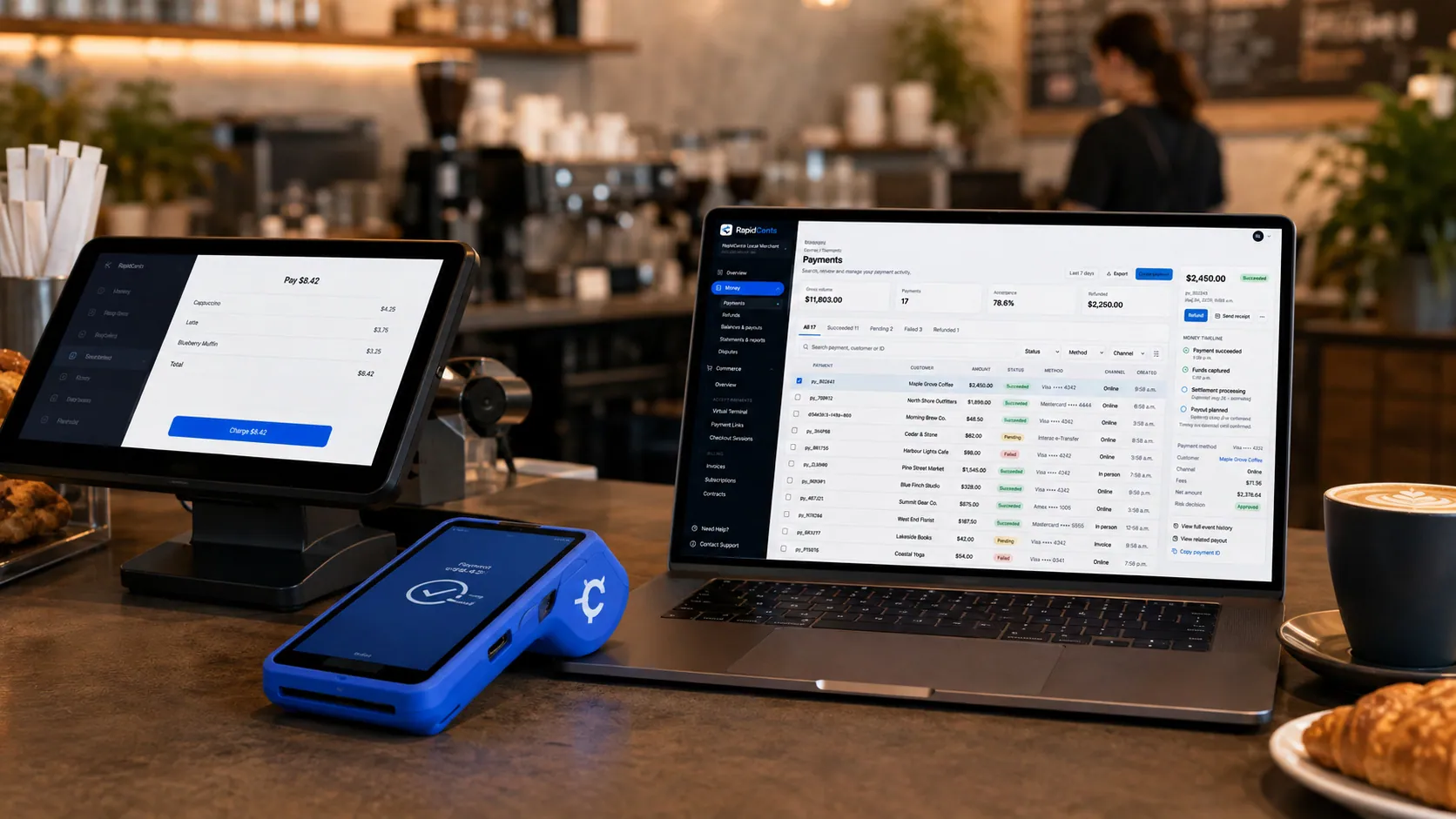
Payments taken inside existing business software through RapidCents, with the terminal and dashboard in the same workspace. Integrated Payments
RapidCents integrated payments connect certified POS and ERP systems so sale amounts, tips, refunds and…
Explore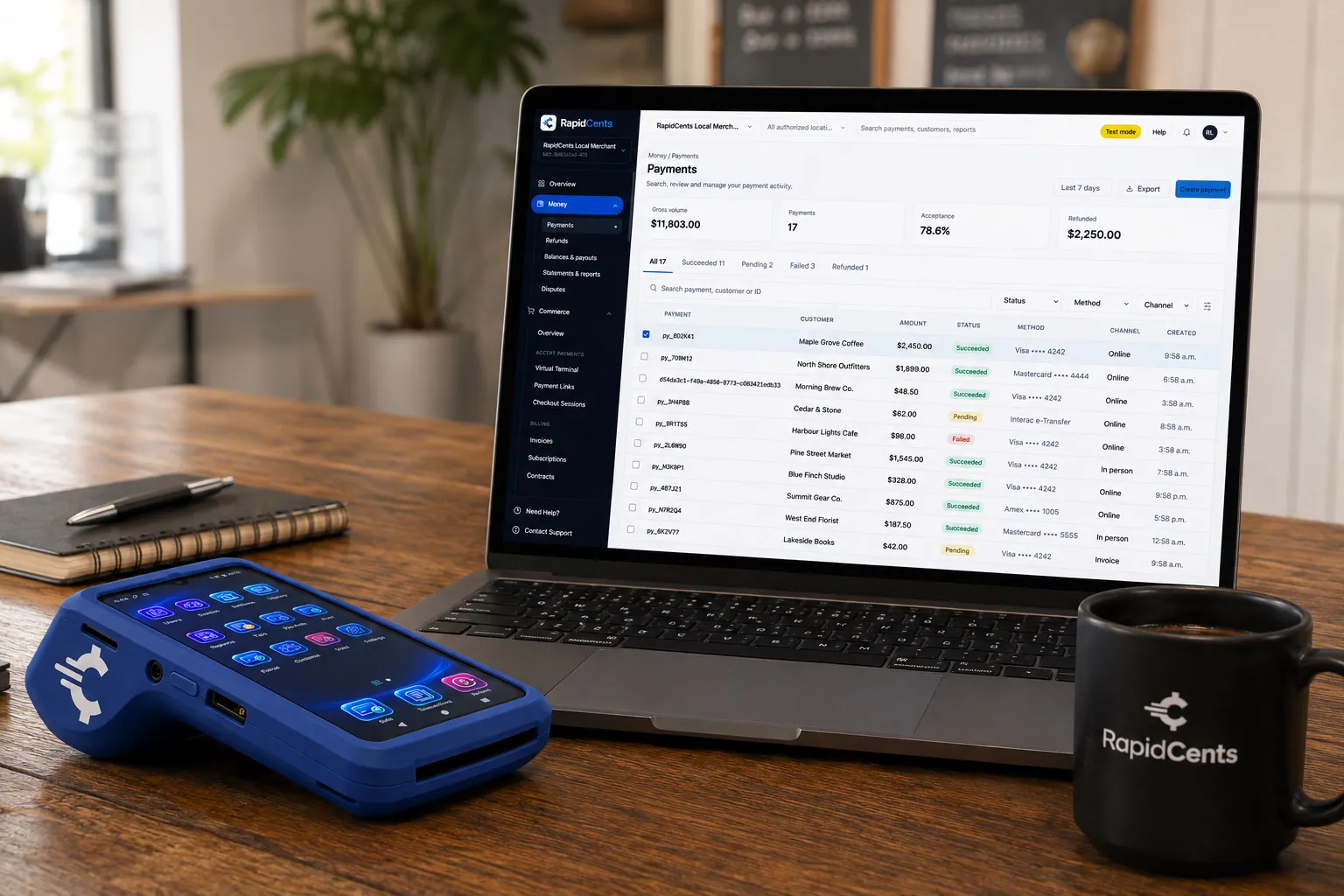
A payment-gateway integration desk: API response on screen, RapidCents terminal ready for a test sale. Payment Gateway
The RapidCents payment gateway exposes REST endpoints for authorize, capture, void, refund and tokenize…
Explore
Card fields hosted by RapidCents sit inside a merchant checkout, with a terminal and the payments dashboard beside them. Embedded Payments
RapidCents embedded payments provide drop-in UI components, card fields, wallet buttons and payment status…
Explore


Implementation approach
Path selection
A short assessment of software, version and requirement, producing one of four routes with an honest effort estimate for each.
Build or configure
Connector configuration, RapidBridge setup, or an API build against the sandbox with test credentials.
Certification and pilot
Test cases completed for the flows you will run, then one lane or one site live before the rest.
Reconciliation check
Finance validates a full settlement cycle against the ledger before the pilot is extended.
What does not change
The software you run
Integration connects to it. Staff keep the interface they know, and the system of record stays where it is.
Your team’s ownership of your code
A connector or RapidBridge does not put RapidCents inside your application. Your developers keep control of what they wrote.
Card data handling
Whichever path you take, the card is captured on a RapidCents surface and returned as a token. The integration moves references, not credentials.
Frequently asked questions
How do I know which of the four paths applies?
A certified connector if one exists for your version. RapidBridge if the software is in place and no connector covers it. A semi-integrated terminal if the register only needs the amount to reach the device. An API build if you own the software and need control over the flow. Version, not product name, decides the first.
What does RapidBridge actually do?
It connects RapidCents to software already running, without rebuilding that software. It exists for the common case where a system is in place, is working, and has no certified connector.
Is a semi-integrated terminal a real integration?
It solves the specific problem of the total being typed twice, and it keeps card data on the terminal rather than in the register. It does not give you item-level reporting, which is the trade you are making.
What is APPIE?
The interoperability layer that lets existing point-of-sale software drive RapidCents hardware, so a point of sale can control the terminal without a bespoke device integration.
How much of the work is the refund?
More than teams expect. Refunds, partial captures, voids and the settlement posting typically outweigh the sale path, and they are exactly the flows certification test cases exist to cover.
Can we start on one path and move to another?
Yes, and it is a reasonable sequence: a semi-integrated lane or a connector gets you trading, and an API build follows when the reporting or the workflow justifies it. Moving between paths is easier than moving the credential store, which is the part worth deciding early.
Does RapidCents end up inside our codebase?
No. A certified connector or RapidBridge sits between the two systems, and your developers keep control of what they wrote. On an API build the integration is code your team owns, calling REST endpoints over HTTPS, and the system of record stays where it is.
Does the integration ever handle card numbers?
No, on any of the four paths. The card is captured on a RapidCents surface — a terminal, hosted fields or a hosted page — and returned as a token. What moves between the systems is a reference, not a credential, which is what keeps the software out of the card data path.
Take the next step
Talk to a RapidCents specialist
RapidCents Fee Check reads a processing statement and shows interchange separately from the markup. Upload a statement for an instant breakdown, or open a merchant account and start accepting payments on one account.
- No obligation
- Canadian payment specialists
- Secure statement upload



