Keep fraud, disputes and expired cards from quietly interrupting revenue
Revenue leaks in three separate places: an order that should not have been accepted, a dispute answered after the network deadline, and a renewal declined on a card the customer already replaced. Each needs its own mechanism. RapidCents screens by amount, geography, method and velocity with ambiguous cases held for a human decision, alerts on disputes while there is still time to respond with evidence assembled, and applies 3-D Secure by rule alongside Account Updater on stored cards.
- Canadian specialists
- Interchange-plus available
- Guided migration
- Post-launch support
Who this solution is for
Card-not-present sellers
Online sales carry the fraud liability by default, which is what makes screening and authentication worth configuring properly.
Subscription businesses
Where recognition disputes and failed renewals are the two recurring losses.
Operators with rising dispute volume
Where the question is which disputes are worth contesting, not whether to contest at all.
Common challenges
Rules set too tight
Aggressive screening refuses good customers, and those refusals stay invisible unless false positives are reported.
Deadlines that pass quietly
A dispute has a network-set response window. Missing it loses a case the evidence would have won.
Expired cards counted as churn
An expired card and a cancelled customer look identical in a revenue report, and only one of the two is recoverable — RapidCents separates them.
The RapidCents approach
Screen before settlement: rules by amount, geography, method and pattern, with velocity checks on repeated attempts.
Hold the ambiguous cases in a review queue for a human decision rather than declining them outright.
Apply 3-D Secure by rule, where the liability shift is worth the extra step, instead of to every sale.
Work disputes as a queue with deadline tracking, and let win rate by reason code decide what is worth contesting.
Close the renewal leak with Account Updater and a retry schedule, so recoverable revenue is actually recovered.
Recommended capabilities
Risk rules and velocity checks
Thresholds by amount, geography, method and pattern, plus repeated-attempt detection on the same card, device or address.
Address and CVV verification
Required where the risk justifies it rather than applied to every transaction.
Review queue and outcome reporting
Flagged transactions held for a person, with reporting that shows both what was caught and what was refused in error.
Dispute alerts and evidence packs
Notification while there is still time to respond, with transaction, authorization and available delivery detail assembled into the response.
3-D Secure and Account Updater
Issuer authentication with liability shift where network rules apply, and stored cards refreshed so renewals do not fail on an expiry date.
Related products
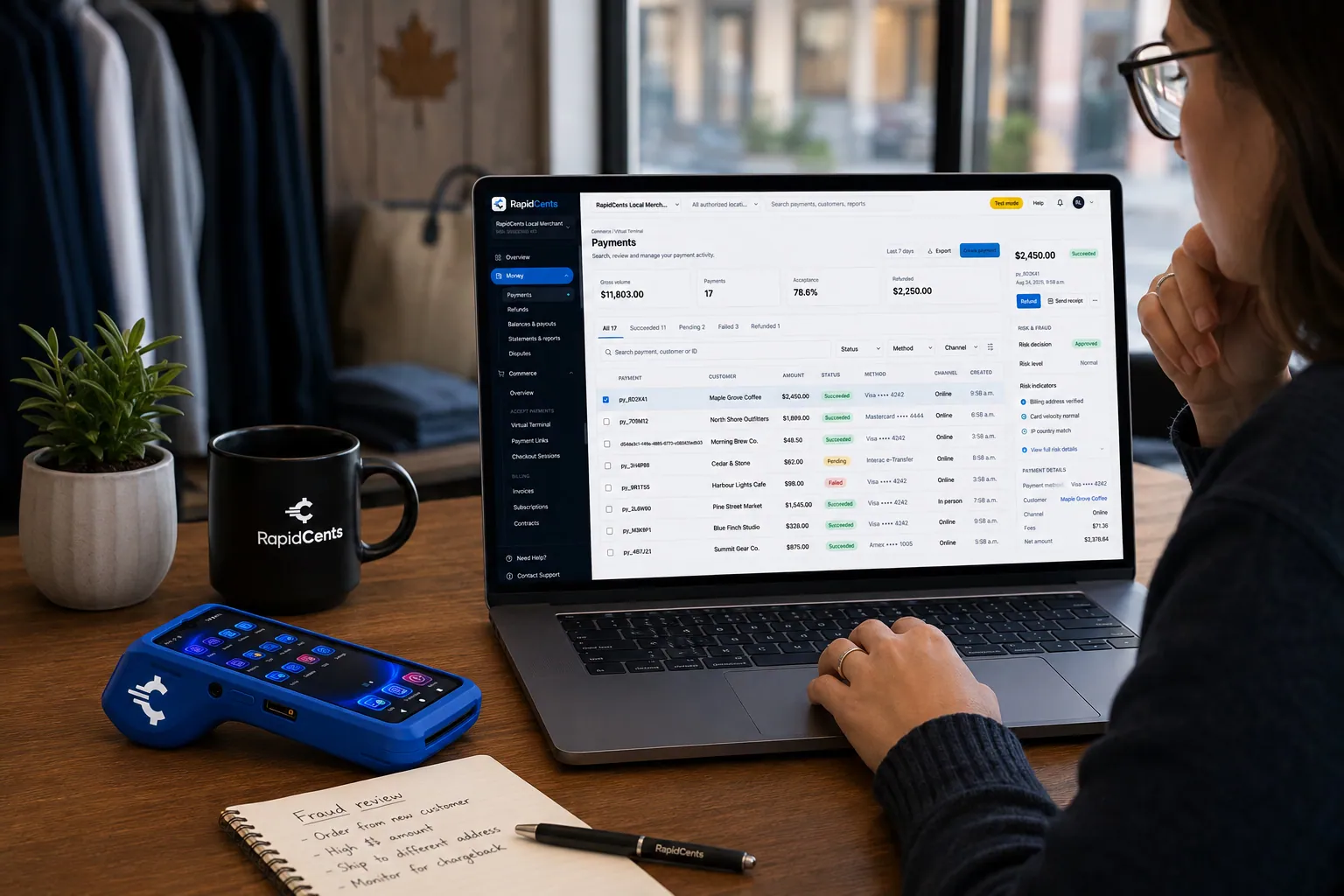
A RapidCents risk screen flags an unusual payment for review, with the capturing terminal still on the desk. Fraud Prevention
Rules, velocity checks and verification screen transactions before they settle.
Explore
RapidCents assembles chargeback evidence from the original sale, with the terminal and receipts still at hand. Chargeback Protection
Disputes arrive with a deadline. Alerts, assembled evidence and tracked outcomes turn a scramble into a…
Explore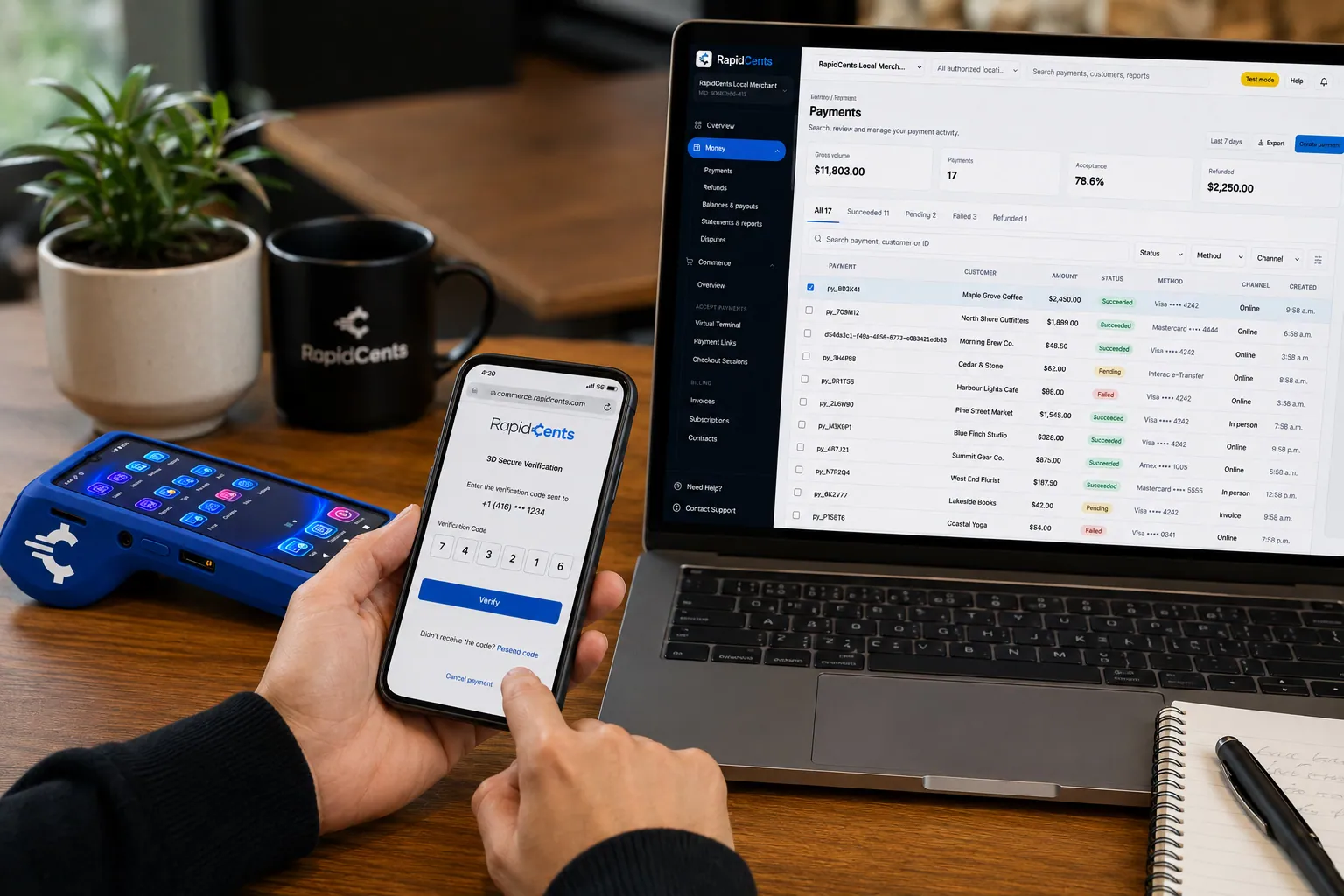
A cardholder completes 3-D Secure on RapidCents checkout, so the issuer can authenticate the online payment. 3D Secure
3-D Secure asks the issuer to verify the cardholder and, where it applies, shifts liability for fraudulent…
Explore


Implementation approach
Baseline the losses
Establish where revenue is actually going: refused good orders, lost disputes, or failed renewals. The three call for different work.
Configure rules conservatively
Start looser than feels comfortable and tighten using the false-positive reporting, because an over-tight rule set is expensive and silent.
Set up the dispute process
Decide who responds, on what cadence, and what evidence they can reach without asking someone else for it.
Review by outcome
Win rate by reason code and false-positive rate are the two numbers that say whether the configuration is right.
What does not change
Your acceptance policy
Screening decides which transactions get held, not which cards you take. What you accept remains your decision.
The dispute rules themselves
Deadlines, reason codes and outcomes are set by the card networks. Tooling makes them visible and answerable; it does not change them.
Your refund and service policy
Good policy prevents more disputes than any rule set. A recognizable descriptor, clear terms and responsive service remain the cheapest protection available.
Frequently asked questions
Can every dispute be won?
No. Some reason codes are rarely winnable, which is exactly why outcome reporting by reason code matters: it tells you where a response is worth assembling and where it is not.
Will fraud screening turn away real customers?
It will if the rules are set too tightly, and that cost stays invisible without reporting. The false-positive view is what turns threshold-setting into a decision instead of a guess.
Does 3-D Secure replace fraud screening?
No. Authentication shifts liability for fraudulent chargebacks where its rules apply. Screening stops transactions you did not want at all, including ones an authenticated card could still complete.
How much time is there to respond to a dispute?
The window is set by the card networks and varies by reason code. Alerts and deadline tracking exist because the window is short and the notification is easy to miss.
What descriptor should appear on a customer statement?
One the customer will recognize: the trading name they bought from, not a legal entity name they have never seen. An unrecognized descriptor generates disputes that have nothing to do with fraud.
How much of this can be turned on at once?
Screening and dispute alerts can be immediate. Authentication rules and retry policy are better tuned over a few cycles, because both carry a conversion or customer-experience cost that only appears in the outcome reports.
How do we tell a failed renewal from a customer who left?
By reporting on the reason. In a revenue report an expired card and a cancellation look identical, and only one of the two is recoverable. Retry history and Account Updater outcomes separate them, so the recoverable group gets a retry schedule instead of being counted as churn.
What happens to a transaction the rules flag but do not decline?
It goes to a review queue and waits for a person. Holding the ambiguous cases rather than declining them is what keeps a tight rule set from quietly refusing good customers, and the outcome reporting then shows both what was caught and what was refused in error.
Take the next step
Talk to a RapidCents specialist
RapidCents Fee Check reads a processing statement and shows interchange separately from the markup. Upload a statement for an instant breakdown, or open a merchant account and start accepting payments on one account.
- No obligation
- Canadian payment specialists
- Secure statement upload