DEVELOPER PLATFORM
Testing
The RapidCents sandbox exposes documented test cards that force specific outcomes: approval, generic decline, insufficient funds, expired card, a 3-D Secure frictionless pass, a 3-D Secure challenge and a fraud block. Because the outcome follows from the card number rather than an issuer decision, a test that asserts on a specific result stays green for the right reason. The endpoints, request bodies and response shapes are the production ones, so every branch of error and webhook handling can be walked before real money is involved.
- Sandbox with documented test cards
- Signed webhooks
- Typed errors and idempotent retries
- Dedicated developer support

What crosses the wire
Where it sits
In the same place your production payment call sits. You change the credential and the card number; the endpoints, the request bodies and the response shapes do not change, which is what makes the exercise transferable.
What you send
A normal payment request carrying a documented test card. The reference lists each card, the brand it emulates and the outcome it produces, including which ones require an authentication step to complete.
What comes back
The same response your integration will see on production, followed by the same lifecycle events. Assert on the state and the typed code, not on the HTTP status alone.
When to use it
Before go-live
Every decline path, the 3-D Secure challenge and at least one refund should be walked once, deliberately, rather than discovered by a customer.
In CI
Sandbox runs make payment logic regression-testable rather than manually verified, and they catch the change that quietly stopped handling a code.
After any dependency upgrade
An SDK bump, a framework change or new middleware can break webhook signature verification without touching a line of your own payment code.
How to implement Testing
Run the approval card to confirm the happy path end to end.
Force each decline code and assert your handling branched correctly.
Trigger a 3-D Secure challenge and complete the authentication flow.
Refund a captured payment and confirm the refund event updates your record.
Simulate settlement events and reconcile the resulting records against your ledger.
What fails, and how you find out
Only the happy path is covered
An integration that has never seen a decline will ship one. The approval card proves connectivity; the decline cards prove the application actually handles the outcome your customers will hit most often.
Tests that assert on message text
Message wording is not part of the contract and will change. A test pinned to it fails on a copy edit and passes on a genuine regression, which is the worst of both.
Webhook handling never exercised
If tests only call the API and read the response, the handler that fulfils orders is untested. Drive at least one test through the event, including a deliberate redelivery.
Sandbox timings copied into production assumptions
Settlement in sandbox is compressed. Code that assumes a funded event follows a capture within minutes will sit idle on production, where it follows your funding schedule.
Sandbox versus production
The outcome is deterministic
No issuer is contacted. A card that declines for insufficient funds does so on every attempt, at any hour, which is the property that makes payment logic safe to assert on in CI.
Authentication is simulated, not skipped
The 3-D Secure step still runs; what changes is that a test card decides whether it passes without friction or presents a challenge, so both branches are reachable on demand.
Nothing settles for real
Sandbox deposits, fees and batch records exist so reconciliation code can be written against them, but they are illustrative. Your actual rate and funding schedule come from your account, not from a sandbox response.
Questions about Testing
Can I test 3-D Secure in the RapidCents sandbox?
Yes. Dedicated test cards force a frictionless pass and a challenge flow so both authentication outcomes can be exercised.
Does sandbox settlement behave like production?
Settlement events are simulated on an accelerated schedule so reconciliation logic can be tested without waiting days for a real deposit.
Do sandbox transactions cost anything?
No. Sandbox processing is free during evaluation and development.
Can I run sandbox tests in continuous integration?
Yes, and that is the point of deterministic cards. Give CI its own sandbox credentials, keep them in the same secret manager as everything else, and treat a failing payment test as a blocking failure.
How do I test a webhook without a public endpoint in CI?
Two layers. Verify the signature function directly against a captured raw payload as a unit test, then run the delivery path against a tunnel or a deployed preview environment for the integration test.
What cannot be tested in the sandbox?
Anything that depends on a real issuer or a real bank: genuine authorization behaviour, actual funding timing, and the outcome of a real dispute. Those are rehearsed on production with small amounts during a controlled cutover.
Should I test with the SDK or with raw HTTP?
Whichever your application uses in production. Testing through a layer you do not ship proves the wrong thing, and SDK retry helpers are exactly the behaviour worth having under test.
How do I test a refund without a real payment?
Capture a sandbox payment with the approval card, then refund it and assert that the refund event updates your own record. The refund path is where a plugin, a platform and custom code most often disagree, and it is the one most rarely exercised before go-live.
Why did a payment test that passed for months fail after a dependency upgrade?
Usually webhook signature verification. New middleware, an SDK bump or a framework change can parse the request body before the raw bytes are read, and nothing in your own payment code has to change for every valid event to start being rejected as forged.
Continue the integration
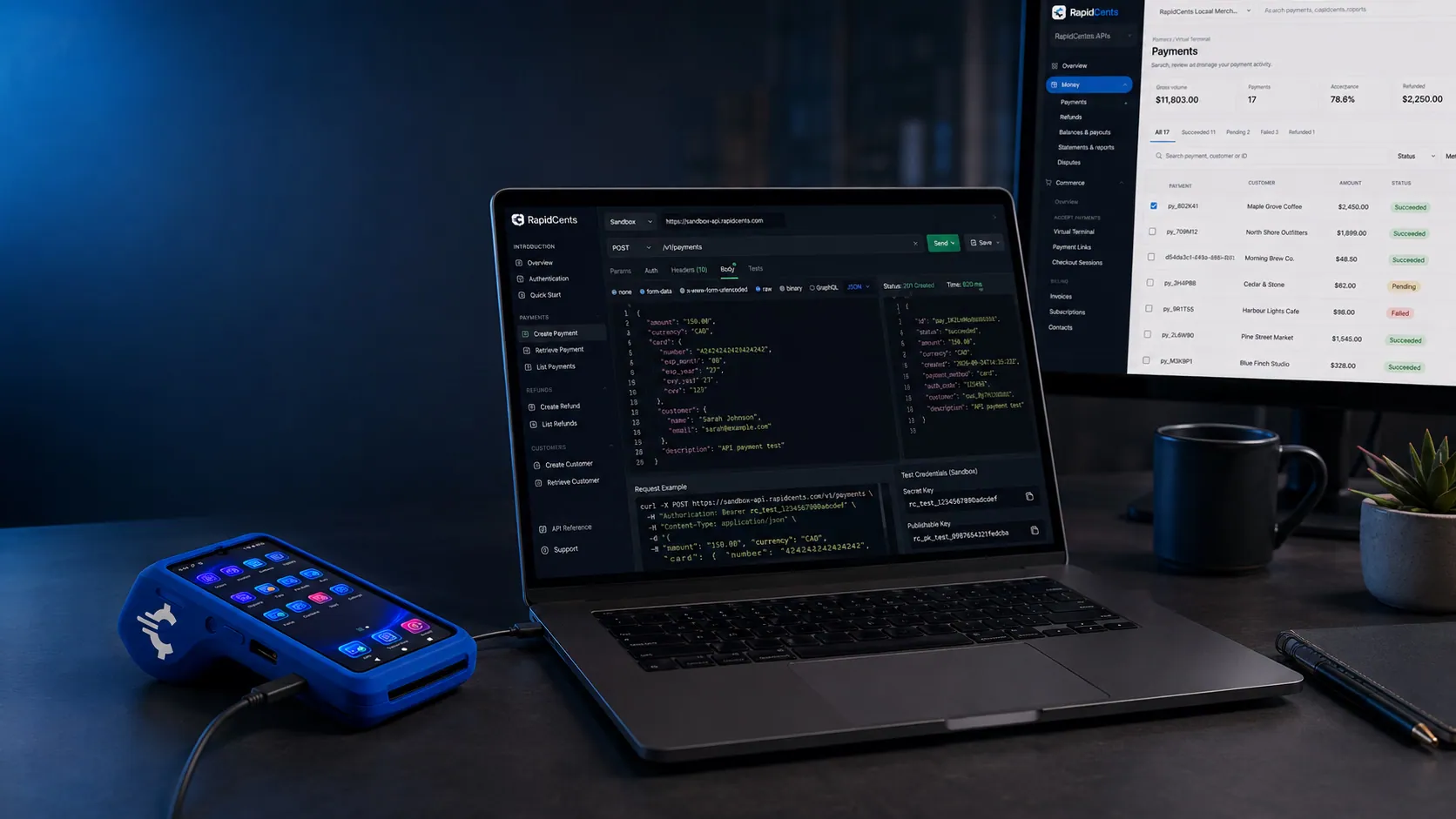
A RapidCents sandbox merchant account running test payments, isolated from production, with a sandbox terminal on the desk. Sandbox
Request sandbox access with test merchant IDs and isolated environment.
ExploreA typed RapidCents API error on screen, next to the declined sandbox terminal sale that produced it. Errors
Typed error codes, retry guidance and idempotency patterns for production reliability.
ExploreThe RapidCents quickstart path: create a test payment, see the response, and confirm it on a sandbox terminal. Quickstart
Get sandbox credentials, create a test payment, receive a webhook and prepare for production in…
Explore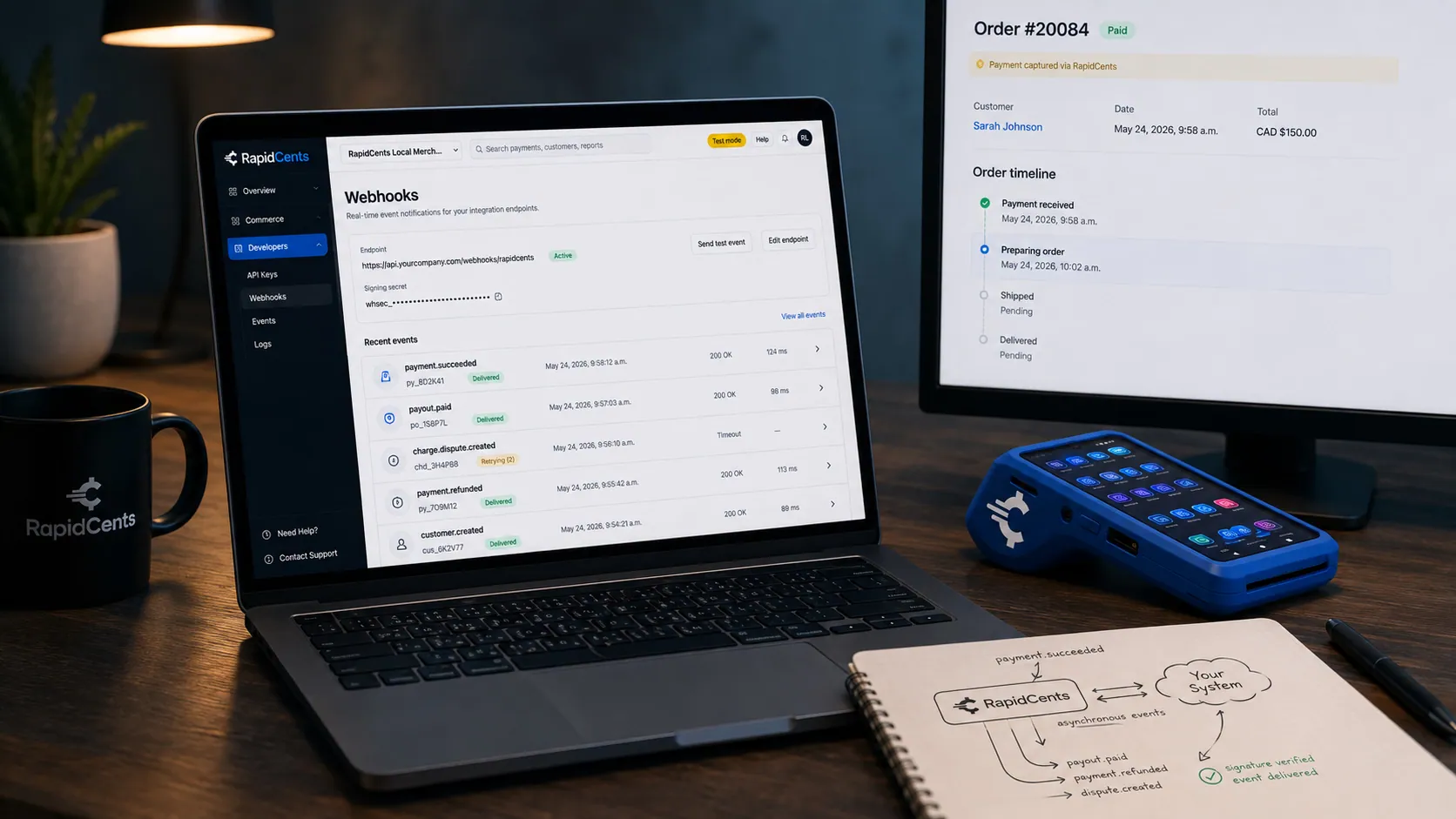
A RapidCents webhook delivery timeline next to the payment that triggered it, with a test terminal on the desk. Webhooks
Signed webhook events for payment lifecycle with idempotent processing guidance.
Explore

Take the next step
Talk to a RapidCents specialist
RapidCents Fee Check reads a processing statement and shows interchange separately from the markup. Upload a statement for an instant breakdown, or open a merchant account and start accepting payments on one account.
- No obligation
- Canadian payment specialists
- Secure statement upload