DEVELOPER PLATFORM
SDKs
Official RapidCents SDKs wrap the REST API with typed models, automatic retries carrying idempotency keys and helpers for webhook signature verification, in Node.js, Python, PHP and mobile. They exist so the two mistakes that cost the most, an unverified webhook and an unsafe retry, are hard to make by accident. Nothing in an SDK is privileged: each one calls the same endpoints an HTTP client would, so it is a set of guardrails rather than a requirement or a faster path.
- Sandbox with documented test cards
- Signed webhooks
- Typed errors and idempotent retries
- Dedicated developer support

What crosses the wire
Where it sits
Between your application and the REST interface. It builds the request, attaches the credential and the API version, applies the retry policy and turns the response into a typed object your compiler can check.
What you configure
An environment-scoped secret key, the API version to pin, and a timeout. Everything else has a documented default. The reference for your language lists the constructor options and the exact method names.
What it hands back
A typed model of the resource on success, and a typed error carrying the same code the raw API would have returned on failure. Your handling logic is the same either way; the SDK only saves you the parsing.
When to use it
Server-side integration
Typed models catch schema mistakes at compile time rather than in production, which matters most on the request bodies you write once and never look at again.
Mobile acceptance
Mobile SDKs handle card entry and tokenization without card data touching your app code, which is what keeps a mobile build out of PCI scope.
Teams without a payments specialist
The retry helper and the signature helper encode decisions that are easy to get subtly wrong and expensive to get wrong quietly.
How to implement SDKs
Install the SDK for your language and pin the version explicitly.
Configure it with an environment-scoped secret key loaded from a secret manager.
Pin the API version in the client rather than relying on an account default.
Use the built-in retry helper rather than writing your own.
Verify webhooks with the provided helper, not a hand-rolled HMAC.
What fails, and how you find out
Floating the SDK version
An unpinned dependency can move the API version it targets, which changes response shapes without any change on your side. Pin the package and pin the API version separately.
Wrapping the retry helper in another retry
An outer retry layer that does not carry the idempotency key turns one safe retry into two independent charges. Pick one layer to own retries, and let the other pass failures through.
Parsing the body before the signature helper sees it
The helper needs the raw bytes. A framework that has already deserialized the request will make every verification fail, and the SDK cannot tell you that from inside.
A typed error caught as a generic exception
Catching broadly and logging the message discards the code the rest of your handling depends on. Catch the typed error, branch on the code, then log.
Sandbox versus production
One client, two configurations
The same SDK talks to both environments; only the credential differs. Building the client from configuration rather than hard-coding it is what makes the cutover a deployment change instead of a code change.
Retry behaviour is observable
Provoking a retryable failure in sandbox is the only practical way to see the helper actually retry, and to confirm your logs record one logical operation rather than several.
Mobile SDKs need the sandbox publishable key
A mobile build pointed at sandbox tokenizes documented test cards. Shipping a build still configured that way produces tokens production cannot charge, so the key belongs in build configuration.
Questions about SDKs
Which languages have official RapidCents SDKs?
Node.js, Python and PHP for server integrations, plus mobile SDKs for card entry and tokenization on iOS and Android.
Do I have to use an SDK?
No. The API is plain REST and can be called directly. SDKs mainly save you from re-implementing retries and signature verification.
How are SDK versions tied to API versions?
Each SDK release documents the API version it targets, and the changelog records breaking changes on both sides.
Is an SDK call faster than calling the API directly?
No. It issues the same HTTPS request to the same endpoint. What it changes is how much of the retry, serialization and verification logic you have to own and keep correct.
What if my language has no official SDK?
Call the REST interface directly. The two pieces worth porting carefully are idempotent retries and constant-time signature verification over the raw body; everything else is ordinary HTTP and JSON.
Should the SDK live in my checkout code or behind a service?
Behind a boundary you control, if payments are called from more than one place. One module that owns the client, the retry policy and the error mapping keeps those decisions from drifting between callers.
How do I upgrade an SDK without risking live payments?
Read the changelog for the API version the new release targets, run your sandbox suite against it including the decline and webhook paths, then deploy behind whatever gradual rollout you already use.
What do I configure on an SDK client beyond the key?
The API version to pin and a timeout. Everything else has a documented default. Pinning the version in the client rather than relying on an account default is what keeps a package bump from moving your response shapes without a change on your side.
Does the mobile SDK use the same key as my server?
No. A mobile build is initialised with a publishable key and returns a token your server then charges; the secret key never leaves the server. Keep the sandbox and production publishable keys in build configuration so a test build cannot ship pointed at the wrong environment.
Continue the integration
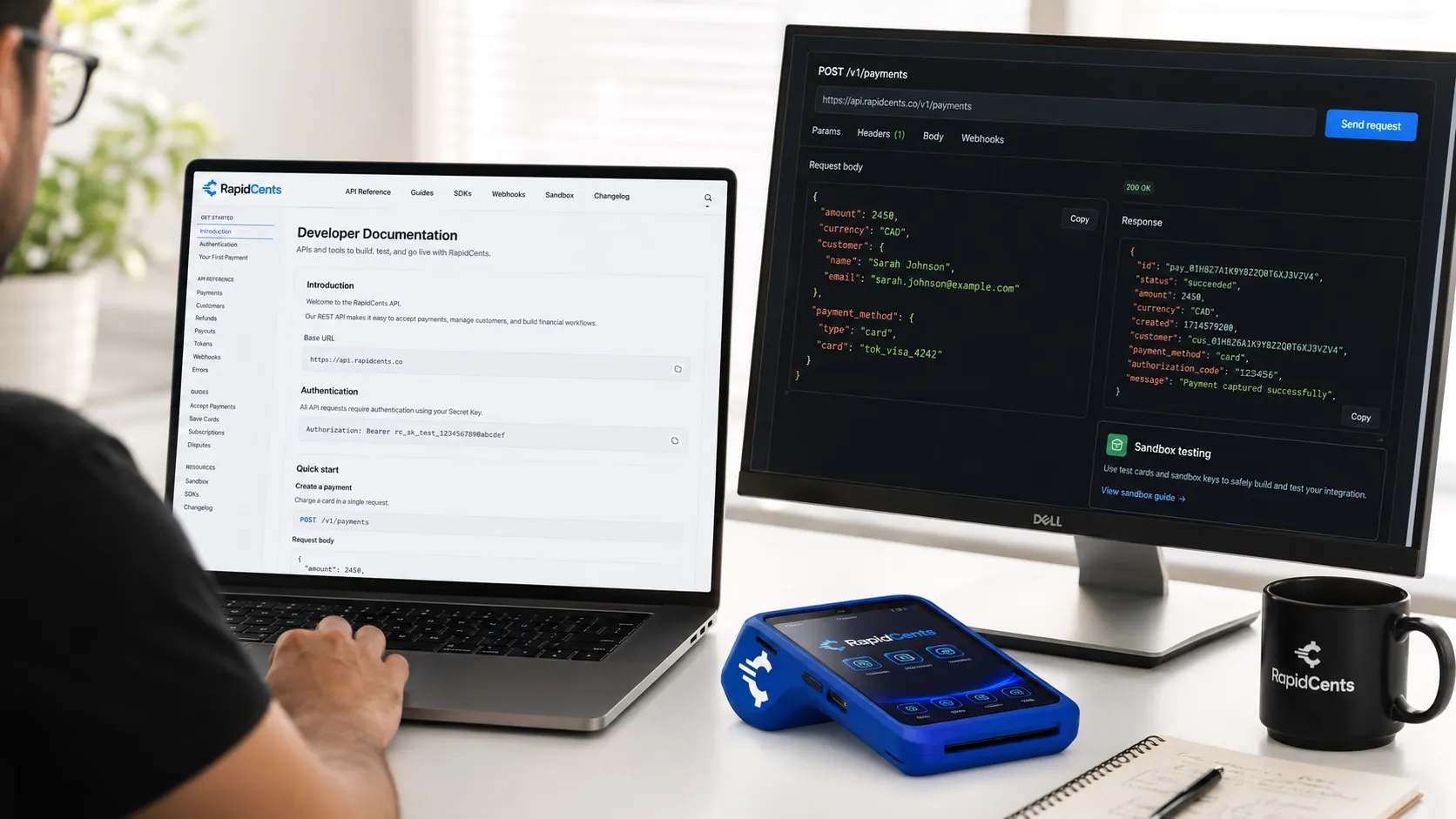
The RapidCents API reference on a workstation, with a sample request, the matching response, and a test terminal. API Reference
REST endpoints for payments, customers, refunds, webhooks and settlements with request and…
ExploreA copy-ready RapidCents payment example next to the sandbox response it produces. Code Samples
Copy-ready examples for payment creation, capture, refund and webhook verification.
Explore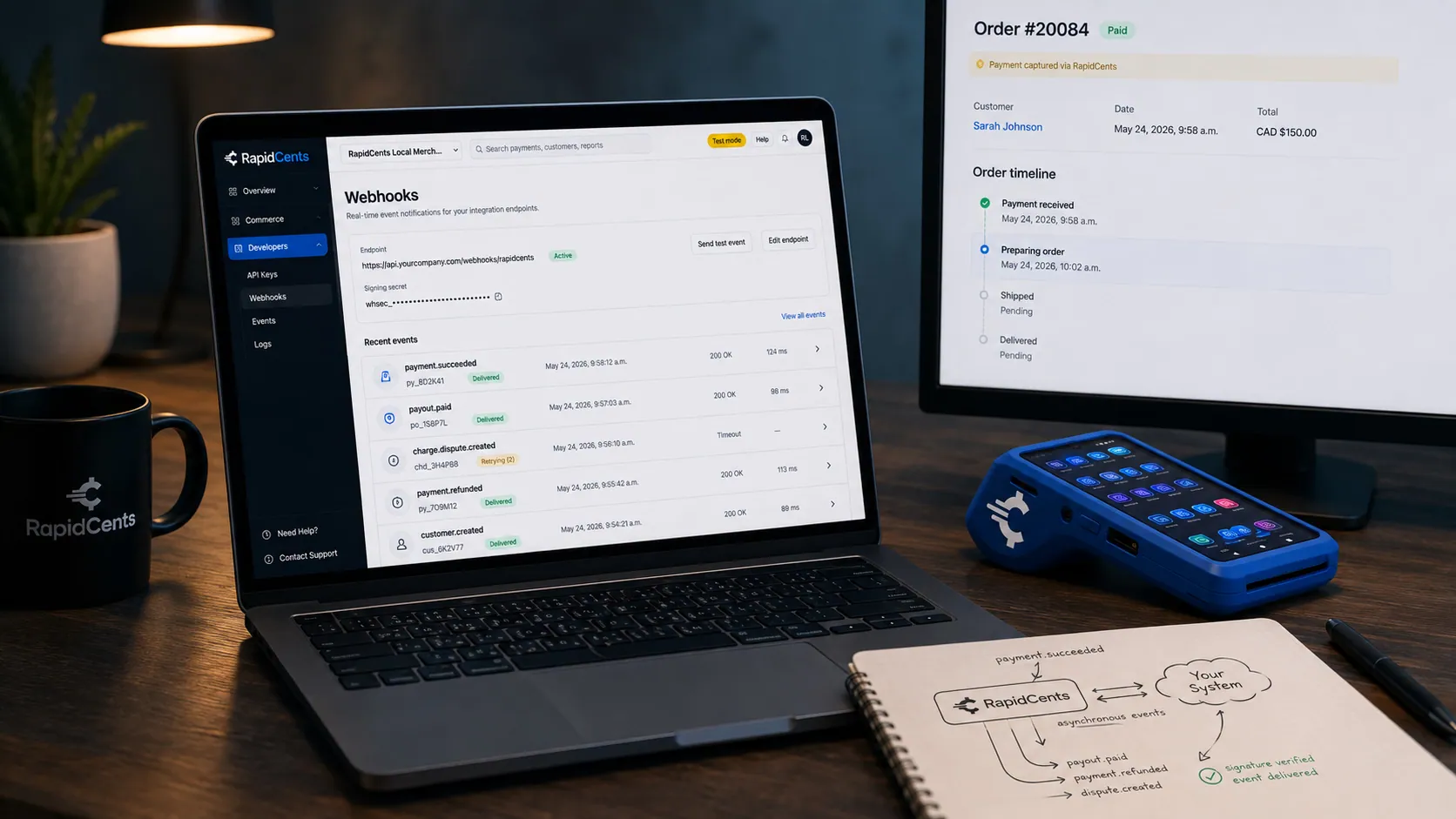
A RapidCents webhook delivery timeline next to the payment that triggered it, with a test terminal on the desk. Webhooks
Signed webhook events for payment lifecycle with idempotent processing guidance.
Explore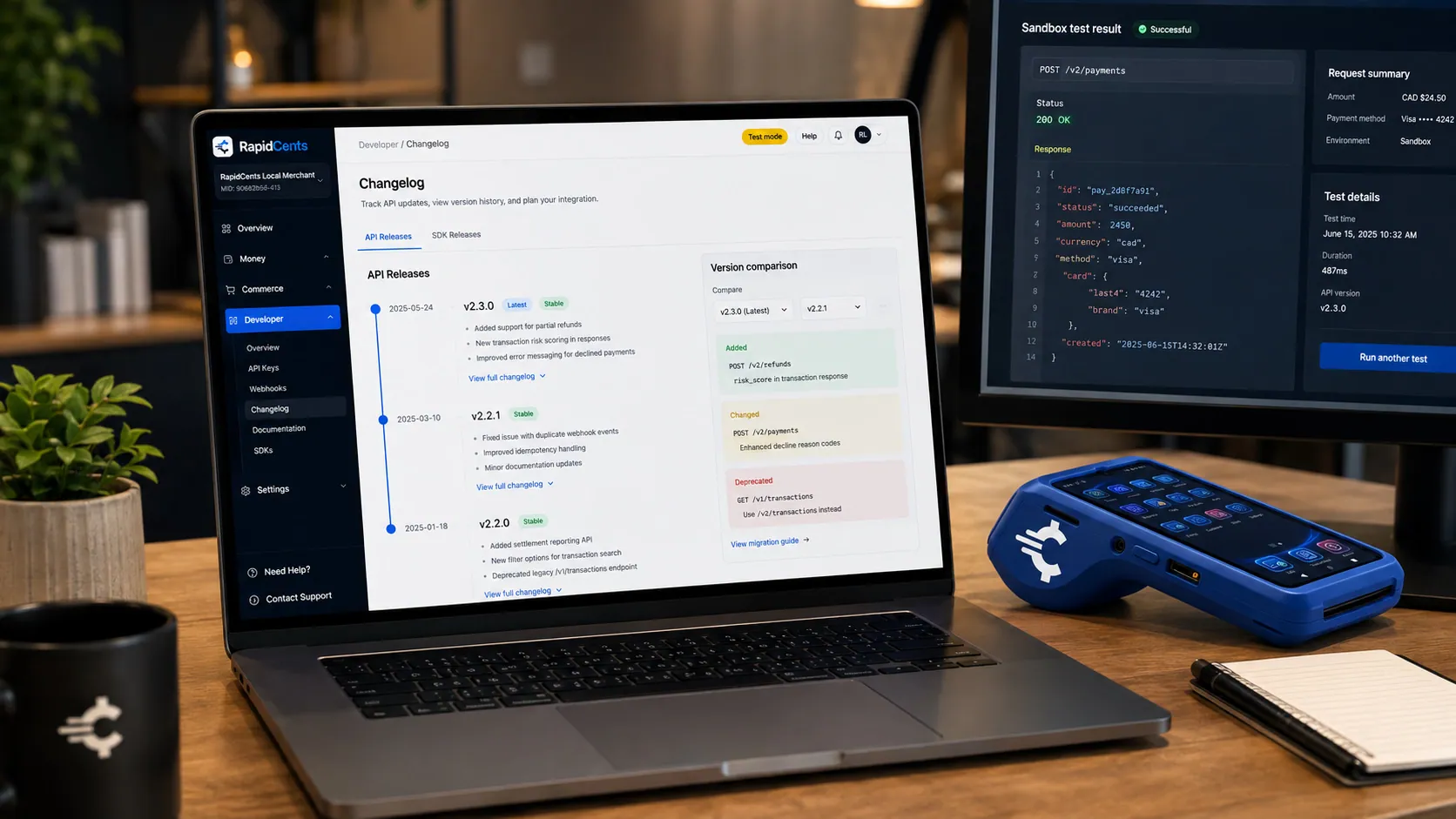
The RapidCents API changelog open beside a sandbox result and a test terminal, showing what changed in the latest release. Changelog
API version history, breaking changes and deprecation notices.
Explore


Take the next step
Talk to a RapidCents specialist
RapidCents Fee Check reads a processing statement and shows interchange separately from the markup. Upload a statement for an instant breakdown, or open a merchant account and start accepting payments on one account.
- No obligation
- Canadian payment specialists
- Secure statement upload