


Payment processing for accounting firms, from monthly retainers to tax season
Payment processing for accounting firms covers three jobs: scheduled monthly engagement fees, tax return invoices paid online, and one-time payments for extra work or by phone. RapidCents handles them with Recurring Payments, Invoicing, Payment Links and the Virtual Terminal, and connects settled payments, fees and refunds to QuickBooks Online and Xero.

- PCI DSS Level 1
- SOC 2 Type II
- All major cards: Visa, Mastercard, Amex, Discover, UnionPay, Diners Club & Interac Debit
- Interchange-plus available
- Canadian support
How accounting firms get paid
Accounting firms get paid through five payment jobs: monthly engagement fees, retainers taken before catch-up or project work, tax return fees in filing season, invoices for work outside the agreed scope, and balances paid by phone. Each job has a different payer and trigger, so accounting practice payment collection works best when each one has its own method and its own reference in your ledger.
Monthly engagement fees
Business clients on bookkeeping, payroll or advisory engagements pay a fixed fee on the same date each month. Recurring Payments charges the card or bank account the client authorized, emails a receipt and retries a failed charge. If a card is reissued, Account Updater refreshes it where the issuer takes part; if a client ends the engagement, you stop the schedule. Finance gets one charge per client per month, tagged to the engagement.
Retainers before catch-up and project work
A new client with months of unreconciled books, or a business ordering year-end or review work, pays a retainer before the work starts. The signed engagement letter triggers it, and the client pays through Contracts & eSignatures or an invoice payment link. If a retainer runs out before the job ends, you send a top-up. Finance gets a retainer payment tied to the engagement letter.
Tax return fees in filing season
Individuals, couples and sole proprietors pay a fee per return, mostly in the weeks before the personal filing deadline, while companies pay when their year-end return is done. The trigger is a return ready for review, and the fee goes out as an invoice with a payment link. If a client wants to pay after filing, your engagement letter sets that out. Finance gets a paid invoice that names each return and its tax year.
Work outside the agreed scope
Existing monthly clients pay separately for requests the engagement does not cover, such as an extra entity, financial statements for a lender or a response to a notice from the tax authority. Your team sends a one-time invoice, or charges the stored card once where the client's authorization allows it. If a client assumed the work was included, the written scope settles it. Finance sees these charges apart from the monthly base.
Balances paid by phone
Some clients would rather phone the office and read out a card number than open a link, including clients who used to mail a paper payment. Staff key the payment in the Virtual Terminal with AVS and CVV checks, and the receipt is emailed automatically. If a card is declined or mistyped, staff simply key it again. Finance gets an audit log entry showing who keyed each payment.
How does accounting firm recurring billing work?
Accounting firm recurring billing works by charging each client's monthly engagement fee to a card or bank account the client has authorized, on the date your engagement letter sets out. Recurring Payments runs the schedule, notifies the client before each charge, emails the receipt and retries failures, so your team handles exceptions instead of keying every client's payment each month.
From engagement letter to monthly charge
The client's owner or finance contact opens a secure link and enters card or bank details once, and the payment method is stored as a token on the client's customer profile. On the agreed date, Recurring Payments charges the fee, the client receives a receipt, and the payment carries the client and engagement reference your billing software uses.
Get the authorization in writing first
Before the first charge, the client agrees to the amount, the charge date, what the fee covers and how either side ends the arrangement. Put those terms in the engagement letter or a separate authorization the client signs, and keep it with the client file. A stored card may only be charged within what the client agreed; a new amount needs new agreement.
When a monthly charge fails
Cards expire, get reissued or hit a limit. Account Updater refreshes reissued cards where the issuer takes part, Recurring Payments retries the charge automatically, and the client can be sent a secure link to enter a new card. Decide in advance how long work continues on an unpaid engagement, and write that into the letter instead of deciding client by client.
Fee changes at renewal or mid-year
When you raise fees at the annual renewal, or a client adds payroll for new staff mid-year, get written agreement to the new amount and its start date before you edit the schedule. Proration can charge the difference for a part month. Keep the old and new terms in the client file, because a dispute over a higher charge turns on what the client agreed to.
Sixty clients charged on the first business day
Say a four-person firm with 60 bookkeeping and payroll clients charges every engagement on the first business day of the month. Fifty-seven charges approve. One card was reissued, so Account Updater refreshes it and the retry goes through. The other two clients receive a link to enter a new card, and the billing manager follows up two exceptions instead of keying 60 payments.
Bookkeeping retainer payment processing for catch-up and project work
Bookkeeping retainer payment processing works best when the client pays the retainer as they sign the engagement letter, before you open their books. Contracts & eSignatures sends the letter, records the signature and takes the payment in one step, or you can send an invoice with a payment link. Your billing software then applies the retainer to later invoices. A retainer billed every month runs on a recurring schedule instead.
Letter, signature and payment in one visit
The client opens the engagement letter from an email or link, signs it electronically and pays the retainer before closing the page. Contracts & eSignatures records the signer and timestamp and keeps the signed letter beside the payment reference, so the file shows what was agreed and what was paid without anyone matching two systems by hand.
Decide how the retainer is applied
Set out in the letter whether the retainer covers the first invoices, is held against the final invoice, or is topped up as work continues. The RapidCents record shows the amount, date and engagement. Applying the retainer to invoices happens in your billing or accounting software. How an advance is held and recorded follows your accounting policy and your professional body's rules, not a processor setting.
Partial payments, top-ups and refunds
An invoice can take a partial payment when a client splits a large retainer, and Invoicing shows it as partly paid until the balance clears. When a retainer runs low, send a top-up payment link before more hours go in. If the engagement ends early, refund the unused part to the original card from the dashboard; the refund then appears on your settlement report.
If a client disputes the retainer
A client who forgets they agreed to a retainer can dispute the charge with their card issuer. Disputes and Chargeback Protection alerts you, shows the response deadline and lets you submit evidence. Keep the timestamped engagement letter, the receipt and a record of the work you started ready to send.
A renovation contractor's catch-up books, then a monthly schedule
Say a renovation contractor arrives with 14 months of unreconciled books and an overdue filing. You send the engagement letter with a retainer covering the first month of catch-up work, and the owner signs and pays before the end of the day, agreeing to save the card for future fees. When the catch-up ends and the owner authorizes a monthly fee, that saved card moves onto a recurring schedule.
RapidCents products for accounting firms
Recurring Payments charges monthly engagements on the agreed date, Invoicing and Payment Links collect tax-season and project fees, and the Virtual Terminal takes a card when a client phones the office. All four report into one dashboard, so finance reconciles from one set of reports.

The RapidCents invoices screen: outstanding, overdue, paid and draft totals across the top, the invoice list below them, and a preview of one invoice on the right with its line items and a View & Record Payment button. Invoicing
RapidCents invoicing helps professional services, contractors and B2B suppliers create branded invoices…
Explore
The RapidCents payment links screen listing created links with their amount, status, click count and whether they have been paid, beside a phone showing the branded page a customer opens to pay $2,500.00. Payment Links
RapidCents payment links let staff generate branded pay-by-link URLs for invoices, deposits, balances and…
Explore
The RapidCents recurring payments screen showing active subscriptions, monthly recurring revenue, failed payments and upcoming renewals, above a list of subscriptions with their plan, amount, frequency and next billing date. Recurring Payments
RapidCents recurring payments manage subscription plans, membership renewals and installment schedules with…
Explore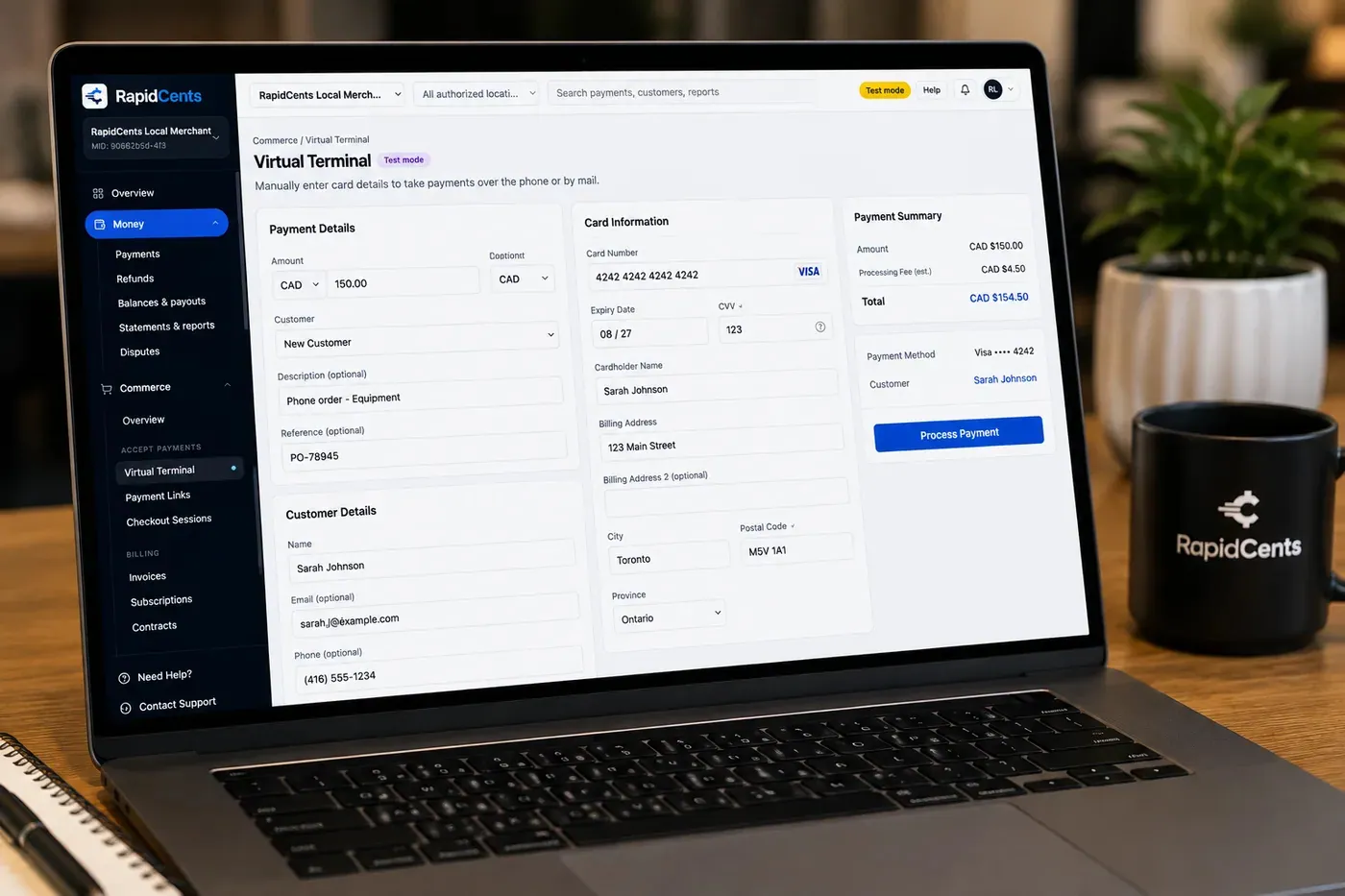
The RapidCents virtual terminal: payment details, card number, expiry and CVV keyed by hand on the left, with a payment summary on the right showing the amount, the estimated processing fee and a Process Payment button. Virtual Terminal
The RapidCents virtual terminal lets authorized staff enter mail-order and telephone-order payments through a…
Explore


How do clients pay an accounting firm's invoices online?
Clients pay an accounting firm's invoices online by opening the RapidCents payment link on each invoice, sent by email or text message, and paying on a mobile-friendly page. Tax return, year-end, financial statement and advisory invoices all work the same way. Send a tax invoice when the return is ready for review, so the fee comes back with the signed authorization to file, and Invoicing shows which invoices are still open.
Tax preparation payment links, sent with the review copy
When a return is ready, the invoice goes out with the review copy and the e-file authorization. The client pays from the link in the email or text message, or by scanning a QR code, and receives a receipt automatically. The invoice changes to paid in Invoicing, and your team files the return under the payment policy your engagement letter sets out.
One client, several entities
The same owner may need a personal return, a company year-end and payroll billed separately. Give each entity its own invoice and a reference agreed before filing season, such as client number, entity, tax year and service. A payment from the company card then lands on the company invoice, not the owner's personal return. Decide too whether a household gets one invoice for several returns or one per return, and keep the format all season.
Unpaid, partly paid and disputed invoices
Invoicing can send reminders before and after the due date, so nobody has to chase each invoice by hand, and a client who pays part of a fee leaves the rest as an open balance. Payment links can carry an expiry date. If a client disputes a fee with their card issuer, send the signed engagement letter and proof that the work was delivered, not the client's tax documents.
Walk-in clients and phone payments
A client who drops off documents at the office can pay on a RapidCents payment terminal or on a supported phone with Tap to Pay. When a client phones instead, staff key the card into the Virtual Terminal, where role permissions decide who can take payments or issue refunds during the busiest weeks of the year.
Two personal returns and a company, invoiced together
Say a couple needs two personal returns, one with rental income, and a return for their small company. The couple gets one invoice with a line for each personal return, and the company gets its own invoice, each with a payment link, sent with the review copies. The couple pays from a phone that evening and the company pays by business card the next day. Each reference names the entity and tax year, so finance matches both without asking anyone.
What drives payment processing fees for accounting firms?
Payment processing fees for accounting firms are driven mainly by which cards your clients use and whether the card is present when it is charged. RapidCents prices on interchange-plus, so you can see the interchange set by the card networks separately from what RapidCents adds, and compare both against your current statement.
Your clients' card mix
Individual tax clients may pay with consumer debit or credit cards, including premium rewards cards, while bookkeeping clients may pay with business or corporate cards. Interchange is set by the card networks and varies by card type, so two firms with the same revenue can pay very different totals. Under interchange-plus, each category passes through at cost rather than inside a bundled price.
How the payment is taken
Interchange also varies with how the card reaches you. A card tapped or inserted at a terminal is a card-present payment; an invoice paid online, a recurring charge on a stored card and a card number read over the phone are card-not-present payments, which often sit in higher interchange categories. A firm that bills by invoice and schedule takes most card payments card-not-present, so those categories shape its statement. If clients could pay monthly fees from a bank account, ask for bank-payment pricing as well.
What sits on top of interchange
On top of interchange, which passes through at cost, you pay your RapidCents markup as set out in your Fee Schedule and fees for equipment or services, if applicable. Compare that layer line by line with other providers' quotes. The agreement is month to month with no fixed term, so there is no term to wait out if the numbers stop working for your firm.
Compare a filing-season month with a quiet one
A processing statement from a filing-season month looks different from a quiet month's: more individual returns, more consumer cards and more payment links, alongside the usual monthly engagement charges. Compare at least one busy month and one quiet month, or the comparison describes only part of your year.
What to bring to a fee comparison
Bring three recent processing statements, including one from filing season, plus your split between recurring, invoice and phone payments, your average invoice amount, and your refund and chargeback counts. Upload a statement to Fee Check to see interchange separated from markup, and ask every provider for a written, itemized quote in the same currency so the numbers line up.
Before you add a card surcharge
If you plan to pass card costs to clients through a surcharge, check the card network rules and the law that applies to your firm and its clients first, and decide whether it covers monthly engagements as well as tax-season invoices. A surcharge changes what clients see on every invoice, so put it in the engagement letter before it appears.
How do payments reach QuickBooks Online, Xero and your practice software?
RapidCents connects settled payments, fees and refunds to QuickBooks Online and Xero, and RapidBridge takes RapidCents payments inside web-based business software without changing it. For practice software such as Karbon, Ignition and Canopy, RapidCents integrates with many major platforms through APPIE and RapidBridge. The right option depends on your software vendor and version, and your RapidCents representative will walk you through it.
QuickBooks Online
If your firm raises client invoices in QuickBooks Online, RapidCents connects settled transactions, fees and refunds to it, and RapidBridge works with QuickBooks Online, so a card payment posts against the invoice you already have open. Intuit also offers its own payment service, QuickBooks Payments, so look at how a RapidCents payment link appears on the invoice or in the email. Your RapidCents representative will walk you through how payments post for your edition.
Xero
Xero shows a pay option on invoices through the payment services connected to it, and its bank reconciliation is where your team matches deposits. RapidCents connects settled transactions, fees and refunds to Xero, and RapidBridge works with Xero too. Your RapidCents representative will walk you through where the payment link sits, on the invoice or in the email, and how fees post.
Karbon
Karbon manages practice work: jobs, deadlines, client requests and team email. If your invoices start in Karbon, or Karbon hands billing to Ignition, RapidCents integrates with many major platforms through APPIE and RapidBridge, and the right option depends on your vendor and version. Your RapidCents representative will walk you through it. If Karbon only tracks the work, your team closes the billing step when RapidCents shows the invoice paid.
Ignition
Ignition turns accepted proposals and engagement letters into billing schedules, including work-in-progress billing, and collects client payments through the payment service connected to it. If you keep Ignition for proposals but collect through RapidCents, decide which system owns the invoice so a client is never billed twice. Tell your RapidCents representative how you run Ignition, and they will show you how the two fit together.
Canopy
Canopy combines a client portal, documents, workflow, and time and billing for tax and accounting firms, and clients can pay invoices through the portal. RapidCents integrates with many major platforms through APPIE and RapidBridge, and the right option depends on your Canopy edition. If you move collection to RapidCents, plan how paid invoices will be recorded in Canopy; your RapidCents representative will walk you through it.
Payment options for accounting firms in Canada
Accounting firms in Canada can take Visa, Mastercard and American Express credit cards on invoices, payment links and phone payments, Interac debit at a terminal for walk-in clients, and EFT or pre-authorized debit (PAD) for monthly engagement fees, with settlement in CAD. Every bank debit needs the client's PAD agreement, and your RapidCents representative sets up the methods you want on your merchant account.
Interac debit for walk-in clients
Clients who drop off slips and receipts, or pick up a finished T1 return, can pay by Interac debit on a RapidCents terminal with chip and PIN or contactless. For firms with a front desk during personal tax season, a terminal covers the clients who would rather pay in person than open a link.
PAD for monthly bookkeeping and payroll fees
Monthly engagement fees can be collected by pre-authorized debit from the client's business bank account. The client signs a PAD agreement setting out the amount or how it is calculated, the timing and how to cancel, and the debits settle in CAD. Ask your RapidCents representative to set up EFT/PAD before you offer it in an engagement letter.
GST/HST on your invoices
Your practice or accounting software calculates GST/HST, and QST in Quebec, on each fee, and the payment collects the invoice total. The RapidCents receipt and settlement report show what was paid and when, while the tax on your fees is recorded in your own books, the same way you record it for clients.
Switch processors in a quiet month and reconcile every deposit
Switch processors in your firm's quietest month, never in the weeks before a filing deadline, so there is time to move monthly clients without missing a charge. List every stored card, recurring schedule, open invoice and unapplied retainer first, test the new account with real transactions, and keep the old account open until its last refunds and reports are done. Then reconcile each deposit to its settlement report.
Inventory what has to move
Once your account is approved, start with your current processor: export every client on a recurring charge with the amount, charge date and card expiry. From your billing software, list open invoices, unapplied retainers and pending refunds. Download transaction and settlement history while you still have access; your ledger keeps the posted entries, and the export keeps the processor-side detail for disputes and year-end questions.
Re-collect cards, or arrange a transfer
Card tokens are tied to the processor that created them. Plan for clients to re-enter their card through a secure RapidCents link, with notice before their next charge date; stored card data moves directly only if both providers agree and transfer it securely. Keep each client's original authorization on file, and tell clients which name will appear on their statement before the first new charge.
Test first, then run both accounts for a cycle
Before moving clients, put a sale, a refund, a retainer payment and a recurring charge through the new account on a staff card, and check each one in the dashboard and on the settlement report. Move clients in batches, and keep the old account open for at least one full monthly cycle so refunds and disputes on earlier payments can still be handled there.
Use one reference across every system
Give each payment the same client number and engagement or invoice reference that QuickBooks Online, Xero or your practice software uses. A payment with the right reference can be matched to the right client straight away; one without it turns into a phone call and a suspense entry until someone works out who paid.
Reconcile each deposit to its settlement report
Match every bank deposit to the RapidCents settlement report behind it: payments in, refunds out, and fees out where they are deducted from deposits. Post processing fees to their own expense account instead of netting them against client receipts, and match on the settlement date, because a payment taken on the last day of the month can settle after your books close.
Payment questions from accounting firms
What is the best payment processor for an accounting firm?
The best processor for an accounting firm handles your actual billing pattern at a total cost you can verify. RapidCents covers recurring billing with client authorization, invoice payment links and phone payments, and connects fees and refunds to QuickBooks Online and Xero. When you compare merchant services for accounting firms, check those jobs, fit with your practice software, whether interchange is shown separately from markup, and who helps when a charge fails in filing season. Then compare written quotes built from your own statements.
What does credit card processing for accounting firms cost?
For an accounting firm, credit card processing costs depend on your clients' card mix and how each payment is taken, so an honest quote starts from your statements rather than a single number. Interchange is set by the card networks and is usually higher for business and rewards cards and for card-not-present payments. RapidCents passes interchange through at cost and adds your markup from your Fee Schedule, plus fees for equipment or services, if applicable, month to month with no fixed term. Upload a statement to Fee Check to see the split.
Can QuickBooks Online use a different payment processor?
Yes, your firm can collect through a different processor and keep its books in QuickBooks Online, but how the payment reaches each invoice depends on your edition and connection. QuickBooks Online offers Intuit's QuickBooks Payments for paying invoices online, so with another processor, plan for the client to pay through a link on the invoice or in the email. RapidCents connects settled transactions, fees and refunds to QuickBooks Online, and your RapidCents representative will walk you through how payments post for your edition.
How can an accounting firm switch processors without losing payment history?
Download your transaction and settlement history before the old account closes, and move client payment authorizations deliberately rather than all at once. List every recurring client, open invoice, unapplied retainer and pending refund, then plan for clients to re-enter cards through a secure link unless both providers agree to transfer stored card data. Your ledger keeps the posted history either way. Switch in a quiet month, test on the new account first, and keep the old one open for at least one billing cycle.
Which payment options can an accounting firm in Canada offer?
An accounting firm in Canada can offer Visa, Mastercard and American Express credit cards online, on invoices and by phone, Interac debit at a terminal, and EFT or pre-authorized debit for recurring fees, with settlement in CAD. Bank debits need the client's PAD agreement, and a stored card can only be charged within the amount and timing the client authorized. Talk to your RapidCents representative about the methods you want before you set payment terms in your engagement letters.
How do we charge a monthly bookkeeping retainer?
Put the retainer on a recurring schedule against a card or bank account the client has authorized, and let RapidCents charge it on the agreed date each month. The engagement letter sets out the amount, charge date, what the fee covers and how to end it. The client saves a payment method through a secure link, Recurring Payments sends a notice before each charge and a receipt after it, and failed charges are retried automatically. RapidCents keeps the payment, the receipt and any refund to the original payment method, and the RapidCents connection marks the month paid in QuickBooks Online or Xero.
How do we collect a tax preparation invoice online?
Send the invoice with a RapidCents payment link when the return is ready for review, and the client pays by card from the email or text message. Put the client number, tax year and return type in the reference so the payment matches without a phone call. Invoicing shows the invoice as sent, viewed, partly paid or paid, and can send reminders before and after the due date. Your engagement letter decides whether you file before or after payment; a refund for a changed fee goes back to the original card.
How do we bill extra work outside a recurring engagement?
Bill it separately, as a one-time invoice or a single charge, and leave the monthly recurring amount unchanged. Agree on the scope and fee in writing first, for example for an added entity or a response to a tax-authority notice. Send an invoice with a payment link, or charge the client's stored card once if their authorization covers one-time charges. Give the charge its own reference so reports separate extras from the monthly base, and refund or adjust it on its own if the scope changes.
How do we match payments and fees to our accounting ledger?
Match each bank deposit to the settlement report behind it, then post payments to client invoices and fees to an expense account. RapidCents Reporting gives transaction, settlement and fee reports with CSV and PDF export, and RapidCents connects settled transactions, fees and refunds to QuickBooks Online and Xero. References on each payment tie it to the client and invoice. Match by settlement date, and treat refunds and chargebacks as their own lines.
How can we reduce overdue invoices without manual reminders?
Reduce overdue invoices by moving predictable fees onto recurring billing and sending every other invoice with a payment link, so paying takes one step. Invoicing can send scheduled reminders before and after the due date and tracks each invoice from sent to paid, so your team follows up only the exceptions. In filing season, send the link with the review copy, accept partial payments where clients need them, and take phone payments in the Virtual Terminal.
What MCC is used for accounting firms?
MCC 8931, accounting, auditing and bookkeeping services, is the merchant category code commonly associated with accounting firms. RapidCents sets the category during onboarding based on what your business actually sells, so a practice that mainly prepares tax returns may be classified differently, for example under MCC 7276 for tax preparation services. The category tells card networks and issuers what kind of business you run, so describe your services accurately when you apply.
Professional services with similar billing
Law firms, IT and managed services providers, marketing agencies and architecture and engineering firms also bill retainers, monthly contracts or project stages, invoice clients online and take card payments by phone. Each page covers that industry's own references, rules and software.
Law Firms
RapidCents helps law firms collect retainers by payment link, send invoices with a link…
Professional Services
Charge monthly retainers, send branded invoice links and collect milestone balances from…
B2B & Wholesale
Collect net-terms invoices by payment link with the PO number attached, take commercial…
Insurance
Collect down payments at binding, monthly installments and agency fees by payment link…
Real Estate
Collect application fees, service fees and keyed deposits by payment link or Virtual…
Property Management
Collect rent by card and bank payment, set up recurring autopay, invoice maintenance…
Freight & Logistics
RapidCents helps carriers, brokers and 3PLs invoice shippers, collect by payment link…
Marketing Agencies
Collect monthly retainers, milestone invoices and ad spend reimbursements from one client…
Take the next step
Check your firm's processing costs before the next filing season
Upload a recent processing statement to Fee Check. It shows interchange separately from markup, so you can see what your current provider charges on top of interchange. For an accounting firm, a statement from filing season next to one from a quiet month gives the fullest picture.
- No obligation
- Canadian payment specialists
- Secure statement upload



