


Hardware store payment processing for counter, account and yard sales
Hardware store payment processing from RapidCents covers walk-in counter checkout, contractor account invoices paid by secure link, special-order deposits and yard or delivery payments taken on a mobile terminal. RapidCents integrates with many major platforms through APPIE and RapidBridge, so you keep the point of sale and accounting software you run today.

- PCI DSS Level 1
- SOC 2 Type II
- All major cards: Visa, Mastercard, Amex, Discover, UnionPay, Diners Club & Interac Debit
- Interchange-plus available
- Canadian support
How hardware stores get paid
Hardware stores get paid through four main jobs: walk-in counter checkout, contractor account invoices, special-order deposits, and yard or delivery payments. Each has a different payer, trigger and record, so each gets its own collection method in your RapidCents setup.
Counter checkout
Homeowners and walk-in tradespeople pay when the basket is rung up. You take the card on a countertop terminal or Retail POS, tapped, inserted or keyed, and the receipt and settlement record show every sale by register and day.
Contractor account invoices
A contractor with a house account is billed after pickups. The payer is the office, not the person at the counter. You send an invoice with a payment link, and finance sees which invoice each payment closed.
Special orders and deposits
A customer who orders a door set, custom-cut lumber or a kitchen package pays a deposit before you place the order with your supplier. You collect it by payment link or at the counter and take the balance at pickup.
Yard and delivery payments
Customers pay at the lumber yard gate, the loading dock or beside the delivery truck. Staff use a mobile terminal or a payment link, and the sale carries the order number so the end-of-day report matches the order.
How do hardware store POS payments work at the counter?
Hardware store POS payments at the counter run through a terminal or Retail POS that takes tap, chip or keyed cards and writes each sale to the day's batch. You set up refunds, partial tender and receipts first, and the register then closes against settlement.
Ring up, take payment, close the batch
The cashier scans items, the customer taps or inserts a card, and the receipt prints with the SKU lines. At close, you compare the register total to the settlement report in the Merchant Dashboard, one location at a time with Multi-Location.
Returns, exchanges and partial tender
Returns go back to the original card where possible, with a refund reference tied to the receipt. When a customer pays part by card and part another way, record both tenders on the sale so the batch still reconciles. A declined card is retried or replaced.
A faucet return and a paint sale
Say a customer returns a $42 faucet and buys $30 of caulk and paint supplies. The cashier refunds the faucet to the original card and takes a separate sale for the new items, so the day's report shows the refund and the sale as two lines.
How can a contractor pay a hardware store account invoice remotely?
A contractor can pay an account invoice remotely when you send the invoice with its reference number and a secure payment link by email or SMS. The office pays from any device, the invoice status updates, and finance matches the payment to the right job.
Invoice reference and secure link
Create the invoice in RapidCents Invoicing or your accounting software, add the job name or purchase order number, and send a Payment Link. The contractor's bookkeeper pays by card without calling the counter, and the reference travels with the payment.
Authorization for stored cards and partial payments
Before you keep a contractor's card on file for later account charges, get the customer's authorization and agree the amount, timing and cancellation in writing. Partial payments apply to the open balance. A payment schedule here is a collection schedule you agree on, not financing.
A framing crew's monthly account
Say a framing contractor picks up materials on account all month. On the first of the month you send one invoice listing the job names. The office pays part by link now, and the open balance stays visible until the rest arrives.
RapidCents products for hardware stores
Retail POS runs the counter, Invoicing and Payment Links handle contractor accounts and deposits, and Mobile Terminals take payment in the yard or at the drop. Your RapidCents representative will help you pick the ones that fit your catalog and volume.
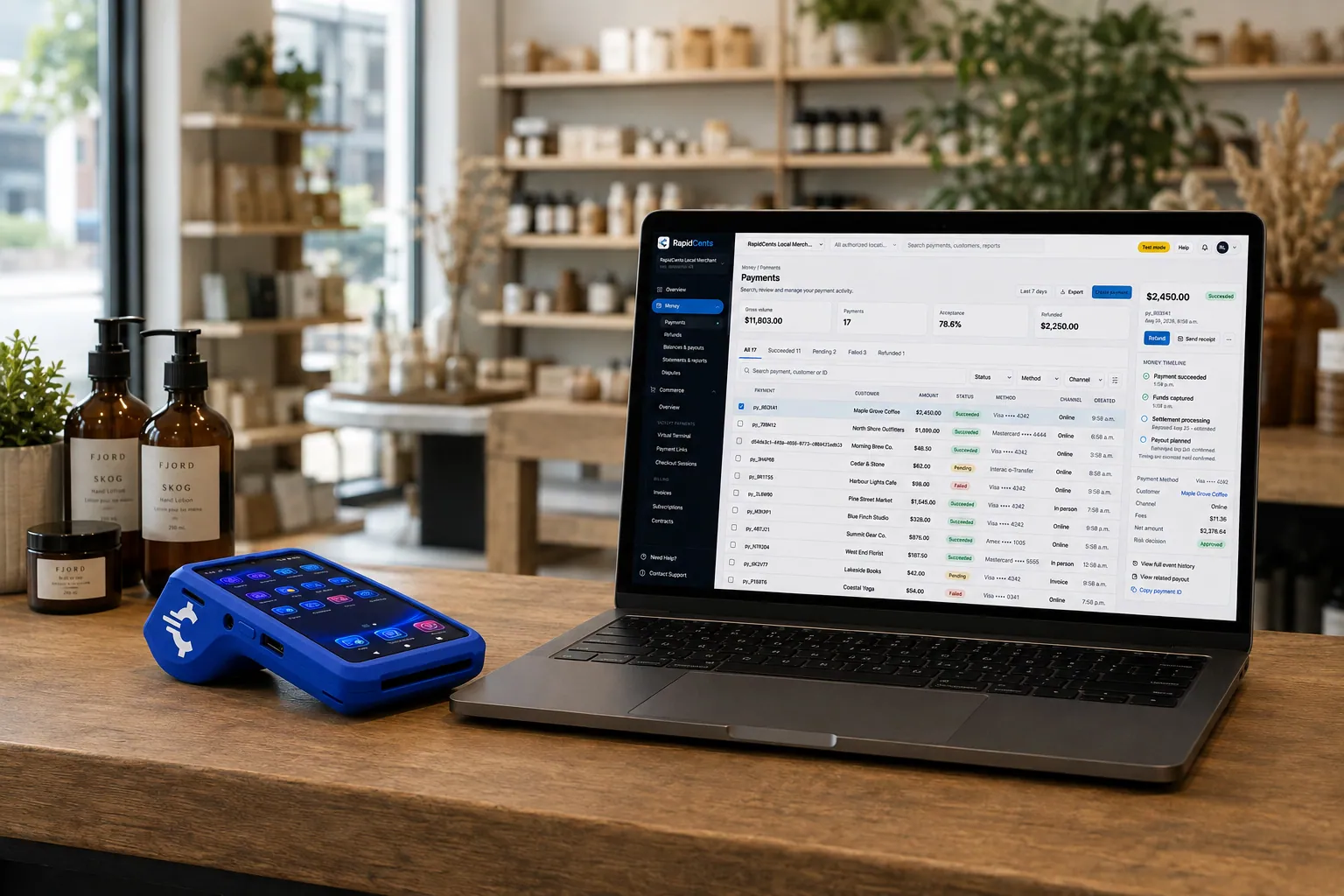
A retail counter ringing a basket on RapidCents POS, terminal taking the card and the dashboard showing the sale. Retail POS
Fast checkout, inventory that reflects what is on the shelf, and reporting that connects in-store and online…
Explore
The RapidCents invoices screen: outstanding, overdue, paid and draft totals across the top, the invoice list below them, and a preview of one invoice on the right with its line items and a View & Record Payment button. Invoicing
RapidCents invoicing helps professional services, contractors and B2B suppliers create branded invoices…
Explore
The RapidCents payment links screen listing created links with their amount, status, click count and whether they have been paid, beside a phone showing the branded page a customer opens to pay $2,500.00. Payment Links
RapidCents payment links let staff generate branded pay-by-link URLs for invoices, deposits, balances and…
Explore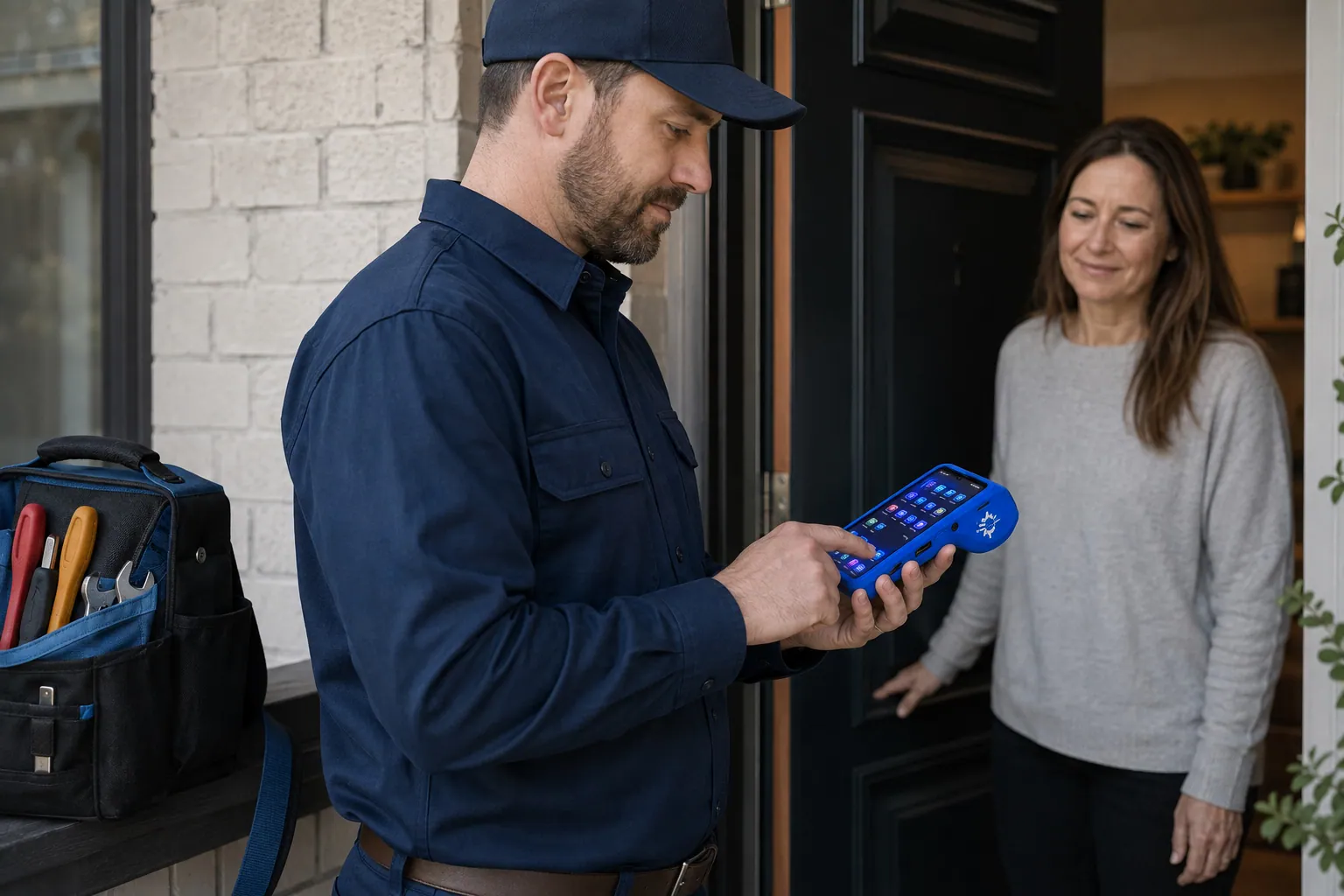
A staff member takes a card payment on a RapidCents handheld terminal, with the same sale appearing on the dashboard. Mobile Terminals
RapidCents mobile terminals are battery-powered wireless devices with LTE and Wi-Fi so staff accept payments…
Explore


How can staff take payment in the yard and for special orders?
Staff can take payment in the yard with a mobile terminal or Tap to Pay on a supported phone, and take special-order deposits by payment link. Your RapidCents representative will go over signal coverage across your yard, loading dock and delivery routes with you.
Mobile terminal at the gate
A mobile terminal with LTE and Wi-Fi lets the yard hand take a card at the lumber rack or loading dock. Metal sheds and far corners can drop a signal, so your RapidCents representative will help you plan coverage for your yard.
Special-order deposits and balances
When a customer orders a custom door or cut-to-length trim, take a deposit by payment link or at the counter, note the supplier order number, and collect the balance at pickup. Set refund terms for custom orders and give them to the customer before the deposit is paid.
A $1,800 delivered deck order
Say a homeowner orders $1,800 of decking for delivery. You take a deposit by link, the driver collects the balance on a mobile terminal at the drop, and the delivery ticket number sits on both payments so the order reconciles.
What drives hardware store credit card processing costs?
Hardware store credit card processing cost depends on your card mix, ticket sizes and how cards are taken. RapidCents prices on interchange-plus: interchange at cost, your RapidCents markup in your Fee Schedule, and fees for equipment or services, if applicable, month to month with no fixed term.
Card mix and ticket size
Interchange varies by card type: debit, credit, premium and commercial cards each price differently. Contractors often pay large tickets with commercial or purchasing cards, while homeowners tap debit and credit. Your RapidCents representative can tell you what data your setup supports for larger tickets.
Tapped, inserted, keyed and online
A card tapped or inserted at the counter usually prices differently from one keyed over the phone or paid through a link. Your yard sales, phone orders and invoice links change the channel split, so measure each one separately before comparing quotes.
What to bring to Fee Check
Bring your last few processing statements, your split between counter, account and yard sales, average ticket, and your refund and chargeback volume. Fee Check reads an uploaded statement and shows interchange separated from markup, so you can compare written quotes on equal terms.
Which point-of-sale and accounting software works with RapidCents?
RapidCents integrates with many major platforms through APPIE and RapidBridge, so your hardware store POS payments can run alongside the software you already use. The right option depends on your software vendor and version, and your RapidCents representative will walk you through it.
Lightspeed Retail and Shopify POS
Both are retail POS platforms used for counter and online sales. The right integration option depends on your plan, terminals and version. Tell your RapidCents representative which one you run, and they will show you how payments, receipts and refunds connect.
Square for Retail, Clover and NCR Counterpoint
Some retail POS systems bundle their own processing or call for a named gateway. APPIE lets the point-of-sale software you already run drive RapidCents terminals, and your RapidCents representative will walk you through the option that fits your version.
QuickBooks Online and Xero
RapidCents connects settled transactions, fees and refunds to QuickBooks Online and Xero. Keep contractor invoice references in the memo field so each payment matches its job. SAP and NetSuite import settlement files instead.
Payment options for hardware stores in Canada
Hardware stores in Canada can accept Interac debit and major credit cards at the counter and in the yard, collect contractor accounts by EFT or pre-authorized debit, and settle in CAD. Each method is set up on your merchant account, and your RapidCents representative walks you through it.
Interac debit and credit cards
Interac debit is taken by chip and PIN or contactless at the terminal. Visa, Mastercard and American Express are taken at the counter, in the yard or by payment link.
GST/HST and provincial rules
Receipts and invoices can show GST/HST where it applies, and provincial rules may affect materials and delivery. Keep tax lines on the invoice behind your payment link, and leave tax treatment to your accountant.
How do you switch processors and keep trade accounts reconciled?
Once your account is approved, you switch safely by listing what is stored, testing a full sale, refund and deposit, and running both setups in parallel before moving live. Home improvement store merchant services touch many accounts, so plan the cutover around open invoices and special orders.
Inventory what is open
List stored contractor cards and their authorizations, recurring account schedules, unpaid invoices, open special-order deposits and pending refunds. Moving stored cards between processors needs both providers to agree, so your RapidCents representative will tell you what is possible; otherwise customers re-authorize.
Test before the busy season
Run a sale, a refund, a deposit by link and a yard payment on the new terminals before moving live traffic. Switch outside your spring and summer rush, and keep the old setup running in parallel until the test results match.
Match deposits to the ledger
Map invoice and job references to your accounting software, then reconcile each settlement to the register and to account sales. Review the first weeks of reports with your bookkeeper, and your RapidCents representative will show you how fees and refunds appear.
Payment questions from hardware stores
What is the best payment processor for a hardware store?
The best processor for a hardware store is the one that fits your mix of counter, account and yard sales. Compare interchange-plus pricing, terminal range, invoice and payment-link tools, POS compatibility, reporting and support, and compare written quotes on your own processing statements. RapidCents offers these tools, and Fee Check shows what you pay today.
How much does credit card processing cost for a hardware store?
Cost depends on your card mix, ticket sizes and channels. Pricing is interchange-plus: interchange at cost, then your RapidCents markup in your Fee Schedule, plus fees for equipment or services if applicable. It runs month to month with no fixed term. Large contractor tickets and keyed phone orders price differently from tapped debit, so upload a statement to Fee Check.
Can Lightspeed Retail or my other POS use RapidCents for payments?
Most stores keep the POS they run today. RapidCents integrates with many major platforms through APPIE and RapidBridge, and the right option depends on your POS, plan, edition and country. Lightspeed Retail, Shopify POS, Square for Retail, Clover and NCR Counterpoint each work differently, so tell your RapidCents representative which you run and they will walk you through it.
How can a hardware store switch processors without losing payment history?
Export your transaction and settlement history from the current provider first, then list stored cards, open invoices, special-order deposits and recurring account schedules. Moving stored cards needs both providers to agree, and your RapidCents representative will tell you what is possible; otherwise customers re-authorize. Test a sale, refund and deposit, and run both setups in parallel before moving live.
Which payment options can a hardware store in Canada offer?
A hardware store in Canada can offer Interac debit, credit cards, payment links and invoices, with EFT or pre-authorized debit for contractor accounts and CAD settlement. Your RapidCents representative will walk you through the methods that apply to your merchant account. Contractors paying by bank debit must agree in writing to the amount and timing.
Can a contractor pay a hardware store account invoice remotely?
Yes. Send the invoice with its reference number, such as the job name or purchase order number, and a secure Payment Link by email or SMS. The contractor pays by card from any device, and the invoice status updates. Stored cards for later charges need the customer's authorization and agreement on amount and timing.
Can staff take payment in the lumber yard or at a delivery?
Yes. Staff can use a mobile terminal or Tap to Pay on a supported phone, or send a payment link, and your RapidCents representative will go over coverage for your yard, dock and delivery routes. Put the order or delivery ticket number on the payment so it matches the sale later.
Can retail and trade-account sales reconcile in one place?
They can, if your POS, invoices and accounting software carry the same references. RapidCents Reporting separates counter, link and yard payments, and RapidCents connects settled transactions, fees and refunds to QuickBooks Online and Xero. Your RapidCents representative will walk you through connecting your POS to the same flow.
How are special-order deposits handled when the order changes or is returned?
Take the deposit with a payment link or at the counter, note the supplier order number, and agree refund terms for custom items before the customer pays. If the order changes, adjust the balance. If it is cancelled, refund to the original card under those terms, and make sure the customer saw the terms first.
Can we keep a contractor's card on file for account purchases?
Yes, with the customer's authorization. Agree on the amount, timing and cancellation, record the permission, and store the card in the Secure Card Vault instead of writing it down. Charges outside what the contractor agreed can become disputes, so match each charge to an invoice or job reference.
What MCC is used for hardware stores?
MCC 5251 is commonly associated with hardware stores. Your RapidCents representative sets the correct merchant category during onboarding, based on what your business actually sells. A store with a large lumber yard, rental counter or mixed catalog gets a closer look at setup, so describe your full product range.
Related industries
Hardware stores share counter checkout, returns and deposits with appliance stores, electronics stores and computer and phone repair shops. Retail is the parent page, and distributors selling to trade buyers should read the B2B Wholesale page.
Retail
Take tap, chip and PIN payments at every register, sell on your website, refund returns…
Florists
Take counter sales, phone orders, wedding deposits and online orders with receipts, order…
Clothing Boutiques
RapidCents gives clothing boutiques counter terminals, online checkout and pop-up…
Shoe Stores
Take special-order size deposits, online pickup payments and exchanges at the counter, by…
Electronics Stores
Take high-value card purchases in store, online and by phone, keep delivery and return…
Computer & Phone Repair Shops
Take diagnostic fees, remote parts deposits and pickup balances at the counter or by…
Appliance Stores
Take special-order deposits in store, collect delivery balances by mobile terminal or…
Convenience Stores
RapidCents gives convenience stores countertop terminals for debit and credit taps, Tap…
Take the next step
Review your hardware store payment setup
Upload a recent processing statement to Fee Check and see interchange separated from your markup across counter, account and yard sales.
- No obligation
- Canadian payment specialists
- Secure statement upload



