


HVAC payment processing for installs, service calls and renewals
HVAC payment processing has to cover three jobs: an installation deposit before the equipment is ordered, card payment at the end of a service call, and maintenance plan billing on a card the customer has authorized. RapidCents handles them with payment links, invoicing and Recurring Payments.

- PCI DSS Level 1
- SOC 2 Type II
- All major cards: Visa, Mastercard, Amex, Discover, UnionPay, Diners Club & Interac Debit
- Interchange-plus available
- Canadian support
How HVAC contractors get paid
HVAC contractors get paid at five points: an equipment deposit before the order, the balance at startup, the end of a service call, each maintenance plan charge, and invoices to property managers. Each point has a different payer, trigger and RapidCents product, so each one gets its own setup.
Equipment deposit before the order
The homeowner or property manager pays once the proposal is signed and before you order the unit. The office sends a payment link or QR code. If the unit is a special order that cannot go back, take the deposit before you place it. Finance keeps the receipt against the proposal number.
Balance at startup
The customer pays the balance once the system is running and the walkthrough is done. The installer takes the payment on site with Tap to Pay or a mobile terminal, or the office sends a link. If a permit inspection is still pending, invoice the holdback separately. Finance keeps the receipt on the job invoice.
Service calls and repairs
The customer pays at the end of the visit, such as a no-heat call or a blower motor repair. The technician takes a tap or chip payment at the door. If the customer declines the repair, you collect only the diagnostic fee you agreed. The office records the payment on the work order.
Maintenance plan charges
The plan member pays monthly or once a year on a card they authorized when they enrolled. Recurring Payments runs the charge on the billing day. If a customer sells the house mid-term, the cancellation terms in the agreement decide what happens next. Finance sees each charge in the transaction report.
Commercial and property-manager invoices
A property manager or small business pays an invoice after a repair or a rooftop unit install. You send it from Invoicing with a payment link and track it from draft to paid. A purchase order number or an approval step can delay payment. Finance reconciles by invoice number.
How do HVAC contractors collect installation deposits before equipment orders?
HVAC installation deposit payments are collected after the customer signs the proposal and before you order the unit, by invoice and payment link or by a signed document that takes the deposit. The amount, what it covers and the refund terms go in the proposal first, so the payment never has to be explained later.
From signed proposal to receipt
The office creates the deposit in Invoicing with the proposal number in the invoice details. HVAC invoice payment links go out by SMS or email, or as a QR code, and the customer pays from a phone. Contracts & eSignatures can send the agreement, capture the signature and take the deposit.
What to settle before the link goes out
Put four things in the proposal: the deposit amount, what it covers, when the balance is due and what happens on cancellation after the equipment is ordered. A card used for the deposit is not permission to charge the balance later; any stored card needs the customer's authorization.
What goes wrong with large deposits
A large deposit can decline at the cardholder's limit or be held for review by the bank, so send a second link and let the customer split it across two cards. If the customer backs out before you order, refund to the same card. For a dispute, keep the signed proposal, receipt and order confirmation.
A $9,400 furnace and coil changeout, deposit first
Say a family approves a $9,400 furnace and coil changeout on a Monday. The office sends the deposit link by SMS before the technician leaves the house, and the customer pays. You order the equipment once the payment shows in the Merchant Dashboard, and the balance is invoiced at startup.
How do technicians take HVAC service call payments in the field?
A technician takes HVAC service call payments at the door with Tap to Pay on a supported phone or with a RapidCents mobile terminal, as soon as the work order is closed. Tap to Pay is contactless only; the mobile terminal also takes chip cards and has LTE and Wi-Fi, so it can connect without the customer's Wi-Fi when there is a mobile signal.
How checkout runs at the door
The technician confirms the total, and the customer pays by tapping a card on the technician's phone, or by tapping or inserting it on the terminal. The customer gets a receipt, and the office matches the payment to the work order number from the day's transactions.
Choose the device for each truck
Give a technician Tap to Pay on a supported phone if contactless is enough, or an HVAC mobile payment terminal such as the Rivo Go if customers insert chip cards. Decide before the season who can take payments, who can refund, and who sends a payment link when a device or signal fails.
What goes wrong: dead zones, landlords and declines
A basement or attic may have no signal, so finish the payment on the porch or have the office send a payment link. If the payer is a landlord rather than the occupant, send the invoice to the landlord, not the tenant. If a card declines, take another card or send a link before the truck leaves. A customer who phones the office to pay later can be charged in Virtual Terminal.
A $385 no-cool call, paid on the porch
Say a technician replaces a failed capacitor on a no-cool call and closes the work order at $385. The attic is a dead zone, so the customer taps a card on the technician's phone on the porch. That evening the office sees the payment in the day's transactions and closes out the work order.
RapidCents products for HVAC contractors
These four products cover the money an HVAC company handles in a day: Tap to Pay and Mobile Terminals for the technician at the property, and Payment Links and Invoicing for the office that collects deposits and balances.

A café worker holds a phone running RapidCents Tap to Pay, showing an $18.75 sale and the contactless symbol, while a customer holds a Visa card to the screen. No separate card reader is present. Tap to Pay
RapidCents Tap to Pay turns supported iPhones and Android devices into contactless payment terminals without…
Explore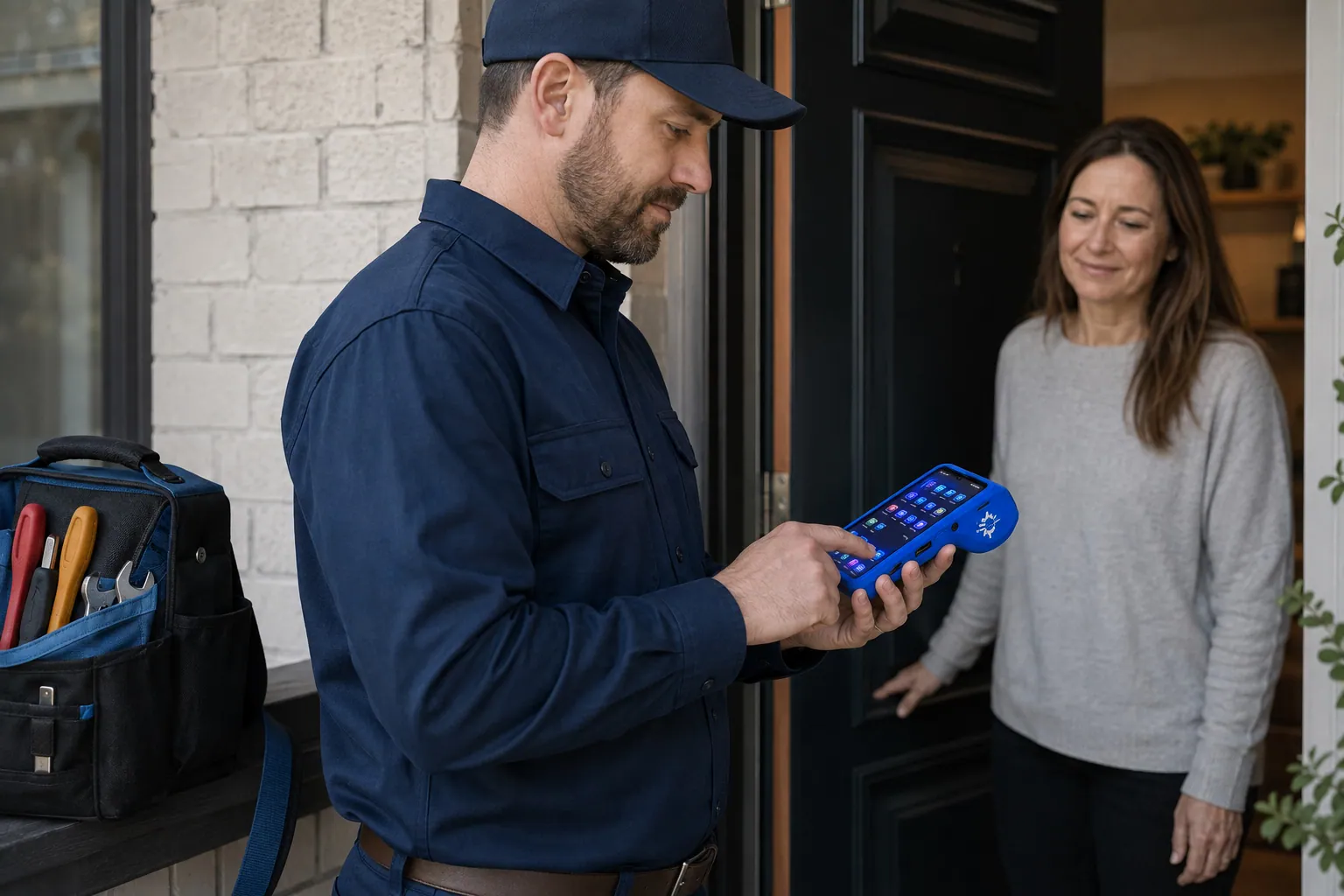
A staff member takes a card payment on a RapidCents handheld terminal, with the same sale appearing on the dashboard. Mobile Terminals
RapidCents mobile terminals are battery-powered wireless devices with LTE and Wi-Fi so staff accept payments…
Explore
The RapidCents payment links screen listing created links with their amount, status, click count and whether they have been paid, beside a phone showing the branded page a customer opens to pay $2,500.00. Payment Links
RapidCents payment links let staff generate branded pay-by-link URLs for invoices, deposits, balances and…
Explore
The RapidCents invoices screen: outstanding, overdue, paid and draft totals across the top, the invoice list below them, and a preview of one invoice on the right with its line items and a View & Record Payment button. Invoicing
RapidCents invoicing helps professional services, contractors and B2B suppliers create branded invoices…
Explore


How do you bill maintenance plan renewals on a card on file?
HVAC maintenance plan billing works by saving a card the customer has authorized and charging it on the agreed billing day, monthly or yearly, with Recurring Payments. The plan agreement sets the amount, timing and how to cancel. Automated retries and Account Updater are there for cards that expire or are replaced.
How a plan is enrolled and charged
The customer enrolls at a tune-up or an install, agrees to the plan price, billing day and cancellation terms, and authorizes a card. The card is stored in the Secure Card Vault, and Recurring Payments charges it on schedule. Your dispatch software, not the payment schedule, books the tune-up visits.
What the customer agrees to first
Recurring charges need the customer's agreement on the amount, timing and how to cancel. Keep a signed copy of the plan agreement. Send a reminder before each yearly renewal, and say in the agreement how a price change will be announced.
What goes wrong on renewal day
A card that expires or is replaced is the usual cause of a failed plan charge. Automated retries try the card again, and Account Updater can refresh card details where supported. If the charge still fails, the office asks the customer for a new card before booking the next tune-up. Refunds for a plan ended mid-term follow the agreement.
A $24 monthly plan and an expiring card
Say a homeowner joins a $24 monthly plan at a spring tune-up. Months later the card on file expires and the scheduled charge fails. Automated retries run, and when they also fail the office calls the customer, who authorizes a new card, and the plan continues on the next billing day.
How do you compare HVAC contractor credit card processing fees?
Compare HVAC contractor credit card processing fees on your own payment mix, because large equipment tickets, debit versus credit cards and tapped versus keyed payments change the cost. RapidCents prices on interchange-plus: interchange passes through at cost, you pay your RapidCents markup as set out in your Fee Schedule, plus equipment or service fees if they apply. It is month to month with no fixed term.
Large tickets change the math
Interchange applies to every sale, so a few large equipment payments can weigh more in your monthly card cost than many small tune-ups. Debit, credit, premium rewards and commercial cards fall into different interchange categories. If you bill property managers or small businesses, expect some commercial cards in your mix.
How the card is taken changes the price
Interchange differs for a card tapped or inserted at the door and a card keyed in or paid on a payment link. Split your volume by channel: technician checkout, payment links and invoices, payments keyed in by the office, and recurring plan charges. That split decides which fees you are really comparing.
What a single blended price hides
A single blended price does not show the split between interchange and markup, so you cannot tell which part moved. Ask any provider to put the markup, terminal costs and the treatment of refunds and disputes in writing, and compare total operating cost, including the office time spent on reconciliation.
What to bring to Fee Check
Bring recent processing statements, your card mix, the average ticket for installs and for service calls, the split by channel, and your refund and chargeback volume. Fee Check reads an uploaded processing statement and shows interchange separately from markup.
Can you use RapidCents with ServiceTitan, Housecall Pro or Jobber?
Yes. RapidBridge works with ServiceTitan, Housecall Pro, Jobber, FieldEdge and FieldPulse, so a card payment posts against the job you already have open and your dispatch software stays as it is. The payment record shows who paid what and when; job details, permits and warranty registration stay in that software. Your RapidCents representative will walk you through the setup for your edition.
ServiceTitan
ServiceTitan runs your dispatch and jobs, and RapidBridge takes RapidCents payments inside it without changing it. A payment taken at the door lands on the right invoice, so the office never retypes a total. Tell your RapidCents representative which ServiceTitan plan you run, and they will show you how the payment posts to the job.
Housecall Pro
If technicians open and close jobs in Housecall Pro, RapidBridge posts a payment taken on a RapidCents terminal, with Tap to Pay or by payment link against that job. The job shows paid without a second entry, and the technician moves on to the next call.
Jobber
If quotes and invoices live in Jobber, RapidBridge connects RapidCents payments to them, so a deposit paid through a RapidCents payment link shows against the quote or invoice. The customer gets a receipt, and the office sees the deposit without chasing it.
FieldEdge
If service agreements are managed in FieldEdge, RapidBridge works with it, and Recurring Payments can run the plan charge on its billing day. Your RapidCents representative will set out which side holds the schedule, so the agreement and the charge stay in step.
FieldPulse
If FieldPulse holds your estimates and work orders, RapidBridge works with it, so payments taken by terminal, Tap to Pay or payment link post against the work order. Run one paid invoice end to end in your first week, and you will see the whole path.
Payment options for HVAC contractors in Canada
An HVAC contractor in Canada can offer Visa, Mastercard and American Express credit cards, Interac debit at the terminal, and bank payments by EFT or pre-authorized debit, with settlement in Canadian dollars. Your RapidCents representative will set out which of them your merchant account carries.
Interac debit at the door
Interac debit by chip and PIN or contactless suits a service call at the technician's terminal. For a large installation payment, ask your RapidCents representative which method fits the amount, because the cardholder's bank may limit a large debit payment.
EFT and PAD for balances and plans
EFT or pre-authorized debit can collect a balance or a maintenance plan from a bank account once the customer agrees the amount, timing and how to cancel. Your RapidCents representative will tell you which of these your account can use.
GST/HST and provincial rules
GST/HST may appear on your receipts and invoices where it applies. Provincial rules on deposits, cancellation periods and home-improvement contracts differ, so check yours with your own accountant or lawyer; card processing does not decide them.
How do you switch HVAC payment processors without losing billing records?
Switch without losing billing records by listing what is on file, testing a sale, a refund and a deposit, moving one truck first, and reconciling every deposit to your ledger before you retire the old account. Once your account is approved, your RapidCents representative helps you set up each truck, and saved cards may need the customer to authorize them again.
Inventory what is on file
List open invoices and unpaid balances, equipment deposits for jobs not yet installed, plan cards and the authorizations behind them, scheduled renewals, pending refunds, the terminal in each truck and any software still pointing at the old processor. Deposits on uninstalled jobs are the easiest to lose track of.
Plan for stored cards
Moving saved cards between processors needs both providers to agree, so ask your current processor what it can release and do not assume plan members' cards will carry over. If they cannot move, ask members to authorize a card again before their first renewal on the new account, and keep their signed agreements.
Test, then move one truck at a time
Run a small sale, a refund and a deposit through the new account and check each one in the Merchant Dashboard and in Reporting. Move one truck first and keep the old terminal until the last payments settle. Avoid cutting over during the first heat wave or cold snap, when the phones are busiest.
Reconcile deposits to the ledger
HVAC payment reconciliation means matching each settlement to the invoices and work orders it paid. Put the job or invoice number on every payment reference and export settlement and fee reports as CSV or PDF. RapidCents connects settled transactions, fees and refunds to QuickBooks Online and Xero, and SAP and NetSuite import settlement files.
Payment questions from HVAC contractors
How should HVAC contractors handle installation deposits before equipment orders?
HVAC contractors should take the installation deposit after the customer signs the proposal and before ordering the equipment, by invoice and payment link or by a signed document that collects it. The proposal should already set the deposit, the balance date and the cancellation terms. A refund goes back to the original card if the customer backs out before the order, and the signed proposal plus the receipt are your evidence if the payment is disputed.
How should HVAC contractors handle service call checkout in the field?
An HVAC technician should collect once the work order is closed, using Tap to Pay on a supported phone or a mobile terminal with LTE and Wi-Fi. Confirm the total, then take the tap or chip payment at the door. Where the signal is weak, finish outside or have the office send a payment link, and match each payment to its work order number in the day's transactions.
How should HVAC contractors handle maintenance plan renewals?
Charge maintenance plan renewals only to a card the customer authorized, under an agreement that sets the amount, timing and cancellation terms. Recurring Payments runs the schedule with automated retries, and a reminder before each yearly renewal helps avoid surprise charges. When a card expires, the office collects a new authorization from the customer.
How should HVAC contractors handle technician-level payment permissions?
Let technicians take payments, and keep refunds and reports with the office. Virtual Terminal offers role permissions and an audit log, and Multi-Location adds permissions and roll-up reporting for companies with several branches. Your RapidCents representative will walk you through which controls apply to Tap to Pay and mobile terminals on your account before you hand out devices.
Which payment options can an HVAC contractor in Canada offer?
In Canada, an HVAC contractor can take Visa, Mastercard and American Express credit cards, Interac debit, and EFT or pre-authorized debit bank payments, all settled in Canadian dollars. Your RapidCents representative will list the exact methods for your merchant account, including which work on Tap to Pay and which need a mobile terminal. Use cards at the door, and payment links, invoices or a bank payment for deposits and plans.
How should HVAC contractors handle large invoice financing versus installments?
An installment schedule is a way to collect your own invoice in parts, not financing. You can split a large job into a deposit, a delivery payment and a completion payment, each charged on the dates and amounts the customer agreed, through payment links or Recurring Payments installment schedules. Customer financing, where a lender pays you and the customer repays the lender, is a separate agreement between them; RapidCents processes the payments on your invoice.
Which payment processor is best for HVAC contractors, and what should you compare?
No single processor suits every HVAC contractor, so compare them on your own mix of deposits, service calls and plan billing. Weigh total fees from a written quote, the markup under interchange-plus, terminal or equipment costs, settlement reporting, support when a truck is down, and how the processor works with your dispatch software. Check every written quote against your recent statements; RapidCents Fee Check shows interchange separately from markup.
What fees should HVAC contractors expect for in-person and online card payments?
HVAC contractors should expect interchange, which the card networks set and which varies with card type and how the card is taken, plus the processor's markup and any equipment or service fees. RapidCents prices on interchange-plus, month to month, with your markup set out in your Fee Schedule. Ask for a written quote built on your real mix of door, link and recurring payments.
Can I use RapidCents with ServiceTitan or Housecall Pro?
Yes. RapidBridge works with ServiceTitan and Housecall Pro, so a payment taken on a RapidCents terminal, with Tap to Pay or by payment link posts against the job you already have open. It works the same way with Jobber, FieldEdge and FieldPulse. Tell your RapidCents representative which edition you run, and they will walk you through it.
How can HVAC contractors reduce payment disputes and protect stored card details?
You reduce disputes with a signed proposal, clear deposit and refund terms, a receipt for every payment and a reminder before each plan renewal. Protect stored cards by tokenizing them in the Secure Card Vault and limiting who can take or refund payments. Disputes and Chargeback Protection adds alerts, evidence and deadlines, but the card issuer decides the outcome of a dispute.
How can HVAC contractors switch payment providers without losing billing records?
With RapidCents, you switch without losing billing records by listing what is on file, testing a sale, a refund and a deposit, and reconciling every deposit before closing the old account. The list covers open invoices, deposits for jobs not yet installed, plan cards with their authorizations and every terminal. Saved cards may not transfer because both providers must agree, so plan to collect authorization from plan members again.
What MCC is used for HVAC contractors?
MCC 1711 is commonly associated with HVAC and other heating and air conditioning contractors. RapidCents sets the correct merchant category with you during onboarding, based on what your business actually sells, so describe every line you run, such as installation, repair, equipment sales and maintenance plans, when you apply.
Related trades and home service industries
Plumbing Contractors, Electricians, Roofing Contractors and Home Services share most of these workflows: a deposit before materials are ordered, payment at the property when the work is done, and recurring charges for service plans. They carry over to each trade with its own vocabulary.
Plumbing Contractors
Take the card at the job with Tap to Pay or a mobile terminal, send deposit links before…
Electricians
Take a materials deposit before the order goes in, get change orders approved and paid…
Construction Contractors
RapidCents helps construction contractors bill draws, collect released retainage and…
Home Services
Card payments for the work your crews finish in customers' homes: tap at the door…
Landscaping
RapidCents handles spring deposits by payment link, monthly maintenance on autopay…
Cleaning Services
RapidCents helps cleaning businesses collect recurring cleans from a card on file, deep…
Roofing Contractors
Take the deposit that orders the shingles, bill the balance at tear-off and completion…
Painting Contractors
Collect the deposit when the estimate is accepted, the balance at the walkthrough and…
Take the next step
See what your HVAC card payments really cost
Upload a recent processing statement to Fee Check and see interchange separated from markup, then compare it with your mix of installation deposits, service calls and plan renewals.
- No obligation
- Canadian payment specialists
- Secure statement upload



