


Payment processing for meat wholesalers and seafood distributors
Payment processing for meat wholesalers means collecting catch-weight invoices, scheduled-delivery balances and freshness credits from restaurants, grocers and institutions by card, payment link, invoice or phone order. RapidCents provides Invoicing, Payment Links and Mobile Terminals so each charge matches the confirmed weight, and we price every account on interchange-plus.

- PCI DSS Level 1
- SOC 2 Type II
- All major cards: Visa, Mastercard, Amex, Discover, UnionPay, Diners Club & PIN Debit
- Interchange-plus available
- Specialist onboarding support
How meat and seafood wholesalers get paid
Foodservice protein distributor payments follow the order. A restaurant, grocer or institution buys on account, you confirm weights and acceptance, then you collect by card, payment link or invoice. Four jobs cover most of the work, and each one carries a reference that finance can match later.
Catch-weight invoices
A restaurant or grocer orders cases of fish or primal cuts priced by the pound. After receiving, you finalize the invoice from confirmed weights and send it with a payment link, or collect by phone on the Virtual Terminal. Finance sees invoice number, weights and receipt together.
Scheduled delivery balances
A buyer on a weekly route owes a balance after each drop. Once the driver captures a signed delivery record, you send the invoice or charge an authorized stored card. A mobile terminal at the dock can take a card when the buyer prefers to pay at receiving.
Deposits on special orders
A caterer orders a whole side of beef or imported shellfish you must source. You request a deposit by payment link before purchasing, apply it to the final invoice once weights are confirmed, and collect the remaining balance after the buyer accepts delivery.
Freshness credits and remaining balances
A buyer rejects part of a delivery for a quality problem and you agree a credit note. You collect only the corrected balance, or refund a card payment already taken for the credited amount. Reports tie the credit, refund and payment to the original invoice.
How do meat wholesalers invoice catch-weight and variable-weight orders?
Meat wholesalers invoice catch-weight orders by confirming received weight first, then issuing the final invoice and collecting that exact amount. A deposit or hold for the estimated order never replaces the final figure. For seafood invoice payments, Invoicing and Payment Links carry the weights and order reference to the buyer and to finance.
How the order runs
The buyer orders cases of salmon or pork loins at an estimated weight. Your team records actual weights at packing or receiving, finalizes the invoice and sends it with a payment link.
What goes wrong
A final weight can land above the estimate, a card can decline, or a buyer can question shrink. Never split one invoice into smaller charges to get around a limit. Use a documented partial payment, send a new link for the balance and keep the weight ticket with the invoice.
A $500 halibut deposit, then a final invoice
Say a restaurant group orders forty pounds of halibut and pays a $500 deposit by link. Thirty-eight pounds arrive. You issue the final invoice, apply the deposit and collect only the remaining balance on a second link. The reference matches the original order.
How do you collect on scheduled deliveries with signed acceptance?
Scheduled-delivery accounts are collected after the buyer accepts the drop, not when the truck leaves. The acceptance record, meaning the signed delivery, final quantities and any noted exceptions, sets the amount you invoice or charge. RapidCents holds the payment record; your routing and traceability systems keep lot and temperature details.
How the route runs
A restaurant buys on a standing weekly route. The driver collects a signature at the dock, noting short cases or rejected items. Office staff then send the invoice with a payment link, or the buyer taps a card on a Mobile Terminal at receiving when you offer that option.
What to set up first
Decide who may authorize payment: the chef, the receiving clerk or head office paying for several kitchens. For stored cards, record who agreed and for which account. Standing orders need agreed amount, timing and cancellation terms so a charge never surprises a buyer.
Short shrimp on a hotel's Tuesday drop
Say a hotel kitchen receives Tuesday's order with two cases of shrimp marked short on the delivery receipt. You invoice only the accepted quantity, the purchasing manager pays by link, and Reporting shows the payment matched to the signed acceptance and route reference.
RapidCents products for meat and seafood wholesalers
Invoicing and Payment Links carry final weights to the buyer, Mobile Terminals take cards at the dock, and Reporting separates payments, fees and refunds for month-end. Your RapidCents representative helps you pick the mix that fits your accounts and software.
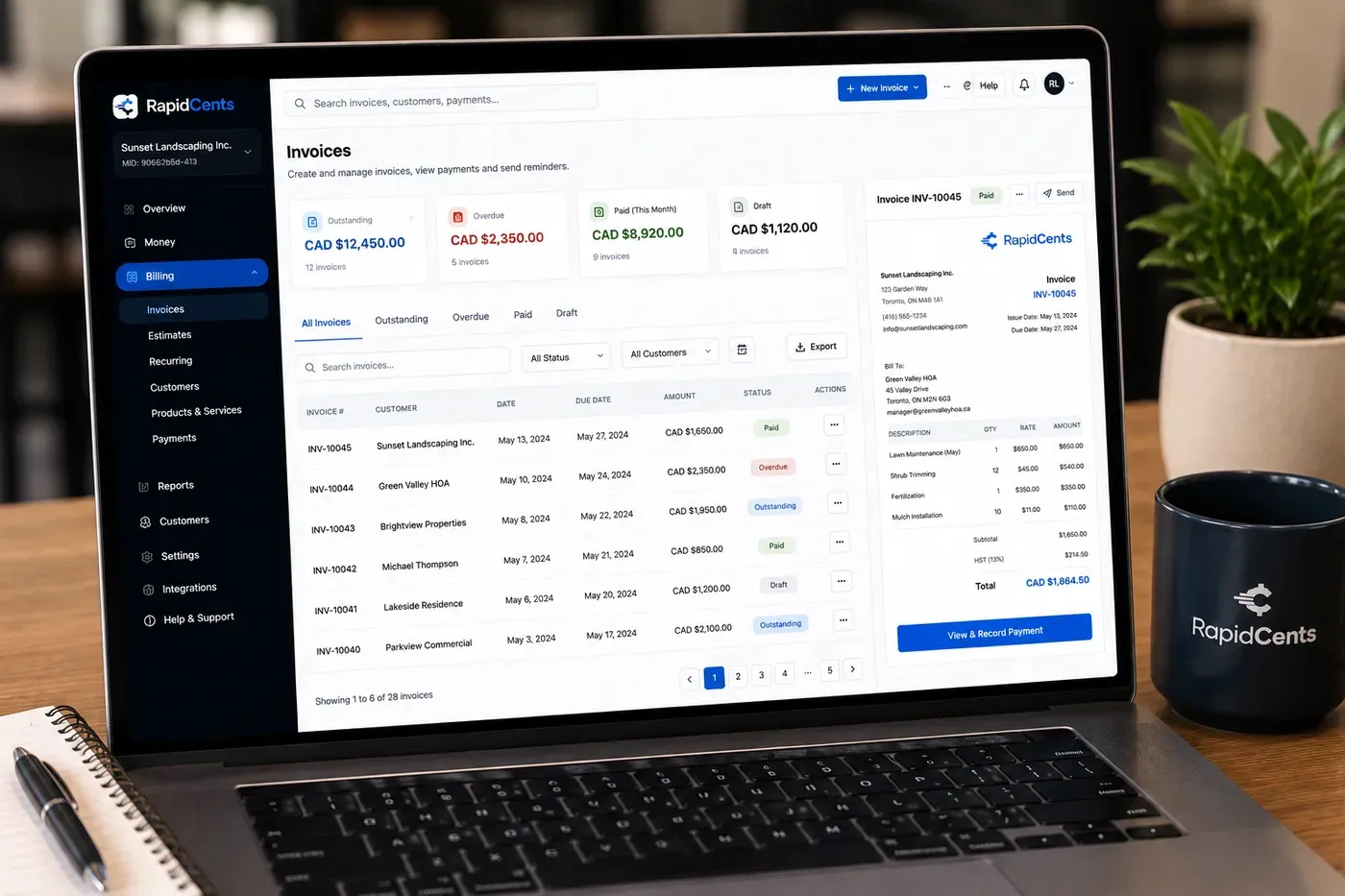
The RapidCents invoices screen: outstanding, overdue, paid and draft totals across the top, the invoice list below them, and a preview of one invoice on the right with its line items and a View & Record Payment button. Invoicing
RapidCents invoicing helps professional services, contractors and B2B suppliers create branded invoices…
Explore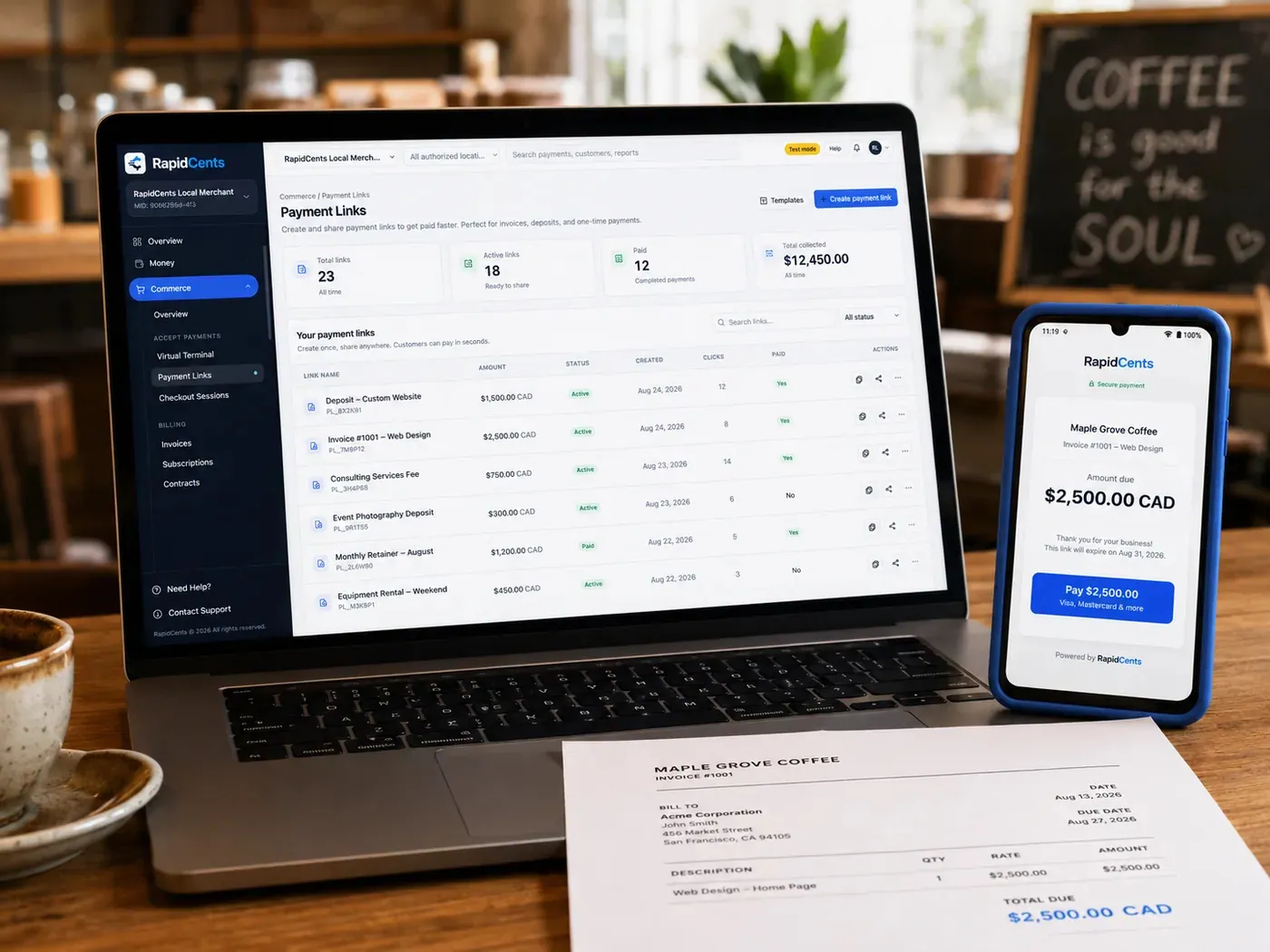
The RapidCents payment links screen listing created links with their amount, status, click count and whether they have been paid, beside a phone showing the branded page a customer opens to pay $2,500.00. Payment Links
RapidCents payment links let staff generate branded pay-by-link URLs for invoices, deposits, balances and…
Explore
A staff member takes a card payment on a RapidCents handheld terminal, with the same sale appearing on the dashboard. Mobile Terminals
RapidCents mobile terminals are battery-powered wireless devices with LTE and Wi-Fi so staff accept payments…
Explore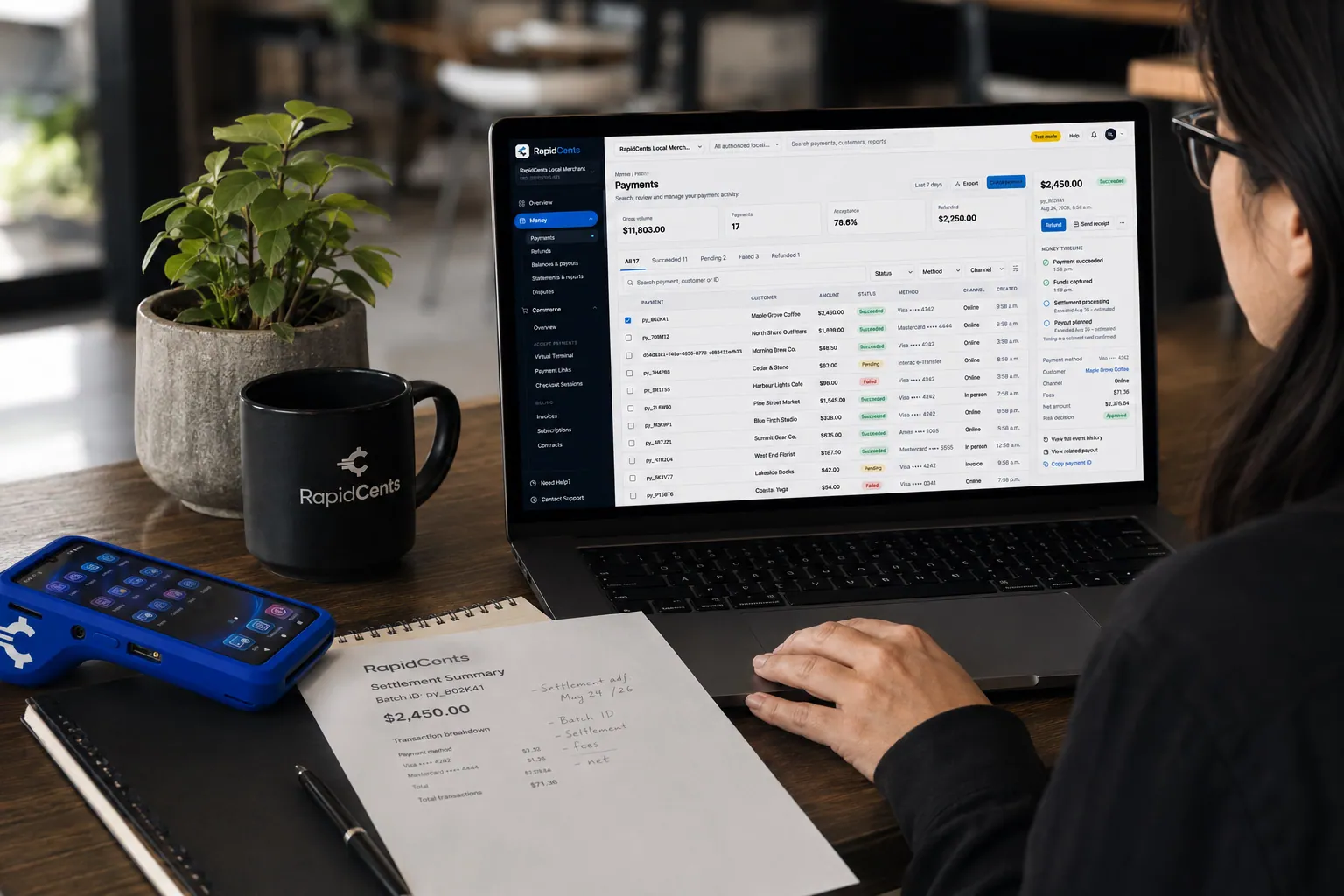
A merchant reviews RapidCents reports for volume, mix and payouts, with the terminal that took the sales on the desk. Reporting
RapidCents reporting delivers customizable transaction, settlement and fee reports with CSV and PDF export…
Explore


How do you settle freshness credits and short-ship adjustments?
A buyer can pay after a freshness credit once you reconcile the agreed credit note and collect only the corrected balance. Not every credit is a full reversal. Match the credit to the original invoice, then decide whether it reduces an open balance or becomes a refund to a card already charged.
How the credit runs
The buyer reports a quality problem, you review photos or the returned product against your policy, and an agreed credit note follows. If the invoice is still open, send a revised balance. If the card was already charged, refund only the credited amount to that card.
What goes wrong
Credits larger than the amount paid, disputes over temperature at delivery, and buyers who dispute the whole charge instead of the credited portion are the usual snags. Keep the accepted order, final quantities, signed delivery and agreed adjustments together so a dispute response is easy to assemble.
A $2,400 grocer invoice with one scallop credit
Say a grocer pays a $2,400 invoice by card. One case of scallops is credited after a quality claim review. You issue a credit note, refund that case to the same card, and the rest of the invoice stays paid. Reports link the refund to the original invoice.
How do you compare card processing fees for protein distribution?
For meat wholesaler merchant services and seafood distributor card processing, cost depends on card type, how the card is taken and invoice size, because interchange varies. RapidCents prices on interchange-plus: interchange at cost, your RapidCents markup in your Fee Schedule, and fees for equipment or services if applicable. Month to month, no fixed term.
What drives the cost
Large invoices paid by commercial or purchasing cards, keyed phone orders and payment links usually carry different interchange than a tapped debit card at the dock. Group your volume by those channels before comparing quotes. Ask your RapidCents representative whether Level 2 and Level 3 data applies to your setup.
What to bring
Bring recent processing statements, your card mix, average and largest invoice, the split between links, phone orders and terminals, plus refund and chargeback counts. Freshness credits affect refund volume, so include them. Ask every provider for written quotes that separate interchange from markup.
Use Fee Check
Use Fee Check to upload a processing statement and see interchange separated from markup. Then compare the same mix across providers. Ask about equipment or service fees, and remember a payment option does not change the net terms you agreed with the buyer.
Which ordering and ERP software works with your payment setup?
RapidCents integrates with many major business platforms through APPIE and RapidBridge, and the right option depends on your software vendor and version. Settled transactions, fees and refunds connect to QuickBooks Online and Xero, while SAP and NetSuite import settlement files. Your RapidCents representative walks you through the fit for your stack.
NetSuite and SAP Business One
Both suit distributors that post invoices and receipts in an ERP. SAP and NetSuite import settlement files, and your RapidCents representative shows you how invoice numbers and references map for your edition and country.
Dynamics 365 Business Central and Acumatica
RapidBridge works with both, so a card payment posts against the invoice you already have open without changing the software. Your RapidCents representative explains the option that fits your edition, and whether your software bundles its own processor or names a required gateway.
Epicor Prophet 21
Epicor Prophet 21 is a distribution ERP many wholesalers run for orders and invoices. RapidCents integrates with many major platforms through APPIE and RapidBridge, and your representative walks you through how payment posting works for your version. Order-entry and route-accounting tools get the same walkthrough.
Payment options for meat and seafood wholesalers in the United States
Meat and seafood wholesalers in the United States typically accept Visa, Mastercard, American Express and Discover, PIN debit where supported, and ACH bank payments for standing accounts. Settlement is in USD. Your RapidCents representative sets up the methods you want to offer your buyers.
Cards and PIN debit
Restaurant and grocery buyers can pay with credit or debit cards, and with PIN debit at a terminal where supported. Phone orders run through the Virtual Terminal and large invoices through a payment link.
ACH bank payments
ACH suits standing weekly accounts, and the buyer must authorize the debit for the agreed amount and schedule. State rules and tax treatment can differ by buyer location, so talk to your accountant about invoice details.
How do you switch processors and reconcile protein invoices?
Switching works best as a short, tested move: list what is open, test the new flow, run both for a period, then reconcile deposits to your ledger. Once your account is approved, your RapidCents representative helps you plan the move. Stored-card portability depends on both providers agreeing, so do not assume cards move.
Inventory what is open
List stored cards and their authorizations, standing orders, open invoices, deposits held and pending credits. Decide which buyers must re-authorize a card. Ask both providers in writing whether stored card data can move, and plan for buyers to re-enter details if it cannot.
Test before going live
Test a sale, a refund against a credit note and a deposit on the new setup before moving live buyers. Run a small group of accounts in parallel, then move standing routes one at a time. Keep invoice numbers and order references identical across both systems.
Map and reconcile
Map payment references to your ERP or accounting software, then reconcile deposits to the ledger. Reporting gives transaction, settlement and fee reports in CSV and PDF, and settled transactions, fees and refunds map to QuickBooks Online or Xero. Your representative helps with the mapping.
Payment questions from meat and seafood wholesalers
What is the best payment processor for meat and seafood wholesalers?
There is no single best processor, so compare on the work you do. Look for invoicing with payment links, support for variable-weight final amounts, phone-order entry, stored cards with authorization, refunds and credits tied to invoices, clear interchange-plus pricing, and reporting your finance team can reconcile. Compare written quotes using your real payment mix before you decide.
How much does credit card processing cost for meat and seafood wholesalers?
Cost depends on your mix, so no single figure applies to every distributor. RapidCents prices on interchange-plus: interchange at cost, your RapidCents markup in your Fee Schedule, and fees for equipment or services if applicable. Large commercial-card invoices, keyed orders and refunds change the total, so upload a processing statement to Fee Check to see interchange separated from markup.
Can NetSuite or SAP Business One use a different payment processor?
Yes, in most setups. Some ERPs bundle a processor or name a required gateway, while others accept payments through a payment link, an API or an import. SAP and NetSuite import settlement files, and RapidCents integrates with many major platforms through APPIE and RapidBridge. Your RapidCents representative walks you through the option for your version and country.
How can meat and seafood wholesalers switch processors without losing payment history?
Export your reports before you switch and keep invoice references identical. Download transaction, settlement and fee reports in CSV or PDF, list stored cards, standing orders and open invoices, and run both systems in parallel for a period. Stored card data moves only if both providers agree, so buyers may need to re-authorize.
Which payment options can a meat and seafood wholesaler in the United States offer?
A meat and seafood wholesaler in the United States can offer Visa, Mastercard, American Express and Discover cards, PIN debit where supported, payment links and invoices, plus ACH bank payments for standing accounts. Settlement is in USD. Tell your RapidCents representative which methods your buyers use, and they will set them up on your merchant account.
How do variable-weight orders affect card amounts?
The final invoice, not the estimate, sets the amount charged. Confirm received weights first, apply any agreed deposit, then collect the remaining balance. If the final weight exceeds what the buyer authorized, get fresh agreement for the difference rather than charging a stored card beyond the agreed range. Keep the weight ticket with the invoice.
What records help resolve a delivered-order dispute?
Keep the accepted order, final quantities, signed delivery record and any agreed adjustments together with the payment. These show what the buyer agreed to, what arrived and what you credited. Card processing records the payment, while traceability, lot and temperature records stay in your food safety and inventory systems.
Can a restaurant buyer keep a card on file for standing orders?
Yes, with the buyer's authorization. Agree the amount or range, timing and how to cancel before the first charge, and record who agreed to it. A restaurant group may authorize a head-office card for several kitchens. Charges outside what was agreed need new consent. Your RapidCents representative sets up stored cards on your account.
How do you take a deposit on a special-order or imported seafood item?
Send a Payment Link or Invoicing request for the agreed deposit before you buy the product, and write down whether it is refundable if the order changes. Apply the deposit to the final invoice once weights are confirmed. A deposit is a collection step, not financing, and net terms stay as you agreed.
Related supplier industries
Restaurant suppliers, grocery and food distributors, produce wholesalers, beverage distributors and bakery ingredient suppliers share these invoice, delivery and credit workflows. Read the B2B & Wholesale page for the wider supplier view. Restaurants collecting from their own diners have their own page.
B2B & Wholesale
Collect net-terms invoices by payment link with the PO number attached, take commercial…
Restaurant Suppliers
For dealers and distributors that sell kitchen equipment, smallwares and consumables to…
Grocery & Food Distributors
Get paid for every delivery to grocery stores, restaurants and institutional kitchens…
Produce Wholesalers
Collect on final weights, apply quality credits to the right delivery, and keep…
Beverage Distributors
Collect route invoices, container deposits and account balances from the stores, cafes…
Bakery & Ingredient Suppliers
Collect from the bakeries and food manufacturers you supply: repeat flour orders…
Dental Suppliers
From monthly consumables reorders to chair and imaging deposits, collect what clinics…
Veterinary Suppliers
Get invoices, standing orders and equipment deposits paid by the veterinary practices…
Take the next step
Review your catch-weight invoice and payment flow
Upload a processing statement to Fee Check to see interchange separated from markup, then walk through your invoices, deliveries and credits with your RapidCents representative.
- No obligation
- Payment specialists, not a call centre
- Secure statement upload



