Payment processing for medical suppliers: invoices and deposits
Payment processing for medical suppliers means collecting from the hospitals, clinics and practices you sell to, not from patients. RapidCents gives you invoice payment links, Virtual Terminal entry for phone orders, stored cards with the buyer's authorization and bank payments, all tied to the buyer's purchase order. Your representative walks through your catalogue and sales channel with you.

- PCI DSS Level 1
- SOC 2 Type II
- All major cards: Visa, Mastercard, Amex, Discover, UnionPay, Diners Club & PIN Debit
- Interchange-plus available
- Specialist onboarding support
How medical and surgical suppliers get paid
Medical and surgical suppliers get paid through four jobs: reorder invoices, equipment deposits, phone and email orders, and repeat shipments to trusted buyers. Each one starts from an accepted order or purchase order and ends with a payment record your finance team can match. Medical equipment invoice payments are the thread that connects all four.
Reorder invoices
A hospital supply room or clinic office reorders gloves, dressings or sutures. You send an invoice with a payment link, the buyer pays by card or bank payment, and the purchase order number stays on the record. Short shipments leave the balance open.
Equipment deposits
A practice orders an exam table or a patient monitor. After the order is accepted in writing, you collect a deposit through a payment link, then invoice the balance at delivery. Finance sees two linked payments against one order reference.
Phone and email orders
A purchasing clerk phones in an urgent order. Authorized staff key the card in the Virtual Terminal, with address and security code checks, and the buyer receives a receipt by email. Each entry is logged against the staff member who made it.
Repeat shipments on a stored card
A clinic that receives a standing monthly shipment agrees in writing to keep a card on file. You charge each shipment on the agreed schedule, and the buyer can cancel or change the card. If there is no authorization, you send a new request each time.
How do medical suppliers collect on hospital and clinic reorder invoices?
You collect on reorder invoices by sending each one with a payment link tied to the buyer's purchase order. The institution's accounts payable clerk pays by card or bank payment, RapidCents records the payment, and your finance team matches it to the open invoice and the delivery that triggered it.
How the invoice-to-payment flow runs
The sequence is accepted order, shipment, invoice, payment request, receipt. Send the invoice from Invoicing with the purchase order number in the reference field. The payer opens the link on any device, pays and receives a receipt. Status moves from sent to paid, so your team sees what remains open.
Short shipments, returns and credits
When a carton arrives damaged or a backorder ships later, adjust the invoice instead of collecting the full amount. If the buyer has already paid, issue a refund to the original card or raise a credit note, and record which one you chose so the ledger matches the paperwork. Agree who at the buyer signs off on a credit.
A pallet of exam gloves, one carton backordered
Say a distributor ships a pallet of exam gloves and wound dressings to a surgical center on a purchase order. One carton is backordered, so the invoice covers the shipped lines. The center pays through the link, and the backordered carton gets its own invoice and payment later.
How do medical suppliers take deposits on equipment orders?
You take medical equipment deposits by sending a payment link after the buyer accepts the quote or order in writing, then invoicing the balance at delivery. The deposit and the balance share one order reference, so finance can show what was paid, what is owed and what the buyer agreed to.
How the deposit runs
After the buyer signs the order, you send a payment link for the agreed deposit. Contracts & eSignatures can capture the signed document before the link goes out. At delivery, invoice the balance with the same order reference so both payments sit against one equipment line.
Cancellations and returns
Set out in the order terms whether the deposit is refundable, and when. Special-order items, custom-configured equipment and opened sterile goods often carry different return conditions, so write them on the order. A refund goes back to the original card or payer, not to a different one.
A $9,000 autoclave, deposit at signing
Say a clinic orders a $9,000 autoclave for a new treatment room. It pays a deposit by link when the order is signed. When the unit is delivered and the buyer acknowledges receipt, you invoice the balance, and the buyer pays it by bank payment or card.
RapidCents products for medical and surgical suppliers
Surgical distributor merchant services start with Invoicing and Payment Links for reorders and deposits, the Virtual Terminal for phone orders, and Bank Payments for larger invoices where card fees are the wrong tool.
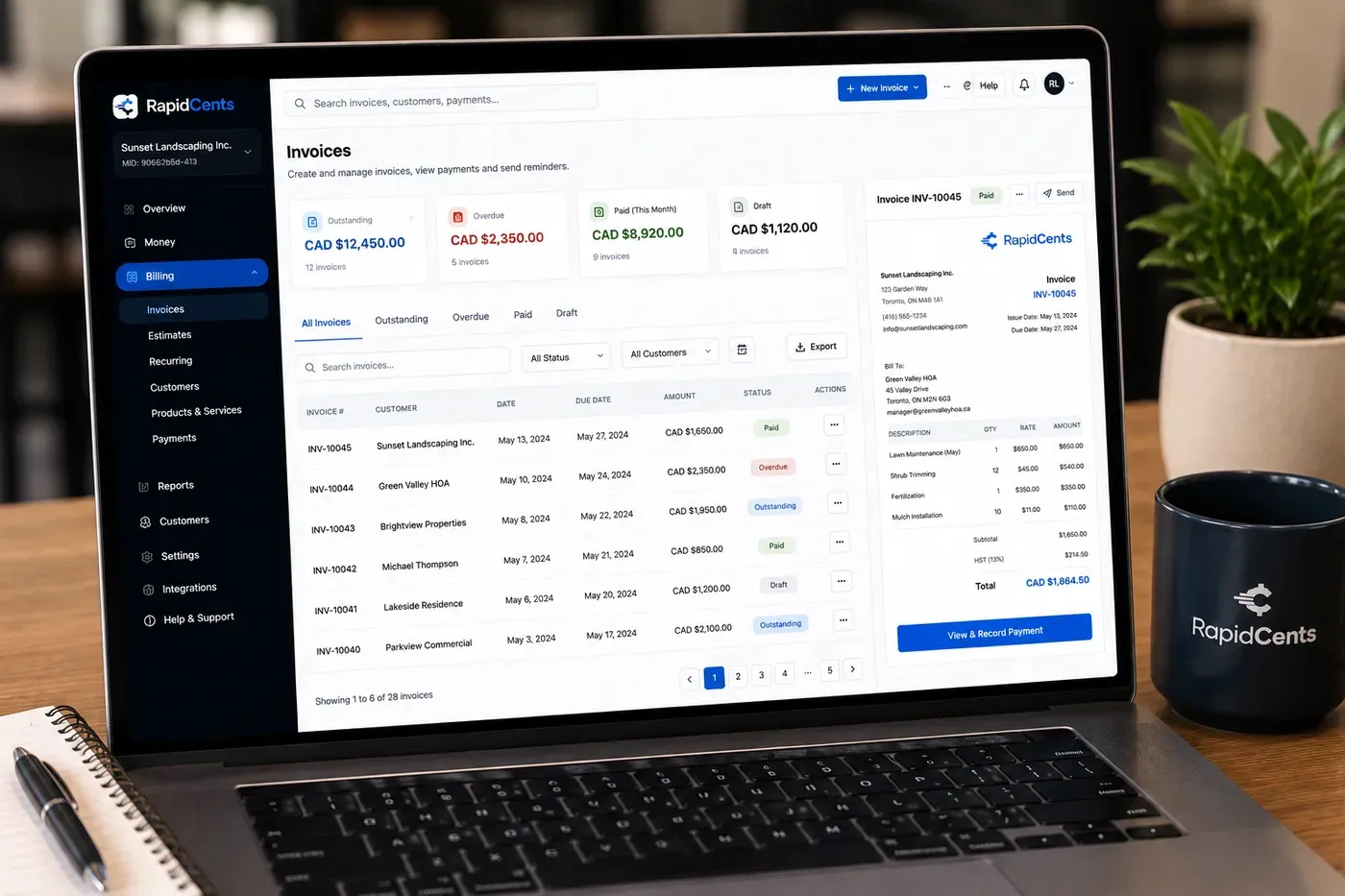
The RapidCents invoices screen: outstanding, overdue, paid and draft totals across the top, the invoice list below them, and a preview of one invoice on the right with its line items and a View & Record Payment button. Invoicing
RapidCents invoicing helps professional services, contractors and B2B suppliers create branded invoices…
Explore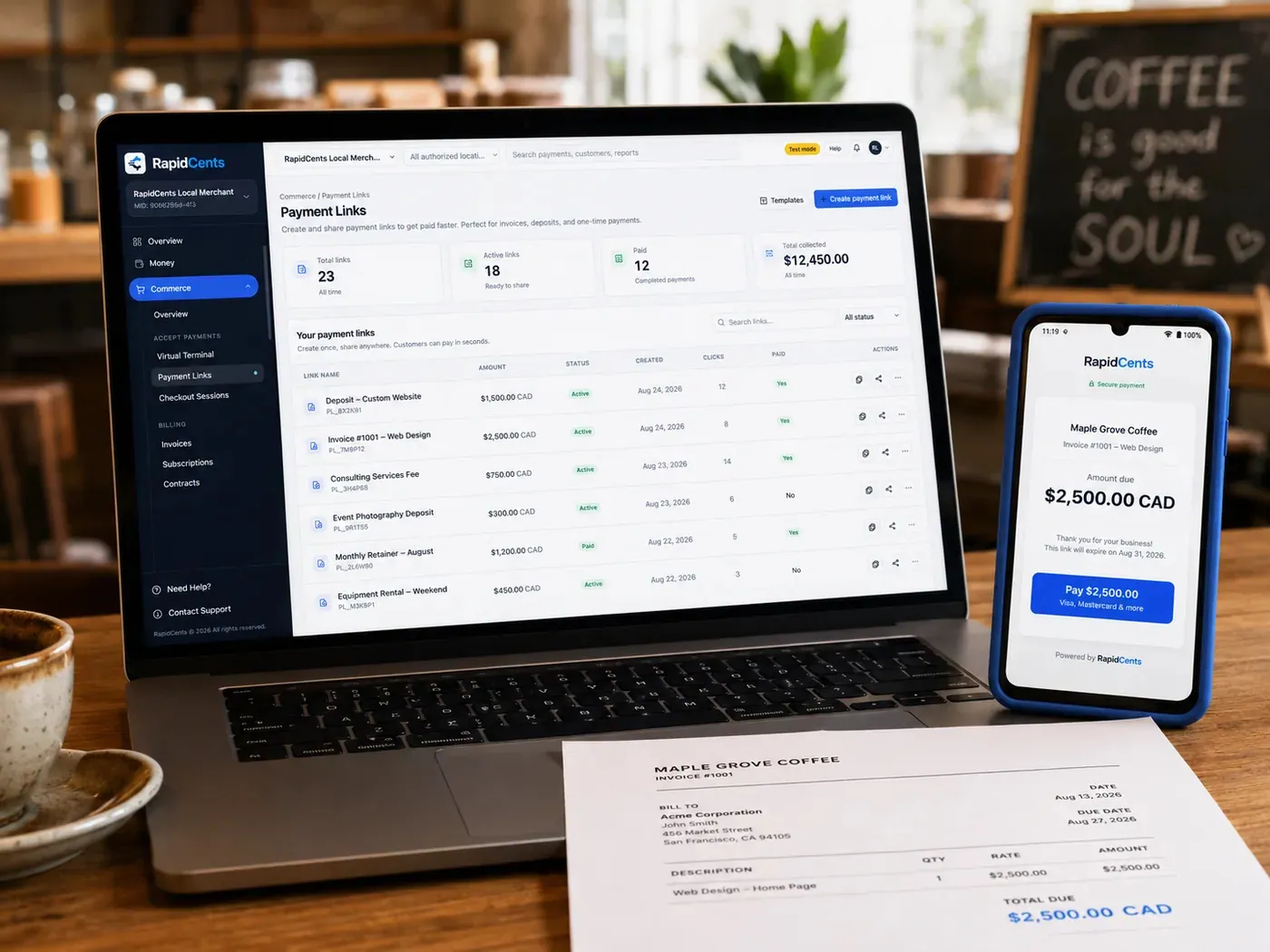
The RapidCents payment links screen listing created links with their amount, status, click count and whether they have been paid, beside a phone showing the branded page a customer opens to pay $2,500.00. Payment Links
RapidCents payment links let staff generate branded pay-by-link URLs for invoices, deposits, balances and…
Explore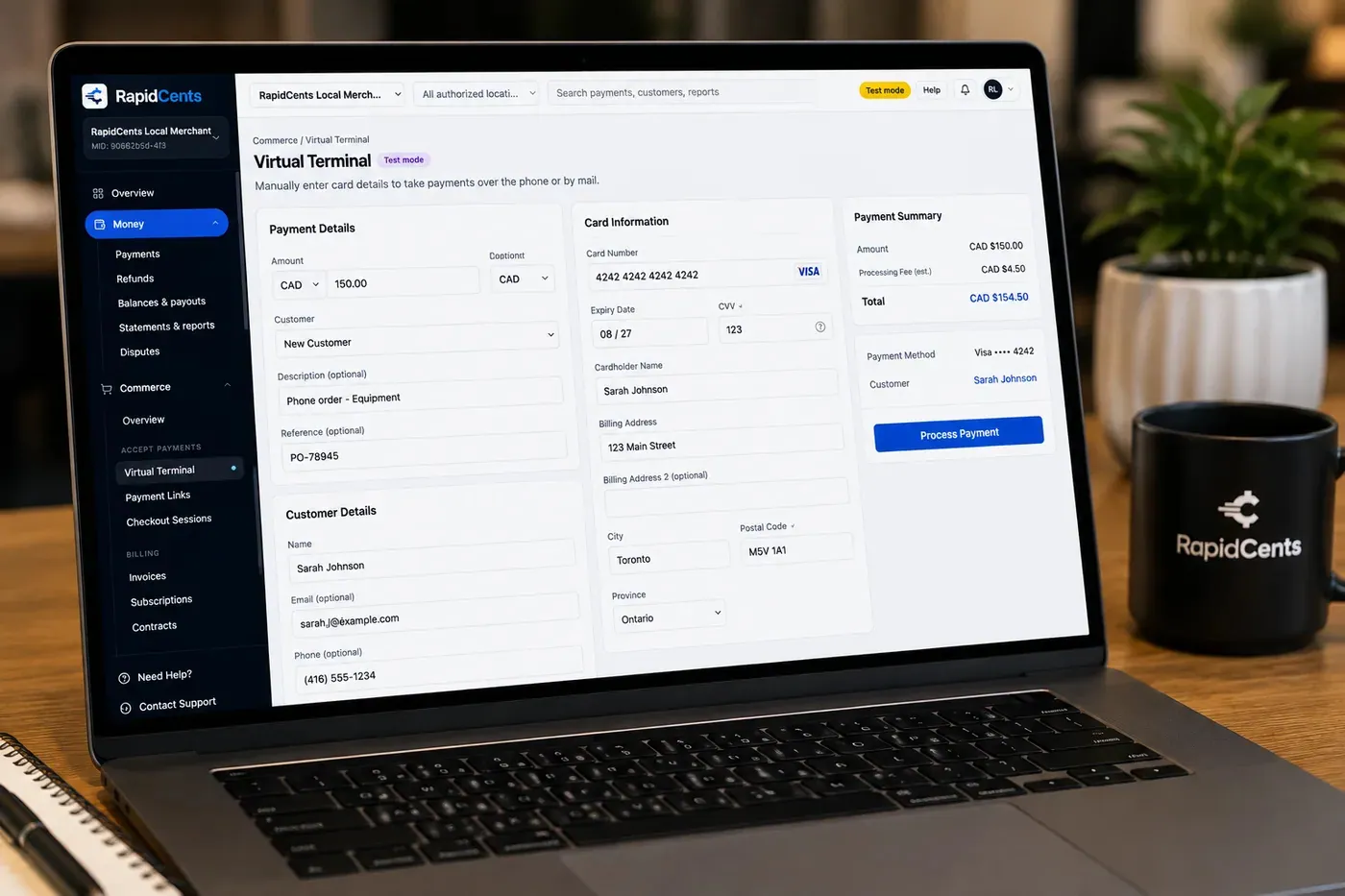
The RapidCents virtual terminal: payment details, card number, expiry and CVV keyed by hand on the left, with a payment summary on the right showing the amount, the estimated processing fee and a Process Payment button. Virtual Terminal
The RapidCents virtual terminal lets authorized staff enter mail-order and telephone-order payments through a…
Explore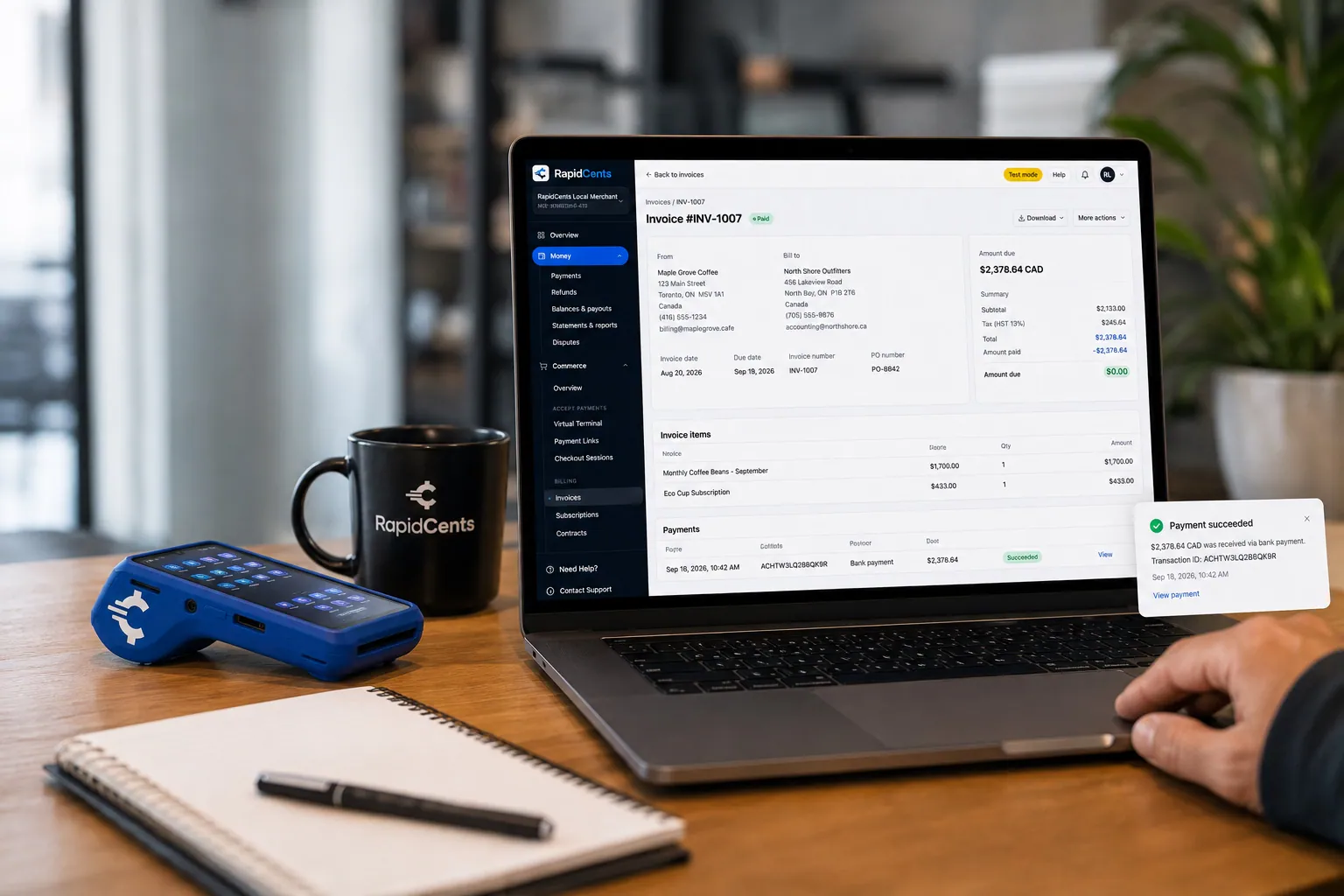
A merchant invoices a customer for bank debit through RapidCents, with card terminal capture available on the same desk. ACH / Bank Payments
Bank payments suit recurring and high-value invoices where card fees are the wrong tool. Collect directly…
Explore


How do you take purchasing card and phone orders from institutional buyers?
You take institutional orders by phone through the Virtual Terminal, or by payment link when the buyer would rather enter the card details. Purchasing cards are a common way hospital departments pay, so your RapidCents representative sets up commercial card handling and the ticket limits on your account before you quote a buyer.
Hospital purchasing card payments
A hospital department may pay with a purchasing card issued to a named cardholder. Capture the cardholder's name, the purchase order number and the department on the payment. Enhanced Level 2/3 data can travel with commercial card payments, and your representative explains how that works on your account.
Staff permissions and entry checks
Give order desk staff permission to key sales and keep refunds and voids for a supervisor. The Virtual Terminal applies address and security code checks, and 3-D Secure where applicable. Never take card numbers by ordinary email or chat; send a payment link so the buyer enters them on a secure page.
An urgent reorder of sutures and drapes
Say a procurement coordinator phones in an urgent reorder of sutures and drapes before a surgery list. Your order desk keys the card with the department's reference and emails a receipt. If the issuer declines, the desk sends a payment link so the coordinator can try another card.
How much does medical supply credit card processing cost?
Medical supply credit card processing cost depends on your card mix, ticket size and how each card is taken. We price every account on interchange-plus: interchange passes through at cost, plus your RapidCents markup set out in your Fee Schedule, plus fees for equipment or services if applicable. It is month to month, with no fixed term.
Card mix and ticket size
Interchange is set by the card networks and varies with card type: debit, credit, premium or commercial. A supplier with large institutional invoices paid on purchasing cards has a different mix than a counter that sells small consumables. Your own mix is what drives your cost.
Channel: keyed, linked or tapped
How the card is taken affects interchange too. A card tapped or inserted at a terminal in a showroom is treated differently from one keyed over the phone or paid through a link. Your split between counter, phone and invoice links shapes what you pay.
What to bring to Fee Check
Upload a recent processing statement to Fee Check to see interchange separated from markup. Bring several months of statements, your average invoice, your refund and chargeback volume, and any equipment or service fees, and your representative lines them up with your Fee Schedule.
Will your ERP or accounting software work with RapidCents payments?
Your ERP can record payments made through RapidCents. We connect settled transactions, fees and refunds to QuickBooks Online and Xero, and SAP and NetSuite import settlement files. RapidBridge also works with web-based platforms like Acumatica and Dynamics 365 Business Central. For other distribution software, RapidCents integrates through APPIE and RapidBridge, and your representative walks you through the right option.
NetSuite
NetSuite holds your customers, invoices and cash application. Settlement import files carry settled transactions, fees and refunds from RapidCents into it, and RapidBridge works with Oracle NetSuite in the browser. Tell your representative your edition and subsidiaries, and they will show you how payment links carry your internal invoice number.
SAP Business One
SAP Business One posts incoming payments against open invoices. SAP imports RapidCents settlement files rather than running a live connector, and RapidBridge works with the SAP Business One Web Client. Your representative walks you through the fields your reconciliation team needs for your version.
Dynamics 365 Business Central
Business Central applies customer payments to open ledger entries. RapidBridge works with Dynamics 365 Business Central, so a card payment posts against the entry you already have open. Your representative shows you how payment references and fees come across for your version.
Acumatica
Acumatica manages receivables and payment application for distributors, and RapidBridge works with it in the browser, so a payment lands on the invoice your team already has open. Your representative explains whether payment links or file imports suit your edition best.
Epicor Prophet 21
Prophet 21 is distribution software that handles orders, invoices and payment application. RapidCents integrates with many major platforms through APPIE and RapidBridge, and the right option depends on your vendor and version. Tell your representative how Prophet 21 posts payments, and they will map the data flow with you.
Payment options for medical suppliers in the United States
Medical and surgical suppliers in the United States can generally offer credit and debit cards, PIN debit where supported, and ACH bank payments, with settlement in USD. Your RapidCents representative sets these up on your account.
Cards and PIN debit
Visa, Mastercard, American Express and Discover work for invoices and deposits. PIN debit, where supported, and contactless suit showroom and counter pickups.
ACH bank payments and state rules
ACH suits larger recurring invoices, with a signed authorization from the payer. Sales tax treatment of medical supplies varies by state, so settle it with your accountant, not from the payment record.
How do you switch processors and reconcile supplier payments?
Switch processors in stages: inventory what you have, test the new flow with a sale, a refund and a deposit, run both providers in parallel where needed, and reconcile every settlement to your ledger. Move live invoices once the test passes and your buyers know where to pay.
Inventory first
List every stored card with its written authorization, every standing shipment schedule, open invoices with payment links, and pending refunds. Moving stored cards between processors takes both providers' agreement, so plan to ask buyers to re-authorize if a transfer is not possible.
Test before live traffic
Once your account is approved, run a test sale, a refund and an equipment deposit through the new setup before you send a real invoice. Check that the purchase order reference shows on the receipt and the report. Keep old payment links active only until the open invoices they cover are paid.
Reconcile deposits to the ledger
Match each settlement to the invoices it covers using the references on the records, and book fees separately from sales. Reports export as CSV or PDF for accounting import. Run both providers in parallel while open invoices overlap, then close out the old one.
Payment questions from medical and surgical suppliers
What is the best payment processor for medical and surgical suppliers?
The best processor is the one that fits your invoices, buyers and software. For a supplier that means invoice payment links, purchase order references, purchasing card handling, bank payment options, refund and credit tools, reporting your ERP can use and written pricing. That is what RapidCents is built around, and your representative reviews your catalogue and sales channel with you.
How much does credit card processing cost for medical and surgical suppliers?
The cost depends on your card mix, invoice size and how cards are taken, so no single figure fits every supplier. RapidCents uses interchange-plus: interchange at cost, your RapidCents markup in your Fee Schedule, and fees for equipment or services if applicable, month to month. Upload a statement to Fee Check to see interchange separated from markup.
Can NetSuite or other distribution software use a different payment processor?
Often yes, and it depends on the software, edition and how payments are posted. Some packages bundle their own processor or require a named gateway, while others accept payment links or file imports. RapidCents connects to QuickBooks Online and Xero, SAP and NetSuite import settlement files, and we integrate with many major platforms through APPIE and RapidBridge. Your representative walks you through the option for your software.
How can medical suppliers switch processors without losing payment history?
Export your payment history before you cancel and keep it with your ledger. List stored cards with written authorizations, standing shipment schedules and open invoices. Moving stored cards takes both providers' agreement, so buyers may need to re-authorize. Test a sale, a refund and a deposit, then run both providers in parallel until open invoices clear.
Which payment options can a medical supplier in the United States offer?
A medical supplier in the United States can usually offer Visa, Mastercard, American Express and Discover, PIN debit where supported, and ACH bank payments, settled in USD. Your RapidCents representative tells you which ones suit your buyers, and your accountant settles state tax details.
Can hospital purchasing cards pay supply invoices?
Yes, and they are common in hospital departments. Your RapidCents representative sets up commercial card handling and the ticket limits on your account. Attach the buyer's purchase order number and department to the payment. Do not split a large invoice to get under a limit; use a documented partial or staged payment the buyer agrees to in writing instead.
What documents support a disputed equipment payment?
Keep the order acceptance, the item details, the delivery acknowledgement and the payment record together. They show what the buyer agreed to, what shipped and when it arrived. Send them within the deadline in the dispute notice. Disputes and Chargeback Protection tools help you track alerts and deadlines, and the card network decides the outcome.
Will a payment platform manage medical-device compliance?
No. RapidCents collects money and records the payment; it does not manage medical-device compliance. Your supplier licensing, product registration, labeling, recall and traceability duties stay with you and your operational software. RapidCents covers payments, and your representative goes through your catalogue at onboarding: what you sell, how you sell it and where.
How do you handle a part payment or short shipment on an open invoice?
Apply the part payment to the open invoice and leave the balance showing. Invoicing lets partial payments apply to an open balance, and a payment link can carry a set amount. For a short shipment, adjust the invoice to what shipped, then bill the backordered lines separately. Net terms are a due date you agreed with the buyer, not financing from RapidCents.
Can we keep a card on file for standing shipments?
Yes, with the buyer's written authorization. Agree the amount or schedule, the timing and how to cancel, and keep that record. RapidCents offers a Secure Card Vault and Payment Tokenization for stored cards. Without authorization, send a new payment link for each order. A cardholder can withdraw permission, and a declined stored card needs a fresh request.
What MCC is used for medical and surgical suppliers?
MCC 5047 is commonly associated with medical, dental and hospital equipment and supplies. RapidCents sets the correct merchant category with you during onboarding, based on what your business actually sells and how. A supplier with a mixed catalogue is reviewed product by product, and the code alone never settles it.
Related supplier pages
Dental clinics collecting from patients have their own industry guide. Healthcare distributor payments follow the same order, invoice and deposit flow for dental, veterinary, laboratory and pharmaceutical suppliers, and B2B & Wholesale covers the wider supplier model.
B2B & Wholesale
Collect net-terms invoices by payment link with the PO number attached, take commercial…
Dental Suppliers
From monthly consumables reorders to chair and imaging deposits, collect what clinics…
Veterinary Suppliers
Get invoices, standing orders and equipment deposits paid by the veterinary practices…
Laboratory & Scientific Suppliers
Collect on lab purchase orders, instrument deposits and staged deliveries, with the PO…
Pharmaceutical Wholesalers
Collect pharmacy account invoices, balances and deposits with payment links, invoicing…
Restaurant Suppliers
For dealers and distributors that sell kitchen equipment, smallwares and consumables to…
Grocery & Food Distributors
Get paid for every delivery to grocery stores, restaurants and institutional kitchens…
Produce Wholesalers
Collect on final weights, apply quality credits to the right delivery, and keep…
Take the next step
Review your medical supplier payment workflow
Upload a recent processing statement to Fee Check to see interchange separated from markup, then walk a RapidCents specialist through your order, invoice and deposit flow.
- No obligation
- Payment specialists, not a call centre
- Secure statement upload