


Payment processing for feed suppliers and farm supply wholesalers
Payment processing for feed suppliers means collecting delivered-feed invoices, final ticket quantities and repeat orders from the farms you sell to. RapidCents gives feed mills, farm supply distributors and livestock supply wholesalers Invoicing, Payment Links, Mobile Terminals and Recurring Payments, so you can take cards in person, online or by phone and hand finance a clean record.

- PCI DSS Level 1
- SOC 2 Type II
- All major cards: Visa, Mastercard, Amex, Discover, UnionPay, Diners Club & Interac Debit
- Interchange-plus available
- Canadian support
How do feed suppliers get paid?
Feed and farm supply wholesalers get paid on delivered-feed invoices, repeat orders, deposits on special orders and dock or truck collections. B2B livestock supply payments differ by who pays, what triggers the charge and which exception your office handles. Here is how each one runs, and the three that need the most care get a closer look.
Delivered-feed invoices
A farm account receives a bulk delivery, and the final ticket quantity triggers the invoice. The farm's bookkeeper pays by payment link, card or phone with your office. If the quantity is adjusted before payment, the invoice is revised first, and finance gets a paid invoice record with the ticket reference.
Repeat and standing orders
A dairy or poultry farm reorders the same ration every few weeks. With the farm's written authorization, a stored card or recurring schedule collects each order. Amounts and dates can vary with tonnage, so agree how each charge is confirmed. Finance sees each charge matched to its order number.
Deposits on special orders
A custom mix or a pallet of imported supplement needs a deposit before the mill blends or ships it. You send a payment link or take the card by phone on the Virtual Terminal, then collect the balance against the final delivery ticket.
Dock and driver collections
A farm hand picks up bagged feed at your dock, or your driver delivers and the farm pays at the truck. A Mobile Terminal takes the card at the dock or yard gate. For partial loads and returned bags, the receipt carries the ticket number so the record stays straight.
How do feed invoice payments work when delivered quantities change?
Collect on the final delivery ticket quantity, not the quoted order. The ticket sets the invoice, an approved adjustment changes it, and the farm pays the final amount by payment link, card or phone. Feed invoice payments stay clean when the ticket number travels with every charge.
From delivery ticket to paid invoice
The farm orders a ration, your mill loads and weighs it, and the delivery ticket records the final quantity. Office staff build the invoice in Invoicing from that ticket and send a Payment Link by email or SMS. Put the ticket number and farm account in the reference field first.
Short loads, moisture and quantity disputes
Agree before the first order who may approve an adjustment. A short load, shrink or moisture correction is handled by a revised invoice before payment, or a credit note or refund after it. Collect any difference with a second link. Keep the ticket with the record if the farm questions the amount.
A ten-tonne dairy ration, quoted at $4,800
Say a feed mill quotes ten tonnes of dairy ration for $4,800 and the scale ticket shows 9.6 tonnes. Staff revise the invoice to match the ticket and resend the link. The farm pays the revised amount, and the ticket number appears on the payment record.
Can a farm authorize repeat-order payments by card?
Yes, when the farm gives explicit authorization. Agree in writing what may be charged, when, and how a variable amount is confirmed. Feed orders change with herd size and season, so a repeat-order authorization should say whether each charge needs a notice, a cap or a fresh approval.
Authorization before the first stored card
Send a document through Contracts & eSignatures or a hosted form where the farm owner or authorized buyer agrees to store a card, names who may order, and sets how amounts and dates are communicated. Without that authorization, do not store the card. Cancellation steps belong in the same document.
Variable amounts and dates
Feed is not a fixed monthly fee. Use a stored card with a notice before each charge, or a Recurring Payments schedule for fixed standing orders such as a weekly mineral supply. Variable amounts should reference the delivery ticket. Declines and expired cards go through your follow-up rules.
A poultry farm's weekly layer-feed order
Say a poultry farm authorizes a weekly layer-feed order by card. The office sends a notice with the ticket amount the day before the charge. When a card declines, staff send a Payment Link instead of retrying silently, and the authorization stays on the farm's customer profile.
RapidCents products for feed suppliers
Invoicing and Payment Links carry delivered-feed invoices and deposits, Mobile Terminals take cards at the dock or yard gate, and Recurring Payments handles authorized standing orders. Your RapidCents representative will match the products to your catalog.
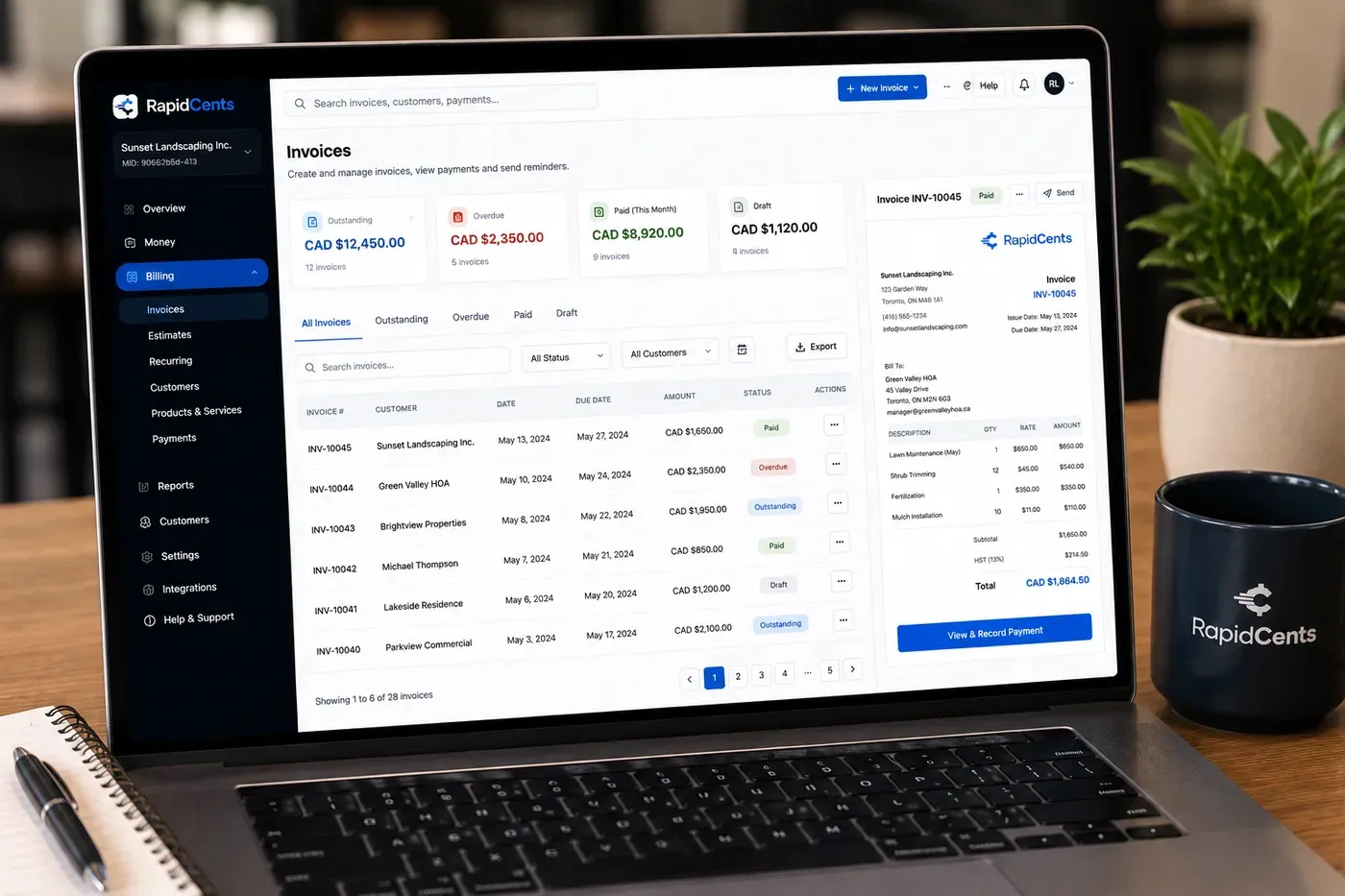
The RapidCents invoices screen: outstanding, overdue, paid and draft totals across the top, the invoice list below them, and a preview of one invoice on the right with its line items and a View & Record Payment button. Invoicing
RapidCents invoicing helps professional services, contractors and B2B suppliers create branded invoices…
Explore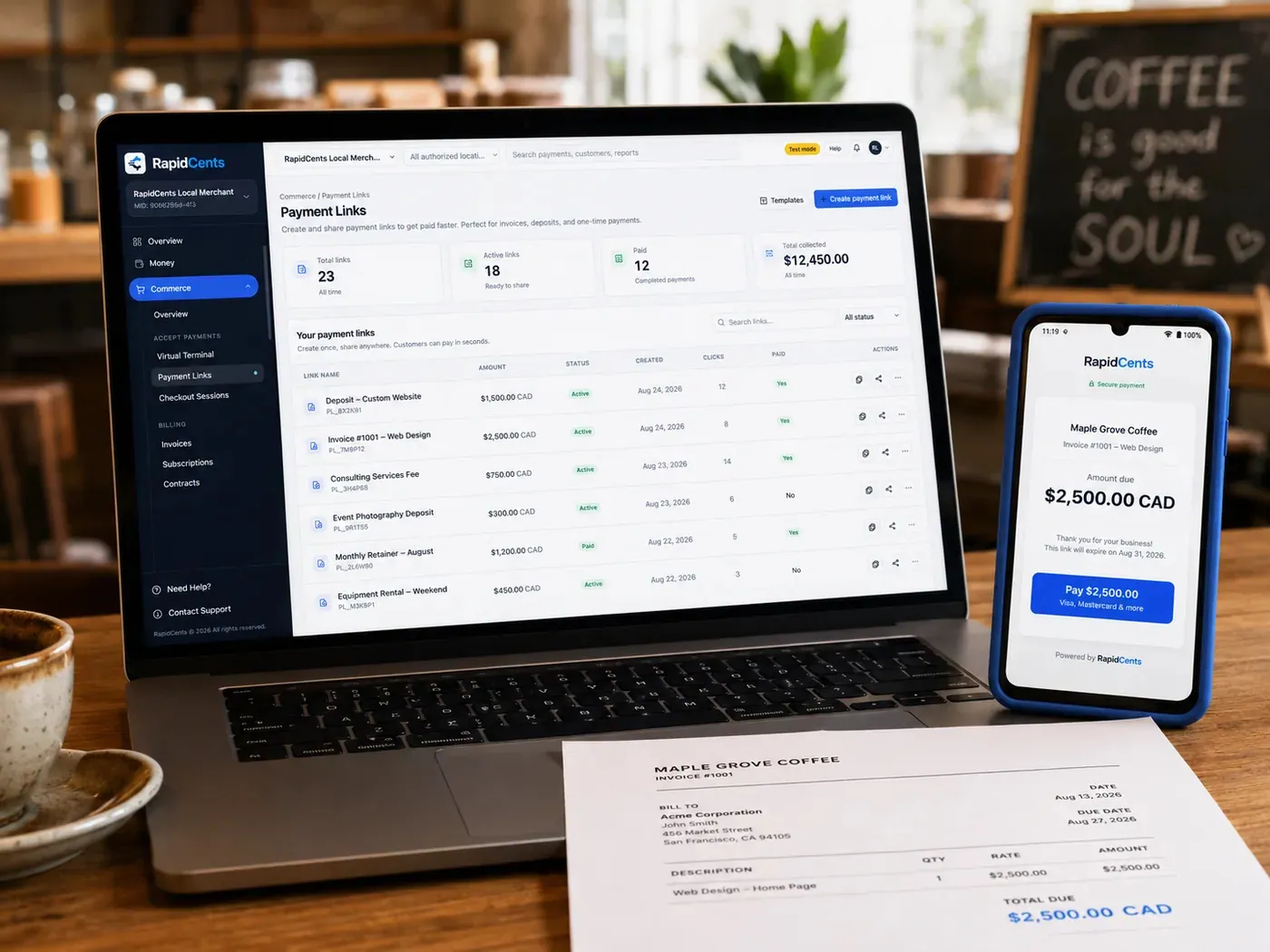
The RapidCents payment links screen listing created links with their amount, status, click count and whether they have been paid, beside a phone showing the branded page a customer opens to pay $2,500.00. Payment Links
RapidCents payment links let staff generate branded pay-by-link URLs for invoices, deposits, balances and…
Explore
A staff member takes a card payment on a RapidCents handheld terminal, with the same sale appearing on the dashboard. Mobile Terminals
RapidCents mobile terminals are battery-powered wireless devices with LTE and Wi-Fi so staff accept payments…
Explore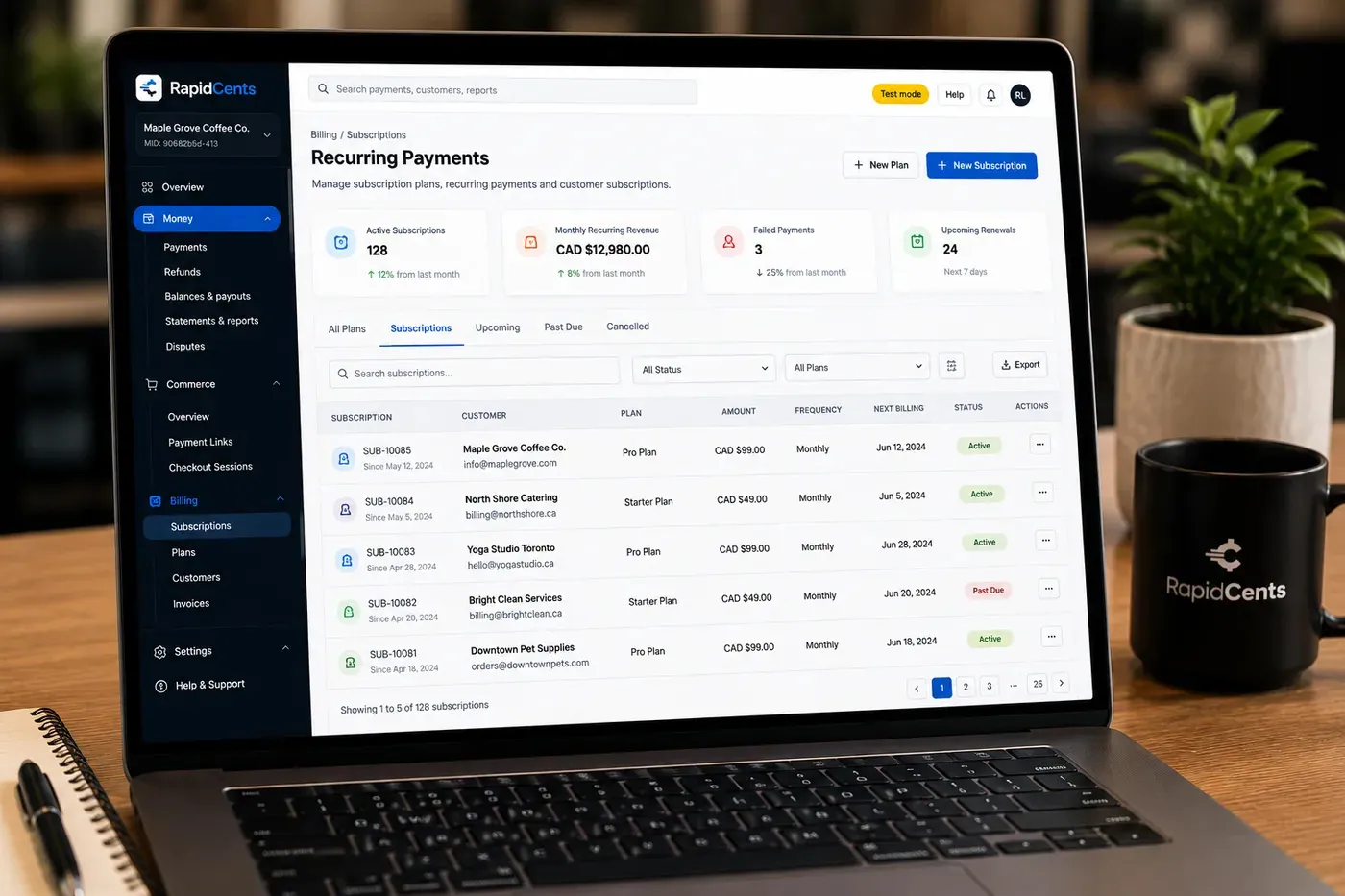
The RapidCents recurring payments screen showing active subscriptions, monthly recurring revenue, failed payments and upcoming renewals, above a list of subscriptions with their plan, amount, frequency and next billing date. Recurring Payments
RapidCents recurring payments manage subscription plans, membership renewals and installment schedules with…
Explore


How do you collect deposits and balances on special-order farm supplies?
Take a deposit when the order needs special blending or imported stock, then collect the balance against the final ticket. Both payments belong to your own sale, with the order reference on each. A deposit is a partial payment of your invoice, not a loan and not funds held for anyone else.
Deposit, blend, deliver, balance
The farm approves a custom mix quote. You send a Payment Link for the deposit, or take the card on the Virtual Terminal when the farm calls. After blending and delivery, the final ticket sets the balance, collected by a second link or at the truck with a Mobile Terminal.
Pickups, driver collections and returns
Bagged goods collected at the dock or paid at the truck use a Mobile Terminal, with the order number on the receipt. Returned bags or unopened pallets go back to the original card as a refund, or as a credit note if the farm keeps an open account with you.
A custom swine mix, $2,000 down
Say a wholesaler takes a $2,000 deposit on a custom swine mix by Payment Link. Delivery ends with a final ticket for $6,350. The driver takes the remaining $4,350 on a Mobile Terminal at the barn gate, and both payments post against one order number.
What affects animal feed wholesaler card processing costs?
RapidCents prices on interchange-plus. Interchange, set by the card networks, passes through at cost. Your RapidCents markup appears in your Fee Schedule, plus fees for equipment or services if applicable. Service is month to month with no fixed term. For a feed supplier, large tickets, card types and channels shape the total.
Large tickets and card type
Feed invoices are often large, and interchange varies with debit, credit, premium and commercial cards. A farm paying a big load on a business card costs differently from a farm hand paying for bagged goods on a debit card. Your RapidCents representative will tell you which enhanced transaction data fits your setup.
Channel and how the card is taken
A card tapped or inserted at the dock is priced differently from a card keyed by phone or paid online through a link. Count how many farm payments arrive by each channel, and how many are refunded or disputed, because those volumes change what you pay.
What to bring to Fee Check
Bring recent processing statements, your average ticket, the split between in-person, phone and link payments, and your refund and chargeback counts. Fee Check reads an uploaded statement and shows interchange separately from markup, so you can compare written quotes on the same mix.
Which accounting and ERP software can receive feed payment data?
RapidCents integrates with many major platforms through APPIE and RapidBridge, so most feed suppliers keep the accounting and ERP software they run today. RapidBridge works with Oracle NetSuite, SAP Business One Web Client, Dynamics 365 Business Central and Acumatica, and settled transactions, fees and refunds flow to QuickBooks Online and Xero. Your RapidCents representative will walk you through the option for your vendor and version.
NetSuite and SAP Business One
These systems hold the customer, invoice and delivery ticket records. RapidBridge works with Oracle NetSuite and SAP Business One Web Client, and SAP and NetSuite also import settlement files, so settled transactions, fees and refunds reach the ledger. Tell your representative your edition and the reference fields your finance team needs.
Dynamics 365 Business Central, Acumatica and Epicor Prophet 21
RapidBridge works with Dynamics 365 Business Central and Acumatica, so a card payment posts against the customer invoice you already have open. For Epicor Prophet 21 and other ERPs, the right option depends on your vendor and version, and your RapidCents representative will walk you through it.
QuickBooks Online and Xero
RapidCents connects settled transactions, fees and refunds to QuickBooks Online and Xero. In any software, match each payment to an invoice by ticket number and keep fees separate from sales, so your books and your bank deposit agree.
Payment options for feed suppliers in Canada
Feed suppliers in Canada can take Interac debit and credit cards at the dock, card payments by phone or link, and EFT or pre-authorized debit (PAD) bank payments for farm accounts, settled in CAD. Your RapidCents representative will walk you through which methods are set up on your account.
Cards and Interac debit
Interac debit with chip and PIN or contactless works at the counter, dock or yard gate on a terminal, alongside Visa, Mastercard and American Express. Invoice payment links and phone orders use credit cards.
EFT and PAD bank payments
EFT and PAD bank payments suit recurring farm accounts only with a signed authorization from the account holder. GST/HST on invoices and provincial rules for feed and farm products stay with your advisers; your representative can show you what is enabled on your account.
How do you switch to RapidCents and reconcile feed payments?
Switch in steps, not overnight. List open invoices, stored cards, authorizations and standing orders, test a sale, a refund and a deposit, run both processors side by side where needed, then reconcile deposits to your ledger. Once your account is approved, your RapidCents representative walks you through moving stored cards, which needs both providers to agree.
Inventory before you move
List open delivered-feed invoices, farm accounts with stored cards, written authorizations, recurring schedules and unapplied deposits. Note who may order and who pays for each farm. Cards without a documented authorization should be re-authorized by the farm, not carried over.
Test, then run in parallel
Run a test sale, refund and deposit with a sample ticket before live traffic moves. Keep your old processor for open invoices while new orders go through RapidCents. Setup steps depend on your account, so your representative will give you a timeline before you promise farms a date.
Reconcile deposits to the ledger
Match each settlement to invoices by ticket number, then post fees and refunds separately so farm balances and your bank deposit agree. Use the Merchant Dashboard and Reporting exports for QuickBooks Online, Xero or your ERP import template, and keep a note of any credit notes.
Payment questions from feed suppliers
What is the best payment processor for feed suppliers?
The best processor is the one that fits your delivered-feed invoices, farm account balances and accounting software at a clear, comparable price. Compare written interchange-plus quotes and check how repeat orders and deposits are handled. RapidCents suits suppliers who want invoice-led collection, and Fee Check lets you compare quotes on your own payment mix.
How much does credit card processing cost for feed suppliers?
The cost depends on your payment mix, so we do not quote a single figure. Pricing is interchange-plus: interchange passes through at cost, your RapidCents markup is in your Fee Schedule, and fees for equipment or services apply if applicable. Service is month to month with no fixed term. Upload a statement to Fee Check to see interchange separately from markup.
Can NetSuite or SAP Business One use a different payment processor?
Yes. RapidBridge works with Oracle NetSuite and SAP Business One Web Client, so payments can run through RapidCents inside the software you already use, and SAP and NetSuite import settlement files so settled transactions, fees and refunds reach the ledger. Tell your RapidCents representative your edition and reference fields, and they will walk you through the setup.
How can feed suppliers switch processors without losing payment history?
Switch in stages and keep the old processor's reports for history. List open invoices, stored cards, written authorizations and standing orders, then test a sale, refund and deposit. Moving stored cards needs both providers to agree, so some farms may need to authorize their card again. Reconcile deposits to the ledger by ticket number.
Which payment options can a feed supplier in Canada offer?
A feed supplier in Canada can usually offer Interac debit, Visa, Mastercard and American Express cards, payment links and phone orders, and EFT or PAD bank payments, settled in CAD. Bank payments need the farm's signed authorization, and your invoice terms stay as agreed with the farm. Your RapidCents representative will walk you through what is enabled on your account.
How are bulk delivered-feed quantities reconciled?
Reconcile to the final delivery ticket quantity and any approved invoice adjustment. The ticket sets the invoice, a revised invoice or credit note records a correction, and the farm pays the approved amount. Put the ticket number in the payment reference so the settlement report, invoice and farm account match. A refund returns an overpayment to the original card.
Can a farm authorize repeat-order payments?
Yes, if the farm gives explicit authorization to store its card and charge repeat orders. Agree who may order, how the variable amount and date are confirmed, and how the farm cancels. A fixed standing order can use Recurring Payments, while a variable order may use a notice before each charge. Without authorization, send a Payment Link each time.
Does RapidCents hold payments for other farms?
No. RapidCents collects only your own sales to the farms you supply. Holding or passing on funds for other farms, livestock sale escrow and marketplace payouts are outside what we offer. Each payment should match your own invoice, your ticket and the buyer's account, never a third party's funds.
Is a credit note the same as a refund on a farm account?
No. A credit note reduces what the farm owes on its account, while a refund returns money to the card that paid. Use a credit note for a short load or returned pallet when the farm has open invoices, and a refund when it has already paid in full. Both should reference the original ticket and invoice.
Can a farm pay part of a feed invoice by card?
Yes, where your invoice terms allow part payments. Invoicing and Payment Links can apply a partial amount to an open balance and show what remains. A card payment does not change the net terms you agreed with the farm, and it is not financing. Do not split one charge to avoid limits; use documented staged payments.
Related supplier industries
Feed and farm supply wholesalers share supplier workflows with the B2B & Wholesale parent page, and with nearby pages for agricultural input, industrial equipment, truck and fleet parts and tire suppliers. Farms collecting from their own customers have their own page.
B2B & Wholesale
Collect net-terms invoices by payment link with the PO number attached, take commercial…
Tire Wholesalers
Collect dealer preseason orders, staged balances and return credits from the tire shops…
Truck & Fleet Parts Suppliers
RapidCents helps heavy duty parts distributors collect urgent pickup orders, depot…
Industrial Equipment Suppliers
Collect deposits, shipment and commissioning balances, and spare-parts reorders from the…
Agricultural Input Suppliers
Collect seasonal farm invoices, deposits and cooperative account balances by card…
Dental Suppliers
From monthly consumables reorders to chair and imaging deposits, collect what clinics…
Veterinary Suppliers
Get invoices, standing orders and equipment deposits paid by the veterinary practices…
Medical & Surgical Suppliers
RapidCents helps medical and surgical suppliers collect hospital, clinic and practice…
Take the next step
Check your feed supplier payment setup
Upload a recent processing statement to Fee Check and see interchange separated from your markup, using your own mix of large invoices, dock and phone payments.
- No obligation
- Canadian payment specialists
- Secure statement upload



