


Payment processing for veterinary suppliers selling to clinics
Payment processing for veterinary suppliers comes down to three jobs: getting practice reorders paid, collecting equipment deposits and delivery balances, and settling head-office invoices. RapidCents covers them with invoice payment links, the Virtual Terminal, stored cards and counter terminals, and integrates with many major platforms through APPIE and RapidBridge. Controlled substances are never accepted.

- PCI DSS Level 1
- SOC 2 Type II
- All major cards: Visa, Mastercard, Amex, Discover, UnionPay, Diners Club & Interac Debit
- Interchange-plus available
- Canadian support
How veterinary suppliers get paid
Veterinary suppliers get paid through four main jobs: practice reorders, equipment orders, clinic-group invoices and urgent orders, with returns and shortages settled as credits. B2B veterinary supply payments come from single-vet clinics, mobile and mixed-animal practices, multi-hospital groups, animal shelters and teaching hospitals. RapidCents gives you one set of tools to collect from all of them, with the clinic, branch and PO on every payment.
Practice reorders and standing orders
An inventory lead or practice manager reorders syringes, IV catheters, suture, exam gloves, cage liners and bandaging, often on a standing order that ships every week or two. Each shipment is invoiced and paid by a card the practice authorized you to store, an invoice payment link or a phone payment. If a line ships short, you invoice only what went out, and finance applies each payment by its invoice, clinic account and PO.
Equipment deposits and delivery balances
A practice owner or medical director buying digital radiography, an anesthesia machine, patient monitors, a lab analyzer or a bank of kennels pays a deposit when the quote is signed and the balance after delivery or installation. The deposit is taken by signed agreement, invoice link or terminal. If the configuration changes after signing, the balance invoice reflects it. Finance follows one order number from quote to final invoice.
Clinic-group and head-office invoices
Each hospital in a group orders under its own branch account, while the group's procurement or accounts payable team may pay for all of them, invoice by invoice through links or as one statement payment. Put a branch identifier on every invoice, so finance can split one payment correctly across hospitals even when the payment arrives without branch references.
Urgent orders from emergency hospitals and ambulatory vets
A 24-hour emergency hospital runs short of infusion sets overnight, or an equine or food-animal vet needs OB sleeves and calving supplies before the next farm call. They pay by phone through the Virtual Terminal, by a payment link opened in the truck, or by card at your will-call counter. If a card declines or an address does not match, send a link for the same invoice. The audit log shows who took each phone payment.
Returns, shortages and credit notes
Practices send back damaged deliveries, the wrong catheter gauge or e-collar size, or unopened stock under your return policy, and short shipments are corrected after delivery. Each agreed return becomes a credit against the original invoice and then a lower open balance, an account credit or a refund to the original payment method. The return authorization number ties each credit back to the original invoice and payment.
How do veterinary practices pay for reorders and standing orders?
Veterinary practices usually pay for reorders remotely: a stored card charged as each standing-order shipment leaves, or an invoice payment link paid when an account invoice falls due. The stored card needs the practice's written authorization, and the link goes by email or text to the person allowed to pay. Either way, charge only the lines that shipped and keep the clinic account, invoice and PO on the payment.
From order to receipt
Orders arrive through your ordering portal, a call to customer service or the territory manager's visit. When the order ships, you invoice the shipped lines. A standing-order practice's stored card is charged for that invoice; an account practice receives the invoice with a payment link showing its account number and PO. The receipt names the invoice paid, so the practice manager can match it to the packing slip.
Set up scope, payers and stored-card consent first
Before the first charge, talk to your RapidCents representative about which products your account covers, since consumables and equipment are reviewed separately from medicines. Each clinic account should list its orderers, its authorized payers and whether a PO is mandatory. Keep a practice's card in the Secure Card Vault only once it has signed an authorization saying the amount follows each shipment's invoice, when charges happen and how consent is withdrawn.
Shortages, substitutions and declines
Backordered lines are invoiced when they ship, under the original PO, and a substitute product goes on the invoice only if the practice accepted it. Account Updater can refresh a stored card that expired or was replaced, where the issuer takes part. If the card still declines, send a payment link for that invoice and decide under your account terms whether the next standing order ships.
A standing order with a short shipment
Say a two-vet companion-animal clinic has a standing order every two weeks for exam gloves, syringes, IV catheters and cage liners under PO 2210. One cycle, the catheters are short and the practice accepts a different glove brand. The supplier invoices only what shipped and charges the stored card, then ships the catheters a week later on a second invoice under the same PO.
How do practices pay for equipment from signed quote to installation?
Vet equipment invoice payments usually come in two or three stages under one order number: a deposit when the practice signs the quote, sometimes a payment on delivery, and the balance after installation and in-service training. Every request lists the quoted total, payments received so far and the amount left. Settle the balance method early, since an imaging system can cost more than a card's available credit.
Signed quote, deposit, delivery, balance
Contracts & eSignatures lets the practice owner sign the quote and pay the deposit together; at a veterinary conference booth, a terminal or Tap to Pay on a supported phone takes it instead. Each later stage is an invoice against the same order number that lists earlier payments. Charge each stage when it falls due, because a card authorization held open until delivery would expire first.
Write the terms down before the deposit
The quote should name the equipment and model, the deposit, the expected delivery window, what triggers each later payment and the cancellation terms. Add what happens if delivery waits on the practice, such as an imaging room or surgical suite that is not finished. Decide early whether the balance goes by bank payment, by card within your account limits, or in stages matched to delivery and training.
Delays, partial deliveries and cancellations
If construction pushes delivery back, the deposit stays on the order under the signed terms. When a kennel bank or surgical package arrives in two shipments, invoice what was delivered and show the rest as open. A cancellation follows the quote's deposit terms, and any refund goes back to the payment method used. Never split one balance into several card charges to get under a limit.
Fitting out a new surgical suite
Say a practice adding a surgical suite orders an anesthesia machine, a multiparameter monitor, a surgical table and lights under order V-3318, and the owner signs and pays the deposit through an emailed agreement. Construction runs three weeks late, so delivery moves under the quote's terms. After installation and in-service training, the balance invoice lists the deposit, and the practice pays the remainder by bank payment.
RapidCents products for veterinary suppliers
Invoicing and Payment Links send each practice an invoice-specific request that keeps the clinic account, branch and PO, with partial amounts where you agree to them. The Secure Card Vault holds authorized cards as tokens for standing orders, and Reporting gives finance the settlement and fee detail to reconcile against your ERP.

The RapidCents invoices screen: outstanding, overdue, paid and draft totals across the top, the invoice list below them, and a preview of one invoice on the right with its line items and a View & Record Payment button. Invoicing
RapidCents invoicing helps professional services, contractors and B2B suppliers create branded invoices…
Explore
The RapidCents payment links screen listing created links with their amount, status, click count and whether they have been paid, beside a phone showing the branded page a customer opens to pay $2,500.00. Payment Links
RapidCents payment links let staff generate branded pay-by-link URLs for invoices, deposits, balances and…
Explore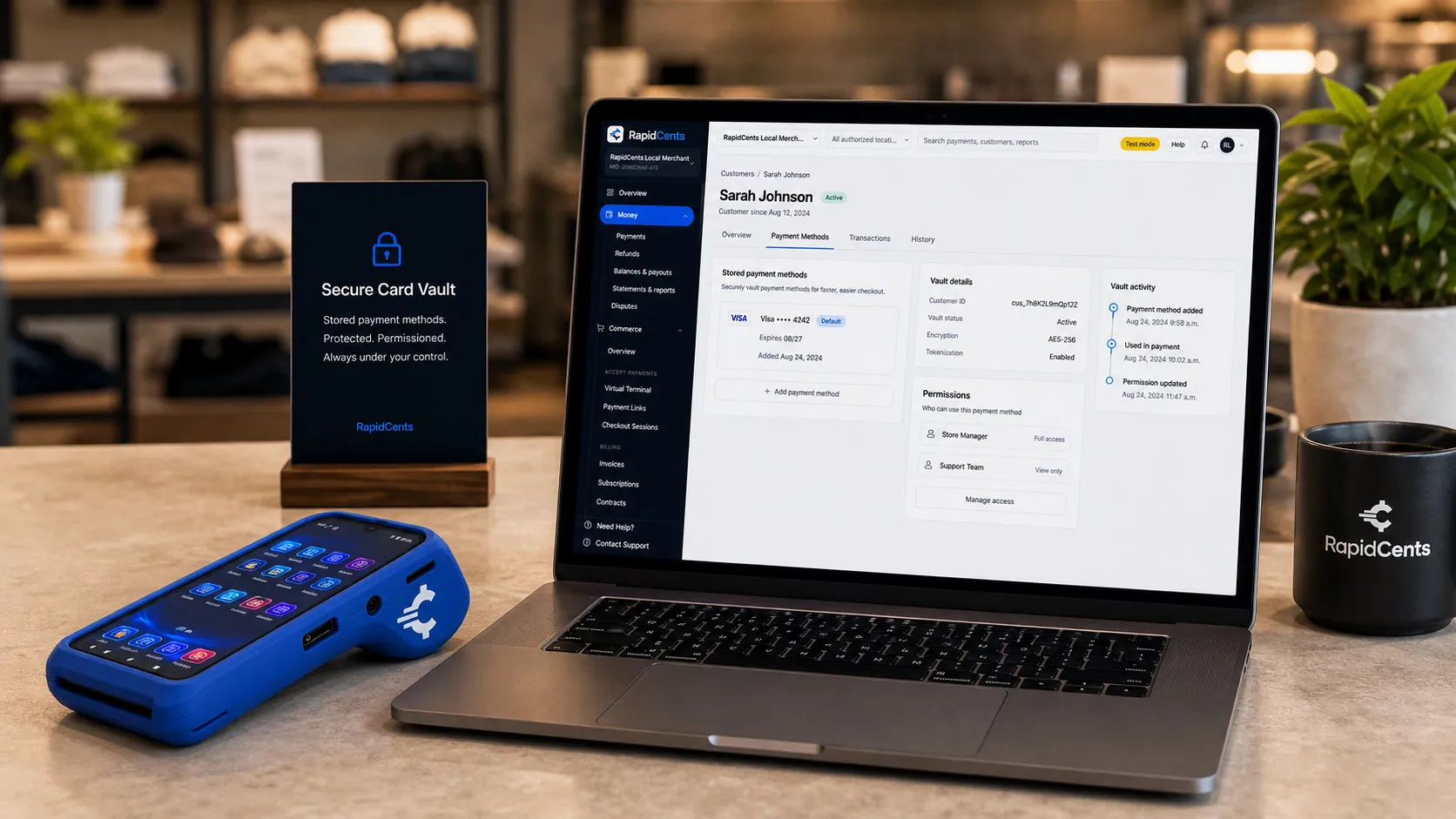
Card credentials sit in the RapidCents vault rather than in merchant software, with a terminal on the desk for new captures. Secure Card Vault
The vault stores tokenized payment methods against a customer record so staff can charge a returning…
Explore
A merchant reviews RapidCents reports for volume, mix and payouts, with the terminal that took the sales on the desk. Reporting
RapidCents reporting delivers customizable transaction, settlement and fee reports with CSV and PDF export…
Explore


How do clinic groups pay invoices for several hospitals?
A clinic group pays for several hospitals in one of two ways: each hospital pays its own invoices, or the group's head office pays for all of them, per invoice or from one statement. Either works when every invoice carries the hospital's branch identifier and every payment is matched to the invoices it covers. Agree the payer rules with the group before its first order, and keep them on file.
Branch accounts under one group
Set each hospital up as its own ship-to or branch account under the group's parent account, so every invoice names the site that ordered. Some groups split the roles: hospitals pay their own consumables by link while head office pays for equipment. When head office pays a statement in one payment, your receivables team applies it invoice by invoice in your ERP or accounting software.
Authorized payers, approved products and allocation
Keep a named list of orderers at each hospital and payers at head office, and send payment requests to no one else. Note any approved product list the group sets for its hospitals. If you want one payment allocated automatically across several invoices, your RapidCents representative will show you what your account, payment links and ERP setup record; otherwise allocate in your receivables process.
Withheld invoices, purchasing platforms and disputes
When head office withholds one invoice over a damaged delivery, apply the payment to the others and keep that invoice open until the credit is agreed. If hospitals order through a group procurement portal or a third-party purchasing platform, settle who collects payment before sending your own link. A disputed purchasing-card payment is tracked in Disputes and Chargeback Protection, where proof of delivery and the PO support your response.
One statement, four hospitals
Say a group with three general practices and a 24-hour emergency hospital gets one monthly statement listing 31 invoices by branch. Head office pays through a single payment link carrying the statement number but holds back one invoice for a damaged delivery. The supplier applies the payment to the other 30 by branch, credits the damaged line, and the corrected invoice rides on the next statement.
What shapes veterinary supply credit card processing costs?
Veterinary supply credit card processing costs are shaped by the cards practices and clinic groups use, how each payment is taken and how your sales split between standing-order consumables and imaging or anesthesia equipment. RapidCents prices on interchange-plus: the card networks set interchange, which passes through at cost, and you add the RapidCents markup written in your Fee Schedule, plus fees for equipment or services where they apply. You stay month to month; there is no fixed term.
Business and purchasing cards versus debit
Clinic groups, teaching hospitals and shelters may pay with business or purchasing cards, and some practice owners use rewards cards. Interchange on those is generally higher than on a debit card used at your will-call counter. One group's purchasing-card statement can make a month look very different from a month of small pickups, so compare several months, not one.
Remote versus in-person payments
Invoice links, portal checkouts and phone orders keyed into the Virtual Terminal are card-not-present payments, including the link an ambulatory vet pays from the truck. They generally carry higher interchange than chip or contactless payments at your will-call counter or a conference booth, so your split between remote and in-person payments is one of the first figures to pull from your statements.
Ticket size, bank payments and Level 2 or 3 data
Equipment balances are few and large; consumables reorders are many and small. For imaging or anesthesia balances, compare what a bank payment and a card payment would cost before setting invoice terms. A group's purchasing card can also pass the PO, tax amount and invoice lines as Level 2 or Level 3 data, and your RapidCents representative will show you how that works on your setup.
What to bring to Fee Check
Gather two or three recent statements from your current processor, your card mix, your average reorder and equipment ticket, your remote versus in-person split, and your refund and chargeback counts, including refunds on returned supplies. Fee Check splits interchange from markup on an uploaded statement, giving you a like-for-like baseline for comparing quotes. Thinking of a surcharge on invoices? Review card network rules and the law in each market you sell to first.
Getting practice payments into NetSuite, SAP Business One and other ERPs
Practice payments reach a veterinary supplier's ERP through RapidBridge, APPIE, a payment link whose receipt is posted afterward, or a settlement file imported on a schedule. RapidBridge works with Oracle NetSuite, SAP Business One Web Client, Dynamics 365 Business Central and Acumatica, and RapidCents connects settled transactions, fees and refunds to QuickBooks Online and Xero. Your RapidCents representative explains the right option for your edition and version.
NetSuite
RapidBridge works with Oracle NetSuite, and NetSuite can also import RapidCents settlement files: settled payments, fees and refunds load as a file. Test a group's statement payment to see that branch and invoice references land on the right customer records, and check whether a payment add-on already holds your stored cards.
SAP Business One
RapidBridge works with SAP Business One Web Client, and SAP can import RapidCents settlement files as well. Test how a deposit on an imaging order and its later balance post, so the deposit is neither recorded twice nor left sitting as unapplied cash. Your RapidCents representative will walk you through the option that fits your version and localization.
Dynamics 365 Business Central and Acumatica
RapidBridge works with both Dynamics 365 Business Central and Acumatica, so a card payment can post against the invoice you already have open. If you prefer a lighter start, send practices payment links that quote the ERP's invoice number and post each receipt to the customer ledger, or import settlement exports on a schedule. Check whether a payment extension you already run holds your stored cards.
Epicor Prophet 21
RapidCents integrates with many major platforms through APPIE and RapidBridge, and the right option for Prophet 21 depends on your version. If your team takes card payments at order entry or at the will-call counter, map which of those would move to RapidCents links, the Virtual Terminal or terminals, and your RapidCents representative will walk you through the rest.
QuickBooks Online and Xero
For books kept in QuickBooks Online or Xero, RapidCents carries each settlement's transactions, fees and refunds across, so your accountant sees every payment alongside the fees taken. Settle with your accountant how an equipment deposit sits before delivery and how a credit note for returned supplies posts.
Payment options for veterinary suppliers in Canada
A veterinary supplier in Canada can take Visa, Mastercard and American Express on invoice links and phone orders, Interac debit on terminals at the counter or a conference booth, and EFT or pre-authorized debit (PAD) for monthly practice accounts and equipment balances. Payments settle in CAD, and your RapidCents representative sets out which methods suit your practices.
Card and Interac debit payments by channel
Practices and clinic groups can pay by credit card, including business and purchasing cards, through a payment link or the Virtual Terminal. A veterinarian collecting an urgent order at your will-call counter can pay with Interac debit by inserting the card and entering a PIN, or by tapping, on a supported terminal.
PAD for practices that pay on a set date
A practice that pays its account on a set date can sign a PAD agreement showing the amount or how it is calculated, the debit date and how to cancel. EFT also fits an imaging or anesthesia balance, since a bank payment does not depend on the practice's card limit.
CAD settlement, GST/HST and the medicines review
Payments settle in CAD. The invoice total a practice pays includes GST/HST and any provincial sales tax; the payment collects it, while working out and remitting the tax remains your job. If you sell veterinary medicines, RapidCents reviews the exact products, your licensing and the provinces you ship to separately from your supplies.
Switching processors without stranding standing orders or deposits
A veterinary supplier switches processors safely by listing what the old processor still holds, testing the new account and moving one payment route at a time while the old account winds down. Standing orders, stored-card authorizations and equipment deposits need the most care, because each stays tied to the processor that took it.
List what the old processor holds
Export the practices with stored cards and the authorization each signed, every standing order and its next ship date, unpaid invoices carrying old payment links and equipment deposits taken on the old account. Stored cards transfer only if both providers agree to move the card data, so plan to ask some practices for a fresh authorization.
Test, then move one route at a time
Once your account is approved, run a test sale, a refund, an equipment deposit through Contracts & eSignatures, a Virtual Terminal phone payment and a stored-card charge for a standing order. Check that each one carries the clinic account, branch and PO through to your ERP import or books. Move standing orders between cycles so no shipment is charged twice or skipped.
Keep the old account open for a period
A deposit taken on the old account is normally refunded through it, and chargebacks on its payments arrive there. Leave it open until outstanding equipment orders close and the dispute window on recent payments has passed. Reissue unpaid invoice links from RapidCents and cancel the old ones, so a practice cannot pay the same invoice twice.
Reconcile daily and tell practices
Match each settlement to its invoices with the transaction, settlement and fee reports in Reporting, exported as CSV or PDF or scheduled to finance by email, and clear unmatched items daily until a month closes cleanly. Tell each practice manager the business name that will appear on card statements, who payment links will come from and whether a new card authorization is needed.
Payment questions from veterinary suppliers
What is the best payment processor for veterinary suppliers?
The best processor for a veterinary supplier is the one built around the way your practices and clinic groups already pay. When comparing veterinary distributor merchant services, ask four things in writing: which of your products the account covers, how standing orders are charged to authorized stored cards, whether branch and PO references survive into your ERP, and how interchange is separated from markup. Then compare written quotes built from the same recent statement, with no fixed term.
How much does credit card processing cost for veterinary suppliers?
It depends on your own mix: a veterinary supplier pays interchange on each payment plus the provider's markup, so standing-order reorders, phone orders and imaging balances each cost differently. With RapidCents, interchange passes through at cost, and you pay the markup in your Fee Schedule and any fees for equipment or services. Purchasing and rewards cards and card-not-present payments generally carry more interchange than debit cards tapped at a counter. Fee Check shows your current interchange and markup separately.
Can a veterinary supplier's ERP, such as NetSuite, use a different payment processor?
Yes. RapidCents integrates with many major platforms through APPIE and RapidBridge. RapidBridge works with Oracle NetSuite, SAP Business One Web Client, Dynamics 365 Business Central and Acumatica, NetSuite and SAP can import settlement files, and QuickBooks Online and Xero receive settled transactions, fees and refunds. For Epicor Prophet 21 or any ERP add-on already holding practices' stored cards, your RapidCents representative will walk you through the right option for your version.
How can veterinary suppliers switch processors without losing payment history?
Your payment history survives a switch if you export it first and run both accounts for a while. Pull transaction, refund and chargeback reports from the old processor, keep that account open until the equipment deposits it took have been delivered or refunded, and move standing orders on a cycle boundary. Plan for some practices to re-authorize stored cards, because card data moves only when both providers agree. Order and invoice history stays in your ERP, untouched by the change.
Which payment options can a veterinary supplier in Canada offer practices?
Practices can pay a veterinary supplier in Canada by credit card, Interac debit, or EFT and pre-authorized debit (PAD). Cards work on invoice links, the Virtual Terminal and terminals, and Interac debit suits payments made in person at your counter or a conference booth. PAD needs the practice's signed agreement and fits monthly accounts and imaging or anesthesia balances. Everything settles in CAD, and your RapidCents representative will walk you through which methods fit your practices.
How can a veterinary practice settle a supply invoice remotely?
Send the practice an invoice-specific payment link instead of asking for card details by email. The link goes by email or text to the authorized purchaser, shows the invoice, clinic account and PO, and opens a mobile-friendly page where the practice pays by card. Its receipt shows which order was paid, and the merchant dashboard shows which links are open, paid or expired. Paying by link settles the invoice without changing the practice's net terms. Never accept card numbers in email, on faxed forms or in voicemail.
Can a head office settle invoices for several clinics?
Yes, once you have agreed who at head office is authorized to pay and how each payment will be allocated. Give every hospital its own branch identifier on invoices and payment links, and decide whether head office pays invoice by invoice or one statement. When one payment covers several locations, allocate it in your ERP or receivables process, and your RapidCents representative will show you how your setup records each branch.
Are veterinary medicines covered by the same merchant account as supplies?
No. Setting up your account for veterinary consumables or equipment does not extend to medicines, vaccines or other regulated products by default. RapidCents reviews the exact products, the licenses you hold, how you sell and the countries you ship to before any of them can be included, and there is no blanket acceptance. Controlled substances and their precursors are never accepted. Tell RapidCents during onboarding everything your business sells, so the review reflects your whole product range rather than only your supplies.
Can veterinary equipment deposits be collected before delivery?
Yes, when the deposit is part of the order terms the practice signed. The quote should list the equipment, the deposit, the expected delivery, the remaining balance and the cancellation terms, and the deposit can be collected by signed agreement, invoice link or terminal. Your RapidCents representative will help you set up the amounts involved. A deposit is a collection step, not financing: if the practice leases or borrows for the equipment, record the lender's payment against the same order.
How should returned supplies affect an account invoice?
Record the agreed return and its credit against the original invoice first, then decide what the credit becomes: a lower open balance, a credit on the practice's account or a refund to the original payment method, never more than one of these for the same amount. Put the return authorization number on the credit note and on any refund. Restocking charges follow your written return policy. Reporting then shows the refund next to the original payment, so finance can close both.
Related supplier pages, and the clinic side
Dental, medical-surgical and laboratory suppliers run the same invoice, deposit and stored-card jobs for other buyers, and the B2B & Wholesale hub covers distributor payments across categories. Distributors whose main line is medicines should also read the pharmaceutical wholesalers page, and veterinary clinics collecting from pet owners have their own page.
B2B & Wholesale
Collect net-terms invoices by payment link with the PO number attached, take commercial…
Dental Suppliers
From monthly consumables reorders to chair and imaging deposits, collect what clinics…
Medical & Surgical Suppliers
RapidCents helps medical and surgical suppliers collect hospital, clinic and practice…
Laboratory & Scientific Suppliers
Collect on lab purchase orders, instrument deposits and staged deliveries, with the PO…
Pharmaceutical Wholesalers
Collect pharmacy account invoices, balances and deposits with payment links, invoicing…
Restaurant Suppliers
For dealers and distributors that sell kitchen equipment, smallwares and consumables to…
Grocery & Food Distributors
Get paid for every delivery to grocery stores, restaurants and institutional kitchens…
Produce Wholesalers
Collect on final weights, apply quality credits to the right delivery, and keep…
Take the next step
See what collecting from practices costs you today
Upload a recent statement to Fee Check and see interchange split from markup across your standing-order charges, remote invoice payments and equipment deposits. Then walk through your veterinary supply invoice workflow with your RapidCents representative, with your product range, your ERP and the way clinic groups pay you in hand.
- No obligation
- Canadian payment specialists
- Secure statement upload



