


Payment processing for pharmaceutical wholesalers
Payment processing for pharmaceutical wholesalers means collecting invoices and account balances from licensed pharmacies by payment link, Virtual Terminal order or bank payment, with a record your finance team can reconcile. We start with your products, licensing and sales channel, and we never take controlled substances or precursors.

- PCI DSS Level 1
- SOC 2 Type II
- All major cards: Visa, Mastercard, Amex, Discover, UnionPay, Diners Club & Interac Debit
- Interchange-plus available
- Canadian support
How pharmaceutical wholesalers get paid
Pharmaceutical wholesaler payments follow an approved pharmacy order: the invoice goes out, the pharmacy pays by link, card or bank payment, and finance matches it. These B2B pharmacy supply payments cover pharmaceutical wholesale invoice payments, account balances, phone orders and credits, never prescription checkout.
Invoice payment links
The pharmacy owner or purchasing manager receives an invoice after an approved order ships. You send a Payment Link or Invoicing request by email or SMS. The pharmacy pays by card, and finance receives a status and receipt tied to the invoice number.
Account balance collection
A pharmacy with an open account owes a balance at month end. Your accounts receivable clerk requests the amount agreed under your terms, in full or in part. The payment applies to the open invoices, and the balance report updates.
Phone and counter orders
A pharmacy buyer phones in a reorder. Your order desk takes the card in the Virtual Terminal with the buyer's consent, adds the purchase order number and sends a receipt. Stored cards need the pharmacy's authorization before any repeat charge.
Credits and returns
A pharmacy returns a damaged carton, or a short delivery is found. Finance issues a credit note on the invoice, or a refund to the original card when the account is already paid. The record shows which one applied.
How do pharmaceutical wholesalers invoice pharmacy accounts?
Pharmaceutical wholesalers invoice pharmacy accounts by turning a purchase order into an invoice with a payment link, so the pharmacy pays by card or bank payment and finance sees the match. The flow is built for your licensed distribution model, and it never covers prescription checkout.
From approved order to paid invoice
The pharmacy places an approved order with a purchase order number. You issue the invoice in Invoicing, add that reference and send the Payment Link. Before the first send, settle which buyer is authorized to pay for each pharmacy and agree the terms in writing.
Declines, wrong contacts and part payments
A link can reach the wrong contact, a card can decline, or a pharmacy can pay only part. Expire old links, resend to the authorized payer and apply part payments to the open invoice. A contested charge goes to Disputes, where you answer with the invoice and delivery record.
A $4,800 carton order, paid by link
Say a regional distributor ships a $4,800 carton order to a pharmacy. The invoice carries the pharmacy's purchase order number and a Payment Link. The pharmacy's buyer pays by card, and the receipt, invoice status and reference all show in Reporting for month-end matching.
How can pharmacies pay account balances by card or bank?
Pharmacies can pay wholesaler account balances by card or bank payment. These pharmacy account balance payments work best as documented full or part payments against open invoices, never as a way to change agreed terms.
Card or bank payment for a balance
At statement time your accounts receivable clerk sends a payment request for the balance owed. Smaller balances suit a card, while larger or repeat balances may suit Bank Payments, which are priced differently. Your RapidCents representative will walk you through the ticket limits for your account.
Authorization, part payments and stored cards
Get written agreement on the amount, timing and cancellation before any recurring balance schedule. A stored card needs the pharmacy's authorization. A part payment applies to the oldest open invoice unless you agree otherwise. A payment schedule only collects; it is not financing.
A $12,000 balance, paid in two halves
Say a pharmacy owes $12,000 across three invoices and agrees in writing to pay half now and half in two weeks. You send two Payment Links tied to those invoices, and the aging report shows the balance falling as each payment settles.
RapidCents products for pharmaceutical wholesalers
Invoicing and Payment Links collect pharmacy account payments, Bank Payments suit larger repeat invoices, and Reporting supports reconciliation. Your RapidCents representative sets them up around your pharmacy workflow.
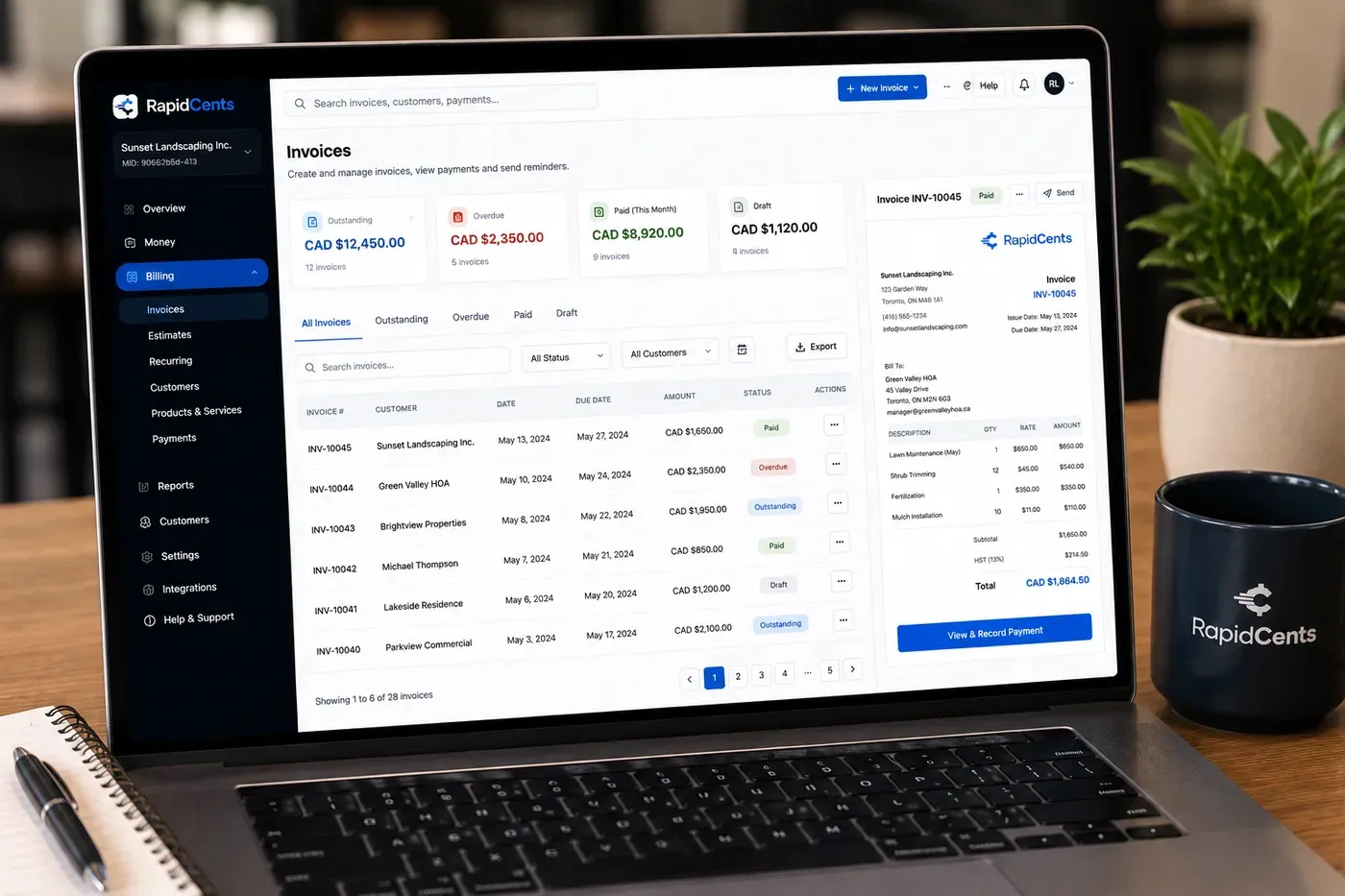
The RapidCents invoices screen: outstanding, overdue, paid and draft totals across the top, the invoice list below them, and a preview of one invoice on the right with its line items and a View & Record Payment button. Invoicing
RapidCents invoicing helps professional services, contractors and B2B suppliers create branded invoices…
Explore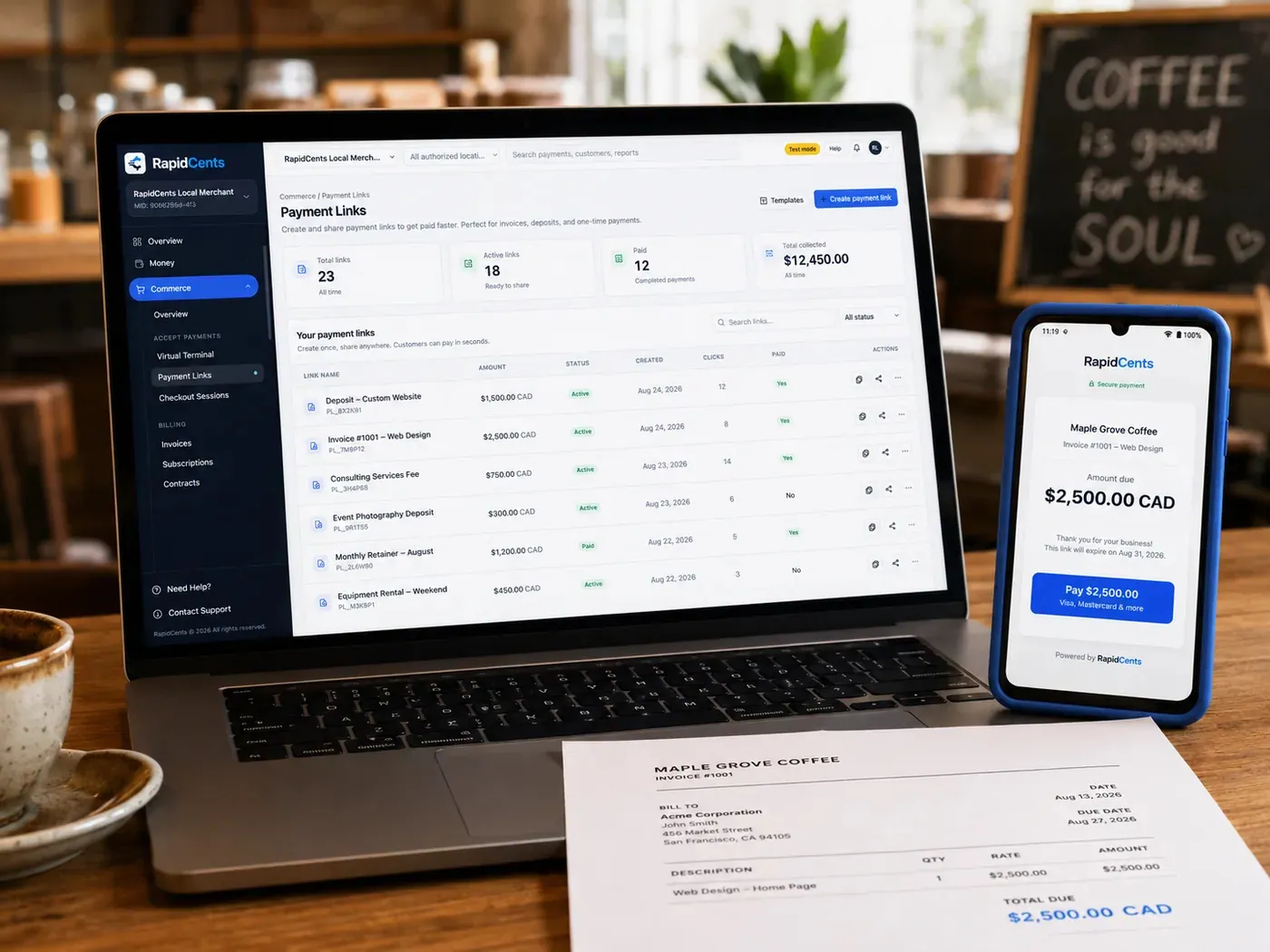
The RapidCents payment links screen listing created links with their amount, status, click count and whether they have been paid, beside a phone showing the branded page a customer opens to pay $2,500.00. Payment Links
RapidCents payment links let staff generate branded pay-by-link URLs for invoices, deposits, balances and…
Explore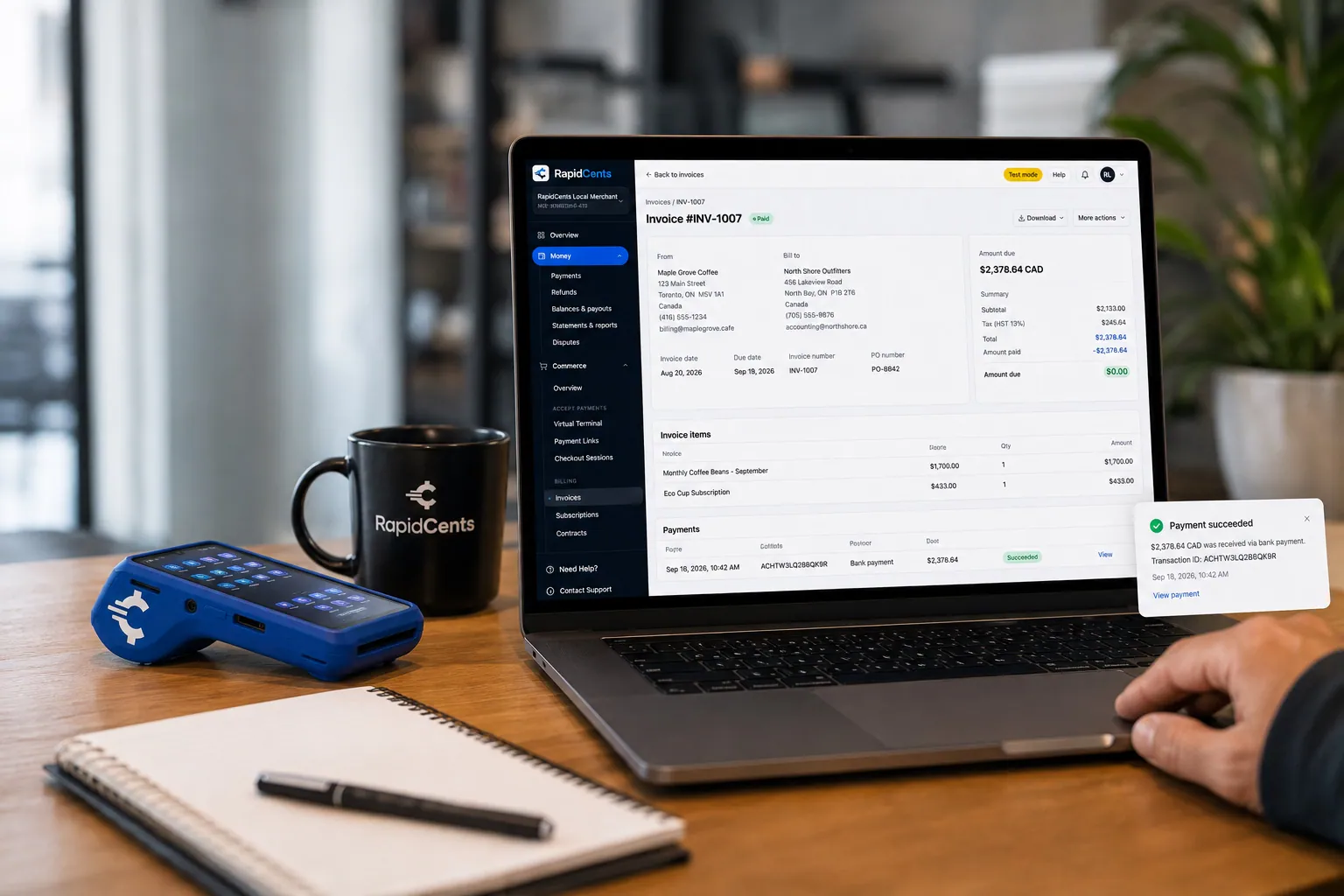
A merchant invoices a customer for bank debit through RapidCents, with card terminal capture available on the same desk. ACH / Bank Payments
Bank payments suit recurring and high-value invoices where card fees are the wrong tool. Collect directly…
Explore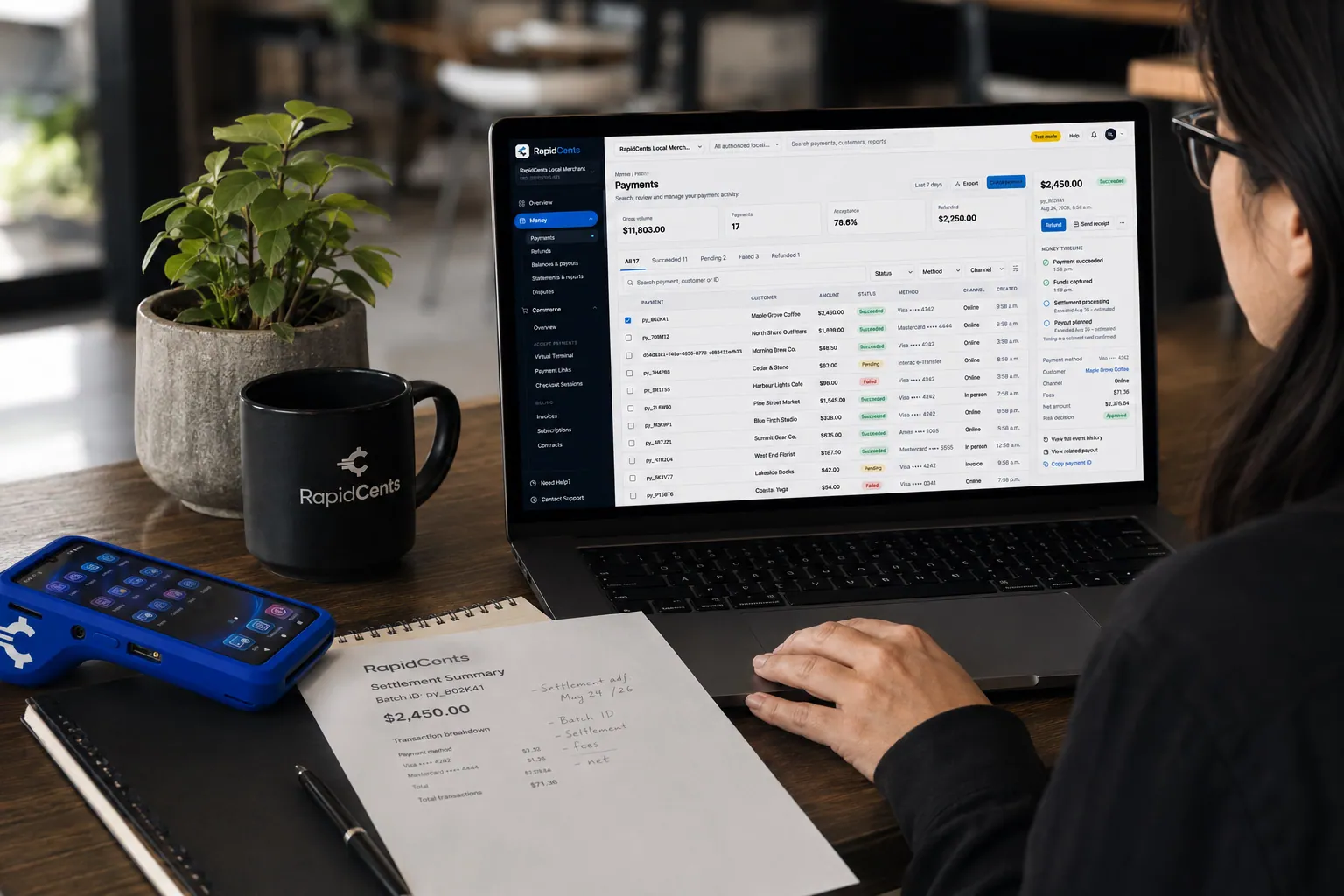
A merchant reviews RapidCents reports for volume, mix and payouts, with the terminal that took the sales on the desk. Reporting
RapidCents reporting delivers customizable transaction, settlement and fee reports with CSV and PDF export…
Explore


How do pharmaceutical wholesalers handle returns and credits?
Pharmaceutical wholesalers handle returns and credits by choosing between a credit note on an open account and a refund to the original card once the invoice is paid. Each path needs its own record, and returns of regulated product follow your license and recall procedures, not the payment record.
Credit note or refund
If the invoice is still open, finance issues a credit note and the balance falls. If the pharmacy already paid by card, you refund to that same card from the Merchant Dashboard. Refunds follow the original payment, not a different card or account.
Short deliveries and recalled lots
A short delivery or a recalled lot changes what is owed, not what was collected. Adjust the invoice in your ERP first, then credit or refund the difference. Product returns, storage and recall duties stay in your licensed systems; the payment record only shows the money.
Two damaged cartons on a $2,400 invoice
Say a pharmacy pays a $2,400 invoice by card, and two cartons later arrive damaged. Your team records the credit in the ERP, refunds the carton value to the original card and exports the refund line so finance matches it to the credit note.
Compare fees using your real payment mix
Pharmaceutical distributor card processing costs depend on the cards pharmacies use, how the order is taken and how large each payment is. We price every account on interchange-plus: interchange at cost, your RapidCents markup in your Fee Schedule, and fees for equipment or services if applicable, month to month with no fixed term.
What drives the cost
Interchange is set by the card networks and varies with card type, such as debit, credit, premium or commercial, and with how the card is taken: tapped or inserted versus keyed or online. A mostly keyed phone-order mix prices differently from counter pickups.
Cards and bank payments
Pharmacy buyers may pay by business card or by bank payment. Your RapidCents representative will show you which method fits your account and ticket size, and whether enhanced Level 2/3 data applies to your setup.
What to bring to Fee Check
Bring recent processing statements, your card mix, average invoice size, the split of phone, link and counter payments, and refund and chargeback volume. Fee Check reads an uploaded statement and shows interchange separately from markup, so you can compare written quotes.
Which ERP and accounting software work with your payments?
ERP and accounting software for pharmaceutical wholesalers holds the invoice and customer record, while RapidCents collects the payment. We connect settled transactions, fees and refunds to QuickBooks Online and Xero, and RapidBridge works with Dynamics 365 Business Central, Acumatica and Oracle NetSuite. Your representative explains the right option for your version.
NetSuite and SAP Business One
SAP and NetSuite import settlement files, so payments land in your ledger without a live connector. Your RapidCents representative will walk you through the customer, invoice and purchase order fields your import needs for your edition and version.
Dynamics 365 Business Central, Acumatica and Epicor Prophet 21
RapidBridge works with Dynamics 365 Business Central and Acumatica, so a card payment posts against the invoice you already have open. If you run Epicor Prophet 21, RapidCents integrates with many major platforms through APPIE and RapidBridge, and your representative will walk you through the option for your version.
QuickBooks Online and Xero
RapidCents connects settled transactions, fees and refunds to QuickBooks Online and Xero. Your deposits then match to the ledger using Reporting exports, with fees and refunds already separated out.
Payment options for pharmaceutical wholesalers in Canada
Canadian pharmaceutical wholesalers can usually discuss credit cards, Interac debit at a counter, EFT or pre-authorized debit (PAD) bank payments and CAD settlement. We set up each method around your licensed distribution model, and provincial licensing rules apply to what you sell.
Cards, Interac and bank payments
Pharmacies may pay invoices by Visa, Mastercard or American Express, by Interac debit at a counter pickup, or by EFT or PAD from their bank account. Your RapidCents representative shows you which methods suit your account, along with the ticket limits, before you offer them.
Taxes and records
Invoices may show GST/HST where it applies to your products, and settlement is in CAD. Provincial licensing and each pharmacy's purchasing rules stay with you and the pharmacy, not with the payment record.
How do you switch processors and reconcile pharmacy payments?
You switch processors by listing open invoices, stored cards and recurring schedules, testing the new flow, running both for a short period if needed, and then reconciling deposits to your ledger. Once your account is approved, your RapidCents representative helps you plan a cutover date.
Inventory before you move
List open invoices, stored cards with their authorizations, recurring balance schedules, pending credits and refunds. Token portability between processors needs both providers to agree, so plan on pharmacies re-authorizing their cards where tokens cannot move.
Test, then run in parallel
Run a test sale, a refund and a part payment on the new flow before moving live invoices. Where you need it, keep the old processor for open items while new invoices use RapidCents, and move over once the open items clear.
Map references and reconcile
Map each payment to the invoice and purchase order number in your ERP. Use Reporting settlement and fee reports to reconcile deposits to the ledger, and keep one note for every credit or refund.
Payment questions from pharmaceutical wholesalers
What is the best payment processor for pharmaceutical wholesalers?
The best processor fits your exact catalogue and licensing as well as your invoice workflow. Compare written quotes on interchange-plus pricing, bank payment options, ticket limits, reporting, ERP fit and contract term. RapidCents is month to month with no fixed term, and we look at your products, channel and country before we set you up.
How much does credit card processing cost for pharmaceutical wholesalers?
The cost depends on your card mix, invoice size and how orders are taken, not on one published number. We price every account on interchange-plus: interchange at cost, your RapidCents markup in your Fee Schedule, and fees for equipment or services if applicable. Upload a statement to Fee Check to see interchange separate from markup, then compare other written quotes.
Can NetSuite or SAP Business One use a different payment processor?
Yes. SAP and NetSuite import RapidCents settlement files, so payments land in your ledger, and RapidCents integrates with many major platforms through APPIE and RapidBridge, which works with Oracle NetSuite. Some ERP editions bundle their own payment gateway, so the route depends on your edition and version. Your RapidCents representative will walk you through the option for your edition.
How can pharmaceutical wholesalers switch processors without losing payment history?
Keep your history by exporting it from the old processor before you move and matching it to invoices in your ERP. List open invoices, stored cards with their authorizations, recurring schedules and pending credits. Stored card portability needs both providers to agree. Test a sale, a refund and a part payment, then run both in parallel if needed.
Which payment options can a pharmaceutical wholesaler in Canada offer?
The mix depends on your products, license and sales channel. Canadian pharmaceutical wholesalers can usually collect by credit card, Interac debit at a counter, and EFT or PAD bank payments, with CAD settlement. Your RapidCents representative will walk you through provincial licensing, ticket limits and bank-payment mandates. Controlled substances and precursors are never accepted.
If I already process for a pharmacy, does that cover pharmaceutical wholesaling?
No. A pharmacy and a wholesaler are different merchant types, so we look at each one separately, including the catalogue, sales channel and country. We never accept controlled substances or precursors. Your RapidCents representative reviews your wholesale model with you and tells you plainly where you stand.
Can pharmacies pay wholesaler account balances by card?
Yes. Agree with each pharmacy which balances may be paid by card or bank payment, the ticket limits and who is authorized to pay. A payment request does not change agreed terms, and part payments apply to open invoices as you agree in writing. Your RapidCents representative will set the limits with you.
Can pharmaceutical wholesalers take cross-border orders?
Not by default. Cross-border orders are covered only for the scope set on your account, and a country that works for one account does not carry over to another. Drug licensing, shipping and customs rules stay with you. Talk to your RapidCents representative about countries, products and currencies before you quote a pharmacy abroad.
How do we keep a purchase order reference with each pharmacy payment?
Put the purchase order number on the invoice and in the payment link reference field. The reference travels with the payment, so Reporting exports can match it to the invoice in your ERP. For phone orders, enter the reference in the Virtual Terminal. Your RapidCents representative will show you the field names and export format for your setup.
How do credit notes and returns work against paid invoices?
A credit note reduces an open invoice, while a refund returns money to the original card after payment. Choose based on whether the invoice is paid. Record the credit in your ERP first, then refund the matching amount and export the line for reconciliation. Product return and recall duties stay in your licensed systems.
What MCC is used for pharmaceutical wholesalers?
MCC 5122 is commonly associated with this type of business. We set the correct merchant category during onboarding, based on what you actually sell, to whom and through which channel. The category alone does not decide anything; your products, licensing and country are reviewed with your RapidCents representative.
Related supplier industries
Dental suppliers, veterinary suppliers, medical-surgical suppliers and laboratory and scientific suppliers share the same order, invoice and credit workflow. B2B and Wholesale covers the wider supplier sequence.
B2B & Wholesale
Collect net-terms invoices by payment link with the PO number attached, take commercial…
Dental Suppliers
From monthly consumables reorders to chair and imaging deposits, collect what clinics…
Veterinary Suppliers
Get invoices, standing orders and equipment deposits paid by the veterinary practices…
Medical & Surgical Suppliers
RapidCents helps medical and surgical suppliers collect hospital, clinic and practice…
Laboratory & Scientific Suppliers
Collect on lab purchase orders, instrument deposits and staged deliveries, with the PO…
Restaurant Suppliers
For dealers and distributors that sell kitchen equipment, smallwares and consumables to…
Grocery & Food Distributors
Get paid for every delivery to grocery stores, restaurants and institutional kitchens…
Produce Wholesalers
Collect on final weights, apply quality credits to the right delivery, and keep…
Take the next step
Review your pharmacy invoice workflow
Upload a processing statement to Fee Check to see interchange separated from markup, then walk through your pharmacy invoice and credit workflow with your RapidCents representative.
- No obligation
- Canadian payment specialists
- Secure statement upload



