


Payment processing for managed service providers
Payment processing for managed service providers means charging monthly per-seat or per-device contracts on stored cards, invoicing hardware and project work separately, and collecting larger client payments by bank payment. We run these through Recurring Payments, Account Updater, Invoicing and Payment Links, and each client authorizes the stored card first.

- PCI DSS Level 1
- SOC 2 Type II
- All major cards: Visa, Mastercard, Amex, Discover, UnionPay, Diners Club & Interac Debit
- Interchange-plus available
- Canadian support
How managed service providers get paid
A managed service provider collects money in four ways: the monthly per-seat or per-device contract, project and hardware deposits, balances on invoices raised from the PSA, and recovery of monthly charges that failed. Each has a different payer, trigger and record for finance.
Monthly managed contract
The client's finance contact authorizes a stored card once, and RapidCents Recurring Payments charges the agreed monthly amount on the contract date. The seat or device count you confirm before billing sets the amount, and each charge returns a receipt and a settlement line your bookkeeper can match.
Project and hardware deposits
Before you order switches, laptops or licenses, you send a Payment Link by email or SMS for the deposit. The client pays by card or bank payment, and the payment reference ties back to the quote number so purchasing knows the order can be placed.
Invoice balances
When a project closes or a quarterly true-up is due, you send an Invoicing request with a payment link. The client's accounts payable contact pays by card or bank payment, and the invoice status shows paid, open or overdue without a manual lookup.
Failed monthly payments
When a stored card is declined or has expired, automated retries run on the schedule you set, and Account Updater refreshes reissued cards where the networks supply new details. If the charge still fails, you send a payment link to the billing contact before service is paused.
How do you run MSP recurring billing payments?
You run MSP recurring billing payments by confirming each client's seat and device count, charging an authorized stored card on the contract date through Recurring Payments, and letting Account Updater and automated retries handle expired or declined cards. Finance receives one charge, one receipt and one settlement line per client contract.
How the monthly charge runs
Your service manager confirms the count at month end, the amount is set on the client's recurring schedule, and the card is charged on the contract date. The client receives a notice before each charge, and the receipt carries the contract number you use for matching in the PSA.
What to set up first
Get the client's written authorization for the stored card, covering the amount, timing and how to cancel. Record the contract number as the payment reference, and agree who at the client receives decline notices. A stored card is only charged with that authorization in hand.
A 40-seat client, billed on the first
Say a client with 40 seats and 12 managed devices is billed on the first of the month. Two seats are added on the 18th, so you confirm the count before the next charge. One card has expired, so Account Updater refreshes it where the networks supply new details.
How does managed IT invoice payment processing work?
Managed IT invoice payment processing means sending project, hardware and true-up invoices with a payment link, so the client pays by card or bank payment and the invoice marks paid. You collect deposits before orders are placed and balances when the work is signed off.
How project and hardware invoices are paid
You send the invoice from Invoicing, or send a Payment Link that carries your quote or invoice number. The client's accounts payable contact pays by card, or by bank payment for larger amounts, and the status updates so your dispatcher sees the order is funded.
Deposits, refunds and disputes
Set the deposit terms on the quote: the amount, what happens if the client cancels, and whether restocking applies to special-order hardware. A refund returns to the original card or account. Keep the signed quote and delivery record, because a hardware dispute is answered with them.
A $9,000 office move, deposit first
Say an office move needs a $9,000 hardware and cabling project. You send a deposit link for half before ordering, the client's controller pays it by bank payment, and you invoice the balance after cutover. Later cabling work gets its own invoice.
RapidCents products for IT and managed services providers
Recurring Payments runs the monthly contract, Account Updater keeps stored cards current, Invoicing and payment links handle projects and hardware, and bank payments suit larger invoices. Your RapidCents representative will show you how they fit your contract and hardware mix.

The RapidCents recurring payments screen showing active subscriptions, monthly recurring revenue, failed payments and upcoming renewals, above a list of subscriptions with their plan, amount, frequency and next billing date. Recurring Payments
RapidCents recurring payments manage subscription plans, membership renewals and installment schedules with…
Explore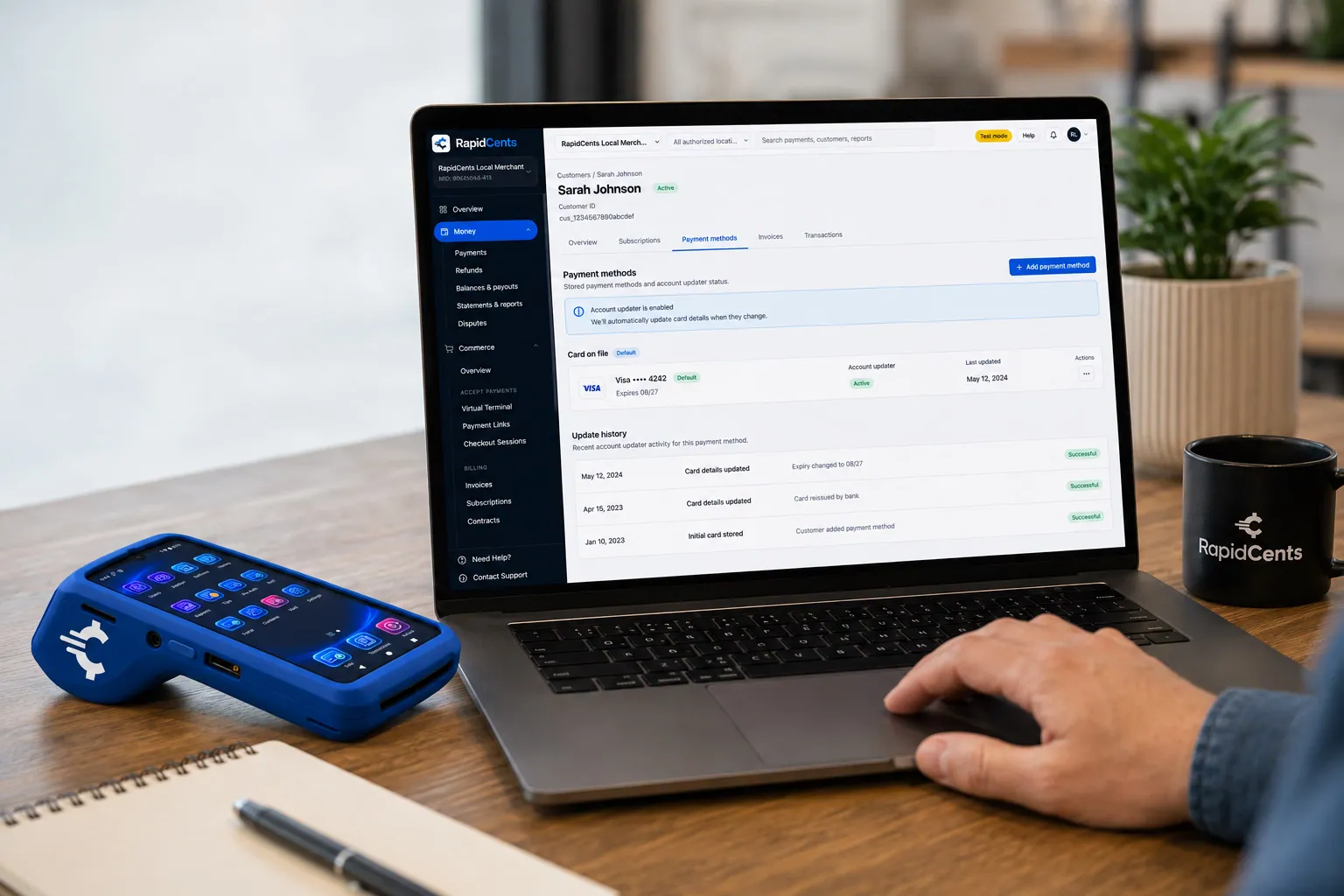
RapidCents refreshes a stored card after a reissue, so the vaulted credential keeps working without asking the customer again. Account Updater
Cards expire, get reissued and get replaced after fraud. Account Updater refreshes stored credentials with…
Explore
The RapidCents invoices screen: outstanding, overdue, paid and draft totals across the top, the invoice list below them, and a preview of one invoice on the right with its line items and a View & Record Payment button. Invoicing
RapidCents invoicing helps professional services, contractors and B2B suppliers create branded invoices…
Explore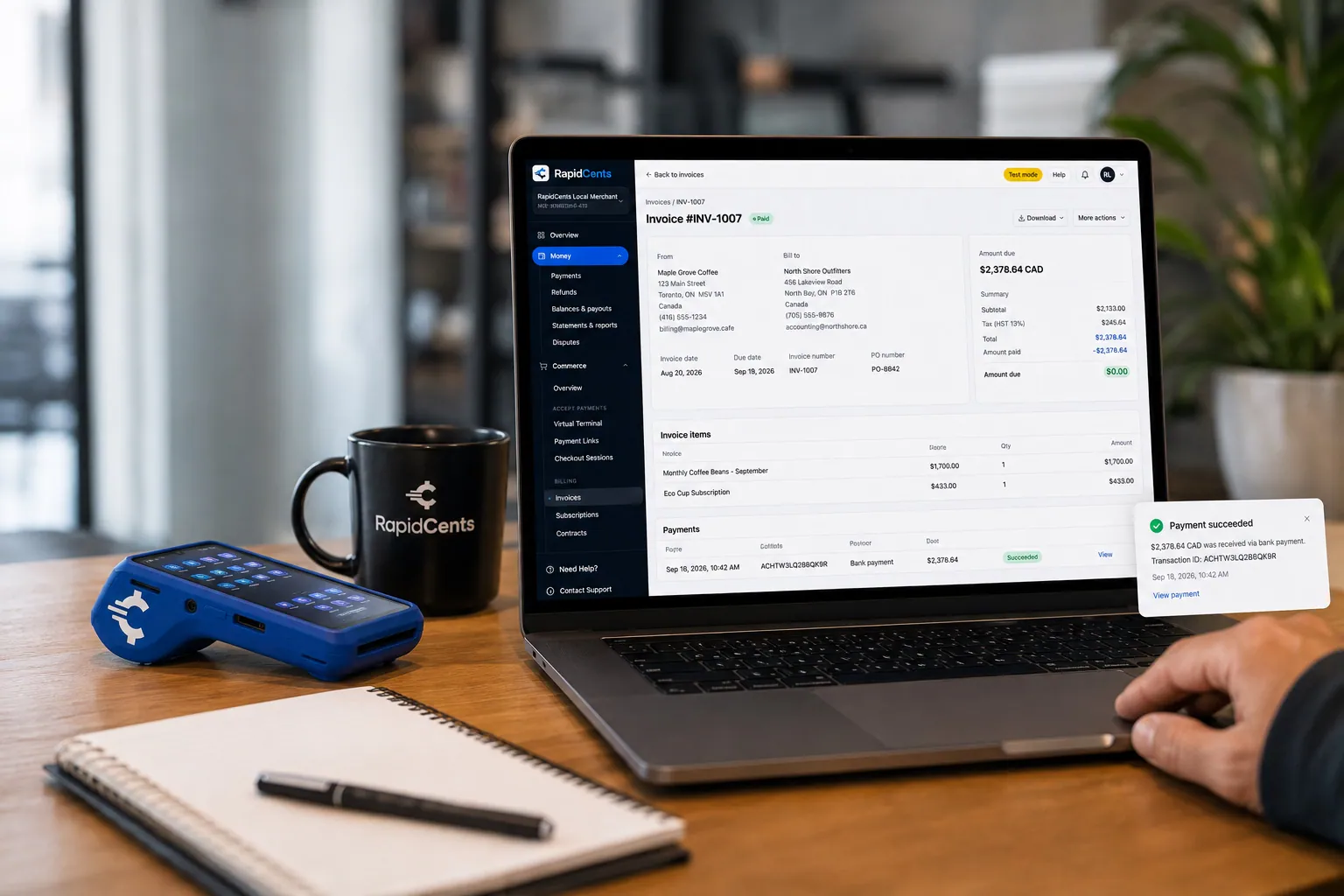
A merchant invoices a customer for bank debit through RapidCents, with card terminal capture available on the same desk. ACH / Bank Payments
Bank payments suit recurring and high-value invoices where card fees are the wrong tool. Collect directly…
Explore


How does MSP card payment automation handle midmonth changes?
MSP card payment automation handles a midmonth contract change by adjusting the recurring schedule, billing the difference on an invoice or the next charge, and recording the client's agreement. Retries and notices run automatically, while your PSA stays the record of the contract.
Adding or removing seats midmonth
Update the schedule when the client changes the contract, and decide in writing whether the difference is billed now by invoice or added to the next charge. Get the client's agreement to the new amount and timing, since the stored card authorization covers only what was agreed.
Failed charges and retries
A declined charge triggers automated retries on your schedule, a notice to the client's billing contact, and a payment link if retries run out. Write the rule for when service is paused into the contract, so the client has agreed to it beforehand.
A client drops from 30 seats to 24
Say a client drops from 30 seats to 24 on the 10th after laying off staff. You adjust the schedule, send an invoice credit for the difference, and the next charge uses 24 seats. If the card declines, retries run and the billing contact receives a payment link.
Compare fees using your real payment mix
Your cost depends on card type, how cards are taken and your recurring and invoice mix. We price every account on interchange-plus: interchange passes through at cost, plus your RapidCents markup in your Fee Schedule, plus fees for equipment or services if applicable. It is month to month with no fixed term.
What drives interchange for an MSP
Interchange varies with card type, such as debit, credit, premium or commercial, and with how the card is taken. Most MSP volume is keyed or stored-card recurring billing, plus some terminal payments at the service counter, and business clients often pay with commercial cards.
What to bring to compare
Bring recent processing statements, your card mix, average monthly contract and invoice size, the split between recurring, invoiced and terminal payments, and your refund and chargeback volume. Ask each provider to itemize interchange, markup and other fees so quotes compare like for like.
Fee Check and bank payments
Upload a statement to Fee Check and it shows interchange separately from markup. Bank payments suit large recurring invoices where card cost is the wrong tool, and your RapidCents representative will set them up with you. Your Fee Schedule lists your markup.
Connect your PSA and payment data to your books
RapidCents integrates with many major platforms through APPIE and RapidBridge, and the right option depends on your PSA vendor and version. Your RapidCents representative will walk you through it. Settled transactions, fees and refunds flow to QuickBooks Online and Xero, and SAP and NetSuite import settlement files.
ConnectWise PSA and Autotask PSA
These PSAs hold your agreements, tickets and invoices. RapidCents integrates with many major platforms through APPIE and RapidBridge, so tell your representative which edition you run and they will show you how payments connect, whether through an integration or a Payment Link that carries the invoice number.
HaloPSA, Syncro and SuperOps
The same goes for each of these. Your representative will map which payment events come back and how a payment ties to an invoice number. A payment link carrying the invoice number, plus a settlement report you reconcile, works with any PSA.
Accounting software
RapidCents connects settled transactions, fees and refunds to QuickBooks Online and Xero, so your bookkeeper sees each payment and its cost without re-keying. SAP and NetSuite import settlement files, which gives them the same detail on a schedule you choose.
Payment options for managed service providers in Canada
A managed service provider in Canada can take credit cards, Interac debit at the counter, and bank payments by EFT or pre-authorized debit (PAD) for larger recurring invoices, with settlement in CAD. Your representative builds the mix around your contracts.
Cards and Interac debit
Visa, Mastercard and American Express work for stored-card billing and payment links. Interac debit applies where a client pays by chip and PIN or contactless at your terminal, such as at a service counter or hardware pickup.
EFT, PAD and GST/HST
EFT or PAD can collect large monthly contracts directly from a client's account once the client signs a PAD agreement. Invoices and receipts may show GST/HST, and provincial rules can affect how you bill, so your accountant is the right person for those details.
Switching, reconciliation and answers for buyers
Switching processors starts with an inventory of stored cards, authorizations, recurring schedules, open invoices and refunds, then a test of sale, refund and deposit before live traffic moves. Once your account is approved, run both in parallel where needed and reconcile deposits to your ledger.
Inventory before you move
List every client with a stored card, the signed authorization, the schedule and amount, open invoices, pending refunds and transaction references. Stored-card tokens move between providers only when both providers agree to it, so plan on having clients re-authorize their cards where they don't.
Test and run in parallel
Test one sale, one refund and one deposit link on the new account. Move a few client contracts first, keep the others where they are, and compare results before you move the rest. Keep the old account open until open items settle.
Reconcile to your ledger
Map each payment reference to the contract or invoice number, then match deposits to your ledger using settlement reports. Assign one person to review failed charges, refunds and disputes every week so nothing sits unmatched.
Payment questions from managed service providers
What is the best payment processor for managed service providers?
The best fit is the one that handles stored-card recurring billing, invoice payment links, bank payments, itemized fees, PSA integration, support and reconciliation reports the way your business runs. We built RapidCents around Recurring Payments, Account Updater, Invoicing and bank payments, and Fee Check shows your current interchange separately from markup so you can compare us with anyone.
How much does credit card processing cost for managed service providers?
It depends on your card mix, average ticket, channel mix and your RapidCents markup, so no single number applies. We price every account on interchange-plus: interchange at cost, your markup in your Fee Schedule, and fees for equipment or services if applicable, month to month. Upload a statement to Fee Check or request an itemized quote.
Can ConnectWise PSA use a different payment processor?
Yes. RapidCents integrates with many major platforms through APPIE and RapidBridge, and the right option depends on your ConnectWise edition and version. Tell your RapidCents representative which one you run, and they will walk you through how payments, receipts and invoice numbers connect, including a payment link or settlement import where that fits best.
How can managed service providers switch processors without losing payment history?
Inventory first, then test. List stored cards, client authorizations, schedules, open invoices, refunds and transaction references, and export history from the old processor. Stored-card tokens move only when both providers agree, so collect fresh authorization from clients where they don't. Test a sale, refund and deposit, then move contracts in groups.
Which payment options can a managed service provider in Canada offer?
A managed service provider in Canada can offer credit cards, Interac debit in person, payment links and invoicing, and EFT or pre-authorized debit (PAD) bank payments. Settlement is in CAD. Your RapidCents representative will set up the options that fit your contracts, and you get the client's PAD authorization before the first debit.
How can we bill a monthly per-seat or per-device contract?
Set up each client on Recurring Payments with an authorized stored card, the contract amount and the billing date. Confirm the seat and device count before the charge, use the contract number as the payment reference, and let notices and retries run. Your PSA stays the contract record; RapidCents records the payment and settlement.
How can we collect project and hardware deposits?
Send a Payment Link by email or SMS for the deposit, or attach it to an Invoicing request. The client pays by card or bank payment, the reference ties to the quote, and you order once the deposit shows paid. Set cancellation and restocking terms on the quote, because refunds and disputes follow those terms.
How can we sync payments with our PSA invoice?
Carry the PSA invoice number as the payment reference, then match settled payments to invoices. How the sync runs depends on your PSA vendor and version, and your RapidCents representative will walk you through the options. A settlement report or import maps payments to invoices, and your bookkeeper reconciles them.
How can we handle a midmonth contract change?
Adjust the recurring schedule and bill the difference by invoice or on the next charge, whichever the contract says. Get the client's agreement to the new amount and timing first, because the stored card authorization covers only what was agreed. Record the change in your PSA and keep any credit or extra charge matched to its reference.
How can we recover failed monthly MSP payments?
Use automated retries, Account Updater and a notice to the client's billing contact, then a payment link if the charge still fails. Decide in the contract when service is paused for non-payment. Retries don't recover every charge: a closed card may need the client's new details and a fresh authorization.
What MCC is used for IT and managed services?
MCC 7379 is commonly associated with this type of business. We set the merchant category during onboarding based on what your business actually sells, so a provider that mostly resells hardware or runs a different line may be classified differently. Share your service and hardware mix when you apply.
Related industries with the same payment workflows
Law firms, accounting firms, professional services, marketing agencies and other B2B suppliers share the same patterns: monthly retainers on stored cards, invoices with payment links and deposits before work begins.
Law Firms
RapidCents helps law firms collect retainers by payment link, send invoices with a link…
Accounting Firms
Charge monthly bookkeeping and payroll fees on a schedule, collect tax preparation…
Professional Services
Charge monthly retainers, send branded invoice links and collect milestone balances from…
B2B & Wholesale
Collect net-terms invoices by payment link with the PO number attached, take commercial…
Insurance
Collect down payments at binding, monthly installments and agency fees by payment link…
Real Estate
Collect application fees, service fees and keyed deposits by payment link or Virtual…
Property Management
Collect rent by card and bank payment, set up recurring autopay, invoice maintenance…
Freight & Logistics
RapidCents helps carriers, brokers and 3PLs invoice shippers, collect by payment link…
Take the next step
Review your managed services payment workflow
Upload a recent processing statement to Fee Check and see interchange separated from markup, then compare it with your monthly contract and hardware invoice mix.
- No obligation
- Canadian payment specialists
- Secure statement upload



