


Pricing & transparency, Guides
Interchange-plus, effective rate and statement reading. 23 pieces in guides, written for Canadian merchants: what pricing & transparency covers, what to check on your own statement, and the decisions it changes.
Pricing & transparency
Pricing & transparency
Interchange-plus, effective rate and statement reading.
On this shelf

Finance team calculating an effective processing rate from a merchant statement Effective Processing Rate: Definition and Formula
The effective processing rate is total payment-processing fees divided by total processed card volume, times 100 — the one figure that compares two providers honestly.
Explore
Customer tapping a card on a payment terminal, the moment a transaction is authorized How Credit Card Processing Works
A card payment is a sequence of messages before it is a movement of money: authorization, capture, clearing, settlement, then funding.
Explore
Printed statements and a calculator on a desk, with a phone, pen and glasses alongside Why Payment Processors Hold Funds, and How to Get Yours Released
Processors hold funds when a transaction pattern looks riskier than the profile they underwrote: a sudden volume spike, an unusually large ticket, a surge of card-not-present sales or rising disputes. The hold protects the processor from chargebacks that could arrive after paying you out. Most holds resolve quickly once you supply invoices, delivery proof or an explanation; the durable fix is keeping your processing profile current.
ExplorePrinted statements and a calculator on a desk, with a phone, pen and glasses alongside What Is a Merchant Acquirer? A Plain-English Guide
A merchant acquirer is the financial institution or payment processor that maintains your merchant account, routes card transactions to Visa, Mastercard and Interac, carries the risk of your transactions, and deposits the settled funds into your bank account. Every business that accepts cards has one, whether they chose it knowingly or not.
ExplorePrinted statements and a calculator on a desk, with a phone, pen and glasses alongside What Is a Merchant Account and How Do You Qualify for One?
A merchant account is a specialized intermediary account, held with an acquiring institution, through which your card sales clear before depositing to your business bank account. It exists because someone must carry the risk between a customer's payment and its possible reversal, and qualifying for one is an underwriting process: business verification, ownership, expected volumes and industry risk. Most straightforward Canadian businesses are approved in one to three days.
ExplorePrinted statements and a calculator on a desk, with a phone, pen and glasses alongside How Visa Debit Works in Canada vs the US (and Why Your Online Debit Costs More)
Canadian debit is a dual-network arrangement: the same card runs in-person payments over Interac at a flat few cents, and online payments over Visa's or Mastercard's rails at percentage-based rates. In the US, debit works differently again, with Durbin-regulated interchange caps for large-bank cards and routing choice mandates. For Canadian merchants, the practical consequence is simple and financial: the identical customer costs cents at the counter and a percentage at the checkout.
ExplorePrinted statements and a calculator on a desk, with a phone, pen and glasses alongside Interchange Fees: The Ultimate Guide for Canadian Merchants
Interchange is the fee the card networks set and the cardholder's bank collects on every card transaction, and it is the largest component of your processing cost. It varies by card type, entry method and merchant category: in-person Interac debit costs a flat few cents, while premium credit cards accepted online sit at the top of the range. You cannot negotiate interchange, but you can reduce it by changing how you accept.
ExplorePrinted statements and a calculator on a desk, with a phone, pen and glasses alongside How to Switch Payment Processors in 5 Steps (Without Losing a Day of Sales)
Switching payment processors safely follows five steps: calculate your current effective rate from a real statement, read your contract's term and exit clauses, set up the new account and run it in parallel, migrate stored customer cards through a PCI-compliant transfer, and cut over outside peak hours. Done in that order, most Canadian businesses complete the move in one to three weeks without losing a single day of sales.
ExplorePrinted statements and a calculator on a desk, with a phone, pen and glasses alongside Credit Card Surcharging in Canada: Rules, Limits and a Step-by-Step Setup
Since October 2022, Canadian merchants outside Quebec may add a surcharge to credit card transactions, capped at the lower of their actual acceptance cost and 2.4 percent, with advance notice to the card networks and clear disclosure at point of sale and on receipts. Surcharging is prohibited in Quebec by consumer protection law and never permitted on Interac debit. Whether you should is a different question from whether you can.
ExplorePrinted statements and a calculator on a desk, with a phone, pen and glasses alongside B2B Payment Processing: How Level 2 and Level 3 Data Cut Your Card Costs
When a business pays another business by corporate or purchasing card, the card networks offer reduced interchange rates in exchange for richer transaction data. Level 2 adds tax amounts and customer codes; Level 3 adds line-item detail like an invoice. The savings on qualifying transactions are meaningful, frequently dozens of basis points, and most eligible B2B merchants never collect them because their payment systems simply do not send the data.
ExplorePrinted statements and a calculator on a desk, with a phone, pen and glasses alongside Accepting American Express in Canada: Costs, Myths and Whether It's Worth It
American Express runs a closed-loop model: it issues the cards, operates the network and sets merchant pricing itself, historically a step above Visa and Mastercard interchange, though the gap has narrowed through integrated acceptance programs that let one provider settle all brands together. The business case turns on your customers: Amex holders skew toward corporate travel, entertainment and higher-spending demographics, so the question is whether the wallet share you gain outruns the basis points you pay.
ExploreFinancial analysis How to Read a Merchant Statement
Effective rate, interchange, assessments and markup each tell a different story, map sections to review steps.
ExploreFinance professional reviewing payment statement Interchange-Plus Pricing Explained
Interchange-plus separates network interchange from processor markup so Canadian merchants can compare on true cost.
Explore
What Is the Cheapest Way to Accept Card Payments in Person? Cheapest Way to Accept Card Payments in Person
For most small and medium businesses, the cheapest way to accept card payments in person is a transparent interchange-plus processor paired with an all-in-one POS or mobile card reader and no extra monthly or compliance fees. Mobile readers cost the least upfront at roughly 2.6%-2.9% per transaction, but POS systems on interchange-plus pricing usually win long term.
Explore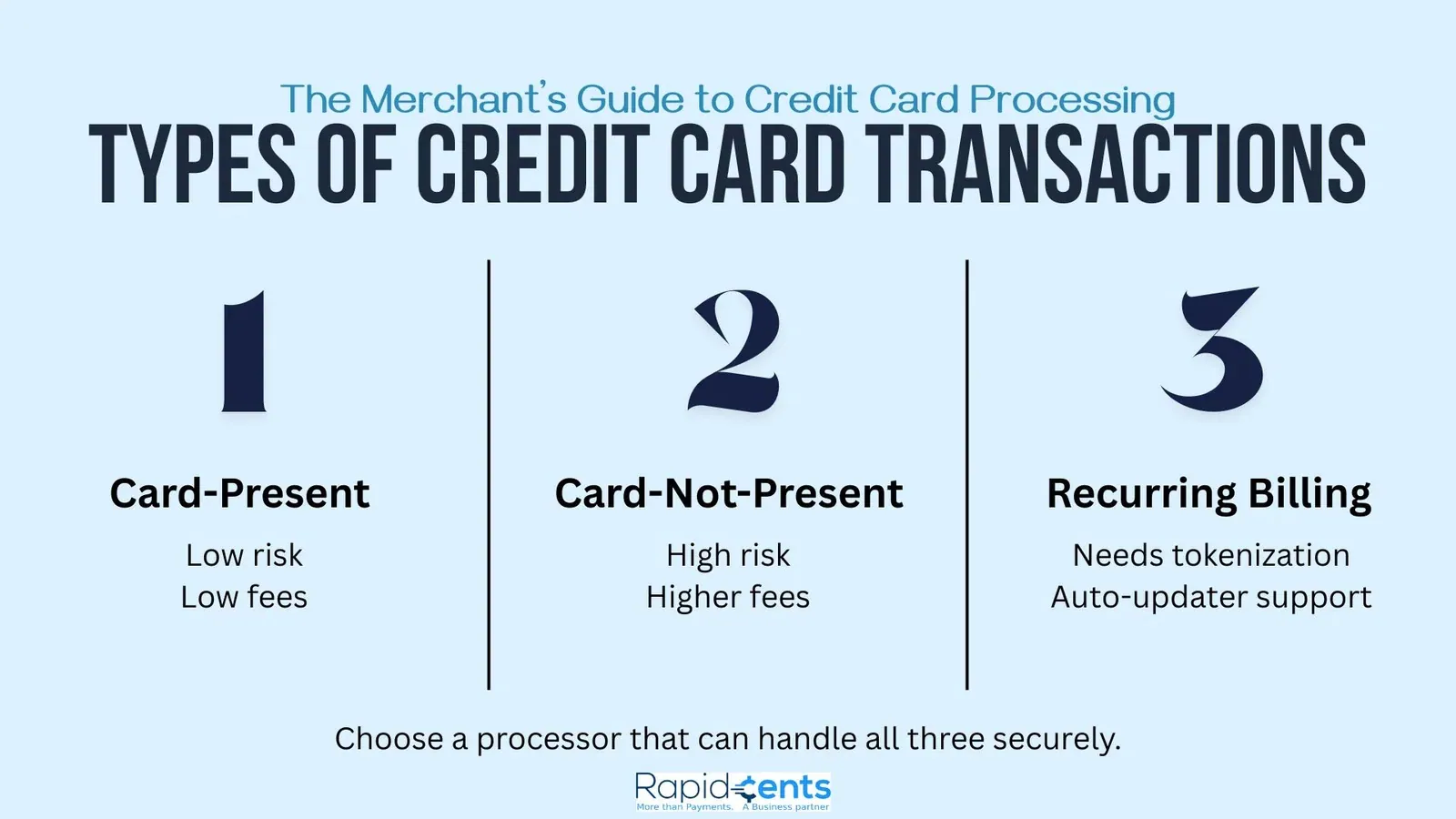
The Merchant's Guide to Credit Card Processing The Merchant's Guide to Credit Card Processing
Credit card processing moves money from a customer's card to the merchant's bank account through a chain of players: gateway, processor, issuing bank, and acquiring bank. Merchants pay interchange fees, assessment fees, and processor markup, funds typically settle in 1-3 business days, and understanding each cost helps lower the effective rate.
Explore
Everything You Need to Know About Credit Card Processing Credit Card Processing Explained: Parties, Fees, Pricing
Credit card processing moves a payment from the cardholder's issuing bank to the merchant's acquiring bank through a payment processor, with card associations like Visa and Mastercard setting interchange rates. Merchants pay transaction, recurring, and one-off fees under pricing models such as interchange-plus, flat rate, tiered, or membership pricing.
Explore
How Virtual Terminal Fees Impact Small Businesses in Canada How Virtual Terminal Fees Impact Small Businesses in Canada
Virtual terminal fees are the charges Canadian businesses pay to accept card payments remotely, typically a per-transaction fee, a monthly subscription, a one-time setup charge, and extra service fees such as chargebacks or currency conversion. For small businesses with lower volumes, these fees can meaningfully reduce profit margins, so comparing processors and negotiating terms is essential.
Explore
The Pros and Cons of Different Credit Processing Rate Models for Canadian Businesses Credit Processing Rate Models for Canadian Businesses
Canadian businesses choose between three main credit processing rate models: flat-rate (one fixed percentage on every transaction, simple but costly at high volume), interchange-plus (the network's interchange fee plus a transparent processor markup, itemized but more complex), and tiered pricing (qualified, mid-qualified, and non-qualified tiers, simple but opaque). The right fit depends on transaction size, volume, industry, and growth plans.
Explore
Tips for Reducing Transaction Processing Fees in Your Business How to Reduce Transaction Processing Fees
You can reduce transaction processing fees by understanding every component of your current fee structure, comparing and negotiating with payment processors, steering customers toward lower-cost methods like debit and bank transfers, automating payment operations, claiming volume discounts, and auditing statements regularly. Together these steps protect margins and free up cash for growth.
Explore
Demystifying Credit Card Processing Fees: What Every Business Should Know Credit Card Processing Fees: What Every Business Should Know
Credit card processing fees break down into interchange fees paid to issuing banks, assessment fees charged by card networks, payment gateway fees, and monthly or annual processor fees. Hidden charges like batch, retrieval, and inactivity fees add to the real cost. Businesses can lower costs by knowing their transaction volume, comparing processors, understanding industry benchmarks, and negotiating rates as they grow.
Explore
Understanding Prorated Charges: A Guide to Prorated Billing Prorated Billing: A Guide to Prorated Charges
Prorated billing charges customers only for the portion of a billing period they actually use a service — calculated by dividing the full-period cost by the number of days and multiplying by days used. It appears in telecom, utilities, subscriptions, SaaS, insurance, and real estate, improving cash flow for businesses and delivering fair, usage-based pricing for customers.
Explore
Merchant comparing two payment-pricing statements Flat-rate vs. interchange-plus pricing: an evidence-led comparison
Flat-rate pricing combines several payment costs into a simple quoted rate. Interchange-plus separates card interchange from the processor markup and may show other pass-through fees separately. Neither model is automatically cheaper: compare both over the same statement period, using the same sales, refunds, card mix and non-processing fees.
Explore
How to Save on Your Credit Card Payment Processing Fee How to Save on Credit Card Processing Fees
To save on credit card processing fees, understand the three fee components — interchange fees set by card networks, assessment fees paid to networks, and markup fees set by processors — then negotiate the markup, since that is the portion merchants can control. Consolidating processors, maintaining PCI compliance, preventing chargebacks, and monitoring statements for fee creep all reduce costs further.
Explore


Frequently asked questions
What does interchange-plus actually mean on a statement?
That the statement shows two separate things for every transaction: the interchange and network assessments the card networks set, passed through at cost, and the processor’s markup as its own line. A blended or flat rate averages the two into one number, which is comfortable until the card mix moves.
How do I work out my effective rate?
Divide a month’s total fees by that month’s processed volume. The result is what you are actually paying, whatever the headline rate says. Fee Check on the pricing page does the arithmetic from your uploaded statement and shows the same month on RapidCents’ schedule.
Which fees are negotiable and which are not?
Interchange and network assessments are set by the networks and are the same for every processor; they are not negotiable by anyone. The markup, monthly fees, hardware and any per-item charges are the processor’s own, and those are the lines worth comparing.
Does RapidCents charge a fee to leave?
No. There is no cancellation fee and no early termination fee, at any point in the term. The Refund and Cancellation Policy sets out what is and is not owed when an account closes, which is the only pricing question these guides answer with a figure: zero.



