Pricing & transparency, Guides
Interchange-plus, effective rate and statement reading. 9 pieces in guides, written for merchants worldwide: what pricing & transparency covers, what to check on your own statement, and the decisions it changes.
Pricing & transparency
Pricing & transparency
Interchange-plus, effective rate and statement reading.
On this shelf

Printed statements and a calculator on a desk, with a phone, pen and glasses alongside Why Payment Processors Hold Funds, and How to Get Yours Released
Processors hold funds when a transaction pattern looks riskier than the profile they underwrote: a sudden volume spike, an unusually large ticket, a surge of card-not-present sales or rising disputes. The hold protects the processor from chargebacks that could arrive after paying you out. Most holds resolve quickly once you supply invoices, delivery proof or an explanation; the durable fix is keeping your processing profile current.
ExplorePrinted statements and a calculator on a desk, with a phone, pen and glasses alongside B2B Payment Processing: How Level 2 and Level 3 Data Cut Your Card Costs
When a business pays another business by corporate or purchasing card, the card networks offer reduced interchange rates in exchange for richer transaction data. Level 2 adds tax amounts and customer codes; Level 3 adds line-item detail like an invoice. The savings on qualifying transactions are meaningful, frequently dozens of basis points, and most eligible B2B merchants never collect them because their payment systems simply do not send the data.
Explore
What Is the Cheapest Way to Accept Card Payments in Person? Cheapest Way to Accept Card Payments in Person
For most small and medium businesses, the cheapest way to accept card payments in person is a transparent interchange-plus processor paired with an all-in-one POS or mobile card reader and no extra monthly or compliance fees. Mobile readers cost the least upfront at roughly 2.6%-2.9% per transaction, but POS systems on interchange-plus pricing usually win long term.
Explore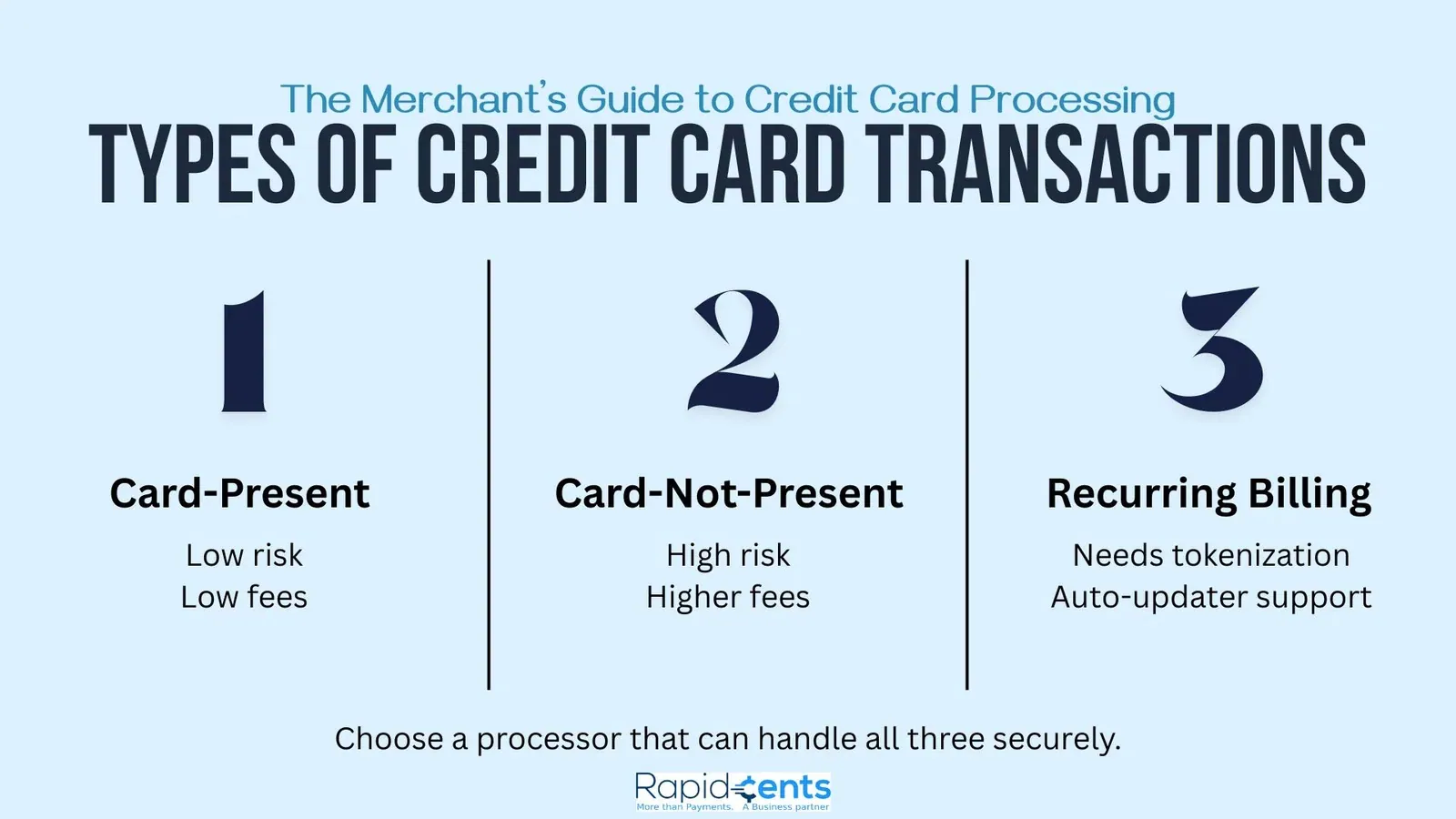
The Merchant's Guide to Credit Card Processing The Merchant's Guide to Credit Card Processing
Credit card processing moves money from a customer's card to the merchant's bank account through a chain of players: gateway, processor, issuing bank, and acquiring bank. Merchants pay interchange fees, assessment fees, and processor markup, funds typically settle in 1-3 business days, and understanding each cost helps lower the effective rate.
Explore
Everything You Need to Know About Credit Card Processing Credit Card Processing Explained: Parties, Fees, Pricing
Credit card processing moves a payment from the cardholder's issuing bank to the merchant's acquiring bank through a payment processor, with card associations like Visa and Mastercard setting interchange rates. Merchants pay transaction, recurring, and one-off fees under pricing models such as interchange-plus, flat rate, tiered, or membership pricing.
Explore
Demystifying Credit Card Processing Fees: What Every Business Should Know Credit Card Processing Fees: What Every Business Should Know
Credit card processing fees break down into interchange fees paid to issuing banks, assessment fees charged by card networks, payment gateway fees, and monthly or annual processor fees. Hidden charges like batch, retrieval, and inactivity fees add to the real cost. Businesses can lower costs by knowing their transaction volume, comparing processors, understanding industry benchmarks, and negotiating rates as they grow.
Explore
Understanding Prorated Charges: A Guide to Prorated Billing Prorated Billing: A Guide to Prorated Charges
Prorated billing charges customers only for the portion of a billing period they actually use a service — calculated by dividing the full-period cost by the number of days and multiplying by days used. It appears in telecom, utilities, subscriptions, SaaS, insurance, and real estate, improving cash flow for businesses and delivering fair, usage-based pricing for customers.
Explore
Merchant comparing two payment-pricing statements Flat-rate vs. interchange-plus pricing: an evidence-led comparison
Flat-rate pricing combines several payment costs into a simple quoted rate. Interchange-plus separates card interchange from the processor markup and may show other pass-through fees separately. Neither model is automatically cheaper: compare both over the same statement period, using the same sales, refunds, card mix and non-processing fees.
Explore
How to Save on Your Credit Card Payment Processing Fee How to Save on Credit Card Processing Fees
To save on credit card processing fees, understand the three fee components — interchange fees set by card networks, assessment fees paid to networks, and markup fees set by processors — then negotiate the markup, since that is the portion merchants can control. Consolidating processors, maintaining PCI compliance, preventing chargebacks, and monitoring statements for fee creep all reduce costs further.
Explore


Frequently asked questions
What does interchange-plus actually mean on a statement?
That the statement shows two separate things for every transaction: the interchange and network assessments the card networks set, passed through at cost, and the processor’s markup as its own line. A blended or flat rate averages the two into one number, which is comfortable until the card mix moves.
How do I work out my effective rate?
Divide a month’s total fees by that month’s processed volume. The result is what you are actually paying, whatever the headline rate says. Fee Check on the pricing page does the arithmetic from your uploaded statement and shows the same month on RapidCents’ schedule.
Which fees are negotiable and which are not?
Interchange and network assessments are set by the networks and are the same for every processor; they are not negotiable by anyone. The markup, monthly fees, hardware and any per-item charges are the processor’s own, and those are the lines worth comparing.
Does RapidCents charge a fee to leave?
No. There is no cancellation fee and no early termination fee, at any point in the term. The Refund and Cancellation Policy sets out what is and is not owed when an account closes, which is the only pricing question these guides answer with a figure: zero.