


Payment processing for aggregate suppliers and ready mix plants
Payment processing for aggregate suppliers means collecting from contractors, builders and municipal buyers on confirmed load tickets, dispatch deposits and delivery charges. RapidCents offers invoice payment links, a virtual terminal for phone orders, mobile terminals for the scale house, and bank payments for large accounts, and connects to your dispatch and ERP software through APPIE and RapidBridge.

- PCI DSS Level 1
- SOC 2 Type II
- All major cards: Visa, Mastercard, Amex, Discover, UnionPay, Diners Club & PIN Debit
- Interchange-plus available
- Specialist onboarding support
How concrete and aggregate suppliers get paid
Concrete, sand and aggregate suppliers get paid on the final load ticket, on a dispatch deposit before a pour, on a site-referenced invoice, or on a standing account balance. Each job has a different payer, trigger and record, so each uses a different RapidCents tool.
Final load ticket payments
The contractor or site foreman pays once the driver and scale ticket confirm the delivered quantity. Your office sends an invoice payment link or keys the card in the virtual terminal. Finance keeps the ticket number on the payment record.
Dispatch deposits before a pour
A builder or concrete finisher pays a deposit when the pour is booked, often by phone. Staff send a payment link or use the virtual terminal. The deposit is applied against the final ticket, and any unused amount is refunded by agreement.
Site-referenced invoice payments
Aggregate invoice payments usually come from a contractor's accounts payable clerk, paying an invoice that carries a job number, site address and purchase order. A payment link with reference fields lets your accountant match each payment to the right job without chasing emails.
Standing account balances
On a monthly account, B2B concrete payments come from regular customers paying the open balance by card or bank payment. Partial payments reduce the balance, and the agreed account terms stay exactly as written. A payment option does not change those terms and is not financing.
How should a supplier collect the final truckload amount?
Collect the final truckload amount from the confirmed ticket, not from the quote. Once the scale ticket shows the delivered quantity, your office issues an invoice with the material, delivery and any extra charges listed, then sends a payment link or takes the card by phone.
How the ticket becomes a payment
The driver returns with the signed ticket. The office builds the invoice from the ticket quantity, adds delivery charges the customer was told about, and sends a payment link. The receipt and ticket number sit together in your Merchant Dashboard.
What to set up first
Agree in writing how the final quantity is confirmed: scale ticket, batch ticket or signed delivery slip. List delivery, waiting time and fuel charges on the quote. If the buyer wants a card kept for repeat loads, get the customer's authorization first.
What goes wrong and how to handle it
A card may decline, the foreman may dispute the quantity, or a load may be rejected on site. Resolve quantity questions against the ticket before charging again. Issue a credit or refund for rejected material, and keep dispute evidence together: ticket, photo, invoice.
Eleven tonnes delivered against a ten-tonne quote
Say a sand and gravel yard quotes ten tonnes of crushed stone for a driveway base, and the ticket shows eleven tonnes delivered. The office invoices the ticket quantity plus the quoted delivery charge, and the contractor pays by link from the cab.
Can a job site pay several delivery tickets together?
Yes, a job site can pay several delivery tickets in one payment, provided your records allocate that payment back to each ticket and invoice. Combine tickets on one invoice or one link, and your RapidCents representative will walk you through how your accounting software reconciles the combined amount.
How a combined payment runs
A site superintendent receives a week of tickets. The office groups them on one invoice, or lists each invoice number in the link reference field. One payment settles the group, and the allocation list shows which ticket each dollar covers.
What to set up first
Decide who may pay for the site: the contractor, the owner or head office paying for several yards. Record each authorized payer. Keep the job number, purchase order and ticket numbers in the reference fields so reconciliation never relies on memory.
What goes wrong and how to handle it
A buyer may pay part of the group, dispute one ticket or ask to remove a line. Apply partial amounts to the oldest tickets unless the customer directs otherwise, and issue a credit note for the disputed ticket. Never split one charge to avoid card limits.
Six loads, one foundation, one payment
Say a ready mix plant delivers six loads to one foundation job in a week. The office combines the six tickets on a single invoice, the foreman pays once, and the accountant posts the settled total against the six ticket numbers.
RapidCents products for concrete and aggregate suppliers
Invoicing and Payment Links collect on tickets and deposits, Mobile Terminals cover the scale house and yard counter, and bank payments suit large account balances. Each fits a different point in the supplier collection sequence.

The RapidCents invoices screen: outstanding, overdue, paid and draft totals across the top, the invoice list below them, and a preview of one invoice on the right with its line items and a View & Record Payment button. Invoicing
RapidCents invoicing helps professional services, contractors and B2B suppliers create branded invoices…
Explore
The RapidCents payment links screen listing created links with their amount, status, click count and whether they have been paid, beside a phone showing the branded page a customer opens to pay $2,500.00. Payment Links
RapidCents payment links let staff generate branded pay-by-link URLs for invoices, deposits, balances and…
Explore
A staff member takes a card payment on a RapidCents handheld terminal, with the same sale appearing on the dashboard. Mobile Terminals
RapidCents mobile terminals are battery-powered wireless devices with LTE and Wi-Fi so staff accept payments…
Explore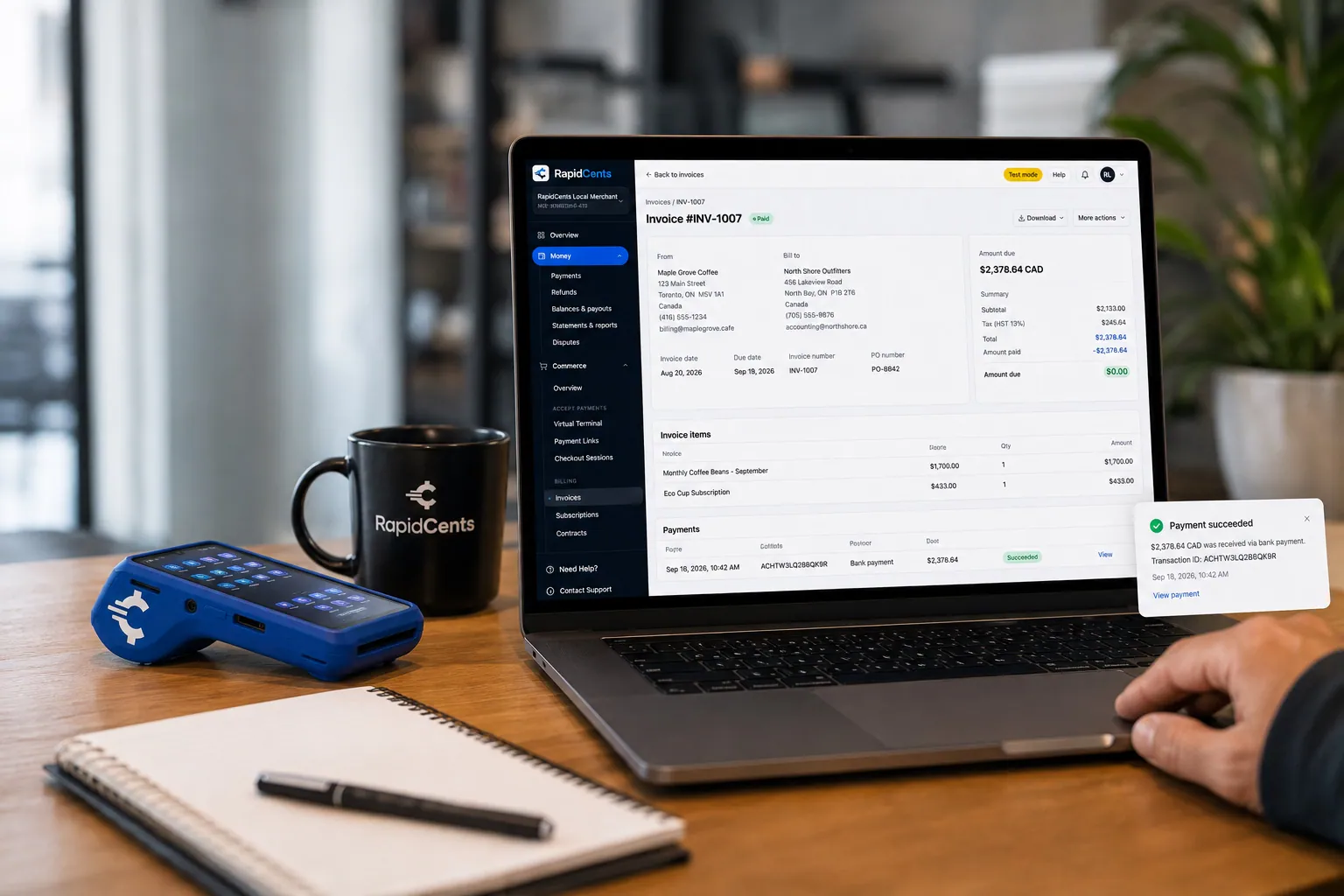
A merchant invoices a customer for bank debit through RapidCents, with card terminal capture available on the same desk. ACH / Bank Payments
Bank payments suit recurring and high-value invoices where card fees are the wrong tool. Collect directly…
Explore


How do dispatch deposits and site references work?
A dispatch deposit secures a delivery slot and a quantity, and a site reference ties every later charge to the right job. Take the deposit by payment link or in the virtual terminal when the pour is booked, then apply it to the final ticket and refund any unused part.
How a deposit is taken and applied
The dispatcher confirms the date, mix or product, and estimated quantity. The office sends a payment link for the deposit amount agreed. At final billing, the deposit is shown as a credit on the invoice, and the buyer pays only the balance.
What to set up first
Put the cancellation and weather-delay terms on the booking confirmation before any money moves. Say whether the deposit is refundable, partly refundable or applied to a rebooked pour. Record the site address and purchase order as reference fields.
What goes wrong and how to handle it
A pour may be postponed, the quantity may change, or the buyer may cancel. Apply the deposit to the rebooked date where you agreed to, or refund it under the written terms. A refund returns to the original card, so keep the original payment record.
A slab pour that slips two days for rain
Say a ready mix supplier takes a deposit when a slab pour is booked, and the pour slips two days for rain. The deposit moves to the new date, the final ticket is invoiced for the real quantity, and only the balance is collected.
How do you compare fees using your real payment mix?
Compare fees using your real mix of card types, ticket sizes and channels. RapidCents prices on interchange-plus: interchange passes through at cost, you pay your RapidCents markup as set out in your Fee Schedule, plus fees for equipment or services if applicable. Service is month to month, with no fixed term.
What drives cost for a materials supplier
Concrete supplier credit card processing and sand gravel supplier merchant services both start with the mix. Large load invoices, commercial and purchasing cards, keyed phone orders and online link payments each carry different interchange. A card tapped at the scale house is priced differently from one keyed by the office. Your mix, not an average, decides cost.
What to bring to a comparison
Bring recent processing statements, your split between link, phone and in-person payments, average and largest ticket, and refund and chargeback volume. Add how many customers pay by bank transfer today. Ask each provider for the full written fee schedule.
How Fee Check helps
Upload a processing statement to Fee Check and it separates interchange from markup, so you can see what is passed through and what is added. Your RapidCents representative will walk you through commercial card data support for your setup.
Which accounting and ERP software works with payment processing?
RapidCents integrates with many major platforms through APPIE and RapidBridge, and your ticketing, dispatch and accounting software decides how payments reach your ledger. Settled transactions, fees and refunds connect to QuickBooks Online and Xero, while SAP and NetSuite import settlement files. Your RapidCents representative will walk you through the right option for your vendor and version.
NetSuite and SAP Business One
RapidBridge works with Oracle NetSuite and the SAP Business One Web Client, so a card payment posts against the invoice you already have open. Both can also import RapidCents settlement files. Your RapidCents representative will walk you through how invoice and ticket references map for your edition.
Dynamics 365 Business Central, Acumatica and Epicor Kinetic
These ERPs often run order, invoice and customer records for suppliers. RapidBridge works with all three, so a card payment posts against the invoice you already have open in the software, with no change to the software itself.
Batch plant, ticketing and dispatch software
Payment software does not schedule trucks or produce batch tickets. Tell your RapidCents representative which ticketing or dispatch software you run, and they will show you how payments connect and which reference data, such as the ticket number, can flow across.
Payment options for concrete and aggregate suppliers in the United States
A concrete or aggregate supplier in the United States can offer credit and debit cards, including PIN debit where supported, and ACH bank payments for larger accounts. Your RapidCents representative will walk you through which options to turn on for your business.
Cards and PIN debit at the yard
Credit and debit cards work on links, by phone and at a terminal. PIN debit, where supported, suits drivers and small buyers paying in person at the scale house or counter.
ACH for account balances
Larger contractors may prefer ACH to pay big invoices from their bank account. ACH needs the payer's written authorization. Settlement is in USD, and state or local tax rules on delivered material are for your tax adviser.
How do you switch processors and reconcile deposits?
Switch in stages: list what you hold today, test the new flow, run both for a short period, and reconcile deposits to your ledger before you close the old account. Once your account is approved, your RapidCents representative walks you through moving stored cards, which only transfer when both providers agree.
Inventory what you hold today
List open invoices, deposits not yet applied, standing account customers, stored cards with their authorizations, and pending refunds. Note which customers pay by link, by phone and at the scale house. Gaps in this list cause most surprises.
Test before moving live traffic
Run a test sale, a deposit, a refund and a combined-ticket payment. Check that the job number and purchase order show on the receipt and the report. Run both providers in parallel for a short period, as your own records allow.
Reconcile deposits to the ledger
Match each settlement report to the invoices, tickets and fees it covers, then export to your accounting software. Keep the old provider's reports for dispute windows. Do not assume stored cards transfer; both providers must agree and customers may need to re-authorize.
Payment questions from concrete and aggregate suppliers
What is the best payment processor for concrete and aggregate suppliers?
The right processor fits your ticket sizes, payment channels and ERP. RapidCents carries the job number, purchase order and ticket number on every invoice and payment link, takes phone payments in the virtual terminal and gives you dispute tools and settlement reports. Ask for our written Fee Schedule and compare it, line by line, with what you pay today.
How much does credit card processing cost for concrete and aggregate suppliers?
Cost depends on your card mix, ticket sizes and channels, so no single figure applies. RapidCents prices on interchange-plus: interchange passes through at cost, plus your RapidCents markup in your Fee Schedule and fees for equipment or services if applicable. Service is month to month with no fixed term. Upload a statement to Fee Check to see interchange separated from markup.
Can NetSuite or SAP Business One use a different payment processor?
Yes. RapidBridge works with Oracle NetSuite and the SAP Business One Web Client, so a card payment posts against the invoice you already have open, and both can also import RapidCents settlement files. Payment links work outside the software too, so you keep your ERP as it is. Your RapidCents representative will walk you through which route fits your invoices and how ticket references map.
How can concrete and aggregate suppliers switch processors without losing payment history?
Keep your old provider's reports and export open invoices, deposits and refunds before you move. Test a sale, a deposit and a refund on the new account, then run both in parallel for a short period. Stored cards only move if both providers agree, and customers may need to re-authorize.
Which payment options can a concrete or aggregate supplier in the United States offer?
A supplier in the United States can offer credit and debit cards, PIN debit where supported, and ACH for bank payments, with settlement in USD. ACH needs the payer's authorization. Your RapidCents representative will walk you through which options to use for your business, including commercial card data support.
How should a final truckload amount be collected?
Collect it from the confirmed ticket quantity, not the original quote. Build the invoice from the signed scale or delivery ticket, list any delivery or waiting charges you disclosed, and send a payment link or take the card by phone. If the quantity is disputed, resolve it against the ticket before charging, then issue a credit or refund for any difference.
Can a site pay multiple delivery tickets together?
Yes, if your records keep each ticket tied to its invoice. Group tickets on one invoice or list each invoice number in the payment reference, so one payment can be allocated back. Your RapidCents representative will walk you through how your accounting software reconciles the combined amount. Never split a single charge to avoid card limits; use documented partial payments instead.
Does payment software schedule concrete trucks?
No. Payment software collects money; it does not schedule trucks, dispatch drivers or produce batch tickets. Your dispatch system keeps doing that, and RapidCents integrates with many major platforms through APPIE and RapidBridge. Tell your RapidCents representative which dispatch or ticketing product you use, and they will show you which references, such as a ticket number, carry across.
Can we take a deposit before a pour or delivery?
Yes. Send a payment link or use the virtual terminal when the delivery is booked, and apply the deposit to the final ticket. Put cancellation, weather-delay and refund terms in writing first. If you keep a card for later charges, you need the customer's authorization and an agreed amount, timing and cancellation process.
How do we handle a short load, rejected material or a returned load?
Adjust the invoice to the confirmed quantity, then credit or refund the difference. Use a credit note when the balance stays on the customer's account, and a refund when money returns to the original card. Keep the ticket, site photo and invoice together, because they are your evidence if the buyer disputes the charge.
What MCC is used for concrete and aggregate suppliers?
MCC 5039 is commonly associated with construction materials suppliers, including some concrete, sand and aggregate sellers. RapidCents sets the right merchant category during onboarding, based on what your business actually sells and how. Your RapidCents representative will walk you through the code that applies when your account is reviewed.
Related building materials suppliers
Building material suppliers, lumber and timber wholesalers, roofing distributors and flooring distributors share ticket references, deposits and account balances. Contractors who collect from their own customers have their own industry guide, and B2B and wholesale is the broader category.
B2B & Wholesale
Collect net-terms invoices by payment link with the PO number attached, take commercial…
Building Material Suppliers
Collect contractor invoices, delivery deposits and job-level balances from the businesses…
Lumber & Timber Wholesalers
Collect from the contractors and dealers you supply: grade-and-quantity invoices…
Roofing Material Distributors
Collect roof-package deposits, site-delivery balances and will-call sales from…
Flooring & Tile Distributors
Collect lot reservations, special-order deposits, delivery balances and breakage credits…
Dental Suppliers
From monthly consumables reorders to chair and imaging deposits, collect what clinics…
Veterinary Suppliers
Get invoices, standing orders and equipment deposits paid by the veterinary practices…
Medical & Surgical Suppliers
RapidCents helps medical and surgical suppliers collect hospital, clinic and practice…
Take the next step
Review your load ticket and deposit workflow
Upload a recent processing statement to Fee Check and see interchange separated from your markup, then talk through tickets, deposits and site references with RapidCents.
- No obligation
- Payment specialists, not a call centre
- Secure statement upload



