


Dental payment processing: deposits, payment plans and balances after insurance
Dental payment processing for a clinic covers treatment plan deposits, in-house installment plans charged to a stored card, and the patient balance after insurance pays. RapidCents handles them with front-desk terminals, Payment Links, Virtual Terminal and Recurring Payments, and connects to practice software through APPIE and RapidBridge. Stored cards need documented patient authorization.

- PCI DSS Level 1
- SOC 2 Type II
- All major cards: Visa, Mastercard, Amex, Discover, UnionPay, Diners Club & Interac Debit
- Interchange-plus available
- Canadian support
How dental clinics get paid
A dental clinic gets paid at six points in a patient's care: at checkout, when a plan is accepted, on an installment schedule, after the claim, through staged treatment and over the phone. The patient, or the guarantor on a family account, pays what insurance does not. When your clinic accepts assignment of benefits, insurers pay their share to you separately, on claims your practice software submits; when it does not, the patient pays the full fee and the insurer reimburses the patient.
Checkout after today's appointment
After a hygiene visit or a filling, the patient or guarantor pays the estimated patient portion, usually by tapping or inserting a card on a dental office payment terminal at the front desk. If an insurance estimate turns out wrong, a small balance or credit is settled after the claim. Finance gets a transaction with card brand, authorization code and time to match against the day's ledger postings.
Treatment plan deposits
A patient who accepts a plan for crowns, implants, veneers or a bridge pays a deposit that secures the lab case and the long appointment it needs. It is collected at the front desk, or by Payment Link when the patient accepts from home. If the dentist revises the plan before treatment starts, the deposit moves to the new plan. Finance sees the deposit as a credit on the patient ledger until the final invoice draws it down.
In-house installment plans
Larger restorative cases, such as implants or several crowns, and orthodontic treatment are often paid monthly on a schedule your clinic sets and runs itself. The patient or guarantor pays each installment from a stored card under a signed agreement, charged by Recurring Payments. If a card declines or expires partway through, you text a Payment Link for that installment. Finance gets one settled charge per installment, traceable to that agreement.
Balances after the insurance claim
Once the insurer adjudicates the claim, the patient owes whatever the plan did not cover. The front desk sends a Payment Link to the patient's phone or inbox, or charges the card on file when the patient has authorized it. It runs both ways: the claim can pay less than the estimate, leaving more to collect, or more, leaving a credit to refund. Finance gets each payment or refund tied to the patient's account number.
Staged payments for multi-visit treatment
Treatment delivered over several appointments, such as an implant from placement to final crown, is paid stage by stage or drawn from a deposit at each visit. Each stage is collected on the terminal or charged to a card the patient authorized for that plan. If a plan is revised midway, you refund or charge against the specific stages. Finance can trace every payment to one treatment plan when staff post it there.
Phone payments from guarantors
A parent, spouse or other guarantor often pays for someone else's treatment by phone after receiving a statement. Staff key the card in Virtual Terminal with AVS and CVV verification, or send a Payment Link so the guarantor enters the card details. Keyed payments carry more fraud and dispute exposure than cards presented in person. Finance gets the payment with the staff user who took it recorded in the audit log.
Payment pages for specialized businesses
Some businesses in this sector take payments differently enough to need their own page. Each one covers its own payment jobs, software questions and buyer FAQs.
How to take dental treatment plan deposits
Take a treatment plan deposit when the patient accepts the plan, before you order lab work or reserve a long appointment. Collect it on the front-desk terminal, or send a Payment Link by text or email if the patient accepts from home. Write down what the deposit secures, how it applies to the final invoice and when it is refundable, then post it to the patient ledger as a credit against that plan.
How a deposit runs from acceptance to receipt
The patient, or the guarantor on the account, accepts the plan with the treatment coordinator. Staff take the deposit on a RapidCents payment terminal by tap or chip, or send a Payment Link with the patient's account number as its reference. The patient receives a receipt, and staff post the deposit to the ledger with the RapidCents transaction reference so the final invoice draws it down.
What to set up before the first deposit
Decide the deposit amount for each kind of plan, what it secures, how it is applied and what is refunded if the patient cancels before or after the lab case is ordered. Put those terms in the financial agreement the patient signs; Contracts & eSignatures can send that agreement, capture the signature and take the deposit in one flow. Clinical consent stays a separate document in your practice software.
When the plan changes, the patient cancels or the card declines
If the dentist revises the plan, apply the deposit to the new plan and note the change in the ledger. If the patient cancels, refund the refundable portion against the original payment in RapidCents, so the refund traces back to the deposit. If the card declines, the patient can use another card or pay later by Payment Link; hold the lab order until the deposit goes through. If the patient later disputes the deposit, the signed terms and the receipt are your evidence.
A two-crown plan, from agreement to seated crowns
Say a patient accepts a plan for two crowns after an exam. The treatment coordinator sends the financial agreement for signature, and the patient pays a deposit on the front-desk terminal, sized to cover the lab fees, before the case goes to the lab. The receipt names the clinic and the amount, not the procedure, and staff post the deposit to the ledger with its RapidCents reference. When the crowns are seated, the invoice shows the deposit as a credit, the insurer's share is claimed, and the patient pays what remains.
In-house patient payment plans versus third-party financing
In-house patient payment plans for dental practices are collection schedules; third-party financing is credit. On an in-house plan, the patient pays an agreed balance in installments that your clinic collects, and your clinic carries the loss if payments stop. With financing, a lender decides whether the patient qualifies, sets the terms and pays your clinic under its own agreement. RapidCents Recurring Payments runs in-house schedules; RapidCents does not lend to patients.
How an in-house plan runs on Recurring Payments
The patient signs a payment agreement that lists the total, the installment amount, the charge dates, the number of payments and how to cancel or change the card. With that authorization, the card is stored in the Secure Card Vault, and Recurring Payments charges each installment on the agreed date and can notify the patient before each charge. Staff post each installment to the patient's ledger against the plan.
Missed installments and cards that expire mid-plan
A long plan can outlast the card it started on. Account Updater refreshes card details where the card issuer takes part, and automated retries try a declined installment again. If a payment still fails, text the patient a Payment Link for the missed amount, then decide under your agreement whether treatment continues; that decision belongs to the clinic, not the processor. When the dentist changes the plan, change the schedule before the next charge runs.
How third-party financing works
With third-party financing, the patient applies to a lender, the lender decides eligibility and sets interest and repayment terms, and the patient signs the lender's credit agreement rather than yours. RapidCents takes no part in that credit decision. When the lender pays your clinic, post that payment to the patient ledger as a third-party payment, the same way you post an insurer's.
Cash flow, risk and paperwork compared
Compare the two on four points. Cash flow: in-house, you are paid installment by installment; a lender often pays your clinic sooner, under its own fee terms. Risk: in-house, a missed payment is your loss; a lender usually carries repayment risk, though some programs pass it back. Paperwork: your agreement and stored-payment authorization, or the lender's credit agreement. Follow-up: in-house, your front desk chases missed installments. Some clinics offer both, keeping in-house plans for smaller balances.
A veneer plan, two ways
Say a patient wants to spread the cost of veneers that insurance does not cover. On an in-house plan, they pay a down payment at the terminal and sign an agreement for monthly charges, which Recurring Payments takes from the stored card. If the card expires mid-plan, Account Updater carries the new expiry date over where the issuer takes part; otherwise staff text a Payment Link until the patient authorizes a new card. Had the patient used a lender instead, the clinic would post the lender's payment and run no schedule.
RapidCents products for dental clinics
Four products carry most of a dental clinic's payments: Payment Terminals at the front desk, Payment Links for deposits and post-claim balances sent by text or email, Recurring Payments for installment plans, and Virtual Terminal for phone payments from guarantors.

The RapidCents payment links screen listing created links with their amount, status, click count and whether they have been paid, beside a phone showing the branded page a customer opens to pay $2,500.00. Payment Links
RapidCents payment links let staff generate branded pay-by-link URLs for invoices, deposits, balances and…
Explore
The RapidCents recurring payments screen showing active subscriptions, monthly recurring revenue, failed payments and upcoming renewals, above a list of subscriptions with their plan, amount, frequency and next billing date. Recurring Payments
RapidCents recurring payments manage subscription plans, membership renewals and installment schedules with…
Explore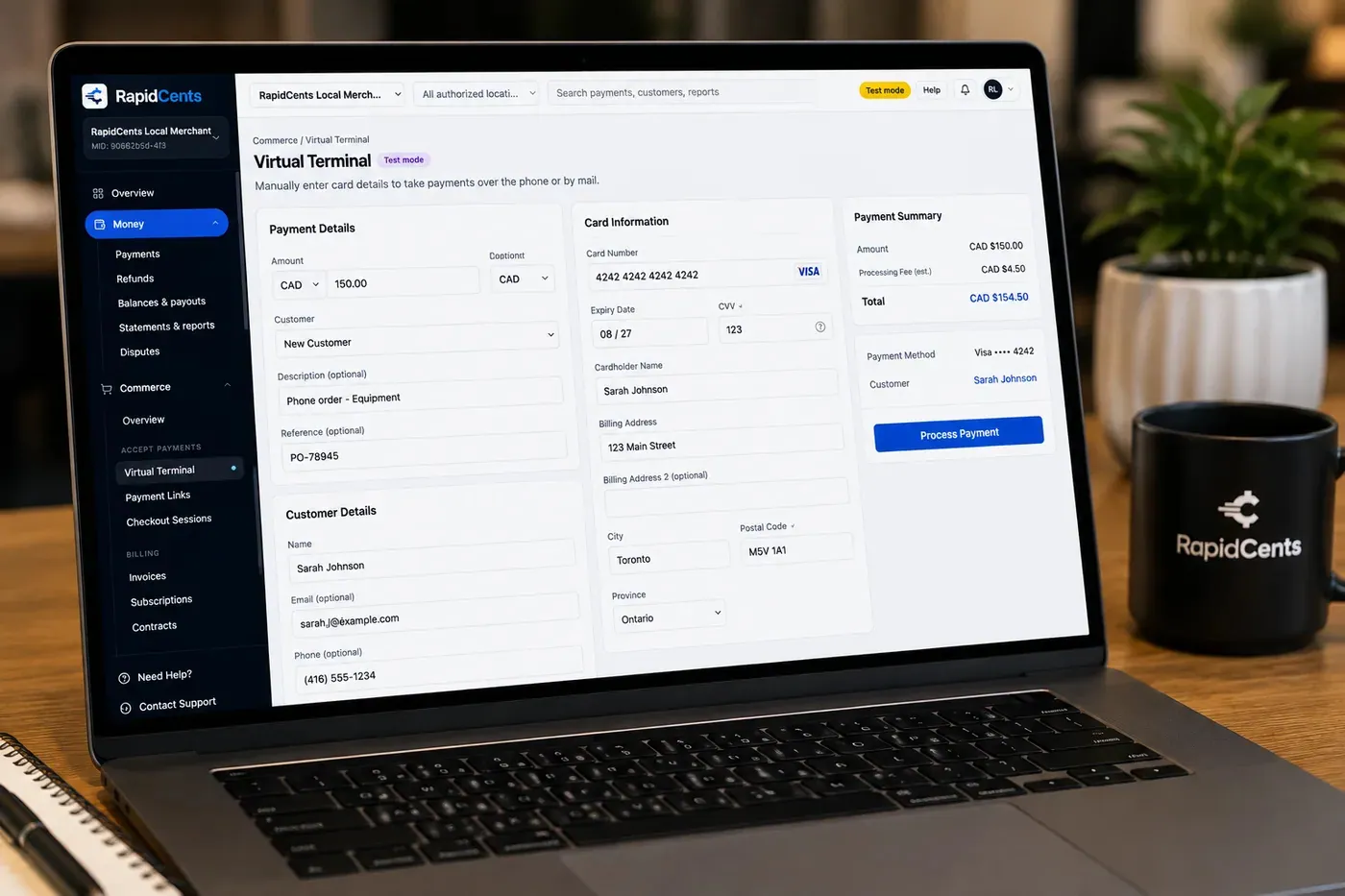
The RapidCents virtual terminal: payment details, card number, expiry and CVV keyed by hand on the left, with a payment summary on the right showing the amount, the estimated processing fee and a Process Payment button. Virtual Terminal
The RapidCents virtual terminal lets authorized staff enter mail-order and telephone-order payments through a…
Explore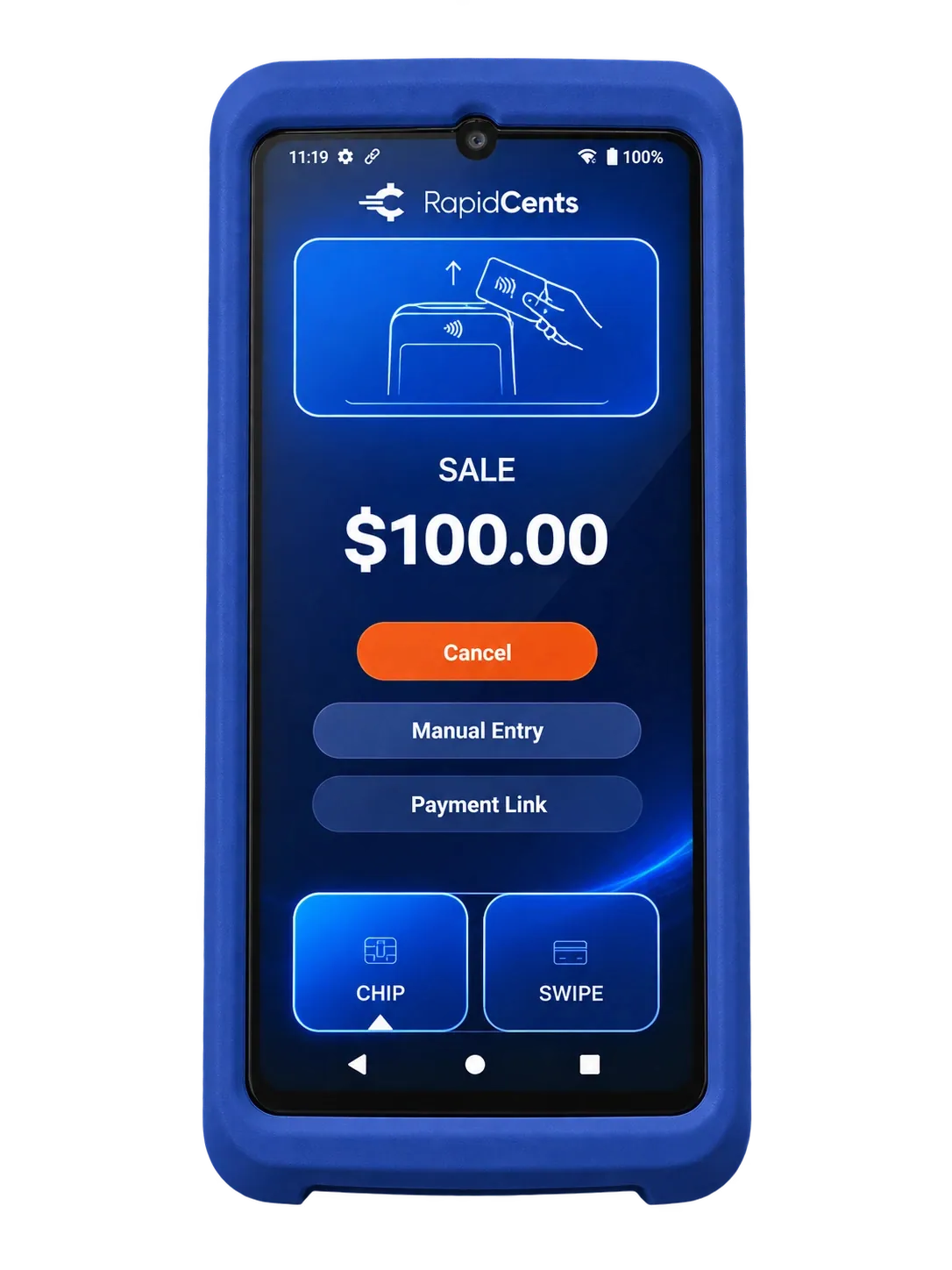
The RapidCents Rivo Go standing upright in its blue silicone case, showing the full-touch sale screen a customer reads across the counter. Payment Terminals
RapidCents payment terminals cover countertop, mobile and smart form factors so you can accept chip…
Explore


How to collect patient balances after insurance pays
Once the insurer has adjudicated the claim, collect the exact amount the patient owes: send a Payment Link by text or email, take it at the next visit, or charge a card on file the patient authorized for post-insurance balances. Timing matters in dental patient balance collection: bill before the claim settles and you may have to refund the difference. The insurer decides what the plan pays; the RapidCents record holds the patient's payment, its date and your reference, not the claim.
Dental text to pay, step by step
To text a patient their balance, the front desk creates a Payment Link for the exact amount, adds the account number as the reference, sets an expiry date and sends it by SMS or email. The patient pays on their phone, the receipt goes out automatically, and the link shows as paid in the Merchant Dashboard. Staff then post the payment to the ledger. Keep procedure names out of the message; the account number is enough.
Charging the dental office card on file
You can charge a stored card once the claim settles, but only for the balances the patient authorized in writing. List which balances the card may be charged for, any upper limit, and how much notice the patient gets before the charge, then keep the signed authorization with the payment record. A charge the patient did not expect invites a dispute, so send the amount first and charge after.
When the claim pays more or less than the estimate
If the claim pays less than estimated, collect the difference by link, at the next visit or from an authorized card on file. If it pays more, the patient has a credit: refund it to the original card in RapidCents, or apply it to booked treatment only if the patient agrees, and post it so the ledger clears. For patients with two dental plans, wait for the secondary claim before billing the patient, or you may collect and then refund the same amount.
A $1,200 crown and a balance after the claim
Say a crown is estimated at $1,200, with the patient's plan expected to pay $600. The patient pays the estimated $600 patient portion at checkout. The claim pays $480 because the annual maximum is nearly used, so the patient owes another $120, and the front desk texts a Payment Link with the account number as the reference. Had the claim paid $650, the clinic would refund $50 to the original card instead.
Compare dental processing fees on your real card mix
Compare dental processing fees on your own card mix, because interchange, set by the card networks, varies with the card type and with how the card is taken. On RapidCents you pay interchange at cost plus the markup and any equipment or service fees in your Fee Schedule, month to month with no fixed term. What moves your total is the card mix on large treatment balances, how much you key, link or schedule instead of taking at the desk, and your refund and dispute volume.
Interchange-plus, line by line
Interchange-plus pricing separates interchange, which varies by card type from debit through standard and premium rewards credit, from your RapidCents markup and any equipment or service fees. Some processors quote one bundled price for every card instead, so you cannot see which payments cost more to accept. Seeing each part lets you compare what a crown deposit on a rewards card cost against a hygiene visit paid by debit.
Large tickets and premium cards
Major dental treatment produces large balances, and when patients put crowns, implants or veneers on premium rewards credit cards, those payments cost more to accept than debit. Two clinics with the same monthly volume can pay different totals if one sees mostly debit and the other mostly rewards cards. Look at your split between debit, standard credit and premium rewards cards before you compare quotes.
Tapped at the desk versus keyed, linked or recurring
A patient's card tapped or inserted at the front desk is a card-present payment. A guarantor's card keyed into Virtual Terminal, a balance paid through a Payment Link and an installment charged on schedule are all card-not-present, where interchange can be higher and fraud screening such as AVS, CVV and 3-D Secure applies where relevant. Work out what share of your volume runs through each channel before you compare offers.
Terminals, refunds and disputes
Count the terminals you need at each front-desk station and consult room, and check whether each quote has you buy, rent or lease them; a lease can run separately from the processing agreement. A treatment coordinator working chairside can use Tap to Pay on a supported iPhone or Android phone instead of another terminal. Refunds on revised plans and disputed charges cost money and staff time, so look at how your Fee Schedule treats them. Ask your current provider about early termination fees too.
What to gather before you compare quotes
Gather your last three monthly processing statements, your average ticket for hygiene visits and for major treatment, your split between front-desk, phone, link and recurring payments, your refund and chargeback counts, and your terminal and lease terms. Upload a statement to Fee Check to see interchange apart from markup; that gives you the baseline for judging any written quote, including one from RapidCents.
Dentrix, ClearDent and other practice software
RapidCents integrates with many major platforms through APPIE and RapidBridge, and which option fits depends on your practice software's edition, version and country. RapidBridge works with CareStack, ClearDent Cloud, Curve Dental (Curve Hero), Denticon, Dentrix Ascend, Dovetail Dental, Oryx Dental and tab32, so a card payment posts against the patient account you already have open. For other software, your RapidCents representative walks you through how each payment reaches the patient ledger.
Dentrix
Dentrix holds the treatment plan, the patient ledger and the insurance claim, so every deposit, installment and refund has to reach it. RapidBridge works with Dentrix Ascend, so card payments post against the patient account you already have open. For other Dentrix editions, your RapidCents representative will walk you through whether payments post through a connection, an import or manual entry with the RapidCents reference.
ClearDent
ClearDent manages appointments, claims and the patient ledger. RapidBridge works with ClearDent Cloud, so a RapidCents card payment posts against the patient account you already have open. If you run ClearDent in another edition, tell your RapidCents representative which version you use, and they will show you how payments and refunds reach the ledger.
ABELDent
ABELDent's patient ledger is where installments and post-claim payments have to appear for balances to stay right. RapidCents integrates with many major platforms through APPIE and RapidBridge, and the right option depends on your edition. Your RapidCents representative will walk you through how payments arrive and how to move your payment plans across.
Open Dental
Open Dental tracks patient payments and payment plans in its own ledger. RapidCents integrates with many major platforms through APPIE and RapidBridge, and the right option depends on your Open Dental version. Your RapidCents representative will walk you through how a payment taken on RapidCents is recorded with its reference and how your payment plans line up with a RapidCents recurring schedule.
Curve Dental
Curve Dental is cloud practice software, and RapidBridge works with Curve Dental (Curve Hero), so card payments taken on RapidCents post against appointments and claims in the patient account you already have open. Your RapidCents representative will walk you through the setup for your country and version.
QuickBooks Online and Xero
Your accounting software receives the money side of every visit. RapidCents connects settled transactions, fees and refunds to QuickBooks Online and Xero, so your bookkeeper can match deposits without rekeying them. Larger dental groups on NetSuite or SAP import settlement files instead of using a live connector.
Payment options for dental clinics in Canada
A dental clinic in Canada can take Interac debit and Visa, Mastercard and American Express credit at the front desk, card payments by Payment Link or Virtual Terminal, and EFT bank payments through pre-authorized debit (PAD) for installment plans where enabled, all settled in CAD. Claims to insurers and to the Canadian Dental Care Plan follow their own process; RapidCents collects only the patient's portion.
Interac debit and credit at the front desk
Patients pay with Interac debit by chip and PIN or contactless tap, or with Visa, Mastercard or American Express credit, on a RapidCents payment terminal. Large treatment balances often exceed the issuer's contactless limit, so expect chip and PIN for those. Interac debit and credit cards are priced differently, so the share of large balances paid by debit versus credit changes your total cost.
Pre-authorized debit for installment plans
For in-house installment plans, a patient can pay by EFT from their bank account under a signed PAD agreement instead of a stored card, where bank payments are enabled on your account. PAD avoids cards expiring partway through a plan, but a returned debit can surface days later, so make sure each payment has cleared before you mark the installment paid.
Dentrix and ClearDent payment setups in Canada
Dentrix's Canadian help pages describe a Moneris Gateway setup, and ClearDent markets ClearDent Pay. If your clinic runs either, your RapidCents representative will walk you through how payments taken on RapidCents are recorded in your edition. RapidBridge works with ClearDent Cloud and Dentrix Ascend.
Switching checklist: setup, testing and daily reconciliation
Once your account is approved, switching a dental clinic's processor safely means listing everything that charges a card today, testing the new setup before patients use it, moving stored cards and payment plans deliberately, and reconciling deposits to the ledger from day one. Leave the old account open until refunds on its earlier payments and any disputes have cleared. Your RapidCents representative will walk you through whether stored cards can move or must be collected again.
Inventory what charges a card today
List every active installment plan with its next charge date, every stored card and the authorization behind it, open treatment plan deposits, unpaid patient balances, pending refunds and open disputes. Add every terminal and its lease, the payment settings in your practice software, and any links or online booking pages that collect deposits. That list becomes your switching plan and your test checklist.
Stored cards and payment plans
Card tokens sit in your current processor's vault, even when that processor comes bundled with your practice software. Moving them needs both providers to agree to a secure transfer. If that is not possible, collect a new card authorization at each patient's next visit, and send a Payment Link for any installment that falls due first. Cancel each schedule on the old system only when its replacement is live, so no patient is charged twice or missed.
Test before live patients
Run a sale, a refund, a deposit and a Payment Link on the new account, then check that each appears in RapidCents reporting and that staff can post it to the ledger with its reference. Train the front desk on refunds and voids, and set role permissions so only the right people can key cards or issue refunds in Virtual Terminal.
Run the old account down, then close it
For a period after the switch, take new payments on RapidCents while the old account handles refunds on its own earlier payments, such as a deposit refunded after a plan changes, and any open disputes. Close it once those refunds, disputes and its final payout are settled, and download its transaction and statement history before you do.
Reconcile every day, by location
Each day, match the RapidCents settlement report to the day sheet in your practice software: card payments posted to patient ledgers, refunds posted as adjustments, and a bank deposit that equals settled sales less refunds and any fees deducted. Group practices can use Multi-Location to give each clinic its own merchant ID and permissions while reporting rolls up for the owner.
Payment questions from dental clinics
How should a dental clinic handle treatment plan deposits?
Take the deposit when the patient accepts the treatment plan, under written terms, and record it as a credit against that plan. When you compare payment providers, check that you can take a deposit in person or by link, attach your own account or plan number as the reference, refund part of a deposit against the original payment, and find each deposit in settlement reports. An insurer's predetermination can guide the deposit amount, but adjudication stays with the insurer; the deposit is only a record of what the patient paid.
What is the difference between an in-house dental payment plan and third-party financing?
An in-house payment plan is your clinic collecting an agreed balance over time; third-party financing is credit the patient takes on with a lender. With an in-house plan, the patient signs your payment agreement, your clinic is paid as each installment clears, and your clinic absorbs any missed payments. With financing, the lender decides whether the patient qualifies, sets the interest and repayment schedule, and pays your clinic according to the agreement your clinic signed with that lender. RapidCents Recurring Payments runs in-house schedules from stored cards; RapidCents does not lend to patients or offer patient financing.
How should we collect patient balances after insurance?
Collect the balance after the insurer has adjudicated the claim, for the exact amount the patient owes. Text or email a Payment Link with the patient's account number as its reference, collect it at the next appointment, or charge a stored card if the patient authorized post-insurance charges in writing. If the claim pays more than estimated, refund the difference to the original card. The explanation of benefits stays in your practice software; the RapidCents record holds the payment amount, date, card and reference.
How do we collect payment for treatment that spans several visits?
Collect stage by stage as treatment is delivered, or take a deposit at the start and draw it down at each visit. An implant case, or a root canal followed by a crown, can be paid at each appointment on the front-desk terminal; a longer plan can run as monthly charges to a stored card under a signed agreement. Post every payment against the same treatment plan in your practice software so the remaining balance stays visible, and refund against specific payments if the dentist revises the plan.
Which payment options can a dental clinic in Canada offer?
A dental clinic in Canada can offer card payments in person, by link, by phone and on a schedule, plus EFT bank payments by pre-authorized debit (PAD) where enabled, all settled in CAD. At the front desk that covers Interac debit and Visa, Mastercard and American Express credit; remotely, Payment Links by text or email and Virtual Terminal; for installment plans, recurring card charges or PAD. Patients covered by the Canadian Dental Care Plan may still owe a co-payment or a balance, which you collect the same way. Your merchant account sets which methods are active, and your RapidCents representative goes through them with you during onboarding.
How do we reconcile card payments with the Dentrix ledger?
Post every card payment to the patient's Dentrix ledger with its RapidCents transaction reference, then match the two systems every day. RapidBridge posts payments for Dentrix Ascend; where your edition has no connection, staff do that posting by hand. At close, compare the card total on the Dentrix day sheet with the RapidCents transaction report, then match the bank deposit to the settlement report. Post refunds against the original payment. Differences usually trace to a payment taken but never posted, posted twice, or posted to another family member's account.
Which payment processor is best for a dental clinic, and what should we compare?
No processor is best for every dental clinic, so compare written quotes on your own payment mix rather than marketing claims. When you compare credit card processing for dental offices, look at whether pricing separates interchange from markup, terminal costs and lease terms, contract length and exit fees, and how each provider handles deposits, installment plans with stored cards, post-insurance balances and phone payments. Check settlement reporting you can match to your ledger, dispute support, and whether your practice software edition bundles or requires a particular processor.
What fees should a dental clinic expect for in-person and online card payments?
Expect two parts in every quote, whether shown separately or bundled into one price: interchange, set by the card networks, and the processor's markup, plus any equipment or service fees. With RapidCents, interchange passes through at cost and your markup is set out in your Fee Schedule, month to month with no fixed term. Interchange depends on the card, from debit to premium rewards credit, and can be higher for keyed and online payments than for cards tapped or inserted at the front desk. Ask for a written quote built on your statements, and check how refunds, disputes and terminals are priced.
Can RapidCents integrate with Dentrix?
Yes. RapidCents integrates with many major platforms through APPIE and RapidBridge, and RapidBridge works with Dentrix Ascend, so a card payment posts against the patient account you already have open. Dentrix editions differ, and the right option depends on your edition, version and country. Tell your RapidCents representative which Dentrix you run, and they will walk you through whether payments reach your ledger through a connection, an import or manual posting with a reference.
How can a dental clinic reduce payment disputes and protect stored card details?
Get documented authorization before every stored-card or scheduled charge, and keep card numbers out of your files. Signed deposit terms, installment agreements and card-on-file authorizations are your evidence if a patient disputes a charge, and patients are less likely to dispute when their card statement shows the clinic name they know, not the professional corporation behind it. Do not write card numbers on paper forms, chart notes or emails; key them into Virtual Terminal or send a Payment Link. Payment Tokenization keeps cards in the Secure Card Vault, role permissions limit who can refund, and Disputes and Chargeback Protection tracks evidence and deadlines. No tool wins every dispute.
How can we switch payment processors without losing billing records?
Keep your billing records in your practice software and download your processor history before you close the old account. The ledger, not the processor, is the record of what each patient owes, so it stays intact through a switch. From the old provider, download transaction, settlement and statement history; note each active installment plan and when it next charges, including plans run by a payment module in your practice software; and ask both providers whether stored cards can be transferred securely. Where they cannot, collect new authorizations before each plan's next charge.
What MCC is used for dental clinics?
MCC 8021, the merchant category code for dentists and orthodontists, is commonly associated with dental clinics. The code tells card networks and card issuers what kind of business took a payment. RapidCents sets the correct merchant category with you during onboarding based on what your business actually sells, so mention any retail products, such as whitening kits or electric toothbrushes, or any separate business that shares your front desk.
Other clinics and appointment-based businesses
Physiotherapy, optometry and medical clinics share the dental pattern of an estimate before treatment, a balance after insurance and scheduled charges to a stored card, while veterinary clinics share the estimate and deposit steps. See how those jobs change with each practice's software and patients.
Healthcare
Take visit payments at reception, send payment links for what insurance leaves unpaid and…
Physio & Chiropractic
Collect visit fees and patient portions at the front desk or in the treatment room, sell…
Veterinary Clinics
Take deposits when owners sign surgery estimates, charge wellness plans monthly with…
Pharmacies
Collect the patient portion once your dispensing system has adjudicated the claim, ring…
Medical Spas
Collect treatment package deposits, bill monthly memberships and ring up retail at…
Optometry
Take exam fees and copays at checkout, deposits when frames and lenses go to the lab…
Gym & Fitness Studios
Bill monthly dues on stored cards, recover failed payments, sell class packs at the front…
Salons & Spas
Take booking deposits, charge no-show fees to cards clients agreed to store, collect tips…
Take the next step
See what your dental clinic pays to accept cards
Upload a recent processing statement to Fee Check and see the interchange on your card mix separated from the markup you pay today. Then compare a RapidCents quote on the same mix of front-desk, phone, link and recurring payments.
- No obligation
- Canadian payment specialists
- Secure statement upload



