


Veterinary payment processing for clinics and animal hospitals
Veterinary payment processing covers a deposit when a surgery estimate is signed, checkout in the exam room, a monthly wellness plan charge and the balance after emergency care. RapidCents handles each one with payment terminals, Tap to Pay, Payment Links and Recurring Payments. RapidBridge works with ezyVet, Covetrus Pulse and Shepherd Veterinary Software.

- PCI DSS Level 1
- SOC 2 Type II
- All major cards: Visa, Mastercard, Amex, Discover, UnionPay, Diners Club & Interac Debit
- Interchange-plus available
- Canadian support
How veterinary clinics get paid
A veterinary clinic collects from pet owners in six situations: checkout after a visit, a deposit when a procedure estimate is approved, monthly wellness plan charges, the balance after emergency care, scheduled installments on a large bill, and remote payments for refills or follow-up fees. Each starts from a different trigger and leaves a different record for the front desk and the bookkeeper to match.
Checkout at the end of an appointment
The owner pays for the exam, vaccines, tests and medications once the invoice is closed in your practice software. Staff take the card on a countertop terminal at reception, or carry a mobile terminal or a Tap to Pay phone into the exam room. If an owner splits the bill across two cards, finance gets one transaction per card to match against the closed invoice.
Deposits on procedure estimates
Before a planned surgery or dental procedure, the owner approves an estimate and pays part of it up front. Staff take the deposit on the terminal at drop-off, or by Payment Link when the estimate is approved by email. If the procedure is postponed, your written deposit terms decide whether the money is held, applied later or refunded. Finance needs the deposit linked to the estimate number.
Monthly wellness plan charges
Owners who join a preventive care plan pay a set monthly amount for the exams, vaccines and routine tests the plan includes. Recurring Payments charges the card the owner authorized the clinic to keep on file, on the billing date in the plan agreement. If a card declines or expires, the front desk sends a Payment Link for that month. Finance gets a dated charge history for every plan member.
Emergency and after-hours balances
When an animal comes in urgently, the owner pays a deposit against an emergency estimate at intake and the balance at discharge, which may be days later. Payment comes by terminal, by phone through Virtual Terminal, or by Payment Link to whoever is paying. If one card cannot carry the whole amount, the balance is split. Finance needs every partial payment applied to one invoice.
Installment schedules on large bills
An owner who cannot pay a large surgical or emergency bill at once may agree to pay it on set dates. Recurring Payments runs the installment schedule from a stored card, with the amounts, dates and cancellation terms in an agreement the owner signs. It is a collection schedule, not a loan, so the clinic carries the unpaid balance. Finance sees each installment against the original invoice.
Refills and follow-up fees paid by text
Some payments happen without a visit: a prescription refill, a bag of prescription diet set aside for pickup, or the fee for a follow-up call. Staff send a Payment Link by SMS or email with the invoice number in the reference field, and the owner pays from a phone. A link can carry an expiry date, and finance can see which links are open, paid or expired.
How do veterinary estimate deposits work before surgery?
Veterinary estimate deposits work best when the owner pays at the moment they approve the estimate, the payment is recorded against the estimate number, and the deposit is applied to the final invoice at discharge. With RapidCents, the front desk takes the deposit on a payment terminal at drop-off or through a Payment Link sent with the estimate, then collects the balance or refunds the difference against the same reference.
How the deposit runs
Build the estimate in your practice software with its low and high figures and the deposit due. When the owner signs, take the deposit before the animal is admitted and post it against the estimate in the practice software that day. A deposit paid by link carries the estimate number in its reference field, so the RapidCents record and the practice software record share one number.
Set deposit terms before the first booking
Decide how much you collect up front, such as a fixed amount or a share of the low estimate, when it is due, and what happens if the owner postpones or cancels or the plan for the procedure changes. Put those terms on the estimate the owner signs. For remote approvals, Contracts & eSignatures can send the estimate document, capture the owner's signature and take the deposit in the same flow.
Charge the deposit or place a hold?
A deposit is a completed charge that settles like any other sale. Some clinics prefer a hold that is captured later, and your RapidCents representative will tell you whether pre-authorization fits your terminal or gateway setup. Card authorizations expire after a period set by card network rules and the issuing bank, so a hold suits a procedure done soon after drop-off better than surgery booked weeks out.
When the final bill moves away from the estimate
If treatment runs above the approved range, get the owner's approval of a revised estimate and note it in the record before you collect the difference on the terminal or by Payment Link. If the final bill is lower than the deposit, refund the excess to the card that paid it, so the refund matches the original transaction. A decline at pickup is handled with a second card or a partial payment against the invoice.
A dental procedure booked a week ahead, deposit by link
Say a clinic books a dog's dental procedure for the following week and emails an estimate showing a low and high range. The owner signs the estimate and pays the deposit through the Payment Link sent with it, so the estimate number travels with the payment. On the day, added treatment moves the bill toward the top of the range; the owner approves the change by phone, and at pickup taps a card for the remaining balance. Deposit and balance now sit against one estimate and one invoice.
How does vet wellness plan billing work with a stored card?
Vet wellness plan billing works as a scheduled card charge. The owner signs a plan agreement that sets the monthly amount, billing date, term and cancellation terms, and authorizes the clinic to keep a card on file. Recurring Payments then charges that card on each billing date. Automated retries and Account Updater address the two usual failures, a temporary decline and a reissued card.
Set up each plan member once
At sign-up, with the owner's authorization, save their card to their Customer Profile as a token in the Secure Card Vault, never on a paper form or in a note in the practice software. Set the plan amount and billing date in Recurring Payments exactly as the signed agreement shows them, with a notice to the owner before each charge. An owner with two pets on two plans should have each plan billed and recorded separately, so ending one does not stop the other.
Put the plan terms in writing first
Before the first charge, the plan agreement should set out the monthly amount, the billing date, the plan length, whether it renews automatically, and what the owner owes or gets back if the plan ends early. Make clear that the plan pays for care your clinic provides and is not pet insurance. Automatic renewal and cancellation rules differ between jurisdictions, so have the terms reviewed for the places where your clinic operates.
Declines, reissued cards and double billing
When a charge declines, automated retries try the card again, and Account Updater can refresh a reissued or expired card where the issuing bank participates. If a charge still fails, send the owner a Payment Link for that month. If your practice software or a plan administrator also bills the plan, choose one system to charge the card so no owner is billed twice.
When a plan ends early
Plans end early after a pet's death, a move or a change of clinic. Your agreement decides the settlement, weighing services already used against charges already taken. Pull the full charge history for that plan, so the front desk can explain exactly what was paid and either collect a final amount or refund the difference to the card on file. After a pet's death, stop the next charge first and settle the rest later.
A twelve-month puppy plan, from first visit to a move
Say a clinic sells a twelve-month puppy plan covering exams, vaccines and parasite screening for a monthly charge. The owner signs the agreement and authorizes the card on file at the first visit. In month five the bank reissues the card: if the issuer takes part in Account Updater, the new details are picked up; if not, the charge fails and the front desk sends a Payment Link for that month and asks for the new card. In month nine the family moves away, and the plan is settled from its charge history.
RapidCents products for veterinary clinics
Payment Terminals and Tap to Pay take payment at reception or in the exam room, Payment Links collect deposits and balances by text or email, and Recurring Payments charges wellness plans and installment schedules to cards owners have authorized you to keep.
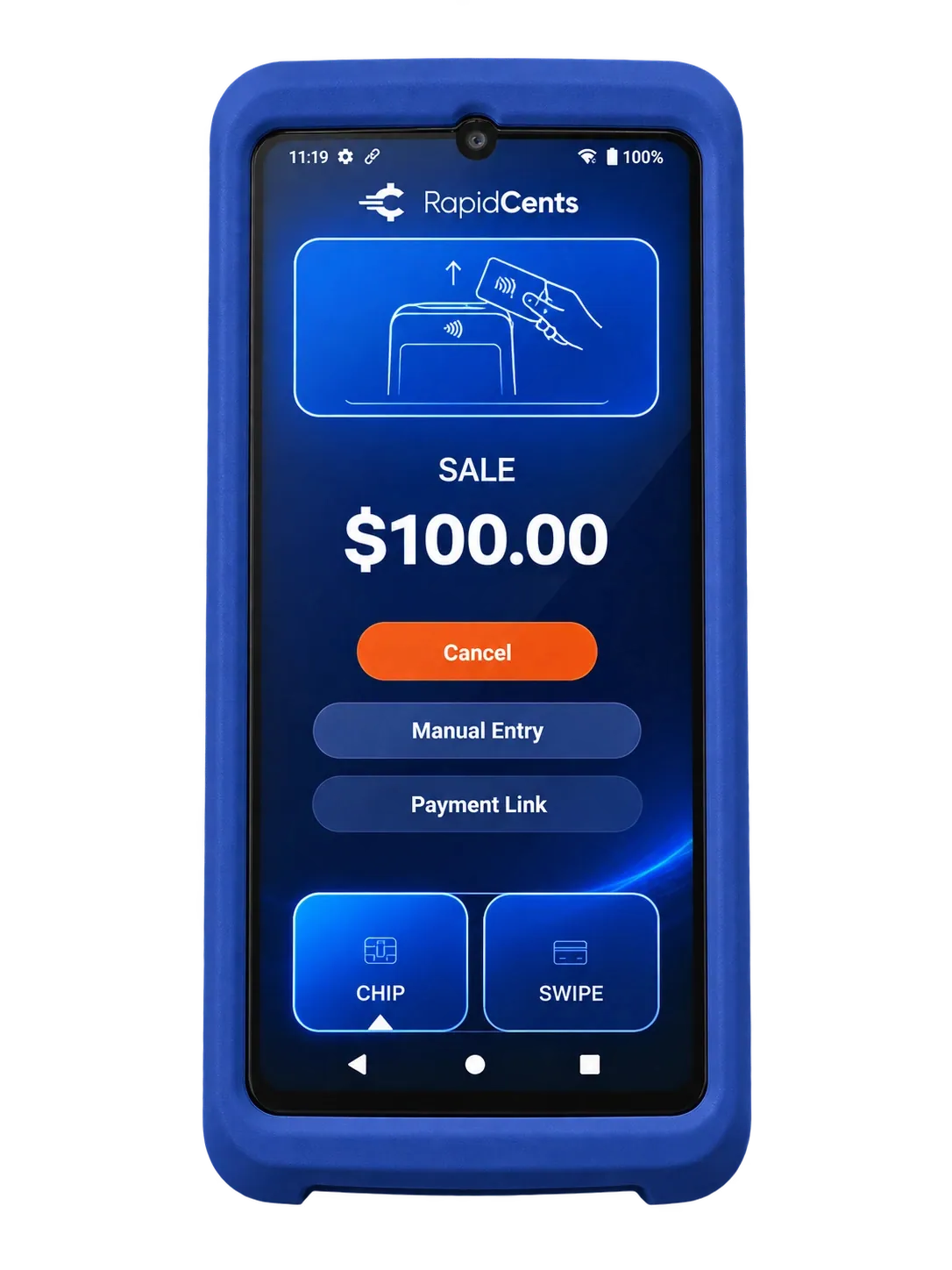
The RapidCents Rivo Go standing upright in its blue silicone case, showing the full-touch sale screen a customer reads across the counter. Payment Terminals
RapidCents payment terminals cover countertop, mobile and smart form factors so you can accept chip…
Explore
A café worker holds a phone running RapidCents Tap to Pay, showing an $18.75 sale and the contactless symbol, while a customer holds a Visa card to the screen. No separate card reader is present. Tap to Pay
RapidCents Tap to Pay turns supported iPhones and Android devices into contactless payment terminals without…
Explore
The RapidCents payment links screen listing created links with their amount, status, click count and whether they have been paid, beside a phone showing the branded page a customer opens to pay $2,500.00. Payment Links
RapidCents payment links let staff generate branded pay-by-link URLs for invoices, deposits, balances and…
Explore
The RapidCents recurring payments screen showing active subscriptions, monthly recurring revenue, failed payments and upcoming renewals, above a list of subscriptions with their plan, amount, frequency and next billing date. Recurring Payments
RapidCents recurring payments manage subscription plans, membership renewals and installment schedules with…
Explore


Emergency treatment balances, from intake deposit to discharge
Emergency treatment balances are easiest to collect in stages: a deposit against the emergency estimate at intake, a revised estimate and a further deposit if treatment changes, and the balance at discharge. RapidCents supports each stage at the desk, by phone with Virtual Terminal, or through a Payment Link sent to a relative paying from elsewhere, with every payment recorded against one invoice.
Keep every stage on one invoice
Open one invoice at intake and record every payment in the stay against it, whether the card was tapped at the desk, keyed in Virtual Terminal or paid by link. Before each further deposit, note the revised estimate in the practice software with the time and the name of the person who approved it. Treatment notes stay in the practice software; the payment record carries the amount, the card used and when it was paid.
Permissions for night and weekend shifts
Emergency payments are taken by whoever is on shift, so set Virtual Terminal role permissions for who can key a card, who can refund and who can only look up transactions; the audit log records who did what. Capture the billing address and CVV on keyed payments so AVS and CVV checks run, because a keyed card leaves the clinic more exposed to fraud disputes than one tapped or inserted.
When the owner cannot pay the whole balance
Split the balance across two cards, or send a second payer a Payment Link set to a partial amount. If the owner needs more time, move the remainder to a signed installment schedule in Recurring Payments; that is your clinic's own collection plan, not a loan from RapidCents. The owner can also apply for credit from a third-party pet financing lender, under a separate agreement between the owner and that lender.
Visits that should not end at the counter
After euthanasia or a difficult diagnosis, the front counter is the wrong place to ask an owner to pay. Take payment in a private room on a mobile terminal or Tap to Pay, before a planned euthanasia or before the owner leaves, or send a Payment Link the next day with a short note. Agree on the approach in advance so staff are not improvising, and put aftercare charges such as cremation on the same invoice.
An overnight emergency, paid in three steps
Say a cat is brought in late in the evening. The owner signs the emergency estimate and taps a card for the deposit. By morning the treatment plan has grown, so the team calls the owner, records approval of a revised estimate and takes a second deposit through Virtual Terminal. At discharge two days later, the owner pays part of the balance by card, and a relative pays the rest from a Payment Link set to that partial amount.
What drives vet clinic credit card processing fees?
Vet clinic credit card processing fees depend first on which cards owners use and how each card is taken. Under RapidCents interchange-plus pricing, interchange passes through at cost; the card networks set it by card type and by whether a card is tapped, inserted, keyed or paid online. Your RapidCents markup and any equipment or service fees are set out in your Fee Schedule, and the agreement runs month to month with no fixed term.
Card type: debit, rewards and business cards
Debit generally costs less to accept than credit, while premium rewards cards and business cards carry higher interchange than standard credit cards. When a large surgical or emergency invoice goes on a rewards card, the higher interchange category applies to the whole amount. Payments from breeders, rescues and farm clients on business cards fall into commercial card categories.
How each card is taken
A card tapped or inserted while the owner is in the exam room is a card-present payment. A deposit keyed in over the phone, a balance paid through a Payment Link and a wellness plan charge to a stored card are card-not-present, which usually means higher interchange and more fraud exposure. Taking payment in person while the owner is already there keeps more of your volume card-present.
Markup, equipment and the rest of the quote
Your RapidCents markup is set out in your Fee Schedule, along with fees for equipment or services, if applicable. When you compare providers, line up the markup on each quote rather than a headline number, and ask how refunds, chargebacks and terminal rental are priced. A quote with one bundled price for every card makes it hard to see what debit at routine checkout and rewards cards on surgical bills each cost you in interchange.
Total operating cost beyond processing
Count the devices you need: a countertop terminal at reception, mobile terminals or Tap to Pay phones for the exam rooms, a spare for when one is charging, and the same set again at each additional hospital. Ask your practice software vendor whether its payment integration carries its own fees or requires its own processor, and add the staff time spent matching payments to invoices each day. These costs belong in the comparison next to the markup.
What to bring to Fee Check
Bring three recent processing statements, your split between debit and credit, your average exam invoice and average surgical invoice, and how much you take each month in person, by phone, by link and through wellness plans. Add your refund and chargeback counts. Fee Check reads an uploaded statement and shows interchange separately from markup, so you can compare like for like against a written RapidCents quote.
IDEXX Cornerstone, ezyVet and other practice software
RapidCents integrates with many major platforms through APPIE and RapidBridge. RapidBridge works with ezyVet, Covetrus Pulse and Shepherd Veterinary Software, so a card payment posts against the invoice you already have open. For IDEXX Cornerstone and IDEXX Neo, the right option depends on your vendor and version, and your RapidCents representative will walk you through it.
IDEXX Cornerstone
Cornerstone holds the estimates, invoices and client balances that deposits and final payments are measured against. RapidCents integrates with many major platforms through APPIE and RapidBridge; the right option depends on your Cornerstone version and country, and your RapidCents representative will walk you through it. Payments carry the invoice number as their reference, so each one matches its Cornerstone invoice.
IDEXX Neo
IDEXX Neo is IDEXX's cloud-based practice software, and the right option depends on the Neo edition you subscribe to. Tell your RapidCents representative which edition you run, and they will show you how a deposit taken at drop-off applies to a later invoice, whether through an integration, a Payment Link outside Neo or posting with a reference.
ezyVet
ezyVet holds estimates, invoices and client accounts in the cloud, and RapidBridge works with it, so a card payment posts against the estimate or invoice you already have open. Deposit and final invoice stay linked, and a Payment Link carrying the ezyVet invoice number keeps both records easy to match.
Covetrus Pulse
RapidBridge works with Covetrus Pulse, so staff take a card payment inside the Pulse invoice they already have open, without changing the software. Your RapidCents representative will walk you through how it fits your Pulse version and your clinic, and how payments, receipts and reconciliation line up with your existing invoices.
Shepherd
RapidBridge works with Shepherd Veterinary Software, so a card payment posts against the Shepherd invoice with its transaction reference. Your clinic keeps the practice software it knows, and your RapidCents representative will show you how deposits, balances and receipts connect before your first live payment.
QuickBooks Online and Xero
RapidCents connects settled transactions, fees and refunds to QuickBooks Online and Xero, so deposits, plan charges and refunds reach the books with their fees alongside. Hospital groups on SAP or NetSuite import settlement files using templates rather than a live connector.
Payment options for veterinary clinics in Canada
A veterinary clinic in Canada can take Interac debit and credit cards at reception or in the exam room, remote card payments by Payment Link or Virtual Terminal, recurring card charges for wellness plans, and EFT bank payments by pre-authorized debit (PAD), with settlement in CAD. Your RapidCents representative sets up the methods that fit your clinic.
Interac debit and credit cards at the terminal
Owners paying for a routine visit can use Interac debit by chip and PIN or contactless tap, and larger surgical or emergency bills can go on Visa, Mastercard or American Express. Interac debit is taken on the terminal, so deposits and balances sent by Payment Link are paid with a card the owner can use online.
EFT and PAD for wellness plans
With EFT on your account, a wellness plan or installment schedule can draw from the owner's bank account by pre-authorized debit instead of a card. PAD needs a PAD agreement with the owner, and Payments Canada Rule H1 sets out the notice and cancellation requirements. Bank debits avoid expired-card failures but can be returned, so track returns as closely as card declines.
CAD settlement, GST/HST and Quebec
Payments settle to your business bank account in CAD. GST/HST, and QST in Quebec, come from the invoice in your practice software, while the payment record carries the total charged. Quebec clinics should also review French-language requirements for plan agreements, receipts and payment pages with their advisor.
Setup, switching and reconciliation checklist for vet clinics
Switching processors without losing billing records comes down to order: list everything your current provider holds, decide how stored cards and schedules move, test each payment type, overlap the two providers for a period, and reconcile RapidCents settlements to your practice software every day. Once your account is approved, set your cutover date and tell plan members about the change.
List what your current processor holds
Before you give notice, list the stored cards behind wellness plans and installment schedules, deposits sitting on open estimates, unpaid balances, pending refunds and any rented terminals. Read your current agreement for notice periods, early termination fees and equipment return terms; those costs belong in the switching decision alongside the work of collecting plan members' cards again.
Move stored cards and schedules deliberately
Stored card tokens move between processors only if both providers agree to a migration, so do not assume they transfer. Where they cannot, collect each plan member's card and permission again, at their next visit or through a secure payment page, and line up their first RapidCents charge with their next billing date so no month is skipped or charged twice.
Test every payment type before going live
Run a deposit, an exam-room sale, a refund, a partial payment, a wellness plan charge and a Payment Link on each device and under each staff login. Set refund permissions, and check that receipts and card statements show a business name owners will recognize. Then move one exam room or one location first.
Overlap both processors for a period
Keep the old account open until deposits it took for procedures not yet done have been applied or refunded, and its last wellness plan charges have run, because a refund is simplest through the processor that took the original payment. Close it only when nothing is outstanding, and keep its transaction history export with your records.
Map references in your practice software
Create a payment type for RapidCents in your practice software and agree on one reference, usually the invoice or estimate number, for every terminal payment, Payment Link and recurring charge. When the front desk and the overnight team post payments the same way, the end-of-day match stays simple.
Reconcile daily, then monthly
Vet payment reconciliation is a three-way match between the practice software's end-of-day payments report, the RapidCents settlement report and the bank deposit. Fees appear in their own report, so sales, refunds and fees each reconcile separately. At month end, export reports to CSV or PDF or map settlements to QuickBooks Online or Xero, and if you run more than one hospital, use Multi-Location reporting to confirm each location's deposits.
Payment questions from veterinary clinics
What should a payment provider support for surgery estimate deposits?
A payment provider for surgery estimate deposits should let you take the deposit when the owner approves the estimate and tie that payment to the estimate. In practice that means a terminal at drop-off, Payment Links for estimates approved by email, a reference field for the estimate number, partial payments for the balance, and refunds to the original card when the final bill comes in lower. RapidCents covers each of these, and your RapidCents representative will show you how deposits reach your practice software and whether you prefer a hold or a completed charge.
What should we check before billing wellness plans through a payment provider?
Check that the provider can keep an owner's card on file with permission, charge it on a set billing date, retry declines and refresh reissued cards. RapidCents Recurring Payments covers those steps, with owner notifications before each charge and Account Updater where the card issuer participates. Then settle who bills the plan, because charging it from both RapidCents and your practice software or a plan administrator risks billing an owner twice. Keep each signed plan agreement on file, because it is your evidence if an owner disputes a charge.
How should a vet clinic collect emergency treatment balances?
Collect emergency treatment balances in steps rather than as one bill at discharge: a deposit at intake, more deposits as the estimate is revised, then the remainder when the animal goes home. Use the terminal when the owner is present, Virtual Terminal when they call in with a card, and a Payment Link when someone else is paying. Get the owner's approval of each revised estimate before you collect against it, and refund any unused deposit to the card that paid it. With pet insurance, the owner usually pays the clinic and claims reimbursement from the insurer separately, so the payment record shows only what was paid.
What is the best way to take payment in the exam room?
Bring a portable terminal or a Tap to Pay phone into the room, so the owner can pay without taking the animal back to the front desk. An exam room payment terminal such as Rivo Go takes chip and contactless cards, prints receipts and can be shared between rooms. Tap to Pay on a supported iPhone or Android phone accepts contactless cards and mobile wallets and sends receipts by text or email, but a card that cannot tap needs a terminal. Close the invoice in your practice software before the card comes out, so the amount charged matches it, and refund any later correction to the same card.
Which payment options can a veterinary clinic in Canada offer?
In Canada, a veterinary clinic can offer Interac debit plus Visa, Mastercard and American Express in person, remote card payments for deposits and balances, stored-card charges for wellness plans and installments, and EFT/PAD bank payments, all settled in CAD. Your RapidCents representative will walk you through the exact set for your clinic. Because Interac debit is a terminal payment, plan remote collection around credit cards or other cards owners can use online, and consider PAD for plan billing.
Should we offer third-party pet financing or our own installment plans?
You can offer either or both, but they are different arrangements. Third-party pet financing is a credit agreement the owner applies for with a lender, which decides approval and collects repayment; how that lender pays your clinic depends on its own terms. In-house vet payment plans for clients are collection schedules you agree on with the owner and run through Recurring Payments from a stored card, with amounts, dates and cancellation terms in writing, so your clinic carries the unpaid balance. RapidCents collects the installments and does not lend to pet owners.
Which payment processor is best for veterinary clinics, and what should we compare?
The best processor for a veterinary clinic is the one that fits how you actually collect, at a total cost you can verify in writing. Compare how each provider handles estimate deposits, exam-room payments, wellness plan charges and installment schedules; what your practice software allows; how many devices your rooms need; settlement and fee reporting; dispute tools; and support hours that match an emergency schedule. Then compare written quotes that separate interchange from markup, built from the same recent statement for every provider.
What fees should a veterinary clinic expect for in-person and online card payments?
Expect interchange, a processor markup and, where applicable, equipment or service fees, with tapped and inserted payments generally carrying lower interchange than keyed or online ones. With RapidCents, interchange passes through at cost, and the markup and any other fees are set out in your Fee Schedule, on a month-to-month agreement with no fixed term. Online deposits, phone payments and wellness plan charges are all card-not-present, so their share of your volume matters. Ask each provider for a written quote built from your statements, and upload one to Fee Check to see interchange and markup separately.
Can we use RapidCents with IDEXX Cornerstone or IDEXX Neo?
APPIE and RapidBridge connect RapidCents to many major platforms, and the exact option for Cornerstone or Neo depends on your software version and country. Tell your RapidCents representative which one you run, and they will show you how deposits, balances and receipts connect to your invoices, whether through an integration, a Payment Link carrying the invoice number or posting with a reference. Either way, you reconcile to your IDEXX invoices each day.
How can a vet clinic reduce payment disputes and protect stored card details?
Reduce disputes with clear paperwork, and protect card details by never keeping them yourself. Have owners sign estimates and plan agreements, send itemized receipts, apply one refund policy consistently, and use a business name on card statements that owners recognize. A veterinary card on file should exist only as a token in the Secure Card Vault, stored with the owner's permission. Limit who can key cards or issue refunds with role permissions, and track alerts, evidence and deadlines in Disputes and Chargeback Protection. No setup prevents every dispute, but signed estimates and receipts give you evidence to respond.
How do we switch payment processors without losing client billing records?
Your client billing records stay in your practice software, so the work is moving what the processor holds. List stored cards, wellness plan and installment schedules, open deposits, unpaid balances and pending refunds, and ask whether your current provider will migrate stored card tokens, which only happens if both providers agree. Export the old processor's transaction history before you close the account. Test a deposit, a refund and a plan charge on RapidCents, then keep the old account open until its refunds and last scheduled charges have cleared.
What MCC is used for veterinary clinics?
MCC 0742, Veterinary Services, is the merchant category code commonly associated with veterinary clinics and animal hospitals. RapidCents sets the right merchant category with you when you open your account, based on what your business actually sells. If your clinic also runs boarding, grooming or a retail counter for food and supplies, tell your RapidCents representative about those activities so your account reflects them.
Other practices with estimates, plans and stored cards
Dental practices also take deposits against treatment estimates, optometry clinics take deposits on eyewear orders, gyms and medical spas bill memberships to stored cards, and pharmacies collect for refills at pickup. Their pages show how similar payment jobs work with a different front desk and different software.
Healthcare
Take visit payments at reception, send payment links for what insurance leaves unpaid and…
Dental Clinics
Take treatment plan deposits at the front desk or by text, run in-house installment plans…
Physio & Chiropractic
Collect visit fees and patient portions at the front desk or in the treatment room, sell…
Pharmacies
Collect the patient portion once your dispensing system has adjudicated the claim, ring…
Medical Spas
Collect treatment package deposits, bill monthly memberships and ring up retail at…
Optometry
Take exam fees and copays at checkout, deposits when frames and lenses go to the lab…
Gym & Fitness Studios
Bill monthly dues on stored cards, recover failed payments, sell class packs at the front…
Salons & Spas
Take booking deposits, charge no-show fees to cards clients agreed to store, collect tips…
Take the next step
See what your clinic pays to accept cards
Upload a recent processing statement to Fee Check to see interchange shown separately from markup. Then compare it with a written RapidCents quote built on your clinic's own mix of exam-room payments, phone deposits and wellness plan charges.
- No obligation
- Canadian payment specialists
- Secure statement upload



