


Payment processing for municipal governments and public agencies
RapidCents handles payment processing for municipal governments across the resident portal, the clerk's window and the mail. Residents pay permit fees, parking fines and license renewals on Hosted Checkout, clerks take counter payments on Payment Terminals, and staff key mailed-in payments on the Virtual Terminal. Your RapidCents representative sets it all up with you.

- PCI DSS Level 1
- SOC 2 Type II
- All major cards: Visa, Mastercard, Amex, Discover, UnionPay, Diners Club & Interac Debit
- Interchange-plus available
- Canadian support
How municipal governments get paid
Municipal governments get paid through four jobs: fees and fines residents pay online, payments taken at the counter, payments mailed or phoned in, and payments traced back to the file for audit. Each job has a different payer, trigger and record.
Permit and license fees online
Residents or contractors pay a building permit, business license or dog license fee after applying on the portal. The portal sends them to Hosted Checkout, and the receipt returns to the permit file. An unpaid application stays pending until the payment clears.
Counter payments at the clerk's window
A resident walks up to renew a parking permit or pay a utility bill. The clerk takes the card on a Payment Terminal by chip, tap or PIN. A declined card moves to another method, and the batch report supports the end-of-shift cash-out.
Mailed and phoned-in payments
A resident mails a payment slip or calls the finance office. Authorized staff key the card on the Virtual Terminal with AVS and CVV, or send a Payment Link. A slip with no file reference waits until the clerk can match it.
Audit trail and council reporting
The finance office needs every payment traced to the file it settled. Reporting exports transaction, settlement and fee reports to CSV or PDF for council packages and auditors. Refunds and disputes appear as separate lines, not as edits to the original payment.
How do municipal governments collect payments?
Municipal governments collect payments through three doors that lead to one ledger: a resident portal, the clerk's window and the mail or phone line. RapidCents covers each door with Hosted Checkout, Payment Terminals and the Virtual Terminal, so finance sees one settlement trail instead of three.
How the three doors run
The resident pays on Hosted Checkout after choosing a fee, the clerk takes a card on a Payment Terminal, and staff key a mailed slip on the Virtual Terminal. Each payment carries a file reference, such as a permit number or parcel number, that finance uses to match it later.
What to set up first
Agree on the references every payment must carry, who may issue refunds and which staff may use the Virtual Terminal. Ask your council or finance director whether the agency may pass processing costs to residents, because the rules differ by jurisdiction. That policy is yours to set, and your representative works within it.
A town clerk's three payments in one day
Say a town clerk's office takes a $180 business license renewal at the window in the morning, a $95 zoning application online at noon and a mailed $60 dog license slip in the afternoon. All three appear in one settlement report with their file numbers.
How do municipal permit online payments work?
A permit payment works when the portal sends the applicant to Hosted Checkout with the permit number and amount, then returns the result to the permit file. The applicant pays once and receives a receipt, and staff see the status, so the inspector never works from an unpaid application.
From applicant to receipt
The applicant submits the application, sees the fee and is redirected to Hosted Checkout, styled with your logo and receipt message. After payment the receipt is emailed and the permit file shows paid. How the portal updates the file depends on your software vendor and version, and your RapidCents representative walks you through the connection.
Exceptions to plan for
Plan for a declined card, an applicant who closes the page before the receipt, an overpayment and a withdrawn application that needs a refund. Decide who reviews each case, how long the file waits and what the refund record says. Refunds go back to the original card.
A $350 deck permit, declined card first
Say a contractor applies for a deck permit with a $350 fee. The portal redirects to Hosted Checkout, the first card declines and the second works. The receipt lists the permit number, and the clerk sees the declined attempt and the successful payment as separate lines in Reporting.
RapidCents products for municipal governments
Hosted Checkout serves the resident portal, Payment Terminals serve the clerk's window, the Virtual Terminal handles mailed and phoned-in payments, and Reporting gives finance the audit trail. Together they cover the four payment jobs with one settlement record.

A RapidCents hosted checkout page at checkout.rapidcents.com, with the order summary and totals on the left and the card fields on the right, footed by SSL and PCI DSS assurances. Hosted Checkout
RapidCents hosted checkout delivers PCI-scoped payment pages you redirect customers to or embed via iframe…
Explore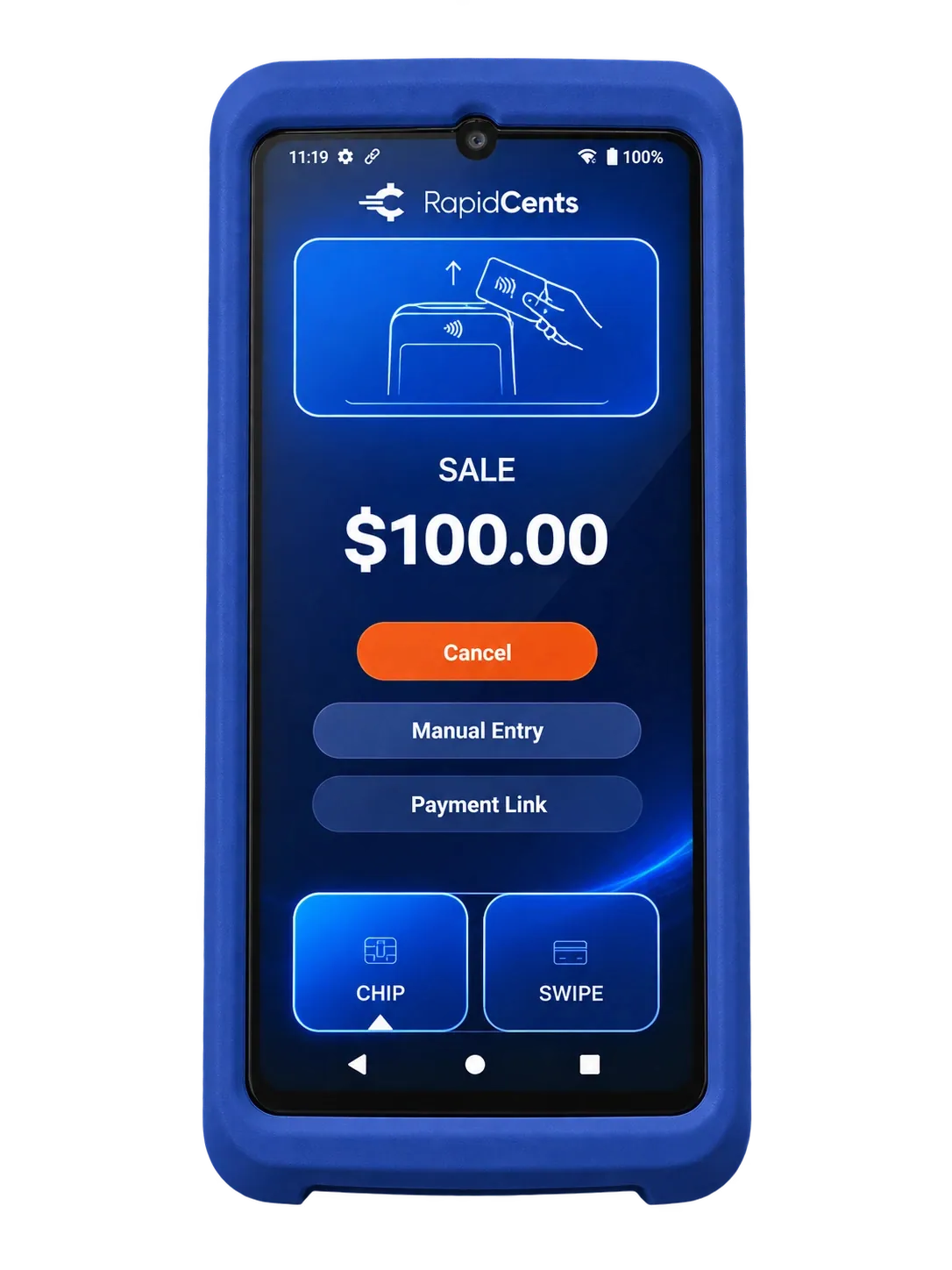
The RapidCents Rivo Go standing upright in its blue silicone case, showing the full-touch sale screen a customer reads across the counter. Payment Terminals
RapidCents payment terminals cover countertop, mobile and smart form factors so you can accept chip…
Explore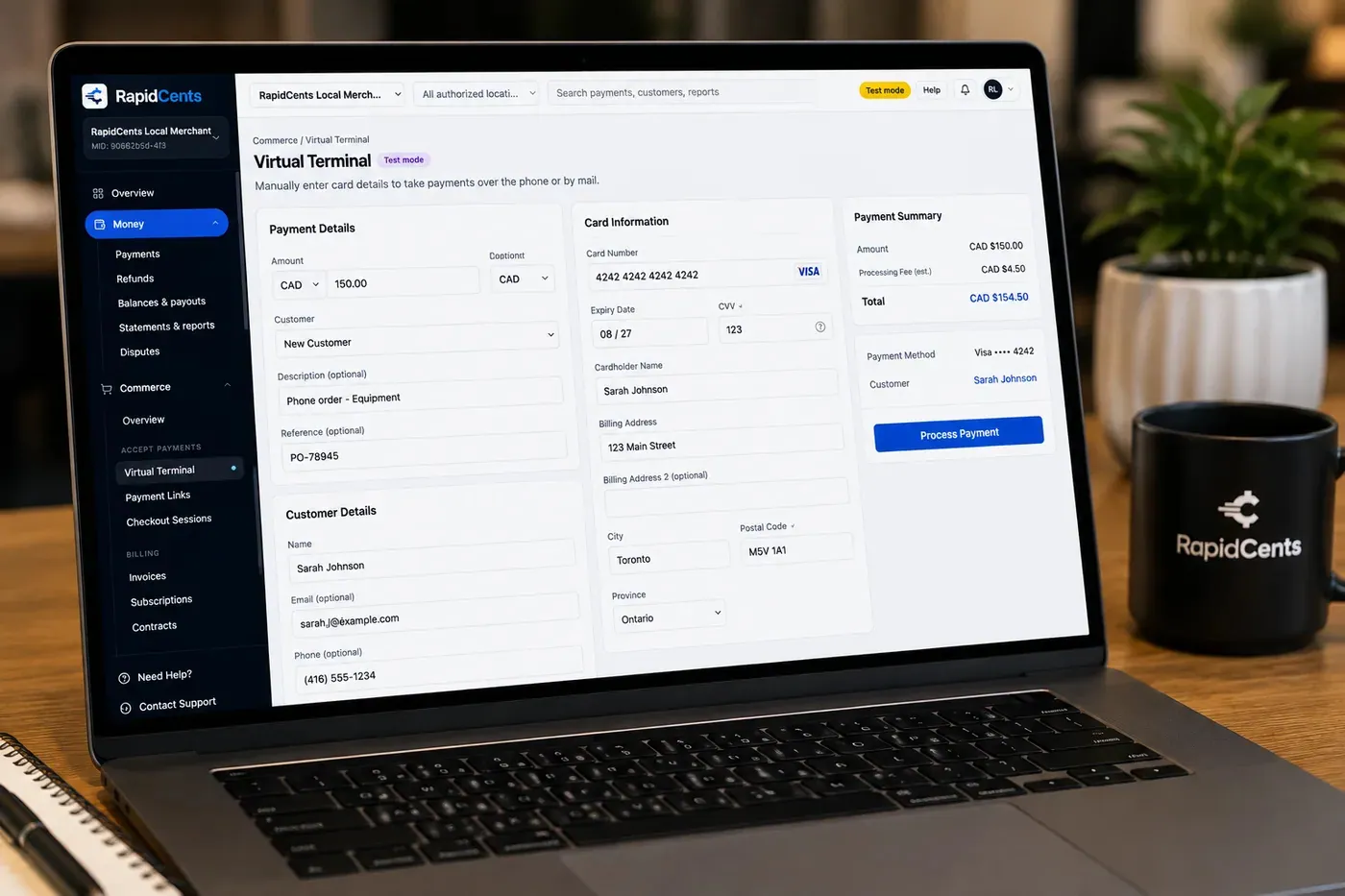
The RapidCents virtual terminal: payment details, card number, expiry and CVV keyed by hand on the left, with a payment summary on the right showing the amount, the estimated processing fee and a Process Payment button. Virtual Terminal
The RapidCents virtual terminal lets authorized staff enter mail-order and telephone-order payments through a…
Explore
A merchant reviews RapidCents reports for volume, mix and payouts, with the terminal that took the sales on the desk. Reporting
RapidCents reporting delivers customizable transaction, settlement and fee reports with CSV and PDF export…
Explore


How do government counter payment terminals work?
A government counter payment terminal takes chip, tap and PIN payments at the clerk's window and ties the sale to the receipt the resident takes away. The clerk keys the file reference, takes the card and closes the batch at the end of the shift for the cash-out.
Running the window
The clerk selects the fee, enters the file or account reference, and the resident taps or inserts a card. Countertop terminals suit fixed windows, while a mobile terminal serves the inspector on a site visit. The resident receives a printed or emailed receipt.
Setup and exceptions
Set up a login for each clerk, and decide who may void or refund. Handle a declined card by trying another method, and a mistaken amount by a refund rather than a second charge. Disputes arrive later, and the file reference helps you gather evidence.
A two-window recreation office at closing
Say a recreation office takes a $45 program fee at window one and a $210 facility rental deposit at window two. At closing, each clerk runs the batch, and the finance clerk compares the two batch totals with the settlement report.
How do you compare municipal government payment fees?
Compare municipal government fees using your real payment mix: card type, how the card is taken, average ticket and refund volume. RapidCents prices on interchange-plus, with interchange passed through at cost, your RapidCents markup in your Fee Schedule and fees for equipment or services if applicable. It is month to month, with no fixed term.
What drives interchange
Interchange is set by the card networks and varies with debit, credit, premium or commercial cards and with whether the card is tapped, inserted, keyed or paid online. A portal heavy in online payments and a counter heavy in tapped debit cards will cost differently under the same pricing structure.
What to bring to compare
Bring recent processing statements, your card mix, average ticket by fee type, the split between portal, counter and mail, and refund and dispute volume. Fee Check reads an uploaded statement and shows interchange separately from markup, so council can see each part before choosing.
Convenience fees and agency policy
Some agencies add a convenience fee to resident payments and some absorb the cost. Whether you may do either depends on your jurisdiction and agency policy, so get your council or finance director's sign-off first. Fees for equipment or services appear in your Fee Schedule when they apply.
Software compatibility: Tyler Technologies, CivicPlus and other systems
RapidCents integrates with many major platforms through APPIE and RapidBridge, so most municipalities keep the permit, tax or citizen portal software they run today. The right option depends on your software vendor and version. Tell your RapidCents representative which system you use, and they will walk you through how payments, receipts and reporting connect to it.
Tyler Technologies and Accela
Both run permit, license and fee workflows. Tell your representative which product and edition you use, and whether payments run inside the software, through a gateway or by a payment link outside it. They will show you where terminals, Hosted Checkout and Payment Links fit around the workflow you already have.
CivicPlus and CityView
CivicPlus and CityView host citizen portals and counter workflows. Whether your portal sends residents to a hosted page, uses an API or exports a file decides the connection, and your representative sorts that out with you. Where the software offers no link, Payment Links, Hosted Checkout and a report export bridge the gap.
PayIt and accounting software
PayIt is a resident payment platform that can bring its own processing, so tell your representative if you run it. For ledgers, RapidCents connects settled transactions, fees and refunds to QuickBooks Online and Xero, and SAP and NetSuite import settlement files, so finance posts from the same numbers it audits.
Payment options for municipal governments in Canada
Municipalities in Canada typically accept Interac debit and credit cards at the counter, credit cards online, and pre-authorized debit for recurring bank payments, settled in CAD. Which methods are enabled depends on your merchant account, and each municipality's own procurement and fee policies apply.
Interac and cards at the counter
Residents expect Interac debit by chip and PIN or contactless at the clerk's window, alongside Visa, Mastercard and American Express. Counter payment terminals take these methods, and the batch settles in CAD to your bank account.
Online and bank payments
Online permit and tax payments use credit cards on Hosted Checkout. EFT or pre-authorized debit (PAD) can collect recurring utility or program payments with the resident's signed authorization. GST/HST may appear on receipts for some fees, so check the treatment with your finance team and provincial rules.
Setup, refunds and payment reporting when you switch
Switch in stages: inventory what you hold, test a sale, a refund and a deposit, run both providers in parallel when needed, then reconcile each deposit to the ledger. Once your account is approved, your representative plans the move with you. Stored cards move only when both providers agree, so settle that early.
Inventory first
List stored cards and their authorizations, recurring schedules such as utility or program payments, open invoices, pending refunds and the files each depends on. Stored cards need the resident's authorization, and recurring charges need agreement on amount, timing and cancellation. Ask your current provider what it will export.
Test before you move
Run a test sale, a refund and a deposit match on a quiet day. Test the portal redirect, the counter terminal and a keyed payment. Run both providers in parallel for a period when your calendar allows, and avoid moving during a renewal or tax-bill rush.
Report and reconcile
Map every payment reference to the permit, tax or receivable file. Reporting exports settlement and fee reports to CSV or PDF, so finance matches each bank deposit to its transactions, refunds and fees. A $2,400 deposit, for example, breaks into payments, less refunds and fees, line by line.
Payment questions from municipal governments
What should municipal governments compare before choosing a payment processor?
Compare the whole acceptance workflow, not a single price. Check how the portal, counter and mailed payments run, how the processor fits your software, the total fees on your real payment mix, settlement reporting, refund handling and support. Ask each provider for a written quote and a permit payment demo, and judge them side by side.
How much does payment processing cost for municipal governments?
The cost depends on your card mix, how cards are taken and your average ticket. RapidCents prices on interchange-plus: interchange passed through at cost, your RapidCents markup in your Fee Schedule, and fees for equipment or services if applicable. It is month to month with no fixed term. Upload a statement to Fee Check to see interchange separated from markup.
Can I use Tyler Technologies with a different payment processor?
Yes, in most cases. RapidCents integrates with many major platforms through APPIE and RapidBridge, and the right option depends on your Tyler product, edition and contract. Tell your RapidCents representative which Tyler product you run, and they will walk you through how payments, receipts and terminals connect to it.
How can we handle municipal permit online payments?
Send the applicant from the permit portal to Hosted Checkout with the permit number and amount, then return the paid status to the file. Decide who reviews declines, partial payments and refunds, and test the full flow before launch. Your RapidCents representative walks you through how the file updates for your software vendor and version.
Which payment options can a municipality in Canada offer?
A municipality in Canada can usually offer Interac debit and credit cards at the counter, credit cards online and by phone, and EFT or pre-authorized debit (PAD) for recurring bank payments, with settlement in CAD. Each method depends on your RapidCents account and your council's policy on fees. Provincial rules and GST/HST on receipts vary, so your finance team and your RapidCents representative can sort out the details together.
What setup is needed for government counter payment terminals?
Choose terminals for each window, assign a login to each clerk and decide who may void or refund. Settle the file reference clerks must enter, test a sale and a refund, and plan the end-of-shift batch. Countertop terminals suit fixed windows, and a mobile terminal suits site visits. Your representative helps you pick the right mix.
How should we manage municipal tax payment reconciliation?
Match each tax payment to its parcel or account record by a reference, then match the settlement to the bank deposit. Decide who may change or reverse a payment and what staff do when a payment fails. Reporting exports transaction and settlement data to CSV or PDF, and final tax records remain in your tax system.
Can one platform handle government fee payment gateway and citizen portal payment integration?
Often yes for cards. Hosted Checkout and the Payment Gateway can serve a portal and a fee system, while counter and mailed payments use terminals and the Virtual Terminal. RapidCents integrates with many major platforms through APPIE and RapidBridge, so tell your RapidCents representative which systems you run and they will show you how they share one settlement report.
How do we reconcile card payments and bank deposits for municipal governments?
Separate gross payments, refunds, disputes and fees, then match each bank deposit to the settlement report by transaction ID and file reference. Reporting exports CSV or PDF for your ledger. RapidCents connects settled transactions, fees and refunds to QuickBooks Online and Xero, and SAP and NetSuite import settlement files.
How do we switch payment providers without losing saved cards or disrupting permit payments?
Plan the switch in stages and do not assume saved cards move. Token portability needs agreement from both providers, so ask your current provider what it will export. List stored cards and authorizations, test a sale, refund and deposit, run both providers in parallel if needed, then reconcile before you retire the old one.
What MCC is used for government payments?
MCC 9399 is commonly associated with government services not classified elsewhere. Your merchant category is set during onboarding based on what your agency actually collects, so describe each fee type you plan to take, such as licenses, permits and utility bills, when you apply.
Related industries
Nonprofits and charities, education and membership clubs share the same payment jobs: portal payments, counter payments, recurring schedules and fund-level reporting. Visit the sibling page where your payer or workflow differs.
Nonprofits & Charities
Take one-time and monthly gifts online, sell event tickets by link and reconcile deposits…
Education
Take enrollment deposits online, run tuition installments on schedules families authorize…
Events & Ticketing
Sell advance tickets online, take cards at the gate and concession stand, and give…
Membership Clubs
RapidCents collects membership dues on a schedule, takes event fees and guest passes by…
Travel Agencies
Take booking deposits, collect final balances and group installments, and match settled…
Agriculture
RapidCents helps farms invoice bulk buyers, take cards at the market stall and bill CSA…
Pet Services
RapidCents helps boarding kennels, dog daycares, groomers, trainers and pet sitters take…
Photography
Collect retainers, session balances and gallery print orders with payment links, invoices…
Take the next step
Check what your municipality pays to accept cards
Upload a recent processing statement to Fee Check and see interchange separated from your current markup, then compare it with your portal, counter and mailed payment mix.
- No obligation
- Canadian payment specialists
- Secure statement upload



