


Payment processing for office suppliers and school distributors
Payment processing for office suppliers lets a stationery wholesaler or school supply distributor collect from the businesses and institutions it sells to, by invoice link, phone order or terminal. RapidCents supports departmental purchase order references, procurement card payments and term-start deposits and balances, and each buyer authorizes its own charge.

- PCI DSS Level 1
- SOC 2 Type II
- All major cards: Visa, Mastercard, Amex, Discover, UnionPay, Diners Club & PIN Debit
- Interchange-plus available
- Specialist onboarding support
How office and school suppliers get paid
Office supply invoice payments come down to four payment jobs: departmental purchase order invoices, procurement card payments, term-start bulk order deposits and balances, and return credits. Each job starts with a confirmed order from a buyer, not a walk-in shopper, and ends with a record your finance team can reconcile.
Departmental purchase order invoices
A school business office or department head sends a purchase order for paper, binders or art supplies. You invoice against it and send a payment link. The buyer pays, and the purchase order number and department stay on the record for your receivables team.
Procurement card payments
An office manager or teacher pays a stationery invoice with a procurement card. You collect by payment link or virtual terminal with the buyer's authorization, and finance matches the settled amount against the invoice.
Term-start bulk order deposits and balances
A district orders classroom kits before the school year. You take a deposit when the order is confirmed and collect the balance when the delivery is complete. Partial deliveries mean the balance follows what actually shipped.
Returns and credits
A school returns overstocked binders or a wrong delivery. You choose between a refund to the original card and a credit against open invoices, then record which one applied so the customer account and the ledger agree.
How do school purchase orders and department invoices get paid?
School purchase order payments run by invoicing against the issued order, sending a payment link for that invoice, and keeping the purchase order number and department code on every payment. One customer can then pay several departmental invoices separately while your receivables stay matched to each order.
From purchase order to paid invoice
The school business office issues a purchase order, you ship and invoice with the purchase order number, and you send a payment link by email. The buyer pays that invoice, a receipt follows, and the invoice status moves to paid in your dashboard.
Agree the references buyers supply
Agree which references the buyer must supply: purchase order number, department, ship-to and cost center. Add them as reference fields on the invoice and link, then check how they appear in your exports so month-end matching runs smoothly.
Wrong department or a shared district card
A payer may pay the wrong department's invoice, or a decline may hit a card the district shares between buildings. Match payments by invoice, not just by customer. A paid link is not a tax decision: use the tax treatment you already apply on the invoice.
Three schools, three $900 purchase orders
Say a district orders from you on three purchase orders for three schools, each invoiced at about $900. The business office pays the first two by link and holds the third for a missing department code. Your report shows two paid and one open, each with its reference.
How do you accept procurement cards on a supply invoice?
Procurement card payments for suppliers work by sending the invoice link or keying the order in the virtual terminal with the cardholder's authorization. Enhanced purchasing data is used where it is supported for your setup, and your RapidCents representative will tell you where that applies. Card type affects cost, so compare it against your real mix.
Paying a supply invoice by procurement card
An office manager receives your invoice, opens the payment link and pays with a company or procurement card. For phone orders, your staff key the card in the virtual terminal. Either way the receipt carries the invoice reference, and finance sees the payment in reporting.
Permissions and purchasing data
Decide who on your team may key cards, issue refunds or void a sale, and set role permissions. Ask your RapidCents representative whether Level 2/3 data applies to your setup before you mention it to buyers, and never ask buyers to email card numbers.
When an invoice exceeds the card limit
A large invoice can exceed the buyer's card limit or trigger a decline. Offer a documented partial payment against the same invoice, and collect the rest by another method. Do not split one sale into several charges to get around a limit.
A $3,800 supply order paid in two steps
Say a local office buys $3,800 of toner, paper and desk supplies. The manager pays $2,000 by procurement card through the payment link, and the remaining balance by a second method a few days later. The invoice shows both receipts until it closes.
RapidCents products for office and school suppliers
Invoicing and Payment Links carry purchase order and department references to buyers, the Virtual Terminal handles phone orders and keyed procurement cards with role permissions, and Reporting gives finance settlement and fee records to reconcile.

The RapidCents invoices screen: outstanding, overdue, paid and draft totals across the top, the invoice list below them, and a preview of one invoice on the right with its line items and a View & Record Payment button. Invoicing
RapidCents invoicing helps professional services, contractors and B2B suppliers create branded invoices…
Explore
The RapidCents payment links screen listing created links with their amount, status, click count and whether they have been paid, beside a phone showing the branded page a customer opens to pay $2,500.00. Payment Links
RapidCents payment links let staff generate branded pay-by-link URLs for invoices, deposits, balances and…
Explore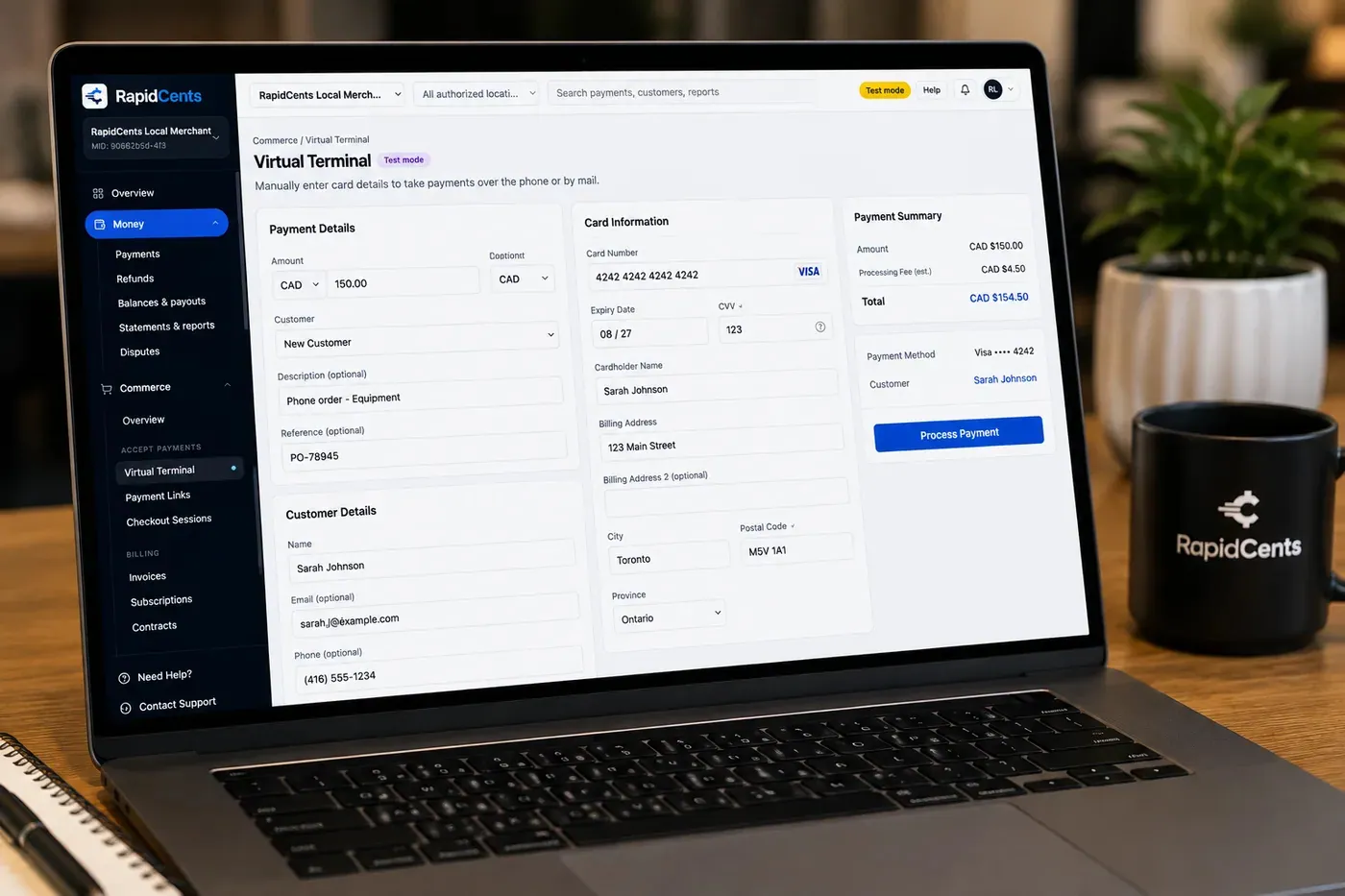
The RapidCents virtual terminal: payment details, card number, expiry and CVV keyed by hand on the left, with a payment summary on the right showing the amount, the estimated processing fee and a Process Payment button. Virtual Terminal
The RapidCents virtual terminal lets authorized staff enter mail-order and telephone-order payments through a…
Explore
A merchant reviews RapidCents reports for volume, mix and payouts, with the terminal that took the sales on the desk. Reporting
RapidCents reporting delivers customizable transaction, settlement and fee reports with CSV and PDF export…
Explore


How do term-start bulk orders, deposits and returns work?
A term-start bulk order works best with a documented deposit at confirmation and a balance when delivery is complete. Partial deliveries adjust the balance, and returns end as a refund to the original card or a credit on the account. Each step is a collection schedule you agree with the buyer, not financing.
Deposit at confirmation, balance at delivery
In late summer a district confirms classroom kits. You send an invoice for the deposit, then a second link for the balance once delivery is signed off. Each payment lands against the same order reference, so the account shows paid, partly paid or open.
Deposit, balance and returns in writing
Write down the deposit amount, the balance trigger and your return window before the order starts, and get the buyer's agreement in writing. If you want to store a card for repeat orders, obtain the cardholder's authorization first and agree on timing and cancellation.
Backorders, split shipments and returns
Backorders and split shipments mean the final amount moves. Invoice what shipped and carry the rest. A returned shipment needs a decision: refund to the original card, or a credit memo that reduces the next invoice. Pick one and record it.
A $6,000 classroom kit order in two lots
Say a school orders $6,000 of classroom kits. You collect a $1,500 deposit, then ship in two lots because pencils are backordered. The balance link is sized to the first lot, a return of damaged binders becomes a credit, and the last lot closes the order.
How do you compare fees using your real payment mix?
For B2B stationery payments, compare fees by looking at the mix your business really runs: card type, ticket size, how the card is taken and how often you refund. We price every account on interchange-plus, which separates network interchange from your markup. Fee Check reads your processing statement and shows that split.
What drives the cost
Interchange is set by the card networks and varies by card type, such as debit, credit, premium or commercial, and by how the card is taken: tapped or inserted at the counter, or keyed or online for an invoice. Large invoices and commercial cards behave differently from counter sales.
How RapidCents prices
Interchange passes through at cost. Your RapidCents markup is set out in your Fee Schedule, plus fees for equipment or services if applicable. The agreement is month to month with no fixed term, so you can compare the real numbers against what you pay today.
What to bring to compare
Bring recent processing statements, your split between invoice links, phone orders and counter sales, average and largest ticket, and your refund and chargeback volume. School suppliers should also bring their peak-season months, because term-start volume changes the mix. Upload them to Fee Check.
Which accounting and ERP software works with supplier payments?
Office wholesaler merchant services start with accounting fit, because suppliers usually keep invoices, customers and inventory in accounting or ERP software. RapidCents connects settled transactions, fees and refunds to QuickBooks Online and Xero, and RapidBridge works with Dynamics 365 Business Central and Acumatica. SAP and NetSuite import settlement files. Your RapidCents representative will walk you through the rest.
QuickBooks Online and Xero
RapidCents connects settled transactions, fees and refunds to QuickBooks Online and Xero, so deposits and fees reach your books without retyping. Your RapidCents representative will show you how purchase order and department references carry across for reconciliation.
NetSuite and SAP Business One
SAP and NetSuite import settlement files rather than using a live connector. Your team brings settled transactions, fees and refunds into the ledger through the import template, and your RapidCents representative will show you how invoice numbers and purchase order references appear in it.
Dynamics 365 Business Central, Acumatica and Epicor Prophet 21
RapidBridge works with Dynamics 365 Business Central and Acumatica, so a card payment posts against the invoice you already have open. For Epicor Prophet 21, RapidCents integrates with many major platforms through APPIE and RapidBridge. The right option depends on your vendor and version, and your representative will walk you through it.
Payment options for office and school suppliers in the United States
US office and school suppliers collect by invoice link, phone order and counter sale. Your RapidCents representative sets up the methods that fit your merchant account when you get started.
Cards and PIN debit
Visa, Mastercard, American Express and Discover credit and debit cards work for invoices and phone orders, including procurement cards. PIN debit works at the counter where it is set up on your account. Settlement is in USD.
ACH bank payments and tax rules
ACH bank payments can suit repeat school and office accounts, with the payer's authorization. State rules on tax-exempt buyers differ. Apply the tax treatment you already use on the invoice, because RapidCents does not determine eligibility.
How do you switch processors without losing open invoices?
You switch processors safely by listing what is open today, testing the new flow before live traffic, and running both for a short overlap. Once your account is approved, your RapidCents representative walks you through the move. Open invoices, stored cards and refunds each need a plan, because token portability between providers depends on both providers agreeing.
Inventory what is open
List open invoices, partly paid purchase orders, stored cards with authorizations, and refunds or credits still pending. Note which buyers pay by link, by phone and at the counter, so each channel is tested.
Test, then overlap
Run a test sale, a refund and a deposit on the new setup before sending buyers new links. Keep the old processor running for invoices already issued until they close. Token portability is not assured, so plan to ask buyers to re-authorize cards.
Reconcile after the move
Map payment references to your accounting or ERP records, then match each deposit to the ledger for the first full cycle. School suppliers should switch outside term-start weeks when possible, so the heaviest billing is not the first live test.
Payment questions from office and school suppliers
What is the best payment processor for office and school suppliers?
The best processor is the one that fits how you collect. For a supplier that means invoice links with reference fields, phone order support, role permissions, clear reporting, accounting connections, and interchange-plus pricing that separates interchange from markup. RapidCents is built around those needs, and Fee Check lets you set a written quote against your own statements.
How much does credit card processing cost for office and school suppliers?
No honest number applies to every supplier, because the cost depends on your mix. Interchange is set by the card networks and varies by card type and how the card is taken. RapidCents passes interchange through at cost and adds your markup from your Fee Schedule, plus equipment or service fees if applicable. Upload a statement to Fee Check to see the split.
Can our accounting or ERP software use a different payment processor?
Often yes, though it depends on your software, edition and country, because some products bundle a processor or require a named gateway. RapidCents integrates with many major platforms through APPIE and RapidBridge, connects settled transactions, fees and refunds to QuickBooks Online and Xero, and works with SAP and NetSuite through settlement import files. Tell your RapidCents representative which system you use, and they will show you the right option.
How can office suppliers switch processors without losing payment history?
Export your reports first, then list open invoices, partly paid purchase orders, stored cards and pending credits. Test a sale, a refund and a deposit on the new setup, and run both processors briefly. Stored cards may not move automatically, because both providers must agree, so plan to ask buyers to re-authorize. Reconcile the first full cycle carefully.
Which payment options can an office or school supplier in the United States offer?
US office and school suppliers typically offer credit and debit cards, PIN debit at the counter, and ACH bank payments, with settlement in USD. Your RapidCents representative sets up the methods that fit your account and walks you through each one. ACH needs the payer's authorization. State tax-exempt treatment stays on your invoice, not in the payment.
Can school purchase orders be included with payment?
Yes, you can carry the purchase order number and department with the payment. Add them as reference fields on the invoice and payment link, so they follow the buyer's payment. Check how those references appear in your exports and accounting import so matching stays easy. A reference identifies the order; it does not change the agreed terms.
Can departments pay separate invoices under one customer?
Yes, a school or district can pay several departmental invoices under one customer account. Each invoice gets its own link and reference, and payments apply to that invoice's balance. Set up your payer and account references first, so a payment lands on the right department. Reporting then shows which invoices are paid and which remain open.
Does RapidCents determine tax exemption for school buyers?
No. RapidCents does not decide whether a school or institution is tax exempt, and the payment tool does not make that decision. Use the tax treatment you already apply and show it on the invoice. Keep any exemption paperwork in your own records. The payment link collects the invoice total you set; it does not assess eligibility.
How do we handle returns on a supply order?
Decide between a refund and an account credit, then record which one you used. A refund goes back to the original card, with a role-restricted user issuing it. A credit memo reduces a later invoice instead. Set your return window with the buyer before the order, and keep the reference so finance can tie the adjustment to the original invoice.
Can we collect a deposit on a term-start bulk order?
Yes, you can take a deposit on a bulk order and collect the balance later. Send an invoice for the deposit when the buyer confirms, then a second link when delivery is complete. Agree the amounts and triggers in writing. This is a collection schedule you set with the buyer, not financing, and partial deliveries should adjust the balance.
What MCC is used for office and school suppliers?
MCC 5111 is commonly associated with stationery, office and school supply businesses. Your RapidCents representative sets the merchant category during onboarding, based on what your business actually sells and to whom. A business that mixes wholesale with retail counter sales may be reviewed on that mix, so describe your products and channels accurately.
Related supplier industries
Office and school suppliers sit within B2B and wholesale. Computer and IT distributors and commercial furniture suppliers share the same order, invoice and reconciliation workflow, so their pages are useful next reads.
B2B & Wholesale
Collect net-terms invoices by payment link with the PO number attached, take commercial…
Computer & IT Distributors
RapidCents helps computer and IT hardware distributors collect approved reseller…
Electronic Component Distributors
Collect purchase order invoices, allocation deposits and partial-shipment balances from…
Commercial Furniture Suppliers
RapidCents helps commercial furniture suppliers collect fit-out deposits, delivery…
Apparel, Textile & Uniform Wholesalers
Collect production deposits, partial seasonal shipments and size-exchange credits from…
Beauty & Salon Suppliers
Collect reorder invoices, equipment deposits and phone orders from salon trade accounts…
Pet Product Wholesalers
Collect from pet retailers on approved invoices, trade-account reorders and credits, with…
Dental Suppliers
From monthly consumables reorders to chair and imaging deposits, collect what clinics…
Take the next step
Review your supplier invoice workflow
Upload a recent processing statement to Fee Check and see interchange separated from your markup, using your real mix of invoice links, phone orders and counter sales.
- No obligation
- Payment specialists, not a call centre
- Secure statement upload



