


Payment processing for pet wholesalers and distributors
Payment processing for pet wholesalers lets a pet supply distributor collect card and bank payments from the retailers it sells to, by invoice payment link, Virtual Terminal or a stored card with authorization. Trade-account reorders and credits for damaged or recalled cases are the core jobs, and your RapidCents representative sets it up around your catalogue and software.

- PCI DSS Level 1
- SOC 2 Type II
- All major cards: Visa, Mastercard, Amex, Discover, UnionPay, Diners Club & PIN Debit
- Interchange-plus available
- Specialist onboarding support
How pet product wholesalers get paid
Pet product wholesalers get paid by pet retailers, groomers and boarding businesses on trade accounts. Four jobs cover most of the money: reorders, invoice payments, credits for damaged or recalled goods, and balances on account.
Trade-account reorders
A pet shop buyer reorders food, litter and accessories on an approved account. Your team charges the agreed method against the order or sends a payment request. Finance receives the buyer account, order number and a payment record that matches the invoice.
Invoice payments by link
A shop owner receives your invoice and pays from a phone or desk using a payment link. The charge is tied to the invoice number and buyer account. If the link expires or the card declines, you reissue it and finance sees the status.
Damaged-case and recall credits
A retailer reports crushed bags or a recalled lot. You record the agreed item credit against the invoice. Where money goes back to a card, the refund is matched to the original payment so finance can reconcile both sides.
Deposits and account balances
A new retailer may pay a deposit on a first large order or settle an open balance in parts. Each part payment is recorded against the account and invoice, so the remaining balance is always visible to your credit team.
How do pet product wholesalers collect trade-account reorders?
A pet product wholesaler collects trade-account reorders by tying each approved order to the buyer account, then charging an authorized stored card or sending a payment request. Pet supply distributor card processing works best when the account holder, order number and invoice are recorded with every payment.
How a reorder runs
The retailer's buyer sends a reorder by phone, email or portal. Your team checks the order against the account, invoices it, and collects through the agreed method. The Merchant Dashboard keeps the order number, buyer and payment together for finance.
Set up authorization first
Before you store a retailer's card in the Secure Card Vault, get the account holder's authorization in writing. Agree which orders may be charged, who may approve them, and how the retailer can withdraw permission. Recurring charges need an agreed amount, timing and cancellation.
What goes wrong
A card declines at pick time, a buyer is not authorized on the account, a short shipment changes the invoice total, or a head office wants to pay for several shops. Charge only the shipped amount and note who approved it.
A twelve-case reorder, ten cases shipped
Say a pet shop reorders twelve cases of dry dog food and four of cat litter, and the warehouse ships ten cases of food. You invoice the shipped goods, charge the stored card the retailer authorized for reorders, and send the receipt with the order number.
How are damaged cases or recalled items credited?
A damaged case or recalled item is credited by recording the agreed item credit against the original invoice, then refunding to the original payment only where money is owed back. The credit note and the card refund are separate records, and finance should reconcile both to the same order.
How a credit runs
The retailer reports the problem with a lot code or photos. Your team agrees the quantity and value, issues a credit note, and decides whether it reduces the next invoice or returns to the card. Refunds go back to the original payment through the Merchant Dashboard.
Set up the rules first
Write down how long a retailer has to report damage, what evidence you need, who approves credits, and whether credits come off the account or return to the card. A manufacturer's recall notice may carry its own instructions, so follow those first.
What goes wrong
A retailer is credited on the account and also asks for a refund, or a refund lands after the original payment settled in a different period. Match each refund to its original payment, and keep disputes separate from agreed credits.
Six crushed bags of treats
Say a groomer receives a pallet where six bags of treats are crushed. You agree a credit for six bags, issue a credit note, and refund the card used on the invoice. Finance matches the credit note, the refund and the original payment to one order.
RapidCents products for pet product wholesalers
These products cover the invoice-led collection a pet wholesaler needs: branded invoices, payment links, stored cards with authorization and reports that finance can reconcile.

The RapidCents invoices screen: outstanding, overdue, paid and draft totals across the top, the invoice list below them, and a preview of one invoice on the right with its line items and a View & Record Payment button. Invoicing
RapidCents invoicing helps professional services, contractors and B2B suppliers create branded invoices…
Explore
The RapidCents payment links screen listing created links with their amount, status, click count and whether they have been paid, beside a phone showing the branded page a customer opens to pay $2,500.00. Payment Links
RapidCents payment links let staff generate branded pay-by-link URLs for invoices, deposits, balances and…
Explore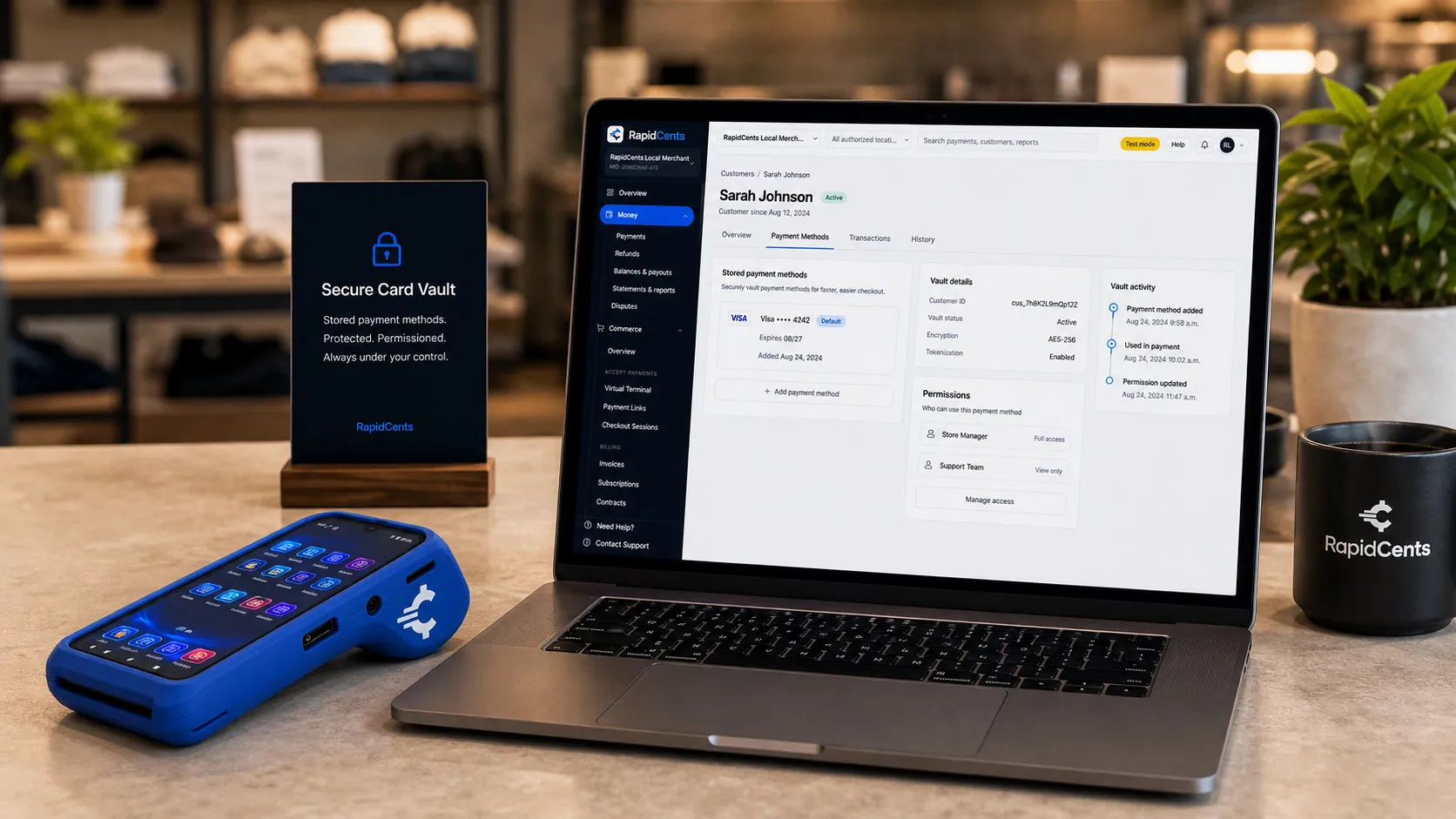
Card credentials sit in the RapidCents vault rather than in merchant software, with a terminal on the desk for new captures. Secure Card Vault
The vault stores tokenized payment methods against a customer record so staff can charge a returning…
Explore
A merchant reviews RapidCents reports for volume, mix and payouts, with the terminal that took the sales on the desk. Reporting
RapidCents reporting delivers customizable transaction, settlement and fee reports with CSV and PDF export…
Explore


How can pet shops pay wholesale orders remotely?
Pet shops can pay wholesale orders remotely through invoice-linked card acceptance: a payment link sent to the buyer, or a phone order keyed in the Virtual Terminal with the buyer and account references. B2B pet supply payments stay clean when each request is tied to one invoice.
How remote payment runs
You issue the invoice with Invoicing, and the shop owner pays through the payment link sent by SMS or email. For phone orders, staff use the Virtual Terminal and enter the invoice reference. Reporting then shows paid, open and expired requests.
Set up references first
Decide which fields every remote payment must carry: buyer account, invoice number, purchase order number and the name of the person approving. Limit who on your team can key cards, and keep card numbers out of email and chat.
What goes wrong
A link goes to the wrong contact, a buyer pays part of an invoice, or a card declines on a large order. Send a fresh link to the verified account contact, apply partial payments to the open balance, and never split one charge to get around limits.
A $640 kennel bedding order
Say a boarding kennel owner places a phone order for bedding and chews. Your inside sales rep sends a payment link on the $640 invoice. The owner pays from a phone, the receipt goes to the account email, and finance sees the paid status in Reporting.
How to compare fees using your real payment mix
Pet product wholesaler merchant services cost depends on your card mix, average invoice size and how cards are taken. We price every account on interchange-plus: interchange at cost, your RapidCents markup set out in your Fee Schedule, and fees for equipment or services if applicable. It is month to month with no fixed term.
What drives cost for a distributor
Interchange varies by card type, such as debit, credit, premium or commercial, and by how the card is taken. Remote and keyed invoice payments usually cost differently from cards tapped at a counter. Large average invoices shift the mix toward commercial cards.
What to bring
Bring three recent processing statements, your split between remote invoices and counter sales, the average invoice, how many refunds and credits you issue, and any disputes. A pet wholesaler with trade accounts has a different mix from a retailer.
Read it with Fee Check
Upload a statement to Fee Check to see interchange separated from markup. Then compare in writing against your Fee Schedule and any quote. Ask about equipment, gateway and reporting fees too, and talk to your RapidCents representative about enhanced commercial card data for your setup.
Which ERP and accounting software works with card payments?
Your ERP decides how payment references travel, and RapidCents integrates with many major platforms through APPIE and RapidBridge. RapidBridge works with Oracle NetSuite, Acumatica, Dynamics 365 Business Central and SAP Business One Web Client, and settled transactions, fees and refunds connect to QuickBooks Online and Xero. Your RapidCents representative will walk you through the option for your vendor and version.
NetSuite
Oracle NetSuite holds customer accounts, invoices and receivables, and RapidBridge works with it, so a card payment posts against the invoice you already have open. NetSuite and SAP can also import settlement files for reconciliation. Your RapidCents representative will show you the option that fits your edition.
SAP Business One and Dynamics 365 Business Central
These systems post orders, invoices and customer payments. RapidBridge works with SAP Business One Web Client and Dynamics 365 Business Central, and SAP imports settlement files too. Tell your RapidCents representative your version and they will show you which route fits.
Acumatica and Epicor Prophet 21
Both manage distribution orders, invoicing and receivables. RapidBridge works with Acumatica. For Epicor Prophet 21, RapidCents integrates with many major platforms through APPIE and RapidBridge, and your RapidCents representative will walk you through the option for your edition.
QuickBooks Online and Xero
For smaller distributors, RapidCents connects settled transactions, fees and refunds to QuickBooks Online and Xero, and RapidBridge works with both. Credit notes and refunds match back to the invoices they belong to, so your books stay clean.
Payment options for pet product wholesalers in the United States
A pet product wholesaler in the United States can typically accept credit and debit cards, including PIN debit where supported, and may offer ACH bank payments from trade accounts. Settlement is in USD. Your RapidCents representative sets up the methods that fit your buyers.
Cards and PIN debit
Pet retailers can pay by credit or debit card online, on a payment link or at a terminal at pickup. PIN debit applies only where supported and when the card is present, so it suits counter sales, not remote invoices.
ACH and state rules
ACH suits repeat trade-account balances once you hold the retailer's written authorization. Sales tax and resale certificate rules vary by state, so confirm how they appear on invoices with your accountant.
How do you switch processors and reconcile deposits?
You switch processors by listing every stored card, open invoice and credit, testing a sale, refund and deposit on the new setup, and running both in parallel until reconciliation matches. Once your account is approved, your RapidCents representative will walk you through setup timing. Stored card portability is not assumed: both providers must agree.
Inventory before you move
List every retailer with a stored card and its written authorization, every open invoice and part payment, every pending credit, and every payment link still out. Decide which accounts need fresh authorization on the new system.
Test, then run in parallel
Run a test sale, a partial payment and a refund through the new flow before you move live traffic. Keep the old processor for open items until they are paid. Check that each payment carries the buyer account and invoice number.
Reconcile deposits
Match each deposit to the invoices and credits it covers using settlement and fee reports. Export to your accounting tool, post fees separately, and review unmatched items weekly until the first full month closes cleanly.
Payment questions from pet product wholesalers
What is the best payment processor for pet product wholesalers?
The best processor is the one that fits your invoices, buyers and software, so compare written quotes. Look at remote invoice payment, stored card authorization, credit and refund handling, reporting for finance, pricing transparency and support. We price on interchange-plus with no fixed term. Use Fee Check to compare your statement, and talk to your RapidCents representative about your software.
How much does credit card processing cost for pet product wholesalers?
Cost depends on your card mix, invoice size and how cards are taken, so no single figure applies. With interchange-plus, interchange passes through at cost, your RapidCents markup is in your Fee Schedule, and equipment or service fees apply if relevant. Month to month, no fixed term. Upload a statement to Fee Check to see interchange separated from markup.
Can NetSuite use a different payment processor?
Yes. RapidCents integrates with many major platforms through APPIE and RapidBridge, and RapidBridge works with Oracle NetSuite, so card payments post against the invoice you already have open. NetSuite can also import settlement files to match payments to invoices. Tell your RapidCents representative your edition and how you map references, and they will walk you through the setup.
How can pet product wholesalers switch processors without losing payment history?
Export your payment history from the old processor before you close it, and keep it for finance and disputes. List stored cards, open invoices and pending credits. Stored card portability is not assumed, because both providers must agree. Test a sale and refund, run both in parallel, then reconcile deposits.
Which payment options can a pet product wholesaler in the United States offer?
A pet product wholesaler in the United States can usually offer credit and debit cards, PIN debit where supported for card-present pickup, and ACH bank payments on authorized trade accounts, with settlement in USD. PIN debit does not suit remote invoices. Tell your RapidCents representative which methods your buyers use, and they will set up the right mix for you.
Can pet shops pay wholesale orders remotely?
Yes, through invoice-linked card acceptance. Send a payment link on the invoice, or key a phone order in the Virtual Terminal, and carry the buyer account and invoice reference on every payment. Check that the payer is authorized on the account, and never take card numbers by email or chat.
How are damaged cases or recalled items credited?
Record the agreed item credit against the original invoice, then reconcile any refund to the original payment. A credit note adjusts what the retailer owes; a refund returns money to the card. Keep the lot code, the agreed quantity and who approved it, and treat recall notices according to the manufacturer's instructions.
Do you support veterinary drug distribution?
Our pet wholesaler setup is built for pet food, accessories and supplies sold to pet retailers. A supplier of veterinary medicines or clinical goods has different needs around catalogue, licensing, sales channel and country, so talk to your RapidCents representative and read about veterinary suppliers in our industries section.
How do you keep an order reference with each pet supply payment?
Put the buyer account, invoice number and purchase order number in the reference fields of every payment link or Virtual Terminal entry. Reporting then shows those references beside each settlement, so finance can match deposits to invoices without asking buyers. Decide the required fields before you send the first request.
How do partial deliveries and split shipments affect payment?
Charge for what has shipped, and record any balance against the order. Where the buyer agrees, invoice each shipment or collect a documented deposit and balance. Do not split a single large charge to get around card limits. Each payment should reference its shipment so finance sees what is paid and what is open.
Related supplier industries
Other wholesale suppliers share the same order-to-invoice collection flow. Start with the B2B and wholesale parent industry, then look at beauty salon suppliers or office and school suppliers if you sell to similar trade accounts.
B2B & Wholesale
Collect net-terms invoices by payment link with the PO number attached, take commercial…
Computer & IT Distributors
RapidCents helps computer and IT hardware distributors collect approved reseller…
Electronic Component Distributors
Collect purchase order invoices, allocation deposits and partial-shipment balances from…
Office & School Suppliers
Collect payment from schools, districts and offices that buy stationery and supplies from…
Commercial Furniture Suppliers
RapidCents helps commercial furniture suppliers collect fit-out deposits, delivery…
Apparel, Textile & Uniform Wholesalers
Collect production deposits, partial seasonal shipments and size-exchange credits from…
Beauty & Salon Suppliers
Collect reorder invoices, equipment deposits and phone orders from salon trade accounts…
Dental Suppliers
From monthly consumables reorders to chair and imaging deposits, collect what clinics…
Take the next step
Review your pet wholesale invoice workflow
Upload a recent processing statement to Fee Check and see interchange separated from your markup, so you can compare trade-account costs before you change anything.
- No obligation
- Payment specialists, not a call centre
- Secure statement upload



