


Locksmith payment processing for callouts and final invoices
Locksmith payment processing from RapidCents lets you collect callout fees, approved quotes and final invoices by contactless card on a mobile terminal or Tap to Pay phone, by payment link for an absent property owner, and by invoice for commercial accounts. You keep one dashboard for every job and every payer.

- PCI DSS Level 1
- SOC 2 Type II
- All major cards: Visa, Mastercard, Amex, Discover, UnionPay, Diners Club & PIN Debit
- Interchange-plus available
- Specialist onboarding support
How locksmiths get paid
A locksmith is paid at the door, after the work, and sometimes by someone who is not standing there. Each of these jobs has a different payer, trigger and record, so each one needs its own way to collect and its own paper trail.
Callout and lockout fee
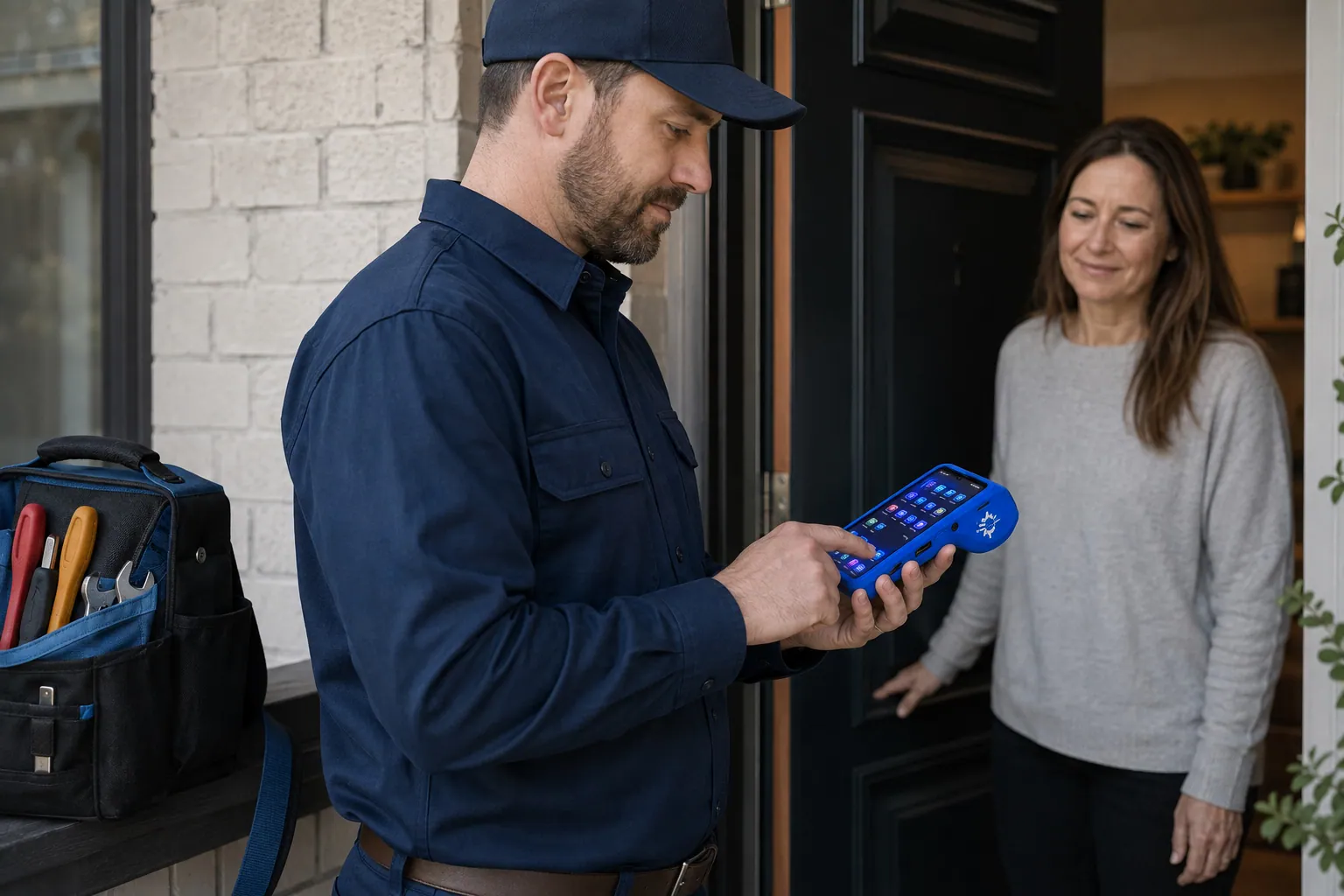
The person locked out, or a tenant, pays a callout fee when you arrive. You tap or insert a card on a mobile terminal or Tap to Pay phone before drilling or picking, and the receipt goes by text or email.
Quote approval and deposit
A homeowner or business approves a quote for a rekey, lock change or master-key system. A payment link takes the deposit for parts ordered, and the approved quote number rides on the payment reference for finance.
Final invoice after the work
When the job ends you collect the balance by card at the door, or send an invoice with a payment link. Partial payments apply to the open balance, and the paid time stamp joins the work order.
Commercial and property manager accounts
Property managers, landlords and fleet or facility buyers pay by invoice with a purchase order or unit reference. Your office sends payment links to the authorized payer and matches settled amounts to each invoice.
How do locksmiths collect the callout fee and final invoice on site?
A locksmith collects on site by confirming the quote, taking the callout fee by tap or insert on a mobile terminal or Tap to Pay phone, and taking the balance when the lock works. The receipt goes to the payer at once and the record joins your work order.
Run the callout from arrival to receipt
The payer agrees the callout fee at the door, you take the card on a mobile terminal, and the receipt goes by text or email. After the work you take the balance the same way, so one dashboard shows both charges.
Set up identity and connectivity first
Before the first job, enable a mobile terminal or Tap to Pay on a supported phone, and test it in the places you work, such as stairwells and parking garages. Note how you verify that the payer lives at or manages the property.
Handle declines, cash and partial payments
If a card declines, ask for another card or send a payment link rather than leaving the door unfinished. A refund after a lockout cancelled mid-job returns to the original card, with the reason noted on the record.
A night lockout, paid on the porch
Say a homeowner is locked out at night. You agree the callout fee, take a contactless payment on the porch, open the door, then change the cylinder and collect the approved balance on the same terminal before you leave.
How can an absent property owner pay a locksmith remotely?
An absent owner can pay through a secure payment link sent by text or email, or through the Virtual Terminal when they read card details to you by phone. The payer must be the authorized person, and the link carries your quote or job reference.
Send a link to the authorized payer
A landlord, property manager or remote owner approves the quote by phone or message, and you send a payment link for the callout fee, deposit or balance. Expiry dates and exact amounts keep the request tied to that job.
Know who may authorize the work
Keep a note of who approved the work and their relationship to the property, such as owner, manager or tenant with permission. Never save or reuse a card for a later visit without the cardholder's authorization.
Handle expired, unpaid and wrong payers
If a link expires, reissue it from the dashboard instead of taking card details by message. If someone other than the cardholder paid, refund to the original card and ask the correct payer to pay by new link.
A $180 rental lockout, landlord out of town
Say a tenant is locked out of a rental and the landlord is out of town. The landlord approves a $180 callout by message, pays the link from a phone, and you open the door once the payment shows as paid.
RapidCents products for locksmiths
Mobile payments for locksmiths start with Mobile Terminals and Tap to Pay at the door, Payment Links reach absent owners, and Invoicing covers commercial accounts, all in one merchant dashboard for the office.
A staff member takes a card payment on a RapidCents handheld terminal, with the same sale appearing on the dashboard. Mobile Terminals
RapidCents mobile terminals are battery-powered wireless devices with LTE and Wi-Fi so staff accept payments…
Explore
A café worker holds a phone running RapidCents Tap to Pay, showing an $18.75 sale and the contactless symbol, while a customer holds a Visa card to the screen. No separate card reader is present. Tap to Pay
RapidCents Tap to Pay turns supported iPhones and Android devices into contactless payment terminals without…
Explore
The RapidCents payment links screen listing created links with their amount, status, click count and whether they have been paid, beside a phone showing the branded page a customer opens to pay $2,500.00. Payment Links
RapidCents payment links let staff generate branded pay-by-link URLs for invoices, deposits, balances and…
Explore
The RapidCents invoices screen: outstanding, overdue, paid and draft totals across the top, the invoice list below them, and a preview of one invoice on the right with its line items and a View & Record Payment button. Invoicing
RapidCents invoicing helps professional services, contractors and B2B suppliers create branded invoices…
Explore


How should locksmiths document work to handle payment disputes?
Locksmiths handle disputes by keeping a trail that links the quote, the payer's approval, proof of the work and the receipt to one payment. Dispute tools show deadlines, and the evidence you saved decides how strong your response is.
Build the record at the door
Save the written quote, the payer's approval, the callout time, photos of the finished lock and the receipt under one job number. The same reference goes on the payment so a dispute notice can be matched in seconds.
Respond inside the dispute deadline
When a cardholder disputes a charge, the dashboard shows the reason and the deadline. Upload the quote, approval and proof of service together. Your RapidCents representative will walk you through the alerts and Chargeback Protection tools on your account.
Separate a dispute from a refund
If the work was wrong, a refund can settle it before a dispute starts. Refunds go back to the original card. Pricing disagreements are better handled by showing the approved quote than by arguing at the door.
A rekey disputed a week later
Say a customer disputes a rekey a week later. You attach the quote approval, the photo of the new cylinders, the technician note and the receipt, all under the job number printed on the payment.
How do you compare locksmith credit card machine costs?
Compare locksmith credit card machine costs by looking at what drives them: card type, whether the card is tapped or keyed, and your channel mix. RapidCents prices on interchange-plus, month to month, with no fixed term, and Fee Check separates interchange from markup.
What drives the cost of a callout
Interchange is set by the card networks and varies with debit, credit, premium or commercial cards, and with a tapped or inserted card versus a keyed one. It passes through at cost on interchange-plus pricing.
What else appears on your Fee Schedule
Your RapidCents markup is set out in your Fee Schedule, plus fees for equipment or services if applicable, such as a mobile terminal. Every line is in writing before you sign, and there is no fixed term.
What to bring to a comparison
Bring recent processing statements, your split between on-site and remote payments, the average callout and invoice amounts, and your refund and dispute volume. Upload a statement to Fee Check to see interchange apart from markup.
Which job software works with locksmith payments?
RapidCents integrates with many major platforms through APPIE and RapidBridge, so most locksmiths keep the job software they run today. RapidBridge works with Jobber, Housecall Pro, Workiz and ServiceTitan, and settled transactions, fees and refunds connect to QuickBooks Online and Xero. Your RapidCents representative will walk you through the options for your vendor and version.
Jobber and Housecall Pro
These field service tools handle quotes, scheduling and invoices, and RapidBridge works with both, so a card payment posts against the job you already have open without changing the software. Your RapidCents representative will show you how it looks for your edition.
Workiz and ServiceM8
Workiz is in the RapidBridge catalogue, so payments land on the job record finance already matches. For ServiceM8 and other dispatch tools, the right option depends on your vendor and version, and your RapidCents representative will walk you through it.
ServiceTitan and accounting
ServiceTitan suits larger fleets, and RapidBridge works with it too. RapidCents connects settled transactions, fees and refunds to QuickBooks Online and Xero, and SAP and NetSuite import settlement files.
Payment options for locksmiths in the United States
A locksmith in the United States can take credit and debit cards at the door, including PIN debit where supported, ACH bank payments for commercial accounts, and settle in USD. Your RapidCents representative will lay out the setup for your account.
Credit and debit cards at the door
Customers tap, insert or swipe Visa, Mastercard, American Express and Discover cards on a mobile terminal or Tap to Pay phone. PIN debit works on the device and account you choose.
State licensing and ACH accounts
Many states set licensing rules for locksmiths, so settle yours with your advisor. Property managers may prefer ACH bank payments, which need the payer's written authorization and are not the same as card payments.
How do you switch locksmith merchant services without losing records?
Switch locksmith merchant services by listing what you have, testing the new flow, running both for a short time and then moving over. Inventory stored cards, open invoices and refunds first, and never assume cards move between providers without both agreeing.
Inventory what you hold today
List stored cards with their authorizations, open invoices with payment links outstanding, pending refunds and commercial accounts with references. Token portability between processors needs both providers to agree, so ask early.
Test before you move live jobs
Run a test sale, a refund and a deposit link on the new mobile terminal or Tap to Pay phone, in the areas where your technicians work. Run in parallel for a short period where your software needs it.
Map references and reconcile deposits
Carry the job or quote number into the payment reference, then match each settlement report to your ledger or to QuickBooks Online or Xero. Once your account is approved, your RapidCents representative will walk you through setup and the steps for moving live jobs over.
Payment questions from locksmiths
What is the best payment processor for locksmiths?
The best processor is the one that fits how you collect, so compare on criteria rather than on a name. Look at mobile terminal and Tap to Pay support, payment links for absent owners, invoicing for commercial accounts, dispute tools and clear written pricing. Compare written quotes from several providers using the same statements, and ask each to show interchange separately.
How much does credit card processing cost for locksmiths?
The cost depends on your card mix and channels, so the useful answer is a method rather than a number. Pricing is interchange-plus: interchange at cost, your RapidCents markup in your Fee Schedule, and fees for equipment or services if applicable. It is month to month with no fixed term. Upload a recent statement to Fee Check to see interchange apart from markup.
Can Jobber, Housecall Pro or Workiz use a different payment processor?
Yes. RapidBridge works with Jobber, Housecall Pro and Workiz, so RapidCents card payments post against the job you already have open without changing the software. For other field service tools, RapidCents integrates with many major platforms through APPIE and RapidBridge, and your RapidCents representative will walk you through the option for your vendor and version.
How can a locksmith switch processors without losing payment history?
Export your history before you leave, and plan the move in steps. List stored cards, open invoices, pending refunds and commercial accounts, test a sale, refund and deposit link on the new setup, and run both in parallel if needed. Stored cards only move if both providers agree, so ask early and expect to re-request authorization otherwise.
Which payment options can a locksmith in the United States offer?
A locksmith in the United States can offer credit and debit cards, including PIN debit where supported, plus payment links, invoices and ACH bank payments for commercial accounts, settled in USD. Your RapidCents representative will walk you through the options for your devices and account. For any stored card or bank debit, keep the customer's authorization on file.
Can I take contactless payments at a callout?
Yes, on a supported device with a connection. Use a RapidCents mobile terminal or a supported iPhone or Android phone with Tap to Pay, and test coverage where you work, such as basements and stairwells. If signal fails, send a payment link instead and check that the payment shows as paid before you leave.
Can an absent property owner pay a locksmith remotely?
Yes, through a secure payment link sent by text or email, as long as the payer is authorized. Settle who may approve the work, whether owner, manager or tenant with permission, then send the link with the quote reference and exact amount. Do not save the card for a later visit unless the cardholder authorizes it.
How should a locksmith document disputed work?
Keep the written quote, the payer's approval, proof of service and the receipt together under one job number. Photos of the finished lock, the callout time and the technician note strengthen the file. When a dispute arrives, respond before the deadline shown in the dashboard and attach those items. Your RapidCents representative will walk you through the dispute tools on your account.
How do locksmiths invoice commercial and property manager accounts?
Send an invoice with a payment link to the authorized payer, with the purchase order or unit reference on it. Property managers often pay for several doors or units, so list each job line and match the settled amount to the invoice. Payment terms you agree with a customer are separate from the payment method, and are not financing.
Can a locksmith take a deposit before ordering parts or a master-key system?
Yes, once the customer approves the quote and the deposit terms. Send a payment link for the agreed amount with the quote number as the reference, then collect the balance when the work is done. Write down what the deposit covers and what happens if the job is cancelled, since a refund goes back to the original card.
What MCC is used for locksmiths?
MCC 7699 is commonly associated with locksmith businesses. RapidCents sets your merchant category with you during onboarding, based on what your business actually sells and does. If you also sell hardware, safes or security systems, tell your RapidCents representative so the category and your risk review reflect your real mix of services and products.
Related industries
Locksmiths share field collection with other Home Services trades. Garage door services, restoration companies, pool and spa services and septic services also take callout payments at the door and send links to absent owners.
Home Services
Card payments for the work your crews finish in customers' homes: tap at the door…
Garage Door Services
Collect the service-call charge at the door, take a deposit on a made-to-order door and…
Pool & Spa Services
Collect maintenance plans, seasonal visits, repairs and installation milestones with…
Restoration Companies
Collect mitigation deposits, staged job payments and the owner's portion by link, invoice…
Septic Services
Collect at the tank, from owners who are not home, and on scheduled maintenance accounts…
HVAC Contractors
RapidCents lets you take the equipment deposit at the kitchen table, collect the balance…
Plumbing Contractors
Take the card at the job with Tap to Pay or a mobile terminal, send deposit links before…
Electricians
Take a materials deposit before the order goes in, get change orders approved and paid…
Take the next step
Review your callout and invoice payment flow
Upload a processing statement to Fee Check and see interchange separated from your markup, so you can compare quotes using your real callout and invoice mix.
- No obligation
- Payment specialists, not a call centre
- Secure statement upload



