


Septic service payment processing for pump trucks and repeat accounts
Septic service payment processing covers pump trucks, inspections and emergency calls: crews take cards on site with a mobile terminal, remote owners pay through a payment link, and repeat maintenance accounts are invoiced against a customer reference. RapidCents supplies Mobile Terminals, Payment Links, Invoicing and Recurring Payments, on interchange-plus pricing, month to month.

- PCI DSS Level 1
- SOC 2 Type II
- All major cards: Visa, Mastercard, Amex, Discover, UnionPay, Diners Club & PIN Debit
- Interchange-plus available
- Specialist onboarding support
How septic services get paid
Septic contractors get paid in four ways: at the property when the pump-out ends, on emergency calls, from remote owners and landlords who are not home, and on scheduled maintenance and commercial invoices. Each job has its own trigger, payer and record.
Pump-out and inspection at the property
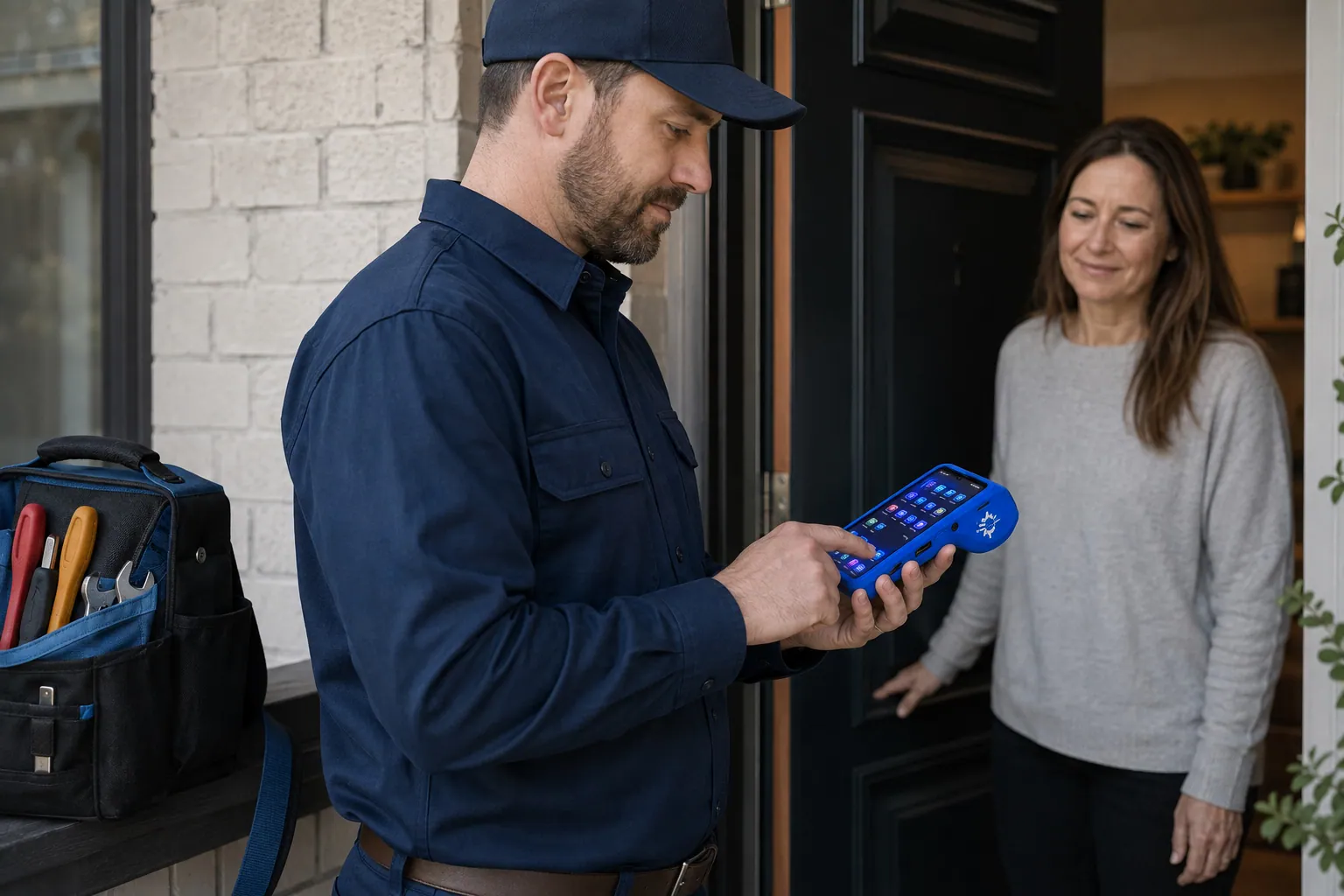
The homeowner pays when the driver closes the lid and the work order is signed. The driver takes the card on a mobile terminal or sends a link by text, and the receipt carries the work order number and tank size for your office.
Emergency and after-hours calls
A backed-up line or a failing alarm triggers a same-day dispatch, often with an after-hours line on the invoice. The dispatcher quotes that charge before the truck rolls, the driver collects on arrival, and the office records it as its own line item.
Remote owner and landlord payments
A cottage owner, landlord or property manager okays the visit by phone while the occupant lets the crew in. You send a payment link to the authorized payer, who pays remotely, and the receipt goes to that payer rather than the occupant.
Scheduled maintenance and commercial accounts
A restaurant, campground or apartment owner has a pump-out interval and a customer reference. You invoice after each completed visit with a payment link, or charge a stored card the customer agreed to in writing, and finance matches each payment to its visit.
How do septic crews take card payments at the property?
Septic crews take card payments at the property by finishing the work order first, then collecting on a mobile payment terminal for service calls or a text-to-pay link before the truck leaves. Mobile Terminals use LTE and Wi-Fi, so the driver can charge in the driveway, and the receipt ties the payment to the visit.
How the on-site collection runs
The driver pumps the tank, records gallons removed and tank condition on the work order, and shows the total. The homeowner taps, inserts or swipes on a mobile terminal, and the receipt goes out by text or email. Test coverage on your rural routes first and keep a payment link as your fallback.
What goes wrong at the driveway
A declined card, a split between two cards, or a dispute over a lid replacement can stall a visit. Offer a payment link for the balance, record each partial payment against the same work order, and keep the signed work order and photos of the tank access as your evidence.
A cracked lid on a 1,000-gallon tank
Say a driver pumps a 1,000-gallon tank and finds a cracked lid. The homeowner okays a replacement on the work order, then pays the full $540 on the terminal. The office posts one payment against one work order.
How can a remote owner pay for a septic visit?
A remote owner can pay for a septic visit through a payment link sent to the authorized payer, who accepts the quote and pays without being at the property. The receipt goes to that payer, and the occupant only needs to give the crew access to the tank.
Authorized payer and link
Record who may agree to the work and pay: the owner, landlord, property manager or an agent handling a home sale inspection. Send home service invoice payment links by text or email with the work order number as the reference. Payment Links can carry an expiry date, so an unpaid link does not stay open indefinitely.
What goes wrong with remote payers
An occupant may say the owner agreed when the owner never did. Do not charge until the authorized payer pays or says yes in writing. If the link expires, send a new one rather than keying a card read out over the phone, unless you use the Virtual Terminal with the payer's permission.
A landlord pays the night before
Say a landlord in another city books a pump-out for a rental. The dispatcher texts a link for the quoted total, the landlord pays that evening, and the crew pumps the next morning. The receipt names the landlord, and the tenant never handles a card.
RapidCents products for septic services
Mobile Terminals take cards at the property, Payment Links reach remote owners, Invoicing bills repeat accounts and Recurring Payments runs agreed schedules. Together they cover trucks, owners and commercial maintenance.
A staff member takes a card payment on a RapidCents handheld terminal, with the same sale appearing on the dashboard. Mobile Terminals
RapidCents mobile terminals are battery-powered wireless devices with LTE and Wi-Fi so staff accept payments…
Explore
The RapidCents payment links screen listing created links with their amount, status, click count and whether they have been paid, beside a phone showing the branded page a customer opens to pay $2,500.00. Payment Links
RapidCents payment links let staff generate branded pay-by-link URLs for invoices, deposits, balances and…
Explore
The RapidCents invoices screen: outstanding, overdue, paid and draft totals across the top, the invoice list below them, and a preview of one invoice on the right with its line items and a View & Record Payment button. Invoicing
RapidCents invoicing helps professional services, contractors and B2B suppliers create branded invoices…
Explore
The RapidCents recurring payments screen showing active subscriptions, monthly recurring revenue, failed payments and upcoming renewals, above a list of subscriptions with their plan, amount, frequency and next billing date. Recurring Payments
RapidCents recurring payments manage subscription plans, membership renewals and installment schedules with…
Explore


How do repeat maintenance invoices work for septic accounts?
Septic contractor payments on repeat accounts work by tying each completed visit to a customer reference and agreed billing terms, then collecting through an invoice payment link or a stored card the customer authorized. The invoice shows the visit, and finance matches each payment to it.
How a commercial cycle runs
A restaurant, campground or apartment complex has a pump-out interval, a site contact and a purchase order or account number. After each visit you issue an Invoice with a payment link and the account reference. Status tracking shows open, paid and overdue invoices for the office.
Stored cards and skipped visits
Charge a stored card only after the customer authorizes it and agrees the amount, timing and how to cancel. A multi-visit plan can use Recurring Payments as a collection schedule, not financing. If a visit is skipped or a tank needs extra pumping, adjust the invoice before collecting.
A campground on quarterly service
Say a campground with three tanks agrees to quarterly service. Each visit produces one invoice with the site reference. The manager pays the first link and authorizes a stored card for the rest. When a tank needs a second pump-out, you add a line and send an updated invoice.
How do you compare septic service processing costs?
Septic service processing costs depend on card type, how the card is taken and your ticket mix, so compare on interchange-plus using your real statements. Interchange passes through at cost, your RapidCents markup appears in your Fee Schedule, and fees for equipment or services apply if relevant. It is month to month, with no fixed term.
What drives cost for a septic business
Interchange varies with card type and with how the card is taken: tapped or inserted at the property versus keyed or paid online. Commercial and premium cards price differently from consumer debit. Septic pumping credit card processing therefore costs what your channel split and card mix make it.
What to bring to a comparison
Bring recent processing statements, your average ticket, the split between on-site, link and invoice payments, and your refund and chargeback volume. List emergency calls and commercial accounts separately, since their cards and ticket sizes often differ. Fee Check reads an uploaded statement and shows interchange separately from markup.
Other costs to ask about
Ask what septic service merchant services include for equipment, mobile terminals and any added services, and how each appears in your Fee Schedule. Compare written quotes on the same volumes, and use your own numbers to decide whether the pricing fits your mix. Your RapidCents representative will walk you through it.
Does your dispatch software work with RapidCents payments?
RapidCents integrates with many major platforms through APPIE and RapidBridge, so most septic and field service companies keep the dispatch software they run today. RapidBridge works with Jobber, Housecall Pro, Workiz and ServiceTitan, and your RapidCents representative walks you through the option that fits your vendor and version.
Jobber
Jobber handles quotes, scheduling and invoices. RapidBridge works with Jobber, so a RapidCents card payment lands against the job you already have open, without changing the software your office knows. Your RapidCents representative will walk you through the setup for your edition.
Housecall Pro
Housecall Pro handles dispatch, invoicing and payments for service trades. RapidBridge works with Housecall Pro, so a payment taken on a RapidCents terminal posts to the job and the invoice your dispatcher is already working from. Tell your representative which devices your drivers use.
Workiz
Workiz covers scheduling, call tracking and invoices for service businesses. RapidBridge works with Workiz, so settled payments reach the job record instead of being retyped by the office. Your RapidCents representative will show you how it fits your plan.
ServiceTitan
ServiceTitan suits larger trade operations with dispatch, memberships and accounting. RapidBridge works with ServiceTitan, so RapidCents payments post against the work your dispatchers and bookkeepers already track. Your RapidCents representative will walk you through the option that fits your edition.
ServiceM8
ServiceM8 manages jobs, quotes and invoices on mobile devices. RapidCents integrates with many major platforms through APPIE and RapidBridge, and the right option depends on your vendor and version. Tell your RapidCents representative you use ServiceM8, and they will show you how payments connect to it.
Payment options for septic services in the United States
Septic services in the United States can take credit and debit cards at the property, including PIN debit where supported, bank payments by ACH, and settle in USD. Your RapidCents representative sets up the mix that fits your business.
Cards and PIN debit at the property
Visa, Mastercard, American Express and Discover cards work at the property by tap, insert or swipe, with PIN debit where supported. State and local rules on septic licensing and disposal records vary, so check what applies to your business.
ACH and remote owners
ACH bank payments can suit commercial maintenance accounts that agree in writing to recurring debits. Payment Links and Invoicing serve remote owners, and funds settle in USD to your business bank account.
How do you switch processors and reconcile septic payments?
Once your account is approved, you switch by listing every stored card, open invoice and recurring schedule first, testing a sale, refund and link payment, then running both setups in parallel before you move your trucks. Then reconcile deposits to your ledger, with your RapidCents representative beside you.
Inventory before you move
List stored cards and their authorizations, quarterly commercial plans, open invoices, unpaid links and pending refunds. Stored cards may not move between processors unless both providers agree, so plan for customers to reauthorize. Keep work order and account references on every record.
Test, then run in parallel
Test a driveway sale, a remote link payment, a refund and an invoice payment before you move live traffic. Run old and new setups in parallel on a few routes, so drivers learn the terminal and the office sees how references arrive. Move all trucks only after the tests match.
Reconcile to the ledger
Match each payment to its work order and account reference. RapidCents connects settled transactions, fees and refunds to QuickBooks Online and Xero, and SAP and NetSuite import settlement files. Your RapidCents representative will walk you through it, and you match deposits to your ledger.
Payment questions from septic contractors
What is the best payment processor for septic services?
No single processor suits every septic business, so choose by fit. Compare mobile terminal coverage on your routes, remote payment links, invoicing, dispute tools, reporting and software fit. Ask for written quotes with interchange shown separately from markup. RapidCents offers all of these tools, on interchange-plus pricing and month to month.
How much does credit card processing cost for septic services?
It depends on your card mix, ticket size and how cards are taken, so there is no single figure. RapidCents prices on interchange-plus: interchange at cost, your RapidCents markup in your Fee Schedule, and fees for equipment or services if applicable. It is month to month. Upload a statement to Fee Check to see interchange separated from markup.
Can Jobber or Housecall Pro use RapidCents as the payment processor?
Yes. RapidBridge works with Jobber and Housecall Pro, as well as Workiz and ServiceTitan, taking RapidCents payments inside the software without changing it, so a payment posts against the job you already have open. Tell your RapidCents representative which edition you run, and they will walk you through the setup.
How can a septic business switch processors without losing payment history?
Export your history before you move and keep it. List stored cards, open invoices and recurring schedules, and remember that customers may need to reauthorize a stored card. Test a sale, link and refund, run in parallel, then reconcile deposits to your ledger. Keep the old account open until open items clear.
Which payment options can a septic service in the United States offer?
A septic service in the United States can offer credit and debit cards at the property, PIN debit where supported, payment links and invoices for remote owners, and ACH bank payments for agreed commercial accounts. Funds settle in USD. Your RapidCents representative sets up the mix that fits your business, so you can tell customers exactly how they can pay.
Can a remote owner pay for a septic visit?
Yes. Send a payment link to the authorized payer, such as the owner, landlord or property manager, with the work order number as the reference. The payer pays remotely and receives the receipt. Charge only with that person's go-ahead, never on the occupant's word alone. Links can have expiry dates, so reissue an expired one.
Can septic drivers collect cards on site?
Yes. RapidCents Mobile Terminals use LTE and Wi-Fi, so drivers collect in the driveway, though coverage on rural routes varies, so test your devices on your own routes first. Keep a payment link as a fallback when a tank sits outside signal range, and set driver permissions for refunds.
How do repeat septic maintenance invoices work?
Each completed visit becomes an invoice tied to a customer reference and the billing terms you agreed. The customer pays by link, or you charge a stored card they authorized for an agreed amount and timing. Recurring Payments can run a collection schedule, which is not financing. Adjust invoices for extra pumping before collecting.
How should you show an after-hours or emergency charge on a septic invoice?
Show it as its own line item, quoted and accepted before the truck is dispatched. Record the yes on the work order, whether by text, phone note or signature. A clear line item and a saved quote give you the evidence you need if a customer questions the charge later, and the receipt shows exactly what the after-hours call cost.
How can septic businesses reduce payment disputes?
Collect a signed work order, photograph tank access and condition, and send a receipt that names the service. Get authorization before storing a card, explain the amount and timing of recurring charges, and answer customer questions before they reach the bank. RapidCents Disputes tools help you track alerts, evidence and deadlines.
Related industries
Home Services is the parent page for dispatched work. Locksmiths, garage door services, pool and spa services and restoration companies share on-site collection, remote approval and invoice payment links, each with its own exceptions.
Home Services
Card payments for the work your crews finish in customers' homes: tap at the door…
Locksmiths
Take the callout fee, the approved quote and the final invoice by contactless card at the…
Garage Door Services
Collect the service-call charge at the door, take a deposit on a made-to-order door and…
Pool & Spa Services
Collect maintenance plans, seasonal visits, repairs and installation milestones with…
Restoration Companies
Collect mitigation deposits, staged job payments and the owner's portion by link, invoice…
HVAC Contractors
RapidCents lets you take the equipment deposit at the kitchen table, collect the balance…
Plumbing Contractors
Take the card at the job with Tap to Pay or a mobile terminal, send deposit links before…
Electricians
Take a materials deposit before the order goes in, get change orders approved and paid…
Take the next step
Compare what your septic trucks really pay
Upload a recent processing statement to Fee Check and see interchange separated from your markup, then compare it with how your trucks, owners and maintenance accounts actually pay.
- No obligation
- Payment specialists, not a call centre
- Secure statement upload



