


Truck repair payment processing for repair orders and fleets
Truck repair payment processing from RapidCents covers counter payments, phone authorizations, payment links for fleet offices and mobile terminals for roadside callouts. We built it around the jobs that define a heavy-duty shop: high-ticket repair orders, parts deposits, and the difference between a driver paying and a fleet account paying.

- PCI DSS Level 1
- SOC 2 Type II
- All major cards: Visa, Mastercard, Amex, Discover, UnionPay, Diners Club & PIN Debit
- Interchange-plus available
- Specialist onboarding support
How truck repair shops get paid
Truck repair shops get paid through repair orders, parts deposits, fleet-office payments and roadside callouts. Each job has a different payer and trigger, so the shop needs a counter terminal, remote payment links, a virtual terminal for phone authorizations and a mobile terminal for the yard or the roadside.
Repair-order balance
A driver or owner-operator settles the final repair order at the counter. The service writer closes the order, takes a tap, chip or swipe on a countertop terminal, and the receipt carries the repair order number so finance can match the deposit to the job.
Parts deposit
Before the shop orders a transmission, turbocharger or axle, the customer pays a deposit against the agreed estimate. The shop sends a payment link or keys the card by phone, records the deposit terms and applies the amount to the final invoice.
Fleet-office payment
A fleet manager or dispatcher in another city pays for a truck that is in your bay. You email an invoice with a payment link or take the card on a virtual terminal call, citing the unit number and purchase order so the receipt names the right truck.
Roadside callout
A mobile technician reaches a stranded truck and finishes the repair on site. The driver pays on a mobile terminal or with Tap to Pay, or the office sends a payment link, and the callout record ties the receipt to the work order and the unit.
How do truck repair shops get high-ticket repair orders authorized and paid?
Authorize before the work, not after. A truck repair shop gets the estimate signed off, takes a parts deposit if the job needs one, and collects the balance against the repair order. Large tickets get a short review so the card, the payer and the amount agree before the truck leaves the bay.
How the repair order runs
The service writer builds the estimate, the driver or fleet contact signs off on it, and the shop sends a payment link or takes the deposit at the counter. The final invoice shows the deposit already applied and the balance due. Put deposit terms and refund rules on the estimate first.
What goes wrong on a large ticket
A large charge may decline or need the issuer's attention. A card may belong to a driver, not the owner. A technician may find a cracked mount after teardown, so record who authorized the added amount and how before you charge it. Plan a second card or a refund path before the work starts.
A $6,800 turbocharger repair, deposit first
Say a two-bay diesel shop quotes a $6,800 turbocharger and aftertreatment repair. The owner pays a $2,000 parts deposit by payment link, a supplemental sign-off adds a sensor, and the balance is taken at pickup against the same repair order.
How can a fleet office pay for a repair while the truck is in your bay?
A fleet office pays remotely through a secure payment link or an authorized phone call on the Virtual Terminal, never by sending card numbers in an email or text. This is how fleet repair merchant services usually run: the invoice names the repair order and unit, and the receipt returns to the fleet's accounts payable contact.
How the remote payment runs
Send the invoice with repair order payment links to the fleet's billing contact, naming the unit number and purchase order. For a phone payment, authorized staff key the card on the Virtual Terminal with AVS and CVV, and the receipt emails to the buyer.
Set up payer authority first
Decide who may pay for which units. A dispatcher may not be an authorized cardholder, and a driver's personal card is not the fleet's card. A stored card needs the customer's authorization, so get written consent before you save one for the next repair.
A $3,400 brake and suspension job, paid by the carrier
Say a regional carrier's maintenance manager signs off on a $3,400 brake and suspension job on a truck sitting in your bay. The shop emails an invoice, the carrier's accounts payable pays with a company card, and the receipt shows the unit and purchase order number.
RapidCents products for truck repair shops
Countertop Terminals take counter payments, the Virtual Terminal handles phone payments, Invoicing sends payment links to fleet offices, and Mobile Terminals collect in the yard or at the roadside.
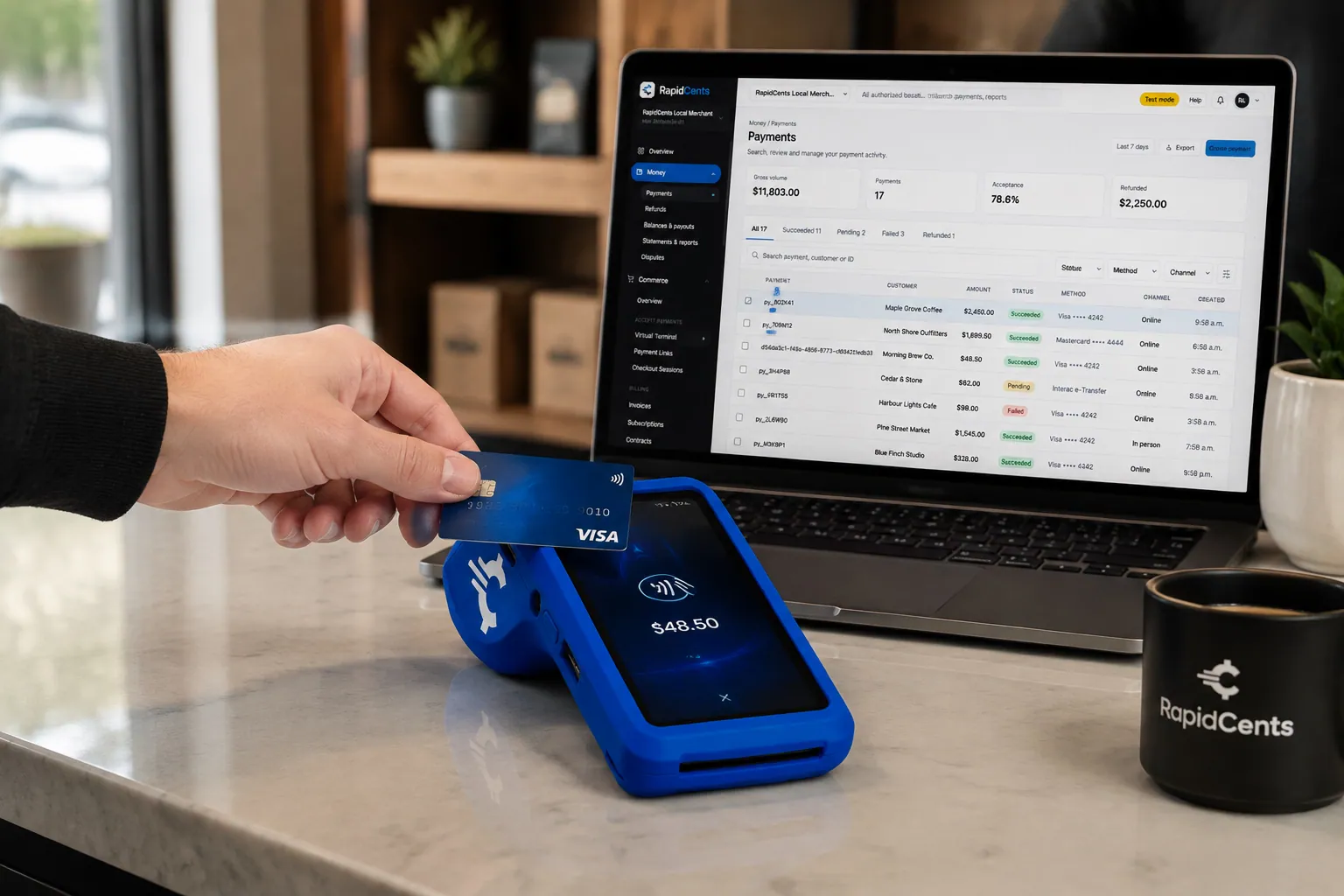
A fixed RapidCents countertop terminal taking card payments at the till, with settlement visible on the dashboard. Countertop Terminals
RapidCents countertop terminals sit at retail counters, restaurant hosts and reception desks where speed and…
Explore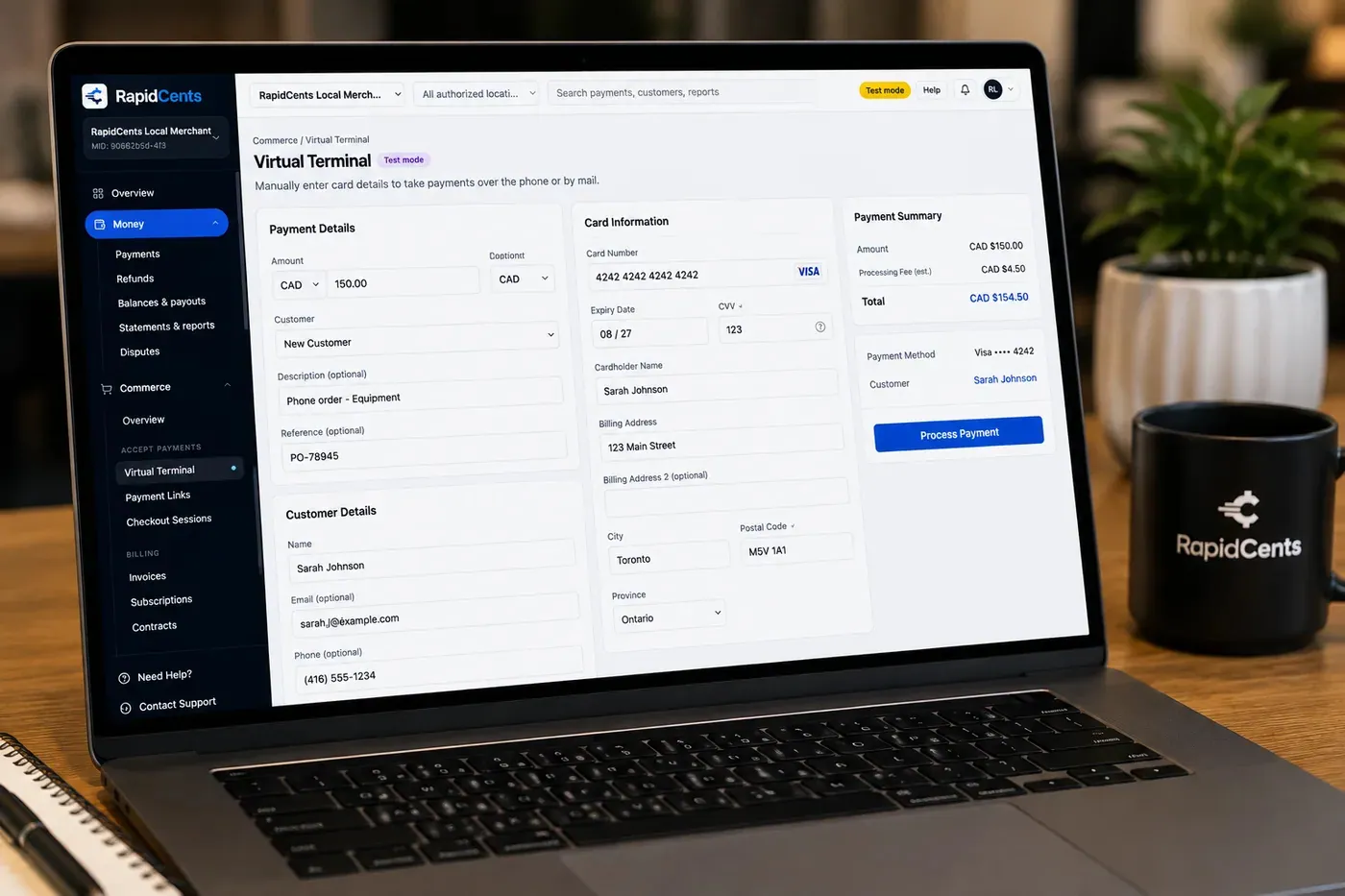
The RapidCents virtual terminal: payment details, card number, expiry and CVV keyed by hand on the left, with a payment summary on the right showing the amount, the estimated processing fee and a Process Payment button. Virtual Terminal
The RapidCents virtual terminal lets authorized staff enter mail-order and telephone-order payments through a…
Explore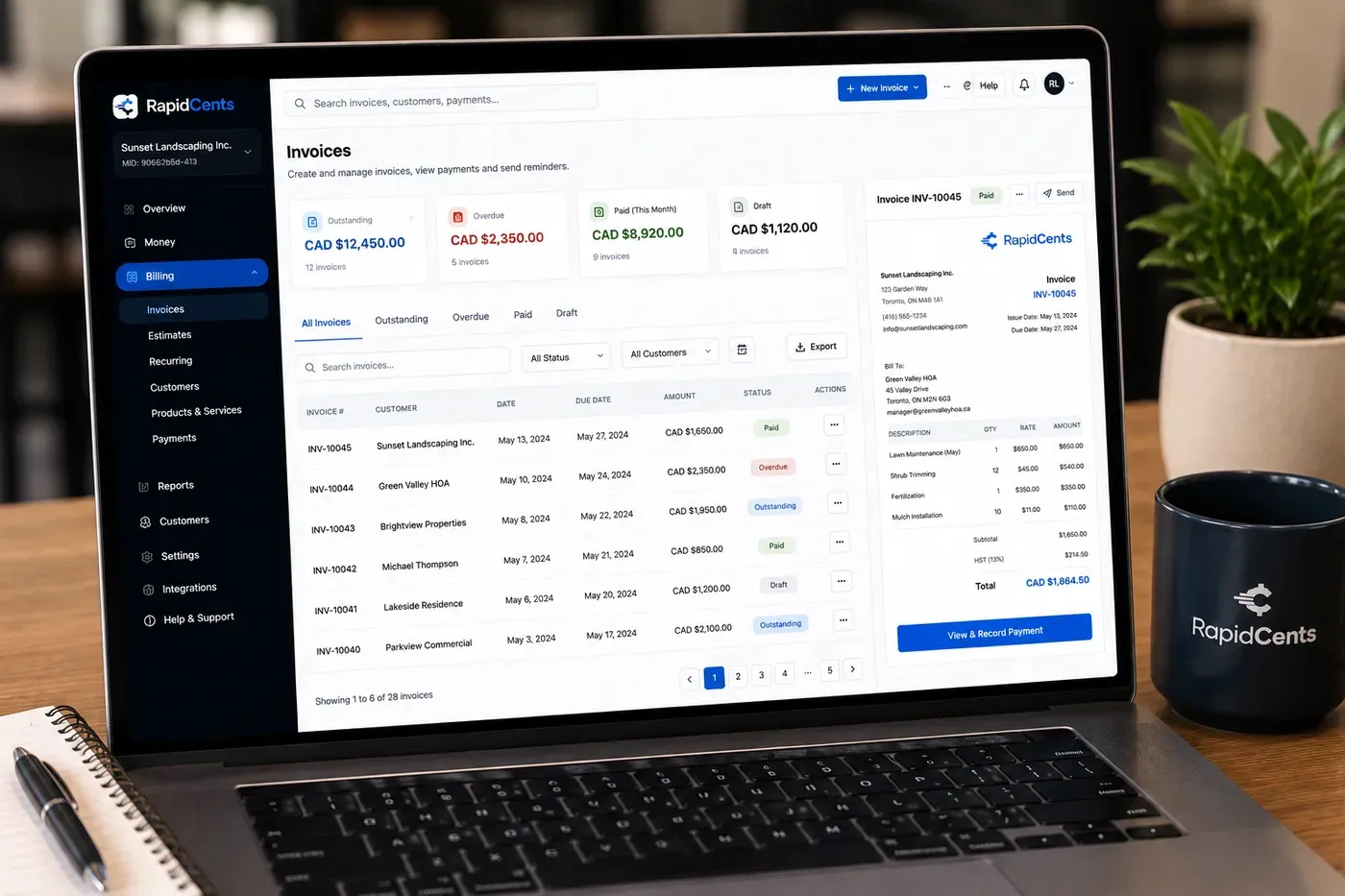
The RapidCents invoices screen: outstanding, overdue, paid and draft totals across the top, the invoice list below them, and a preview of one invoice on the right with its line items and a View & Record Payment button. Invoicing
RapidCents invoicing helps professional services, contractors and B2B suppliers create branded invoices…
Explore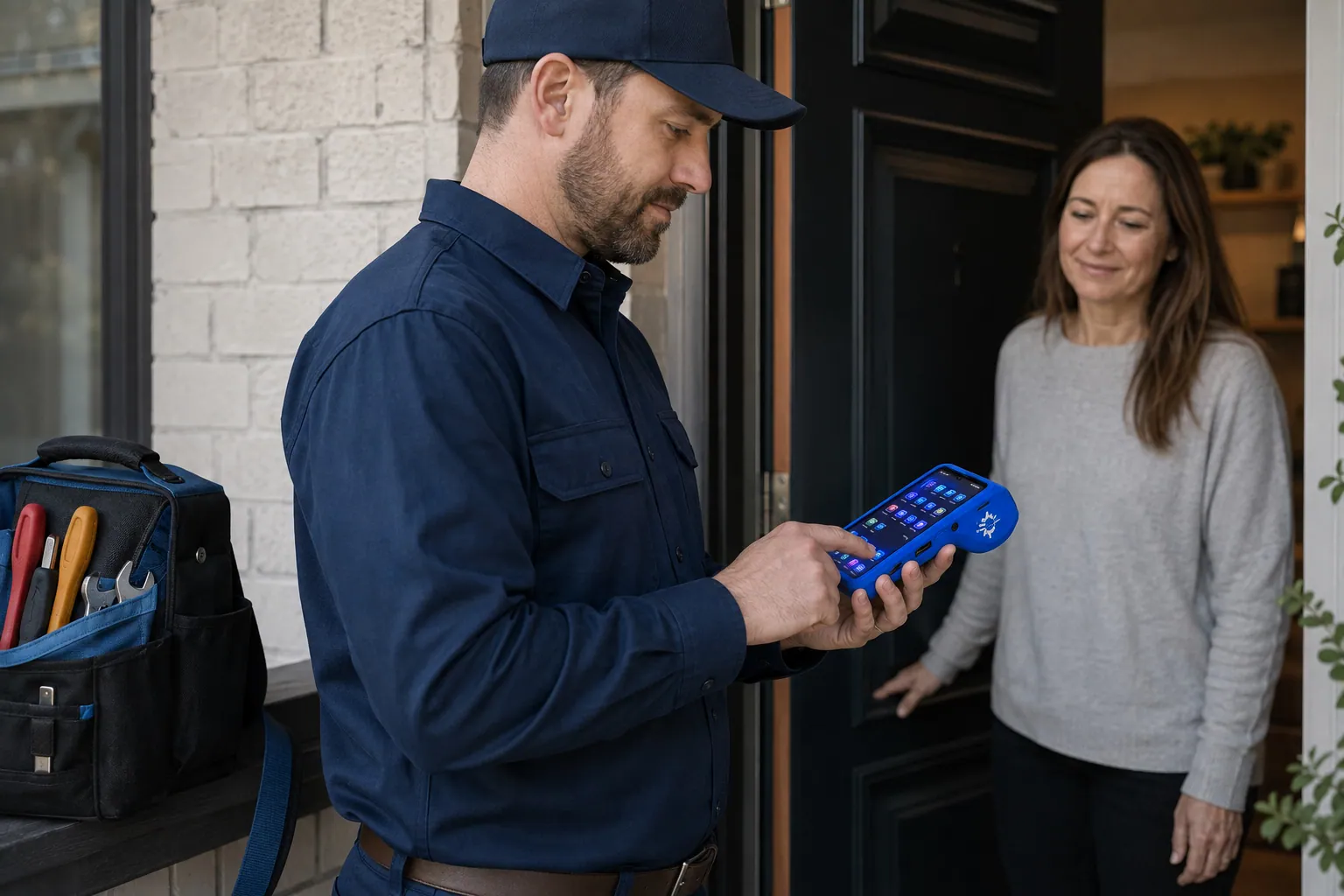
A staff member takes a card payment on a RapidCents handheld terminal, with the same sale appearing on the dashboard. Mobile Terminals
RapidCents mobile terminals are battery-powered wireless devices with LTE and Wi-Fi so staff accept payments…
Explore


How do you take payment on a roadside callout?
Take roadside payment with a Mobile Terminal, Tap to Pay on a supported phone, or a payment link sent to the driver or fleet office. Check the device and connection before the technician leaves the yard, because mobile truck repair payments depend on coverage at the breakdown site.
How the callout payment runs
The technician finishes the repair, the driver taps or inserts a card on a Mobile Terminal with LTE and Wi-Fi, and the receipt goes to the driver by text or email. The callout number, unit and location are written on the work order for finance.
What goes wrong on the shoulder
Coverage can drop in a dead zone, so the technician sends a payment link instead of writing down card numbers. A dispatcher paying for a driver follows the fleet-office flow, with the unit and purchase order number on the receipt. Your RapidCents representative sets up the right devices for your coverage area.
A $780 air line and belt tensioner callout
Say a technician replaces an air line and a belt tensioner on a highway shoulder for $780. The owner-operator taps a card on the mobile terminal, and the office matches the receipt to the callout number and the unit on the work order.
What drives card processing costs for a truck repair shop?
Costs follow your card mix, ticket size and how each card is taken. RapidCents prices heavy duty repair credit card processing on interchange-plus: interchange at cost, your RapidCents markup set out in your Fee Schedule, and fees for equipment or services if applicable. It is month to month with no fixed term.
Card type and how it is taken
Interchange varies with card type, such as debit, credit, premium and commercial cards, and with how the card is taken. A tapped or inserted card at the counter differs from a keyed card on a phone call or a card paid through a link.
Your real repair mix
A heavy-duty shop has large repair orders, small parts counter sales and roadside callouts. Large tickets, commercial cards and keyed payments can each price differently, so weigh your real mix rather than an average ticket.
What to bring to compare
Bring recent processing statements, your average ticket, the split between counter, keyed, link and mobile payments, and your refund and dispute volume. Upload a statement to Fee Check to see interchange separated from markup, then compare quotes in writing.
Which shop and fleet software works with your payment setup?
RapidCents integrates with many major platforms through APPIE and RapidBridge, so most shops keep the software they run today. RapidBridge works with Tekmetric, Shop-Ware, Mitchell 1 Manager SE, Shopmonkey and AutoLeap, and settled transactions, fees and refunds flow to QuickBooks Online and Xero.
Tekmetric, Shop-Ware, Mitchell 1 Manager SE, Shopmonkey and AutoLeap
RapidBridge works with these shop management systems, so a card payment posts against the repair order you already have open, without changing the software your service writers use for estimates, repair orders and invoices.
QuickBooks Online and Xero
RapidCents connects settled transactions, fees and refunds to QuickBooks Online and Xero. Decide with your representative whether deposits and fleet receivables post by repair order or by customer account, and the setup follows that choice.
SAP, NetSuite and fleet maintenance platforms
SAP and NetSuite import settlement files, so finance loads batches on its own schedule. For fleet maintenance platforms and other heavy-duty shop systems, the right option depends on your vendor and version; your RapidCents representative will walk you through it.
Truck repair payment options in the United States
Truck repair shops in the United States can accept credit and debit cards, including PIN debit where supported, and ACH bank payments, with settlement in USD. State rules on repair estimates and invoices may apply, and your representative sets up the methods you want on your account.
Credit and debit cards
Cards work at the counter, on a mobile terminal, by payment link and by keyed phone payment. PIN debit works where your device and account support it.
ACH for fleet accounts
ACH bank payments suit fleet accounts that agree in writing to a one-time or recurring debit. Keep the signed authorization on file, and have your representative turn ACH on for your account. Fleet cards follow the program each card belongs to.
How do you switch truck repair payment processors without losing records?
Switching is a sequence: list what you hold, test the new flow, run both in parallel if you want, then reconcile. Count open repair orders, deposits held against estimates and saved fleet cards, and your representative will plan with you what moves. Saved cards move only when both processors agree.
Inventory what is open
Once your account is approved, list open repair orders, unpaid invoices, parts deposits held against estimates and cards saved for fleet accounts. Token portability needs both processors to agree, so plan to request fresh authorization from customers where saved cards cannot move.
Test before moving live traffic
Test a counter sale, a keyed phone payment, a payment link, a mobile terminal sale, a deposit and a refund. Run old and new side by side for a period if your volume needs it, and give technicians a one-page roadside payment script.
Reconcile to the repair order
Map each receipt to the repair order and unit number, then reconcile deposits to your ledger by batch. Reporting and CSV export help finance, and your representative can tell you which fields your accounting software takes before the first month-end.
Payment questions from truck repair shops
What is the best payment processor for a truck repair shop?
The best processor is the one that fits your repair order flow, ticket size and card mix, so compare written quotes rather than slogans. Look at pricing structure, support for phone and roadside payments, deposit handling, dispute tools, reporting, shop software integrations and contract terms. RapidCents offers interchange-plus pricing, month to month with no fixed term, and Fee Check shows interchange separately from markup.
How much does credit card processing cost for a truck repair shop?
Cost depends on your card mix, ticket size and channels, so we quote no single number. RapidCents pricing is interchange-plus: interchange at cost, your RapidCents markup set out in your Fee Schedule, and fees for equipment or services if applicable. Large commercial-card tickets and keyed payments can price differently from tapped debit, so upload a statement to Fee Check.
Can Tekmetric or other shop software run RapidCents payments?
RapidBridge works with Tekmetric, Shop-Ware, Mitchell 1 Manager SE, Shopmonkey and AutoLeap, taking RapidCents payments inside the software without changing it. For other shop systems, RapidCents integrates with many major platforms through APPIE and RapidBridge. The right option depends on your vendor and version; your RapidCents representative will walk you through it.
How can a truck repair shop switch processors without losing payment history?
Export your transaction history before you close the old account, then list open repair orders, deposits and saved cards. Saved cards move only if both processors agree to transfer tokens, so plan to request fresh authorization where they do not. Test a sale, a deposit and a refund on the new setup, run both in parallel if needed, then reconcile.
Which payment options can a truck repair shop in the United States offer?
A truck repair shop in the United States can offer credit and debit cards, PIN debit where supported, and ACH bank payments for customers who agree to them, settled in USD. Fleet and commercial cards vary by program, so tell your RapidCents representative which ones your customers carry and they will walk you through what fits your setup.
Can a fleet office pay while the truck is at your shop?
Yes, through a secure remote flow. Send an invoice with a payment link, or have authorized staff key the card on the Virtual Terminal during a phone call, never by email or text. The receipt should name the unit, repair order and purchase order number. Your RapidCents representative sets up the remote methods you want on your account.
Can a truck repair shop take a roadside payment?
Yes. A Mobile Terminal with LTE and Wi-Fi, Tap to Pay on a supported phone, or a payment link sent to the driver or fleet office can all collect at the roadside. Your RapidCents representative will help you choose devices for your coverage area, and the technician sends a link if the signal drops.
Are fleet cards supported for truck repair payments?
Standard Visa and Mastercard credit cards are the base for fleet repair. Fleet and commercial cards vary by program, so tell your RapidCents representative which ones your customers carry and they will walk you through what fits your setup, including Level 2 and 3 data. Then you can tell customers exactly how they can pay.
Can a truck repair shop take a parts deposit?
Yes, with the customer's agreement. Put the deposit amount, what it covers and the refund terms on the agreed estimate, then collect by payment link or at the counter and apply it to the final repair order. A deposit is not financing: it is part of the repair price, paid early.
How should a shop handle a supplemental sign-off on a large repair?
Get the added amount authorized by the right person before you charge it. Record who authorized it, how and when on the repair order, then charge only that amount to a new payment link or a saved card. A saved card needs the customer's authorization, and a disputed charge is easier to answer when the sign-off is on file.
Related industries
Automotive is the parent industry. Freight and logistics and towing share fleet-office billing and roadside collection, and auto repair shops, tire shops and auto glass share repair-order and deposit workflows.
Automotive
Take the parts deposit, the phone-approved repair, the insurance deductible and the…
Freight & Logistics
RapidCents helps carriers, brokers and 3PLs invoice shippers, collect by payment link…
Towing & Roadside
Take release fees at the yard gate, card payments at the roadside and invoices for…
Auto Repair Shops
Take the diagnostic fee and parts deposit at the service counter, text a payment link…
Tire Shops
Take deposits on special-order tires, collect installation balances at the counter or by…
Auto Glass Businesses
Take cards at the vehicle or by payment link, collect the customer's portion apart from…
Taxi & Transportation
Take card fares and tips in the vehicle, reconcile each driver's takings by shift and…
Parking
Take cards at booths and event gates, let drivers pay by plate or QR code, and bill…
Take the next step
Review your truck repair payment flow
Upload a recent processing statement to Fee Check and see interchange separated from markup, then compare it with your repair order, fleet and roadside mix.
- No obligation
- Payment specialists, not a call centre
- Secure statement upload



