


Auto glass payment processing for mobile and in-shop work
Auto glass payment processing lets technicians take cards at the vehicle, in the shop or by payment link, and keeps the customer's portion separate from insurer payments. Your core jobs are mobile technician payments, deductible and out-of-pocket collection, and balances for recalibration and completion, all on one Merchant Dashboard.

- PCI DSS Level 1
- SOC 2 Type II
- All major cards: Visa, Mastercard, Amex, Discover, UnionPay, Diners Club & Interac Debit
- Interchange-plus available
- Canadian support
How do auto glass businesses get paid?
Auto glass businesses get paid through mobile technician payments, the customer's portion of an insurance job, deposits on special-order glass, and recalibration and final balances before pickup. Each one has a clear payer and a clear record for finance, and the three busiest are walked through in detail next.
Mobile technician payment
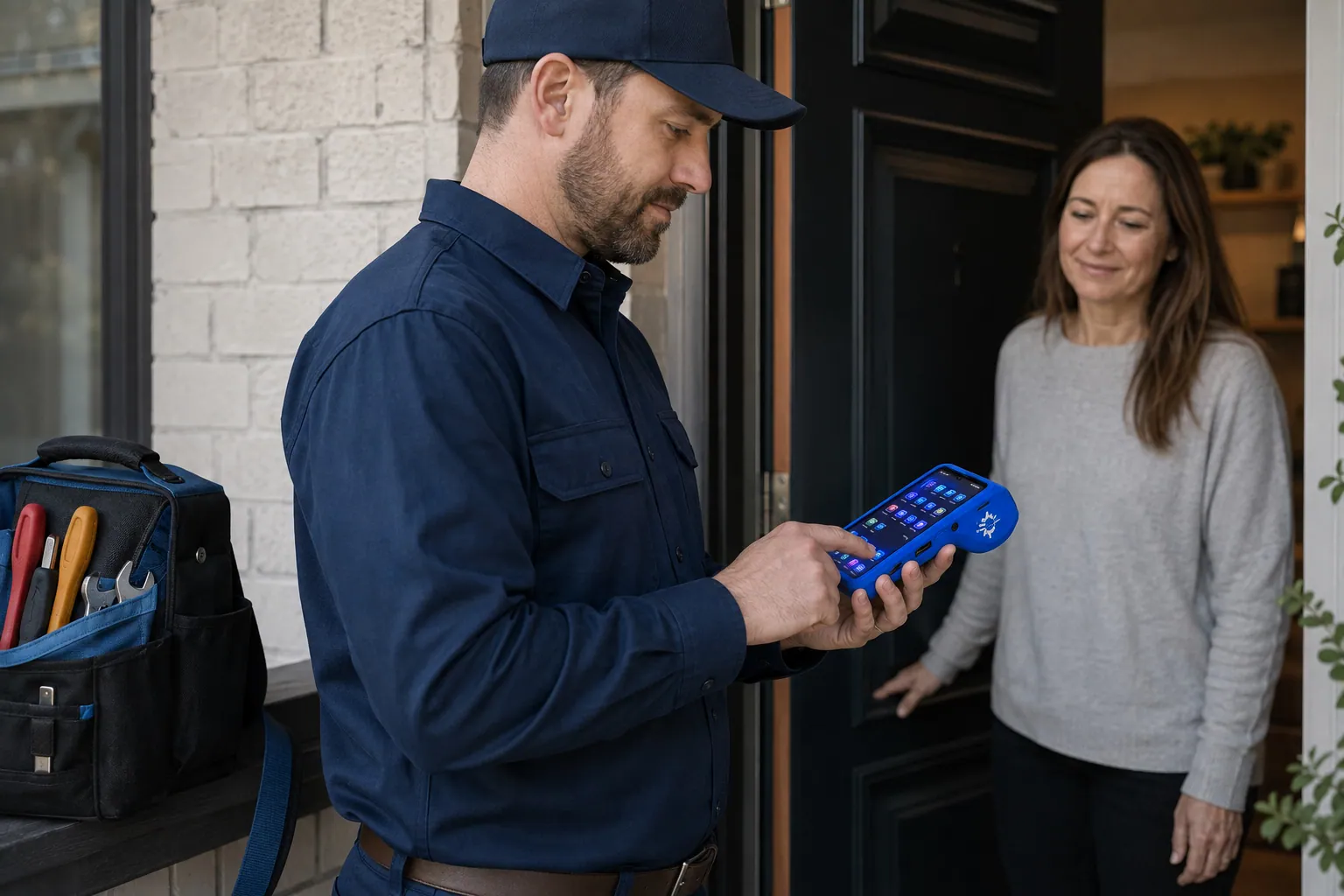
The vehicle owner pays when a mobile install ends, in a driveway or an office lot. The technician collects with a Mobile Terminal or Tap to Pay, and a payment link covers a dropped signal. Finance receives a receipt carrying the work order number.
Customer portion of an insurance job
The customer pays the deductible or any uncovered item, while the insurer or glass network pays the remainder separately. The customer approves the amount first, and if the insurer adjusts the claim, they approve the new amount before you charge again. Finance sees the card payment apart from insurer remittances.
Special-order glass deposit
A customer pays a deposit when glass is ordered for a vehicle that needs a part not on the shelf, by payment link or at the counter. If the customer cancels after the part is ordered, your deposit terms decide what happens next. Finance sees the deposit applied to the final invoice.
Recalibration and final balance
The owner pays the balance, including any ADAS recalibration line, by link before pickup or at the counter. If trim or a recalibration was missing from the estimate, you add it to the invoice and the customer pays the difference. Finance matches the receipt to the invoice.
How do technicians take mobile auto glass payments on site?
Mobile auto glass payments run through a Mobile Terminal or Tap to Pay on the technician's phone, taken once the customer signs off the finished install. Test the device, connectivity and receipt method before the van leaves, and put the work order number on every charge.
How the payment runs
The customer approves the finished install, the technician enters the work order amount, and the customer taps or inserts a card. A receipt goes by text or email, and the sale appears in your Merchant Dashboard with the work order reference.
What to set up first
Test each Mobile Terminal or Tap to Pay phone where your vans actually work: parking structures, rural roads and fleet lots. If the connection drops, the technician sends a payment link instead of writing down card numbers.
A $250 out-of-pocket windshield, paid in the office lot
A technician replaces a windshield in an office lot and recalibrates the forward camera. The customer owes $250 out of pocket, taps a card on the technician's phone, and the office manager receives the receipt by email.
How do you collect the customer's portion apart from the insurer?
Collect the customer's portion, usually the deductible or an uncovered item, as its own approved charge, and treat the insurer's payment as a separate receivable. The card payment shows what the customer paid. RapidCents processes the card payment; claims and coverage stay between you, the customer and the insurer.
How the payment runs
The advisor confirms what the customer owes from the claim authorization or assignment the insurer or glass network issued. Then you send a payment link or take the card at the counter, with the claim or work order number in the reference field.
When the amount changes
If the insurer adjusts the approved amount, or declines an item such as moulding, the customer's portion may change. Do not alter a finished charge silently. Agree the new amount with the customer, then collect the difference or refund the excess.
A $100 deductible plus a rain-sensor kit, charged once
A shop installs a side window. The claim covers the glass, and the customer owes a $100 deductible plus a rain-sensor kit the insurer does not cover. The shop charges the customer once for both, and records the insurer's remittance separately when it arrives.
RapidCents products for auto glass businesses
Mobile Terminals and Tap to Pay take payment at the vehicle. Payment Links collect deposits, recalibration lines and balances before pickup, and Invoicing itemizes the work order. All share one Merchant Dashboard, so van and counter payments reconcile together.
A staff member takes a card payment on a RapidCents handheld terminal, with the same sale appearing on the dashboard. Mobile Terminals
RapidCents mobile terminals are battery-powered wireless devices with LTE and Wi-Fi so staff accept payments…
Explore
A café worker holds a phone running RapidCents Tap to Pay, showing an $18.75 sale and the contactless symbol, while a customer holds a Visa card to the screen. No separate card reader is present. Tap to Pay
RapidCents Tap to Pay turns supported iPhones and Android devices into contactless payment terminals without…
Explore
The RapidCents payment links screen listing created links with their amount, status, click count and whether they have been paid, beside a phone showing the branded page a customer opens to pay $2,500.00. Payment Links
RapidCents payment links let staff generate branded pay-by-link URLs for invoices, deposits, balances and…
Explore
The RapidCents invoices screen: outstanding, overdue, paid and draft totals across the top, the invoice list below them, and a preview of one invoice on the right with its line items and a View & Record Payment button. Invoicing
RapidCents invoicing helps professional services, contractors and B2B suppliers create branded invoices…
Explore


How do customers pay for recalibration and special-order glass before pickup?
A payment link or invoice lets a customer pay before pickup, whether for a deposit on special-order glass, an ADAS recalibration line or the final balance. The receipt shows what was paid, and you release the vehicle under your own rules.
How the payment runs
Send auto glass payment links by SMS or email, or a branded invoice from Invoicing, itemizing glass, labor, moulding and the recalibration line. The customer pays on a mobile page, and the paid status shows on your dashboard before pickup.
What to set up first
Write your deposit terms for special-order glass, including what happens if the customer cancels after the part is ordered, and show them on the invoice. Partial payments apply to the open balance. Storing a card takes the customer's authorization.
A $200 OEM glass deposit, balance by link
A customer whose vehicle needs OEM glass pays a $200 deposit by link when the part is ordered. After installation and recalibration, a second link collects the balance, and the customer shows the receipt at pickup.
What drives auto glass merchant services costs?
Windshield repair credit card processing cost depends on your card mix, average ticket and how cards are taken. We price every account on interchange-plus: interchange passes through at cost, plus your RapidCents markup in your Fee Schedule, and fees for equipment or services if applicable. Month to month, no fixed term.
What moves interchange
Interchange varies with card type, such as debit, credit, premium or commercial, and with how the card is taken. A card tapped or inserted at the vehicle differs from a keyed card or a payment link. Fleet accounts may bring commercial cards.
What to bring to compare
Bring recent processing statements, your average ticket, the split between mobile, counter and link payments, and your refund and chargeback volume. Cancelled special-order glass and insurer adjustments change refund patterns, so mention them.
Use Fee Check
Upload a statement to Fee Check to see interchange separated from markup, then read your Fee Schedule line by line. Compare written quotes from other providers on your own mix of mobile, counter and link payments.
Which shop software works with RapidCents?
RapidBridge takes RapidCents payments inside web-based shop software without changing it, and it works with Tekmetric, Shop-Ware, Mitchell 1 Manager SE, Shopmonkey and AutoLeap, so a card payment posts against the work order you already have open. For your books, we also connect settled transactions, fees and refunds to QuickBooks Online and Xero.
Tekmetric, Shop-Ware and Mitchell 1 Manager SE
These systems hold your work orders, estimates and invoices. RapidBridge works with all three, so the customer pays with RapidCents and the payment lands against the open work order, with no change to the software your advisors already use.
Shopmonkey and AutoLeap
RapidBridge works with both, so estimates, scheduling and customer messages stay where they are while payment posts to the right job. If you dispatch mobile glass jobs from other software, RapidCents integrates with many major platforms through APPIE and RapidBridge, and your RapidCents representative will walk you through the options for your vendor and version.
QuickBooks Online, Xero, SAP and NetSuite
Settled transactions, fees and refunds flow to QuickBooks Online and Xero, and SAP and NetSuite import settlement files. Keep insurer remittances in receivables, apart from card payments, so your ledger shows each payer clearly.
Auto glass payment options in Canada
Auto glass businesses in Canada can accept Interac debit by chip and PIN or contactless at the terminal, plus credit cards, and EFT or pre-authorized debit (PAD) for agreed bank payments, settled in CAD.
Insurance and receipts
Glass coverage arrangements vary by province and by insurer, so check with the insurer or glass network what the customer owes before you charge. Receipts can show GST/HST where it applies to the work.
Counter, van and bank payments
Interac debit suits the counter and Mobile Terminals, and a payment link takes cards remotely. EFT or PAD fits fleet customers who agree to the payment schedule in writing.
How do you switch processors and reconcile auto glass payments?
Switch in steps: list open work orders, stored cards and pending refunds, test a sale, refund and payment link, then run both providers in parallel before every van moves. Reconcile deposits to your ledger by work order. Moving stored cards needs both providers to agree.
Take inventory first
List open deposits for special-order glass, stored cards, unpaid invoices and refunds in progress. Ask your current provider what card data can move. Both providers must agree before any stored card transfers.
Test before the vans move
Run one mobile sale, one refund, one payment link and one deposit on a test work order. Give each technician a short checklist for lost signal and receipt delivery. Run both providers in parallel for a period if you need to.
Map references and reconcile
Map each payment reference to the work order or claim number, and reconcile deposits to your ledger. Keep insurer remittances on a separate account line. Reporting exports are ready for QuickBooks Online or Xero formats, and your RapidCents representative can show you which fits your books.
Payment questions from auto glass businesses
What is the best payment processor for auto glass businesses?
We built RapidCents around how glass shops take payment: Mobile Terminals and Tap to Pay for technicians, payment links, customer charges kept apart from insurer payments, and RapidBridge for your shop software. We price on interchange-plus, with your markup in your Fee Schedule, month to month. Upload a statement to Fee Check and compare us on your own numbers.
How much does credit card processing cost for auto glass businesses?
The cost depends on your card mix, ticket size and how cards are taken. We price every account on interchange-plus: interchange at cost, your RapidCents markup in your Fee Schedule, and fees for equipment or services if applicable. It is month to month with no fixed term. Upload a statement to Fee Check to see interchange separated from markup.
Can Tekmetric, Shop-Ware or other shop software work with RapidCents?
Yes. RapidBridge works with Tekmetric, Shop-Ware, Mitchell 1 Manager SE, Shopmonkey and AutoLeap, so a card payment posts against the work order you already have open. For other shop or glass software, RapidCents integrates with many major platforms through APPIE and RapidBridge. The right option depends on your software vendor and version; your RapidCents representative will walk you through it.
How can auto glass businesses switch processors without losing payment history?
Export your payment history from the current provider before you cancel, and keep it with your records. List open deposits, stored cards and unpaid invoices. Once your account is approved, test a sale, a refund and a payment link, then run both providers in parallel until deposits reconcile. Moving stored cards needs both providers to agree.
Which payment options can an auto glass business in Canada offer?
An auto glass business in Canada can offer Interac debit and credit cards at the vehicle or counter, payment links for remote payment, and EFT or pre-authorized debit (PAD) for agreed bank payments, with CAD settlement. Your RapidCents representative sets up the methods you want during onboarding.
Can technicians take cards on site?
Yes, if the device and connectivity work where you park the van. Technicians can use a Mobile Terminal or Tap to Pay on a supported iPhone or Android phone, and a payment link is the fallback when signal drops. Your RapidCents representative will help you choose devices and test coverage before you roll out to every technician.
Can the customer pay only their portion?
Yes. Collect the customer's approved portion, such as the deductible or an uncovered item, as its own charge, and record the insurer's payment separately. Use the claim or work order number as the reference. RapidCents processes the card payment only. It does not submit claims or check coverage, so agree the amount with the insurer or network.
Can a customer pay before vehicle pickup?
Yes. Send a payment link or invoice by SMS or email, and the customer pays from a phone before pickup. The receipt and paid status show the payment, so the front desk can match it to the work order. Releasing the vehicle follows your own policy, and any later adjustment is a separate charge or refund.
How should recalibration be listed on the invoice and the payment?
List recalibration as its own line on the work order and invoice, next to glass, labor and moulding, so the customer and the insurer can see what each line covers. Whether the insurer pays that line is between you and the insurer. Card processing records only what the customer paid, and the receipt should match the invoice total.
What completion evidence should you keep with a payment?
Keep the signed work order, completion photos or sign-off, the receipt and the payment reference together under one work order number. These records help if a customer later disputes a charge. RapidCents Disputes tools help you gather evidence and track deadlines, and the evidence itself comes from your own job records.
Related automotive businesses
Auto repair shops, tire shops and truck repair run the same workflows: work orders, deposits, payment links before pickup and stored-card authorization. Their pages cover the counter and fleet versions of the same payment jobs, and the Automotive page gives the wider view.
Automotive
Take the parts deposit, the phone-approved repair, the insurance deductible and the…
Auto Repair Shops
Take the diagnostic fee and parts deposit at the service counter, text a payment link…
Tire Shops
Take deposits on special-order tires, collect installation balances at the counter or by…
Commercial Truck Repair
RapidCents helps truck repair shops collect repair orders, parts deposits, fleet-office…
Taxi & Transportation
Take card fares and tips in the vehicle, reconcile each driver's takings by shift and…
Parking
Take cards at booths and event gates, let drivers pay by plate or QR code, and bill…
Towing & Roadside
Take release fees at the yard gate, card payments at the roadside and invoices for…
Car Wash
Single washes at the pay station, unlimited plans on monthly autopay and the renewals…
Take the next step
Review your auto glass payment flow
Upload a processing statement to Fee Check and see interchange separated from your markup, based on your own mix of mobile, counter and link payments.
- No obligation
- Canadian payment specialists
- Secure statement upload



