


Tire shop payment processing for deposits, installs and storage
Tire shop payment processing has to cover three jobs beyond a simple counter sale: deposits on special-order tires, installation balances collected at the counter or by text when the car is ready, and seasonal storage fees that renew at each changeover. RapidCents handles all three, priced on interchange-plus, month to month.

- PCI DSS Level 1
- SOC 2 Type II
- All major cards: Visa, Mastercard, Amex, Discover, UnionPay, Diners Club & Interac Debit
- Interchange-plus available
- Canadian support
How tire shops get paid
Tire shops collect six kinds of payment: special-order deposits, installation and service balances, seasonal storage fees, fleet account invoices, walk-in repairs and counter sales, and the customer's share of warranty replacements. Each is taken on the countertop terminal, by Payment Link or invoice, or on a recurring schedule, and carries the work order or storage-tag number finance uses to reconcile.
Special-order tire deposits
A driver who wants a size, brand or load rating you do not stock pays part of the price before you order from your distributor, at the counter, by phone or by Payment Link. Your special-order terms settle a cancellation after ordering. Finance gets a deposit tagged with the work order number.
Installation and service balances
When the work order closes, the customer pays for the tires, mounting and balancing, valve stems or TPMS service, disposal fees and agreed extras, minus any deposit. It is collected at pickup on the countertop terminal or by Payment Link, and finance sees every payment recorded against one work order.
Seasonal tire storage fees
Customers who leave their off-season set with you pay a storage fee each season or year, timed to the spring or fall changeover, on an authorized stored card or by invoice. If a card expires or a customer sells the vehicle, you switch to an invoice or stop the schedule. Each payment carries the storage-tag or rack number.
Fleet and commercial accounts
Delivery companies, contractors and other businesses with vehicles pay on account by invoice with a Payment Link, by a commercial card kept on file with written authorization, or by bank payment where enabled. Finance matches each payment to the fleet's purchase order or unit number. Your RapidCents representative can walk you through fleet-program cards.
Walk-in repairs and counter sales
Drivers with a puncture, a slow leak or tires bought elsewhere pay for the repair or installation on the spot, sometimes adding wiper blades or a TPMS sensor. These are quick card-present sales on the countertop terminal or Tap to Pay, and a returned accessory is refunded to the original card.
Warranty and road hazard replacements
When a road hazard plan or a tire maker's treadwear warranty covers part of a replacement, the customer pays the prorated remainder plus installation at the counter. The claim goes to the warranty provider through its own process; the card payment covers only the customer's portion, so check coverage before the work starts.
How do special-order tire deposits work?
A special-order tire deposit is taken when the customer okays the quote and before you order from your distributor, and it is recorded against the work order so the install invoice shows it as paid. Collect it on the countertop terminal, by phone through Virtual Terminal, or with a Payment Link, and keep your cancellation and restocking terms with the payment record.
Quote, deposit, order, install
Once the customer picks a size and model from your quote, take the deposit at the counter or send a Payment Link by SMS or email with the work order number in its reference field. Place the order with your distributor when the link shows as paid. When the tires arrive and the install invoice closes, the deposit and the balance carry the same work order reference, so they match in your reports.
Write the special-order terms first
Before the first deposit, put in writing whether it is refundable if the customer cancels after you order, whether a restocking charge applies to tires your distributor takes back, and how long you hold tires nobody picks up. Contracts & eSignatures can send those terms, capture the customer's signature and take the deposit, and the signed copy is evidence you can submit if the deposit is disputed.
Back orders, wrong sizes and cancellations
If the distributor back-orders the tire or ships the wrong size, leave the deposit on the same work order and update the expected date rather than refunding and charging again. If the customer cancels under refundable terms, refund the deposit to the card it came from. Do not use an authorization hold in place of a deposit: a hold can expire before a back-ordered tire arrives.
Four light-truck tires, deposit first
Say a customer orders four light-truck tires in a size your shop does not stock. The counter sends a $300 deposit link tagged with work order 4417, with the special-order terms to sign, and orders the tires once the link shows paid. They arrive two days later; the $1,480 install invoice shows the deposit as paid, and the customer taps a card for the $1,180 balance at pickup.
How do tire shops collect installation balances during the changeover rush?
During the spring and fall changeover, collect installation balances on the countertop terminal for customers who wait and by Payment Link for customers who drop off, with any booking deposit already deducted. Mobile installs can be paid on a phone with Tap to Pay. Update the work order for agreed extras before taking payment, so one receipt matches the final invoice.
Counter, text or driveway
Customers in the waiting area tap, insert or enter a PIN on the countertop terminal when the technician closes the work order. Drop-off customers get a Payment Link by SMS for the balance and pay from their phone, with the receipt sent automatically. A technician on a mobile install takes the balance with Tap to Pay on a supported iPhone or Android phone, and the payment shows in the same dashboard as counter sales.
Booking deposits for the rush
In the weeks before the winter tire changeover, some shops ask for a booking deposit by Payment Link to hold a bay slot. Show the no-show and late-cancellation policy on the booking confirmation, and credit the deposit on the installation invoice when the customer arrives. Charging a no-show fee to a card later requires the customer's prior agreement, so a deposit paid up front is the cleaner record.
Extras found in the bay, and declines at pickup
When a technician finds a cracked valve stem, a failed TPMS sensor or wear that calls for an alignment, get the customer's go-ahead and update the work order before sending the link, so the customer pays one total instead of meeting a surprise second charge. If a card declines on a full set, the customer can use another card or divide the total between two cards they hold; record both against the same work order.
A fall drop-off with two cracked valve stems
Say a driver books a fall changeover and pays a booking deposit by link. She drops the car off at 8 a.m.; the technician finds two cracked valve stems, and she okays them by phone. At 11 a.m. she receives a link for the balance with the deposit deducted and the valve stems added, pays from her office, and collects the car with the receipt already on her phone.
RapidCents products for tire shops
Countertop Terminals take installation balances at the service counter, Payment Links collect special-order deposits and pickup balances by text or email, Recurring Payments renew storage for customers who authorize a stored card, and Reporting gives finance the settlement and fee reports to match each work order.
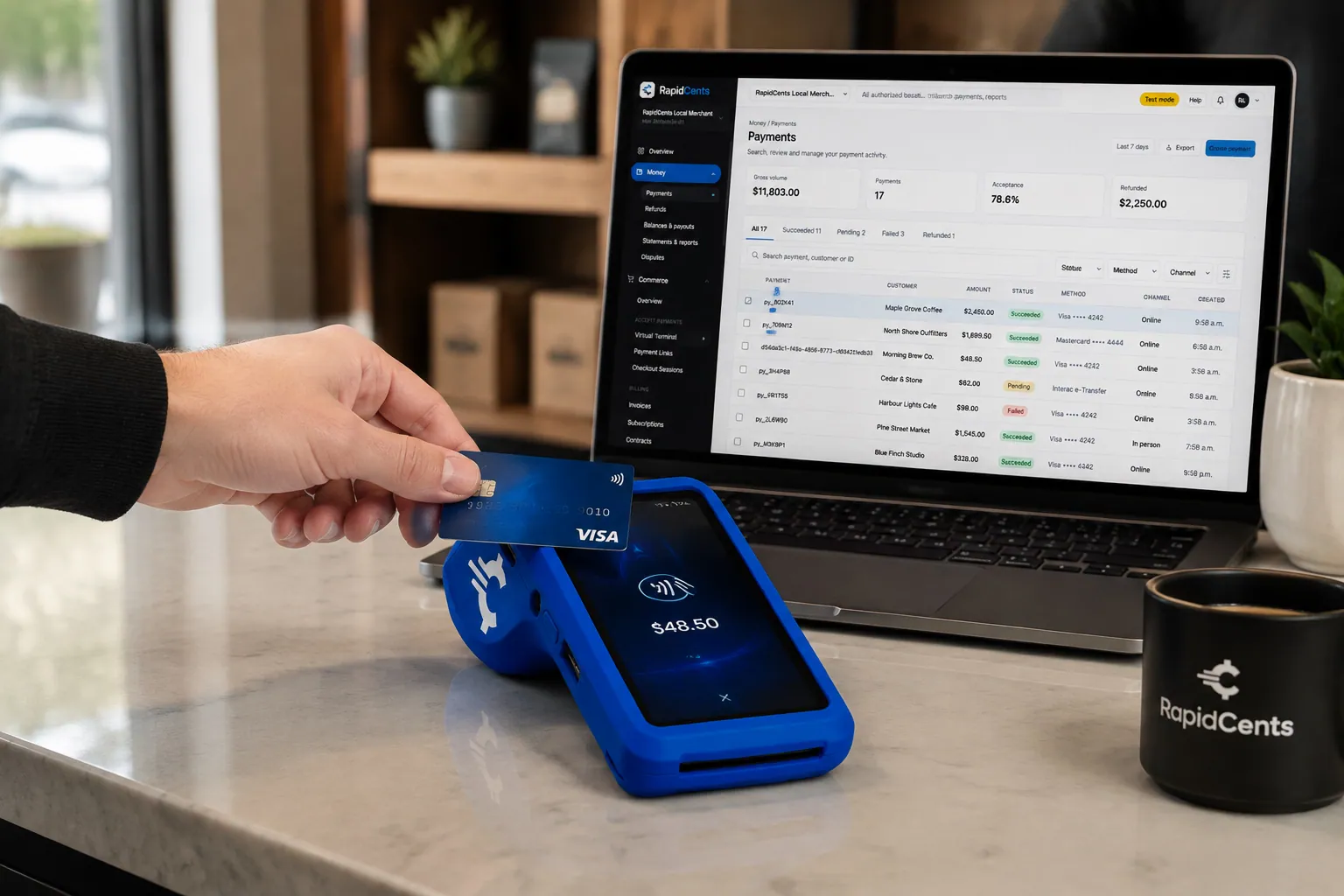
A fixed RapidCents countertop terminal taking card payments at the till, with settlement visible on the dashboard. Countertop Terminals
RapidCents countertop terminals sit at retail counters, restaurant hosts and reception desks where speed and…
Explore
The RapidCents payment links screen listing created links with their amount, status, click count and whether they have been paid, beside a phone showing the branded page a customer opens to pay $2,500.00. Payment Links
RapidCents payment links let staff generate branded pay-by-link URLs for invoices, deposits, balances and…
Explore
The RapidCents recurring payments screen showing active subscriptions, monthly recurring revenue, failed payments and upcoming renewals, above a list of subscriptions with their plan, amount, frequency and next billing date. Recurring Payments
RapidCents recurring payments manage subscription plans, membership renewals and installment schedules with…
Explore
A merchant reviews RapidCents reports for volume, mix and payouts, with the terminal that took the sales on the desk. Reporting
RapidCents reporting delivers customizable transaction, settlement and fee reports with CSV and PDF export…
Explore


Should seasonal tire storage renew on a stored card or by invoice?
Offer both: renew seasonal tire storage on a stored card for customers who authorize automatic charges, and send everyone else an invoice with a Payment Link at each changeover. A stored-card renewal needs the customer's documented agreement on the fee, the charge date and how to cancel; an invoice needs no stored card. Put the storage-tag or rack number in every payment reference.
How each renewal runs
With Recurring Payments, the customer authorizes a stored card once and the storage fee is charged on the schedule you agreed, such as once a year before the fall changeover, with a notice to the customer before each charge. With Invoicing, the customer receives a branded storage invoice with a Payment Link at each changeover, and status tracking shows which storage tags are still unpaid.
Get the storage agreement right first
Before storing a card, record the customer's agreement to the storage fee, when it is charged, how to cancel, and whether the fee covers one season or a full year. Your storage terms, not the payment, set what happens to tires left unclaimed after the season ends; have those terms reviewed against local rules separately, because a card authorization does not settle them.
Expired cards, declines and customers who move on
A card stored in spring can expire before fall. Account Updater can refresh card details where the issuer takes part, and automated retries rerun a soft decline; a hard decline needs a Payment Link and a phone call before the tires come off the rack. If a customer sells the vehicle or cancels, stop the schedule before the next charge and refund any unused prepaid season under your terms.
120 sets on the racks, two ways to renew
Say a shop storing 120 sets offers two choices at the spring drop-off: automatic renewal on a stored card, charged each September after an emailed notice, or a storage invoice sent with the fall booking reminder. In late September, the dashboard's paid and open links and the invoice status show which storage tags are settled, so staff see payment before pulling sets from the racks.
What drives tire shop credit card processing costs?
Tire shop credit card processing costs are driven by your card mix and how each card is taken: a full set may go on a premium rewards card, a fleet may pay with a commercial card, a flat repair may be paid by debit, and deposits paid by link or phone price differently from cards tapped at the counter. RapidCents uses interchange-plus pricing: interchange at cost, plus your RapidCents markup in your Fee Schedule and any equipment or service fees, month to month with no fixed term.
Interchange-plus on a tire-shop statement
Interchange is set by the card networks and changes with the card type (debit, standard credit, premium rewards, commercial) and with whether the card was tapped or inserted, keyed, or paid online. RapidCents passes it through at cost and adds the markup set out in your Fee Schedule, plus fees for equipment or services where they apply, so a deposit link and a tapped installation balance can be compared line by line.
Big tickets, small repairs and fleets
A full set of tires with installation is a large ticket that customers may put on a rewards or premium credit card, which usually carries higher interchange than debit. A flat repair or a single valve stem is a small ticket that may be paid by debit. Fleet accounts paying with commercial cards fall into their own interchange categories, so note how much of your volume each group brings.
Seasonal swings and card-not-present deposits
A spring or fall rush month, heavy with full sets, booking deposits and storage renewals, can carry a very different card mix from a quiet summer month. Deposits paid by link and storage charges on stored cards are card-not-present payments, which can fall in different interchange categories from a card tapped at the counter. Your Fee Schedule lists any fee on refunded deposits and disputed storage charges.
What to bring to Fee Check
Bring two statements, one from a changeover month and one from a quiet month, with your average ticket for a full set, your split between counter, phone and link payments, and your count of refunded deposits and chargebacks. Fee Check reads each uploaded statement and separates interchange from markup, so you can test whether a written quote holds up in both seasons.
How do payments reach your tire shop software?
RapidCents integrates with many major platforms through APPIE and RapidBridge, so most tire shops keep the shop software they run today. RapidBridge works with Tekmetric, Mitchell 1 Manager SE, Shopmonkey, Shop-Ware and AutoLeap, and the right option for any other system depends on your vendor and version. Your RapidCents representative will walk you through it.
Tekmetric
Tekmetric is auto repair shop management software, and RapidBridge works with it, so a card payment or special-order deposit posts against the repair order you already have open and carries through to the final invoice. You keep running tire jobs in Tekmetric the way you do today.
Mitchell 1
If your tire and service tickets live in Mitchell 1 Manager SE, RapidBridge works with it. A storage fee or special-order deposit taken through RapidCents lands on the customer's ticket, so counter staff are not retyping payments between two screens at the end of a changeover day.
Shopmonkey, Shop-Ware and AutoLeap
Shopmonkey, Shop-Ware and AutoLeap are shop management platforms that hold work orders and invoices, and RapidBridge works with all three. If yours sends changeover reminders or its own payment requests, decide which system sends the storage invoice and the pickup link so a driver never receives two requests for one job.
Tire dealer point-of-sale systems
Some tire dealers run a tire-specific point-of-sale system that tracks sizes, stock and storage tags. RapidCents integrates with many major platforms through APPIE and RapidBridge, and APPIE lets the point-of-sale software you already run drive RapidCents terminals. Tell your RapidCents representative which system you use, and they will show you how payments connect.
QuickBooks Online and Xero
RapidCents connects settled transactions, fees and refunds to QuickBooks Online and Xero, so deposits, installation balances and storage renewals reach the books without retyping each day's payout. A tire chain on NetSuite or SAP uses settlement import files, and the split between tires, installation and disposal fees stays in your shop software.
Payment options for tire shops in Canada
Tire shops in Canada can take Interac debit and Visa, Mastercard and American Express credit cards on RapidCents countertop terminals by chip, PIN or contactless, send Payment Links for deposits and pickup balances, and accept EFT or pre-authorized debit (PAD) bank payments where enabled, with settlement in CAD. GST/HST and any provincial fee on new tires belong on the invoice your shop software produces; the card payment collects that total.
Interac debit and credit at the counter
Interac debit by chip and PIN or contactless sits alongside Visa, Mastercard and American Express on the countertop terminal. Reporting filters by card type, so you can see how much of your fall volume arrives on debit versus credit before you compare pricing.
EFT and PAD for fleets and storage
Fleet and commercial accounts can pay invoices by EFT, and storage customers who prefer their bank account to a card can pay by pre-authorized debit (PAD), which needs a signed PAD agreement before the first debit. Both depend on what is enabled on your merchant account.
Winter tire season
Where winter tires are required for part of the year, as in Quebec, the fall changeover packs deposits, installs and storage renewals into a few weeks. Check terminal count, staff refund permissions and storage renewal dates before October rather than during the rush.
How do you switch processors between changeover seasons?
Once your account is approved, switch in a quiet month between changeover seasons, after you have listed every stored card behind a storage renewal, every open special-order deposit and every scheduled charge, because none of them move to a new processor on their own. Test sales, refunds and deposit links on RapidCents before the rush, and run both accounts until the old deposits close out.
List what the old processor holds
Export transaction and settlement history, then list your storage customers with stored cards and renewal dates, open special-order deposits, scheduled charges, and any refunds or disputes still open. Stored-card tokens move only if both processors agree to a transfer; if they cannot move, collect fresh authorization at the spring drop-off or by link before the fall renewal.
Leave the old account open for old deposits
A refund normally goes back through the processor that took the original payment. Keep the old account active until its last deposit has been applied to an installed job or refunded, and mark those work orders so counter staff know which system to refund from. Close it only after its remaining refunds and disputes are settled.
Test before the first busy weekend
On the new account, run a tapped and an inserted sale on the countertop terminal, a refund, a deposit link carrying a work order number, a Tap to Pay sale on the phone used for mobile installs, and one storage charge on a staff card that you then refund. Train counter staff on refunds and two-card payments while the bays are still quiet.
Reconcile from the first day
Put the work order, invoice or storage-tag number in each payment reference so RapidCents reports line up with your shop software's daily close. For the first few weeks, match every settlement to the bank account and to that day's closed work orders. In a multi-store group, a deposit taken at one location and a balance paid at another can settle under different location MIDs, so keep the shared work order number on both.
Payment questions from tire shops
What is the best payment processor for a tire shop?
The best processor for a tire shop is one that handles special-order deposits, pickup balances by text and storage renewals at a cost you can check line by line. Compare written quotes on pricing structure, contract term, equipment costs, how deposits and refunds tie to a work order, how stored cards are authorized and what your shop software supports. Ask each provider for a tire store merchant services quote built from your own statements, including one from a changeover month.
How much does credit card processing cost for a tire shop?
With RapidCents, a tire shop pays interchange at cost plus the RapidCents markup set out in its Fee Schedule, and equipment or service fees if applicable, so the total depends on your card mix, channels and season. Interchange varies by card type and by whether the card is tapped at the counter, keyed for a phone deposit or paid through a link. Pricing is month to month with no fixed term, and Fee Check shows interchange and markup separately on an uploaded statement.
Can Tekmetric, Shopmonkey or other tire shop software use RapidCents payments?
Yes. RapidBridge works with Tekmetric, Mitchell 1 Manager SE, Shopmonkey, Shop-Ware and AutoLeap, so a card payment posts against the repair order you already have open. For other tire dealer systems, RapidCents integrates with many major platforms through APPIE and RapidBridge, and the right option depends on your vendor and version. Your RapidCents representative will walk you through it, and the countertop terminal and Payment Links work with the work order number on each payment.
How can a tire shop switch processors without losing payment history?
Export your history first, then time the switch around storage renewals and open special orders, keeping the old account open until both are cleared. List every stored card behind a storage renewal and every deposit on tires not yet installed. Card tokens move between processors only if both providers agree, so be ready to collect new authorization at the next changeover. Refunds of old deposits go through the old account, so download its reports before you close it.
Which payment options can a tire shop in Canada offer?
A tire shop in Canada can offer Interac debit and Visa, Mastercard and American Express credit cards on RapidCents countertop terminals, Payment Links by SMS or email for special-order deposits and pickup balances, invoices for fleet accounts, and Recurring Payments for authorized storage renewals. EFT and pre-authorized debit (PAD) bank payments are available where enabled, and PAD needs a signed agreement. Settlement is in CAD. Your RapidCents representative sets up the methods on your merchant account during onboarding.
Can I collect deposits on special-order tires?
Yes. Take the deposit on the countertop terminal, by phone through Virtual Terminal or with a Payment Link once the customer okays the quote, and record it against the work order. Tie it to written terms that say whether the deposit is refundable if the customer cancels after you order and whether a restocking charge applies. Apply it on the install invoice so only the balance is due at pickup, and keep the signed terms in case the deposit is disputed.
How do I bill seasonal tire storage?
Use an authorized recurring charge on a stored card, or an invoice with a Payment Link at each changeover. The recurring option needs the customer's agreement on the storage fee, when it is charged and how to cancel, and Recurring Payments can notify the customer before each charge. The invoice option needs no stored card and suits customers who would rather pay season by season. Either way, record the storage tag or rack number on the payment.
Will RapidCents connect to my tire-shop software?
In most cases, yes. RapidBridge works with Tekmetric, Mitchell 1 Manager SE, Shopmonkey, Shop-Ware and AutoLeap, and RapidCents integrates with many major platforms through APPIE and RapidBridge. The right option depends on your software vendor and version, so tell your RapidCents representative which system you use. For the books, RapidCents connects settled transactions, fees and refunds to QuickBooks Online and Xero.
Can customers pay by text when their tires are installed?
Yes. When the technician closes the work order, send a Payment Link by SMS or email for the balance, with the work order number in the reference field. The customer pays on a mobile-friendly page, the receipt goes out automatically, and the link shows as paid in the Merchant Dashboard before the keys go back. If the customer okayed extra work such as valve stems or an alignment, update the invoice first so the link matches the final total.
How do tire shops match deposits and storage fees to the right invoice?
Give every payment a reference your shop software also uses: the work order number for deposits and balances, and the storage tag for storage fees. Reporting filters by date, location, channel and card type and exports CSV or PDF, while the reference ties each payment back to its work order at the daily close. The split between tires, installation, disposal fees and tax stays in your shop software, and your accountant decides how deposits on unfinished jobs are booked.
What MCC is used for tire shops?
MCC 5532, Automotive Tire Stores, is commonly associated with tire shops. Your RapidCents representative sets the correct merchant category during onboarding based on what your business actually sells, so a shop that earns most of its revenue from repair work rather than tires may fit MCC 7538, automotive service shops, instead. Describe your real mix of tire sales, installation, storage and repairs when you apply.
Related automotive industries
Auto repair shops share the deposit-and-pickup pattern for repair orders, auto glass shops separate an insurer's payment from what the driver owes, and truck repair shops bill fleet offices on account. The Automotive page covers payments across the wider sector.
Automotive
Take the parts deposit, the phone-approved repair, the insurance deductible and the…
Auto Repair Shops
Take the diagnostic fee and parts deposit at the service counter, text a payment link…
Auto Glass Businesses
Take cards at the vehicle or by payment link, collect the customer's portion apart from…
Commercial Truck Repair
RapidCents helps truck repair shops collect repair orders, parts deposits, fleet-office…
Taxi & Transportation
Take card fares and tips in the vehicle, reconcile each driver's takings by shift and…
Parking
Take cards at booths and event gates, let drivers pay by plate or QR code, and bill…
Towing & Roadside
Take release fees at the yard gate, card payments at the roadside and invoices for…
Car Wash
Single washes at the pay station, unlimited plans on monthly autopay and the renewals…
Take the next step
See what your changeover season costs to process
Upload a recent processing statement, ideally from a spring or fall rush month, and Fee Check separates interchange from markup so you can compare quotes on your busiest weeks, not an average month.
- No obligation
- Canadian payment specialists
- Secure statement upload



