


Towing payment processing for roadside and impound fees
Towing payment processing has to work at the roadside, at the impound gate and after hours, and RapidCents covers all three with Tap to Pay, mobile terminals, payment links and a virtual terminal. You collect release fees where the vehicle changes hands, and every payment carries the dispatch job number into your books.

- PCI DSS Level 1
- SOC 2 Type II
- All major cards: Visa, Mastercard, Amex, Discover, UnionPay, Diners Club & Interac Debit
- Interchange-plus available
- Canadian support
How towing and roadside businesses get paid
Towing and roadside businesses get paid in five ways: a card tapped after a roadside service call, a card at the drop-off after a tow, a release fee at the yard gate, an invoice to an insurer or fleet, and a link or phone payment from someone who is not on site. Each leaves a different record for your books.
Roadside assistance card payments
Jump starts, lockouts, fuel delivery and tire changes are small tickets paid by the stranded driver. The driver taps a card on the operator's phone with Tap to Pay. If a card will not tap, the operator uses a mobile terminal that reads the chip. Finance gets a receipt and the job number in the payment reference.
Tow tickets at the drop-off
The driver pays when the vehicle is unhooked at the shop or home, or the insurer is invoiced if it covers the tow. Tap to Pay or a mobile terminal takes the card before the hook comes off. If winching or distance falls outside the insurer's cover, the driver pays that part on the spot. Finance gets a card payment or an open invoice.
Release fees at the impound yard
The vehicle owner pays the tow, storage days and gate fees to get the vehicle back, and impound lot card payments are taken at a gate terminal or on the operator's phone. If the owner is away, they pay by link instead. Finance gets the receipt, matched to the yard's job number.
Insurer, motor club and fleet invoices
The insurer, motor club or fleet account pays after the job against an invoice marked with the job number and the claim or purchase order reference. RapidCents Invoicing sends it with a payment link and tracks whether it is open or paid. If the driver owes part of the bill, finance sees two balances, one per payer.
Payments from someone who is not on site
A relative paying for a release, or a driver paying dispatch by phone, uses a payment link by SMS, email or QR, or a card keyed in the Virtual Terminal with AVS and CVV. If the cardholder is not the vehicle owner, record both names. Finance gets the payment with the job reference.
How do towing release fee payments work at the roadside and the impound gate?
Towing release fee payments work by taking the full itemized total by card where the vehicle changes hands: Tap to Pay or a mobile terminal at the roadside, a terminal at the impound gate, and a payment link for an owner who is away. You decide when the vehicle may leave, and the payment reference carries the job number into your books.
Who pays and what releases the vehicle
The vehicle owner pays, or someone the owner authorizes. Before any card comes out, staff work through your release checklist: identification, proof of ownership and any police hold or lien paperwork. The owner then pays on Tap to Pay, a mobile terminal or the gate terminal, gets an emailed receipt, and the job number goes in the payment reference.
What to agree before the card comes out
Show the itemized total first: tow, distance, winching, storage days and any gate or after-hours fee. If a card stays on file to cover more storage days, the owner authorizes it first, with the amount, timing and cancellation agreed. Release paperwork and fee schedules stay in your dispatch software; the card payment does not replace them.
Declines, adjustments and disputes
A declined card means asking for another card or sending a payment link. If one release is split across cards, write each payment on the job. When the total changes after payment, refund the difference or take a second payment with the payer's agreement. RapidCents Disputes tools cover alerts, evidence and deadlines; no outcome is promised.
A two-night yard release, $355 at the gate
Say a car towed from a private lot sits two nights in your yard. The owner shows identification and proof of ownership, and the itemized total is $355: $185 tow, $110 for two storage days and $60 gate fee. The owner taps a card on the gate terminal, and the settlement report lists the payment so the office can match it to the job.
How do you collect when an insurer or the driver is the payer?
You collect from whoever the job paperwork names as the payer. The stranded driver pays by card for anything an insurer does not cover, and the insurer, motor club or fleet pays an invoice that carries the job number and claim reference. For a split bill, take the driver's share at the scene and invoice the rest, so each balance has one payer.
Settle the payer at dispatch
Record who authorized the call, the claim or purchase order reference, and which charges that party covers: tow, distance, winching, storage. Anything outside that list is the driver's. This note decides whether the operator takes a card at the scene or the office invoices later, so write it before the truck rolls.
Invoice the insurer, card the driver
Send towing invoice payment links by email with the job number and claim reference on the invoice, so the insurer's or fleet's accounts team can pay online and you can see whether it is open or paid. Each payer chooses how it pays, by card or by bank payment. The claim and its approval stay with the insurer and your dispatch software, not the card record.
The surprise balance and how to avoid it
The classic failure is a surprise balance: the insurer covers less than the driver expected and the driver disputes the rest. Quote the driver's share before the hook-up, take only that amount by card, and keep the covered charges on a separate invoice. If a gap appears later, send the driver a new payment link rather than charging a saved card without agreement.
A long tow with a split bill, $165 at the scene
Say an insurer's approval covers a tow up to a set distance. The job note shows the driver owes $120 for extra distance and $45 for winching. The operator takes $165 on a mobile terminal before unhooking, and the office invoices the insurer for the covered tow with the claim reference. Finance sees one card payment and one open invoice under one job number.
RapidCents products for towing and roadside businesses
Tap to Pay and Mobile Terminals take the card at the truck, Payment Links reach a payer who is somewhere else, and the Virtual Terminal lets dispatch key a card over the phone. Together they cover the roadside, the impound gate and the office desk.

A café worker holds a phone running RapidCents Tap to Pay, showing an $18.75 sale and the contactless symbol, while a customer holds a Visa card to the screen. No separate card reader is present. Tap to Pay
RapidCents Tap to Pay turns supported iPhones and Android devices into contactless payment terminals without…
Explore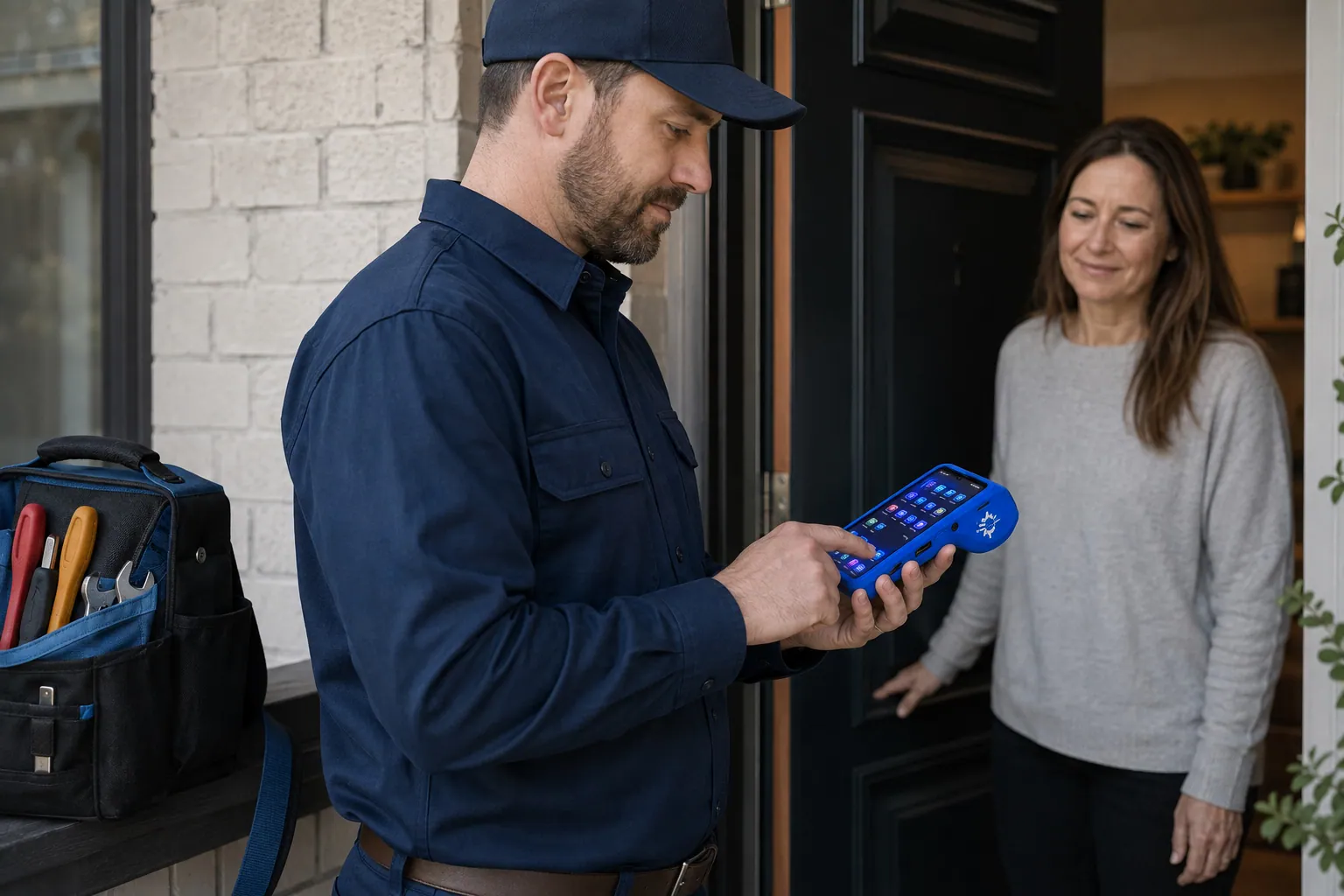
A staff member takes a card payment on a RapidCents handheld terminal, with the same sale appearing on the dashboard. Mobile Terminals
RapidCents mobile terminals are battery-powered wireless devices with LTE and Wi-Fi so staff accept payments…
Explore
The RapidCents payment links screen listing created links with their amount, status, click count and whether they have been paid, beside a phone showing the branded page a customer opens to pay $2,500.00. Payment Links
RapidCents payment links let staff generate branded pay-by-link URLs for invoices, deposits, balances and…
Explore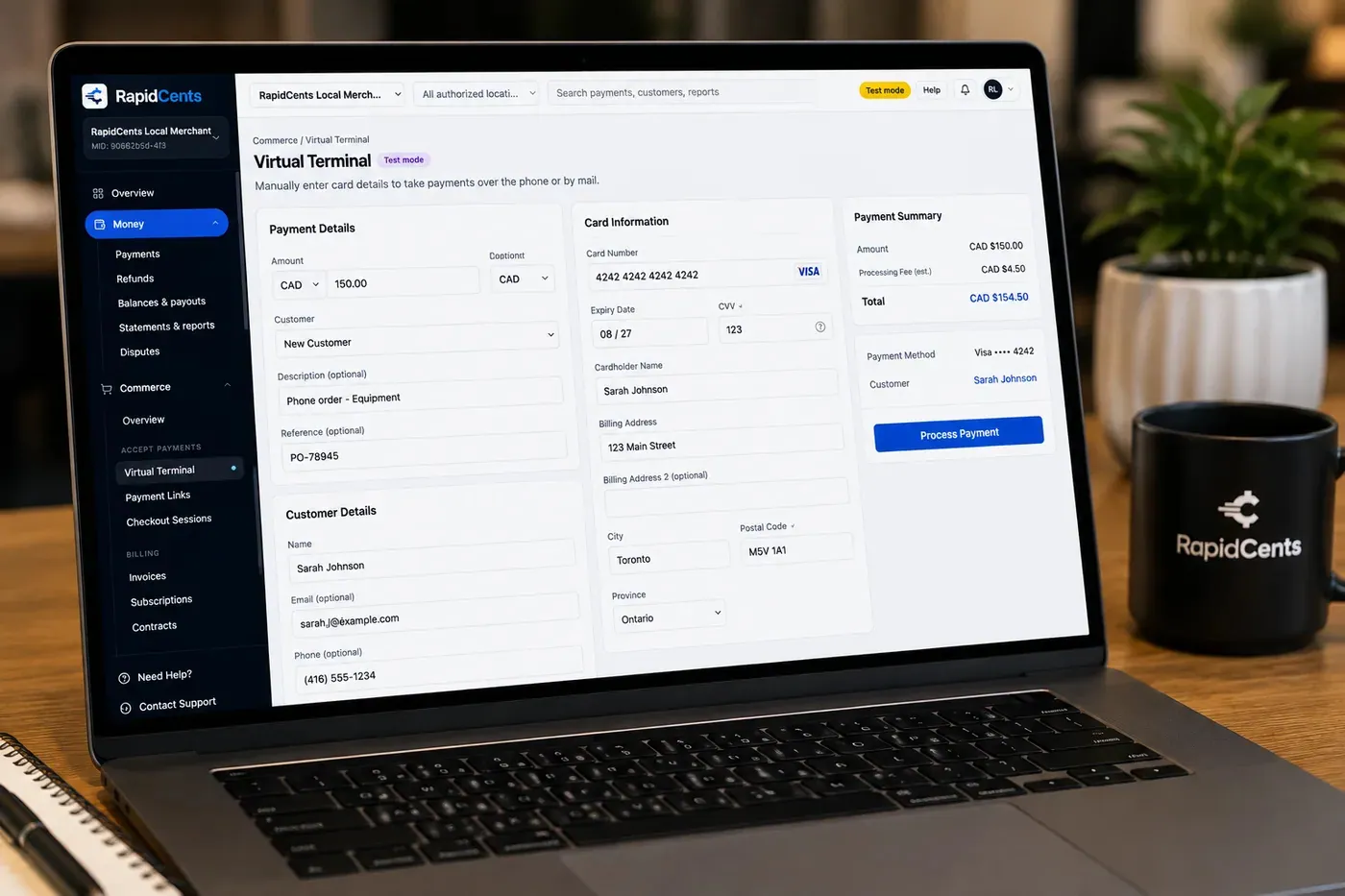
The RapidCents virtual terminal: payment details, card number, expiry and CVV keyed by hand on the left, with a payment summary on the right showing the amount, the estimated processing fee and a Process Payment button. Virtual Terminal
The RapidCents virtual terminal lets authorized staff enter mail-order and telephone-order payments through a…
Explore


How do you take payments after hours with a towing mobile payment terminal?
You take payments after hours by finishing the card payment at the scene or the yard gate, because nobody is in the office to take it later. Tap to Pay on a supported phone or an LTE mobile terminal takes the card, and a payment link or the Virtual Terminal covers a payer who is somewhere else. The job number goes on every payment so the morning team can match it.
Pick the device for the card in front of you
A tow truck credit card reader can be a supported phone running Tap to Pay, which takes contactless cards without extra hardware, or a mobile terminal with LTE and Wi-Fi that also reads chip cards. Use phones where every truck needs a way to take payment; add terminals for cards that will not tap and for the yard gate.
Plan for dead spots and cards that will not tap
LTE depends on coverage at the scene, so map your dead spots first. If a payment will not go through, move to coverage or yard Wi-Fi, or send a payment link once you and the payer both have a signal. For a card that will not tap, use a terminal that reads chip cards, or have dispatch key it in the Virtual Terminal with AVS and CVV.
Control who can take and refund payments at night
Night shifts put one operator in charge of a card terminal with nobody watching. Decide who may refund before the first night call, and your RapidCents representative will set that permission on each phone and terminal you plan to use. Anything keyed at the dispatch desk in the Virtual Terminal sits behind role permissions and an audit log.
A winch-out at 2 a.m., $265 on the operator's phone
Say a car is winched out of a ditch at 2 a.m. and towed to your yard, where the office is closed. The operator confirms a $265 total with the driver, who taps a contactless card on the operator's phone. The receipt goes to the driver's email, and in the morning the office matches the payment to the job and closes it.
How do you compare towing processing fees and total operating cost?
You compare towing processing fees by separating the three parts: interchange, which the card networks set and RapidCents passes through at cost; your RapidCents markup as set out in your Fee Schedule; and any fees for equipment or services. Pricing is interchange-plus and month to month with no fixed term. Then price your own cards, channels and ticket sizes, and add the staff time spent keying and matching payments.
Your card mix at the truck and the gate
Interchange moves with the card: debit and credit differ, premium cards fall in another category from basic ones, and commercial cards from fleets are their own category. Your mix probably includes personal cards at the roadside and some fleet or corporate cards, so ask for a quote built on your own split.
How the card is taken matters
Interchange also depends on how the card is taken. A card tapped or inserted at the truck or the gate can fall in a different interchange category from a card keyed at the dispatch desk or paid through a payment link, and your RapidCents representative shows you how each channel is priced.
What to bring, and what else costs money
Bring your recent processing statements, average tow and release tickets, the split between tapped, keyed and link payments, refund frequency and dispute volume. Upload a statement to Fee Check to see interchange separated from markup, then ask each provider to quote in writing, including terminals per truck and any equipment or service fees.
How does RapidCents work with Towbook and other towing software?
RapidCents integrates with many major platforms through APPIE and RapidBridge, so most towing operations keep the dispatch software they run today. The right option depends on your software vendor and version, and your RapidCents representative will walk you through it. Tell them whether you run Towbook, Omadi, TowSoft, Tracker Management Systems or Traxero, and which jobs you want to connect.
Towbook
If Towbook holds your dispatch jobs, payer notes and invoices, tell your RapidCents representative your edition and country. They will show you how the payment reference and amount line up with the job, so the office matches each card payment without retyping.
Omadi
If Omadi is where your crew records the job in the field, your representative will explain how a payment reference and amount travel between Omadi and a RapidCents payment, whether that is a connector, a payment link or a file you import.
TowSoft
If TowSoft is where storage days and release totals are calculated, the key question is how the release total reaches the terminal. Your representative will show you the option that fits your version, and you can always type the total and match by job number.
Tracker Management Systems
If Tracker Management Systems holds your yard inventory and release charges, your representative will walk you through what comes back after payment: a receipt, a payment reference or a ledger entry, so the yard record closes with the sale.
Traxero
If Traxero produces your insurer and fleet invoices, your representative will show you how a RapidCents payment link sits on those invoices and how a paid link closes the invoice. You can also export the settlement report and match by invoice number.
Payment options for towing and roadside businesses in Canada
Towing and roadside businesses in Canada can accept Visa, Mastercard and American Express cards, Interac debit at the terminal and, where enabled, EFT or pre-authorized debit for invoices, with settlement in Canadian dollars. Your RapidCents representative sets up the methods that suit your roadside, gate and fleet billing.
Interac debit at the truck and the gate
An owner paying a release fee may hold only an Interac debit card. Your RapidCents representative tells you which devices on your account take Interac debit, including the gate terminal, any mobile terminal and Tap to Pay on a phone, so you can assign devices to trucks with that in mind.
EFT and pre-authorized debit for invoices
Where enabled on your account, EFT or pre-authorized debit can collect an insurer, motor club or fleet invoice from a bank account instead of a card. A pre-authorized debit needs the account holder's authorization in advance, so a one-off roadside payment is normally taken by card.
Provincial rules and receipts
Rules for towing and storage fees differ by province and sometimes by municipality, so check yours with the regulator or an advisor. Where GST/HST applies to your invoices, set it in your dispatch or accounting software; the card payment record shows what was paid, not tax treatment.
How do you switch providers and keep towing payment reconciliation clean?
Switching towing payment providers safely means listing what depends on the old processor, testing a sale, a refund and a deposit on the new setup, and running both side by side until the books agree. Keep the job number in every payment reference, and do not assume saved cards move with you: both providers must agree to any transfer.
List what depends on the old processor
Write down open insurer and fleet invoices, cards kept on file for storage days, every terminal and phone, and the payment settings in your dispatch software. If you run more than one yard, note which yard uses which device; Multi-Location can give each yard its own merchant ID and roll-up reporting.
Test a sale, a refund and a deposit first
Once your account is approved, run a test sale on the gate terminal, one on a phone with Tap to Pay, one payment link and one refund. Check the receipt, the job number in the reference and the line on the settlement report. Move trucks one at a time, and keep the old terminals until the first deposits match your jobs.
Reconcile deposits to jobs and the ledger
Match each deposit to the day's job numbers, split by payer: driver cards, insurer invoices and fleet accounts. RapidCents connects settled transactions, fees and refunds to QuickBooks Online and Xero, and the settlement report exports to CSV or PDF for any other ledger.
Agree one rule for the crew
Give every operator and dispatcher the same rule: the job number goes in the payment reference, an itemized total is shown before any card is tapped, and refunds go through one named person. Run a practice night release with the on-call dispatcher before you retire the old setup.
Payment questions from towing and roadside businesses
How should we collect release fees at the roadside or impound gate, and what should a provider support?
Pick a provider that can collect the whole itemized release total by card when the vehicle is handed back and tie it to the job. That means Tap to Pay or a terminal at the roadside and the gate, a payment link for an owner who is away, a receipt, a payment reference that holds the job number, and clear refund rules.
How should we handle an insurer or a driver as the payer on the same tow?
Name the payer at dispatch, then collect from each party on its own terms. The driver covers whatever the insurer's approval leaves out, paid by card before the vehicle is unhooked. The insurer, motor club or fleet receives an invoice with a payment link, the job number and the claim reference. Both payments sit under one job number, so the books show who paid what. RapidCents processes the payments; it does not submit or decide insurance claims.
How do we take payment after hours when the office is closed?
Give each truck its own way to take payment: Tap to Pay on a supported phone for contactless cards, or an LTE mobile terminal that also reads chip cards. Add the Virtual Terminal for cards read over the phone and a payment link for anyone who is elsewhere. Test your dead spots first, and decide who may refund before the first night shift.
How should we keep itemized receipt evidence for a tow?
Keep one itemized record per job that matches the card payment: job number, date and time, pickup and drop-off, each charge such as tow, distance, winching, storage days and gate or after-hours fees, who paid and the amount. The card receipt shows the payment and your dispatch software holds the itemization, so keep both. That evidence answers a disputed charge better than memory.
Which payment options can a towing business in Canada offer?
A towing business in Canada can offer Visa, Mastercard and American Express cards, Interac debit at the terminal, and, where enabled, EFT or pre-authorized debit for invoices, settled in Canadian dollars. Cards cover the roadside, the gate and payment links; bank payments suit insurer and fleet invoices. Your RapidCents representative lists the methods active on your merchant account.
How do we match each dispatch job to its card payment?
Put the dispatch job number in the payment reference every time, then match each line on the settlement report to a job. Depending on your software and version, the amount and reference can travel with the payment, and your RapidCents representative explains the options. Without a connection, type the total at the terminal and reconcile from the report, which separates payments, fees and refunds. Match insurer invoices by invoice number.
Which payment processor fits a towing company, and what should we compare?
The right processor covers your roadside, gate and dispatch-desk payments at a price you can read, so compare those in writing. Check the device for each truck and the gate, interchange-plus pricing with the markup shown apart from interchange, reporting by job, support for night calls, and what your dispatch software needs. No provider fits every yard, so upload a statement to Fee Check and decide on your own numbers.
What fees should a towing company expect for in-person and online card payments?
Expect interchange, which the card networks set and which varies with the card type and how the card is taken, plus your RapidCents markup as set out in your Fee Schedule and any fees for equipment or services. A tap at the truck, a keyed call and a payment link can fall in different interchange categories. Pricing is interchange-plus and month to month.
Can we use RapidCents with Towbook or Omadi?
RapidCents integrates with many major platforms through APPIE and RapidBridge, so most towing companies keep the dispatch software they run today. The exact option depends on your vendor, edition and version. Tell your RapidCents representative that you use Towbook or Omadi, and they will show you how payments, job references and invoices connect to it.
How can a towing company reduce payment disputes and protect stored card details?
Reduce disputes by showing the itemized total before the card comes out, sending a receipt, putting the job number in the payment reference, and keeping notes that show who authorized the tow. Keep stored cards in the Secure Card Vault, not in job notes, and limit who can key or refund payments with Virtual Terminal role permissions and its audit log. A card on file needs the owner's authorization for amount, timing and cancellation.
How can a towing company switch payment providers without losing billing records?
Switch without losing billing records by inventorying what depends on the old processor, proving one sale, one refund and one deposit on the new setup, and keeping both running until the books agree. The inventory covers open insurer and fleet invoices, cards kept on file, terminals and phones, and your dispatch software settings. Export your payment history first. Saved cards move only if both providers agree to a vendor-controlled migration; if not, ask owners for fresh authorization.
What MCC is used for towing and roadside businesses?
MCC 7549 is commonly associated with towing services. RapidCents sets the right merchant category during onboarding based on what your business actually sells. If you also repair vehicles or sell parts, say so on the application so the category matches what you really sell.
Industries with similar payment workflows
Parking operators share the gate moment when a vehicle is released against payment, automotive shops share the work order a receipt must match, and taxi and transportation businesses share mobile checkout away from a counter.
Taxi & Transportation
Take card fares and tips in the vehicle, reconcile each driver's takings by shift and…
Parking
Take cards at booths and event gates, let drivers pay by plate or QR code, and bill…
Automotive
Take the parts deposit, the phone-approved repair, the insurance deductible and the…
Car Wash
Single washes at the pay station, unlimited plans on monthly autopay and the renewals…
Car Dealerships
Take holding deposits by payment link, ring service and parts tickets on terminals, and…
Limousine & Charter
Take a booking deposit, adjust for wait time and gratuity, and capture the final fare…
Courier & Delivery
Bill business accounts on terms, take card payments from walk-in senders and collect from…
Driving Schools
RapidCents helps driving schools sell lesson packages online, collect installments and…
Take the next step
See what your tow tickets cost to accept
Upload a recent processing statement to Fee Check and see interchange separated from markup, then compare it with a written quote built on your roadside, gate and invoice payments. Pricing is month to month with no fixed term.
- No obligation
- Canadian payment specialists
- Secure statement upload



