


Payment processing for flooring distributors and tile wholesalers
Payment processing for flooring distributors means collecting from the contractors, dealers and builders you supply: lot reservation deposits, special-order deposits, delivery balances and breakage credits. RapidCents gives you countertop terminals, a virtual terminal, payment links and invoicing for in-person, phone and online payments, with settled records your accountant can reconcile.

- PCI DSS Level 1
- SOC 2 Type II
- All major cards: Visa, Mastercard, Amex, Discover, UnionPay, Diners Club & Interac Debit
- Interchange-plus available
- Canadian support
How flooring and tile distributors get paid
Flooring and tile distributors get paid through four payment jobs: lot reservation deposits, special-order deposits, delivery balances across split shipments, and breakage credits. Each one starts from a confirmed order and ends in a record your finance team can reconcile. We built this for distributors who collect from the trade, not installers who collect from homeowners.
Lot reservation deposits
A contractor or dealer reserves a dye lot or a pallet count before a project starts. You collect the deposit by payment link or phone, and the order records product, lot, quantity and balance terms. Finance receives one receipt matched to the reservation.
Special-order deposits
A buyer orders a tile or plank you do not stock. You send a signed quote, take a deposit by payment link before placing the order with the mill, and keep one order reference for the deposit and the later balance.
Delivery balances and split shipments
Material leaves your warehouse in several trucks or will-call pickups. Each shipment gets its own invoice under a shared order ID, and the buyer pays each balance by invoice link, card on the phone or at the counter terminal. Finance sees which delivery each payment cleared.
Breakage credits and returns
A pallet arrives with broken cartons and the buyer files a claim. Once you sign off on the credit, you refund the original card payment or apply an account adjustment, and the record names the invoice, the claim and the agreed amount.
How do flooring distributors take lot reservation deposits?
A flooring distributor takes a lot reservation deposit by writing the product, dye lot, reserved quantity and balance terms on the order, then sending a payment link or taking the card by phone. The deposit holds the stock under the terms you set, and the receipt is tied to that order.
How a reservation runs
The buyer asks for twelve pallets of a single dye lot. Your counter staff add the SKU, lot number, boxes and square footage to the order and send a payment link. The receipt carries your order reference. If the card declines, the stock is not held yet.
Set the terms first
Write the reservation terms before you ask for money: how long the lot is held, whether the deposit applies to the balance, and what happens if the buyer cancels. Show the terms on the order or signed quote. If you store the card for the balance, the buyer must authorize that.
A dye lot that comes up two cartons short
Say a dealer reserves a dye lot for a job, then finds the lot is two cartons short. You adjust the order, then refund the difference to the original card or hold it as account credit under your written terms. The order history shows each step.
How do special orders and split deliveries share one payment reference?
Special orders and split deliveries share one payment reference when every deposit, invoice and shipment carries a common order ID plus its own invoice or shipment number. You take a deposit at order, bill each delivery separately and still see the whole order on one trail.
How a split order runs
A contractor orders a porcelain tile that comes from the mill in two lots. You take the deposit at order, then invoice each delivery as it ships. Each invoice carries the common order ID and its shipment number, and the buyer pays by payment link or by card over the phone through the virtual terminal.
Set the references first
Decide how the common order ID and the invoice numbers appear in the reference field before the first order. Run one deposit and two partial invoices end to end, and see how your accounting software allocates each payment. Record who may pay when a head office funds several job sites.
A $9,000 special order on two trucks
Say a $9,000 special order ships in two trucks. The deposit counts toward the order, truck one is invoiced for its share, and truck two is invoiced after it arrives. A short delivery on truck two lowers that invoice only, so the first payment stays untouched.
RapidCents products for flooring and tile distributors
Invoicing and Payment Links carry deposits and delivery balances, Contracts & eSignatures captures signed quotes before a special-order deposit, and Countertop Terminals take will-call payments at your counter. Your RapidCents representative helps you choose the mix that fits how you sell.

The RapidCents invoices screen: outstanding, overdue, paid and draft totals across the top, the invoice list below them, and a preview of one invoice on the right with its line items and a View & Record Payment button. Invoicing
RapidCents invoicing helps professional services, contractors and B2B suppliers create branded invoices…
Explore
The RapidCents payment links screen listing created links with their amount, status, click count and whether they have been paid, beside a phone showing the branded page a customer opens to pay $2,500.00. Payment Links
RapidCents payment links let staff generate branded pay-by-link URLs for invoices, deposits, balances and…
Explore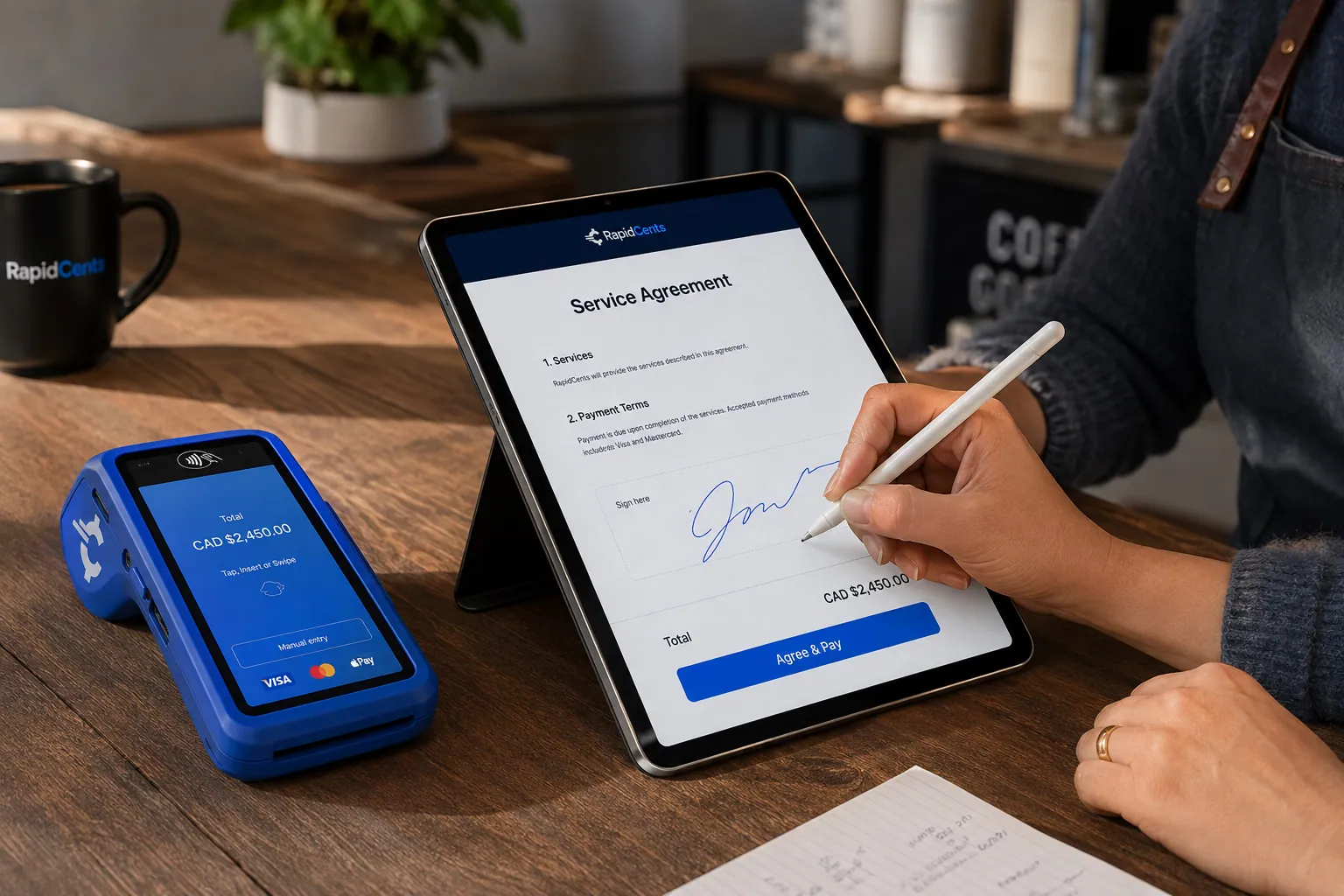
A merchant sends a RapidCents contract for e-signature with payment attached, terminal ready for an in-person counterpart. Contracts & eSignatures
Quotes, service agreements and enrolment forms usually end in a payment. Send the document, capture the…
Explore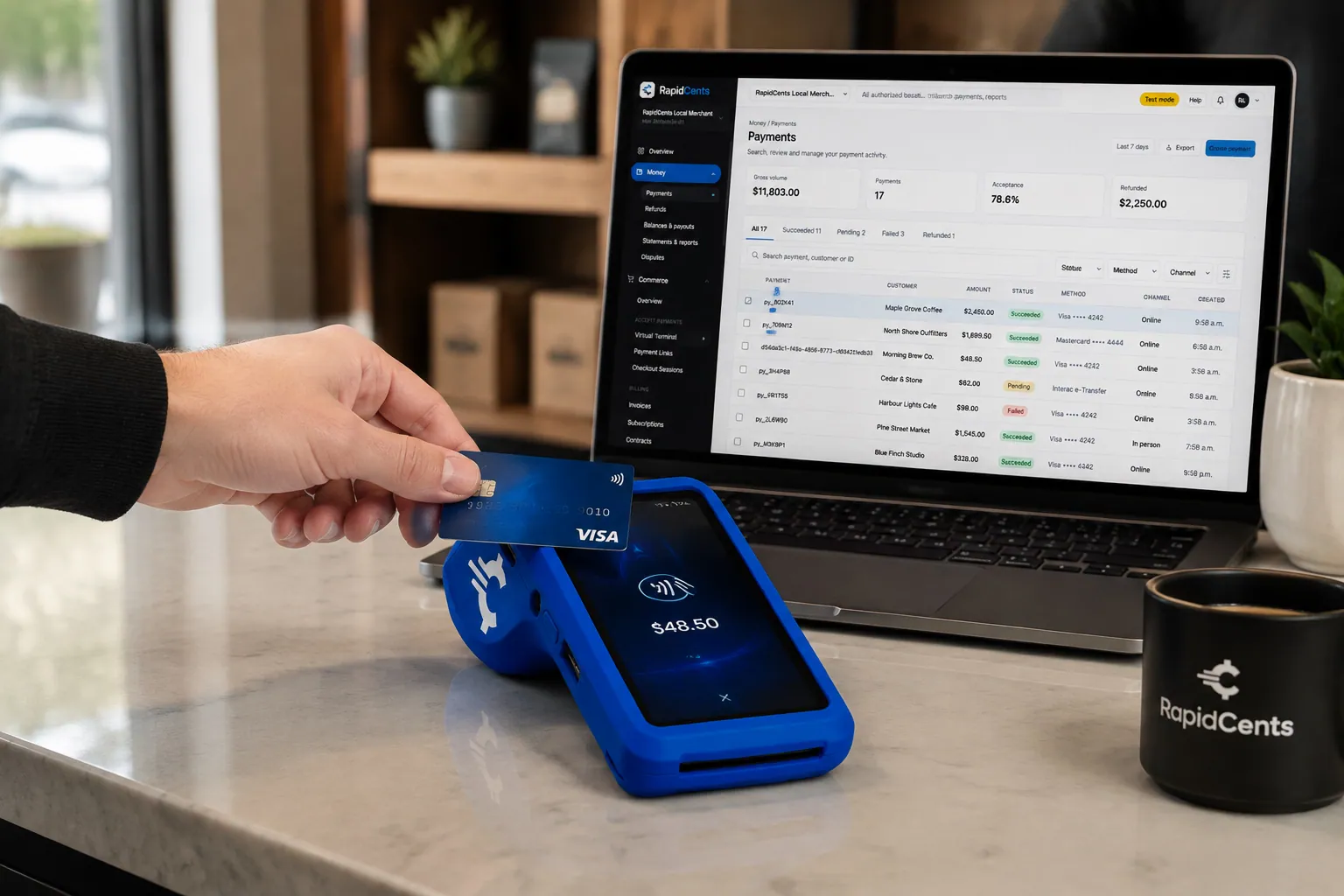
A fixed RapidCents countertop terminal taking card payments at the till, with settlement visible on the dashboard. Countertop Terminals
RapidCents countertop terminals sit at retail counters, restaurant hosts and reception desks where speed and…
Explore


How do breakage credits affect a paid invoice?
A breakage credit does not erase a paid invoice. You document the agreed credit against the original invoice, then either refund the original card payment or apply an account adjustment, so the payment record and the credit note agree.
How a claim runs
The buyer reports broken cartons and sends photos and the carton count within your claim window. Your team reviews the claim, agrees a credit amount in writing, and records it against the original invoice. A credit note and a refund are different records, so decide which one applies before you act.
Refund or account adjustment
If the invoice was paid by card, you can refund up to the amount paid to the original card, or apply the credit to the buyer's next invoice. Your written terms decide which. Tell the buyer which route you chose, because a card refund appears on the cardholder's own timeline.
Six broken cartons on a $6,400 tile invoice
Say a buyer paid a $6,400 invoice for tile, then reports six broken cartons. You agree a credit for those cartons only, refund that amount to the original card, note the claim number on the refund, and leave the rest of the payment as it was.
What drives credit card processing costs for flooring distributors?
Cost for a flooring distributor follows your card mix, ticket size and how the card is taken. RapidCents prices every account on interchange-plus: interchange passes through at cost, plus your RapidCents markup in your Fee Schedule and fees for equipment or services, if applicable. Month to month, no fixed term.
Card mix and ticket size
Contractor and dealer accounts often pay large invoices with business, commercial or purchasing cards, while walk-in counter sales use consumer debit and credit. Interchange varies by card type, so a large commercial-card order prices differently from a small counter sale. Enhanced data may apply where it is supported for your setup.
How the card is taken
A tapped or inserted card at the counter terminal carries different interchange from a keyed phone order or an online payment. Many flooring orders are keyed from a quote, so know your channel split before you compare quotes. Tell your RapidCents representative which channel carries your largest invoices.
What to bring to compare
Bring recent processing statements, your card mix, average and largest ticket, channel split, and refund and chargeback volume. Fee Check reads a statement and shows interchange separated from markup. Tile wholesaler card processing compares fairly when every quote reads the same statement.
Which accounting and ERP software works with flooring distributor payments?
RapidCents connects settled transactions, fees and refunds to QuickBooks Online and Xero, and SAP and NetSuite import settlement files. RapidBridge works with Acumatica and Dynamics 365 Business Central. For any other package, RapidCents integrates with many major platforms through APPIE and RapidBridge, and your representative walks you through the options.
NetSuite
NetSuite holds customer accounts, orders and invoices for many distributors. Settlement import templates carry payments and fees to the ledger by import rather than a live connector. Decide which fields your invoice reference needs and who maps each deposit, and your RapidCents representative will set up the template with you.
SAP Business One
SAP Business One tracks stock, lots and receivables. Settlement import templates are how RapidCents payments reach SAP. Agree how lot numbers and order IDs map to the import and who posts it, and your RapidCents representative will walk you through the file.
Dynamics 365 Business Central
Dynamics 365 Business Central handles sales orders and customer ledgers. RapidBridge works with it, so a card payment posts against the sales order you already have open, without changing how your team uses the software.
Acumatica
Acumatica manages distribution orders, shipments and invoices. RapidBridge works with Acumatica, so payments land on the open invoice. Test that a shipment-level invoice number carries into the payment record, and your RapidCents representative will help you check it.
Epicor Prophet 21
Epicor Prophet 21 is distribution software with order, lot and invoice detail. RapidCents integrates with many major platforms through APPIE and RapidBridge. The right option depends on your version, and your RapidCents representative will walk you through it. Payment links work alongside the software from day one.
Payment options for flooring distributors in Canada
Flooring and tile distributors in Canada can offer Interac debit and credit cards at the counter, credit cards by phone or payment link, and bank payments by EFT or pre-authorized debit (PAD). Settlement is in CAD.
At the counter
Will-call buyers can tap, insert or use chip and PIN, including Interac debit, on a countertop terminal. Put the order number in the receipt reference so each payment matches its pickup.
Bank payments and tax
For larger contractor accounts, EFT or PAD can collect invoice balances from a bank account once the buyer authorizes it in writing. GST/HST appears on invoices where it applies, and provincial rules can affect how you document deposits. Your RapidCents representative will walk you through the setup.
How do flooring distributors switch processors without losing payment history?
Switch in steps: list what is open, test the new flow, run both processors for a short period, then reconcile deposits to your ledger. Once your account is approved, your RapidCents representative guides each step. Stored cards move only if both providers agree, so plan to ask buyers to authorize again where they do not.
List what is open
Inventory open reservations, special orders with deposits, invoices awaiting delivery balances, stored cards with authorizations, recurring schedules and pending breakage credits. Export statements and reports first so the history stays with you.
Test before you move
Run a sale, a deposit against a reservation, a partial invoice payment and a refund on the new setup. Check that the order ID and the shipment number appear in the record, and that your accounting software receives them.
Run in parallel and reconcile
Keep the old processor for open items while new orders go to RapidCents, then reconcile each deposit to the ledger. Ask each buyer who pays by stored card to authorize again if the cards cannot move. Close the old account only after the last refund window ends.
Payment questions from flooring and tile distributors
What is the best payment processor for flooring distributors?
Judge a processor on how you actually get paid, not on a headline number. RapidCents handles lot and special-order deposits, split-shipment invoices, breakage refunds, stored cards with the buyer's authorization and the hand-off to your accounting software. Run a recent statement through Fee Check to see interchange separated from markup, and your RapidCents representative will price that same statement in writing. Flooring supplier merchant services should be compared on these workflows.
How much does credit card processing cost for flooring distributors?
Your cost follows your card mix, ticket size and how the card is taken. RapidCents prices every account on interchange-plus: interchange at cost, your RapidCents markup in your Fee Schedule, and fees for equipment or services, if applicable. Month to month, no fixed term. Run a statement through Fee Check to see where interchange ends and markup begins.
Can NetSuite use a different payment processor?
Yes. SAP and NetSuite use settlement import templates with RapidCents, so settled transactions, fees and refunds reach the ledger by import rather than a live connector. Your RapidCents representative will walk you through the template for your NetSuite edition and country, and you can test one deposit and one refund before you move everything.
How can flooring distributors switch processors without losing payment history?
Keep your history by exporting statements and reports before you move, and by moving open items in stages. List open reservations, deposits, stored cards and recurring schedules, test a sale, a deposit and a refund, then run both processors for a short period. Stored cards move only if both providers agree, so you may need new authorization from buyers. Reconcile deposits to your ledger as you go.
Which payment options can a flooring distributor in Canada offer?
A flooring distributor in Canada can offer Interac debit and credit cards at the counter, credit cards by phone or payment link, and EFT or pre-authorized debit (PAD) for bank payments, with settlement in CAD. Your RapidCents representative will walk you through each method for your business. Keep written authorization for any stored card or bank payment.
How is a stock-reservation deposit documented?
Document it on the order: product and dye lot, reserved quantity, deposit amount, balance terms and how long you hold the stock. Send the payment link or take the card against that order reference, so the receipt matches the reservation. Include what happens to the deposit if the buyer cancels or the lot is short. Flooring invoice payments reconcile more easily when the order carries these details.
Does a breakage credit change a paid invoice?
A breakage credit does not change what was paid; it adds an agreed credit against the original invoice. Document the claim, the carton count and the agreed amount, then refund the original card payment or apply an account adjustment under your written terms. Leave the paid invoice in place instead of deleting or re-issuing it, so the payment record and the credit note stay linked.
Can we charge a buyer's stored card for the balance on a special order?
Only with the buyer's authorization. Agree in writing the amount or how it is calculated, when you charge it and how the buyer cancels, then store the card in the Secure Card Vault. A signed quote through Contracts & eSignatures can hold that agreement. Without that authorization, send a payment link so the buyer pays each balance directly.
How do we handle a head office paying for several job sites?
Record who is authorized to pay and which orders the payment covers before you collect. Send one payment link per invoice, or one invoice that lists each job site under the common order ID, so allocation is clear. Never split one charge to get around issuer limits; use documented partial payments instead. Ask the buyer about their card limits up front.
Related supplier industries
Flooring and tile distributors share deposits, split shipments and credits with sibling building-material suppliers such as lumber and timber wholesalers and roofing material distributors. If your business sells more broadly to the trade, B2B & Wholesale shows the wider supplier workflow.
B2B & Wholesale
Collect net-terms invoices by payment link with the PO number attached, take commercial…
Building Material Suppliers
Collect contractor invoices, delivery deposits and job-level balances from the businesses…
Lumber & Timber Wholesalers
Collect from the contractors and dealers you supply: grade-and-quantity invoices…
Roofing Material Distributors
Collect roof-package deposits, site-delivery balances and will-call sales from…
Concrete & Aggregate Suppliers
Collect on confirmed load tickets, dispatch deposits and site-referenced delivery charges…
Dental Suppliers
From monthly consumables reorders to chair and imaging deposits, collect what clinics…
Veterinary Suppliers
Get invoices, standing orders and equipment deposits paid by the veterinary practices…
Medical & Surgical Suppliers
RapidCents helps medical and surgical suppliers collect hospital, clinic and practice…
Take the next step
See what drives your flooring payment costs
Upload a recent processing statement to Fee Check and see interchange separated from your markup, then compare it against your lot deposits, delivery balances and breakage credits.
- No obligation
- Canadian payment specialists
- Secure statement upload



