Payment processing for packaging suppliers and distributors
Payment processing for packaging suppliers covers three collection jobs: production deposits once a buyer approves the artwork proof, balances billed shipment by shipment as a custom run is delivered, and repeat orders for stock cartons, mailers, tape and stretch film. RapidCents handles all three with payment links, stored cards and bank payments.

- PCI DSS Level 1
- SOC 2 Type II
- All major cards: Visa, Mastercard, Amex, Discover, UnionPay, Diners Club & PIN Debit
- Interchange-plus available
- Specialist onboarding support
How packaging suppliers get paid
Packaging suppliers get paid by the brands, manufacturers, food producers and online sellers they print, convert or stock packaging for. Custom runs bring a deposit after artwork approval and a balance as the run ships, while standard materials bring frequent B2B packaging payments for repeat orders. Online brands collecting from their own shoppers will find what they need on our e-commerce page.
Production deposits on custom print runs
A brand owner or procurement manager orders printed mailer boxes, folding cartons, labels or pouches. The deposit falls due once the buyer signs off the final proof and accepts the quote, paid by payment link or in a signing flow. If the artwork changes after sign-off, a new proof version follows under the same job number. Finance records the job number and approved proof version with the deposit.
Tooling, plates and setup charges
New structures and print designs often need cutting dies, printing plates or other tooling before the first run. The buyer pays these one-time charges at order confirmation or on the first invoice, as the quote sets out. If a reorder reuses existing tooling, there is no new charge. Finance keeps tooling on its own invoice lines, apart from the packaging itself.
Shipment balances and stock releases
A finished run may ship in several deliveries, or wait in your warehouse and go out in releases against the buyer's blanket PO. Each shipment triggers an invoice or charge for what left the dock, paid by link, stored card or bank payment. If a delivery arrives short or damaged, that invoice is credited for the affected quantity. Finance tracks order, release and shipment numbers until the order is paid.
Repeat orders for standard materials
Warehouses, shippers and retailers reorder stock cartons, padded mailers, tape, stretch film and void fill, often on a weekly or monthly rhythm. When an order ships, the buyer's stored card is charged or an account on terms receives an invoice link. If an item is backordered, only the shipped lines are charged. Finance matches each payment to the buyer's PO.
Phone orders, will-call pickups and delivery payments
Buyers phone in rush orders, collect pallets at your will-call door or pay your driver when cartons arrive. Staff key phoned cards into the Virtual Terminal; pickups and deliveries are paid on a terminal or with Tap to Pay on a supported phone. If a card declines at the dock, a payment link follows. Finance matches each receipt to its invoice number.
How do you collect production deposits after artwork approval?
Collect the production deposit once the buyer has approved a specific proof version and accepted the quote, and keep all three under one job number. Custom packaging invoice payments then follow that job: the deposit, any tooling charge and the balance when the run ships. Release the job to press only when both the sign-off and the deposit are in, so board and press time go to confirmed work.
How the deposit runs
Send the quote, the dieline and the final proof together. With Contracts & eSignatures, the buyer signs the approval and pays the deposit in one flow; otherwise send an invoice whose payment link carries the job number and proof version. When the deposit is approved, the buyer receives a receipt and your team releases the job to pre-press.
Set the terms before the proof goes out
The quote should set out the deposit, what triggers the balance, the over-run and under-run tolerance, who owns the tooling and what happens if the buyer withdraws after plates are made. Record who may approve artwork and who may pay: when a marketing lead signs proofs and accounts payable pays, send the approval and the deposit request separately.
Revisions, declines and print disputes
If artwork changes after approval, issue a new proof version and revised quote under the same job number, showing how the deposit applies. A large deposit declined on a card can move to a bank payment or to staged payments the quote documents; never split one charge to fit under a limit. In a print-quality chargeback, the signed proof is your evidence, and Disputes and Chargeback Protection tracks the deadline.
5,000 printed mailers for a coffee roaster, deposit first
Say a coffee roaster orders 5,000 printed mailer boxes under job 3318. The owner approves proof version 3 and pays the deposit by card in the same signing flow, and the quote lists the cutting die and plates as separate one-time lines. When the run ships, the balance invoice shows the quoted total, the deposit already paid and the amount still due.
How do you bill split shipments and stock releases?
Bill each shipment for what actually left your dock, against the original order or blanket PO, until the order total is paid. Send a shipment-specific invoice for every delivery, or keep one order open with a running partial balance, and put the order, release and shipment numbers on each payment. Run one split order through your ERP as a test before relying on its partial-payment allocation.
How a split order gets paid
When a run ships in stages, each delivery gets its own invoice for the quantity shipped, sent with a payment link or charged to a card the buyer has authorized. Stock you hold for a buyer is invoiced release by release as it leaves your warehouse. Invoicing applies partial payments to the open balance, so each invoice shows what is paid and what is still owed.
Agree the billing rule in writing
Before production, agree whether you invoice each shipment as it goes, bill the whole run when it is finished and release stock against that invoice, or take a deposit and invoice the rest per release. For stock you hold, also agree how long you store it and any storage charge. A payment option does not change the account terms you agreed; net terms stay your credit decision, not RapidCents financing.
Short deliveries, damage and the final release
If a delivery arrives short or a pallet is crushed in transit, credit the affected quantity on that shipment's invoice or issue a credit note, rather than refunding and recharging. Charge each release when it ships instead of holding a card authorization for weeks, because authorizations expire under card network rules. The final release carries any over-run or under-run adjustment.
40,000 shipper boxes released in four loads
Say a meal-kit company orders 40,000 printed shipper boxes on one blanket PO. The supplier produces the full run, stores it and releases it in four pallet loads over two months. Each release is invoiced with the PO and release number and charged to the card the company authorized. The last load comes in slightly under, within the quoted tolerance, so its invoice covers only the boxes delivered.
RapidCents products for packaging suppliers
These products follow a packaging job from quote to final shipment: Contracts & eSignatures for proof sign-off with the deposit, Invoicing and Payment Links for tooling, shipment and balance invoices, and bank payments for production balances too large for a card. Each payment request can carry the job, PO and release numbers your team reconciles against.
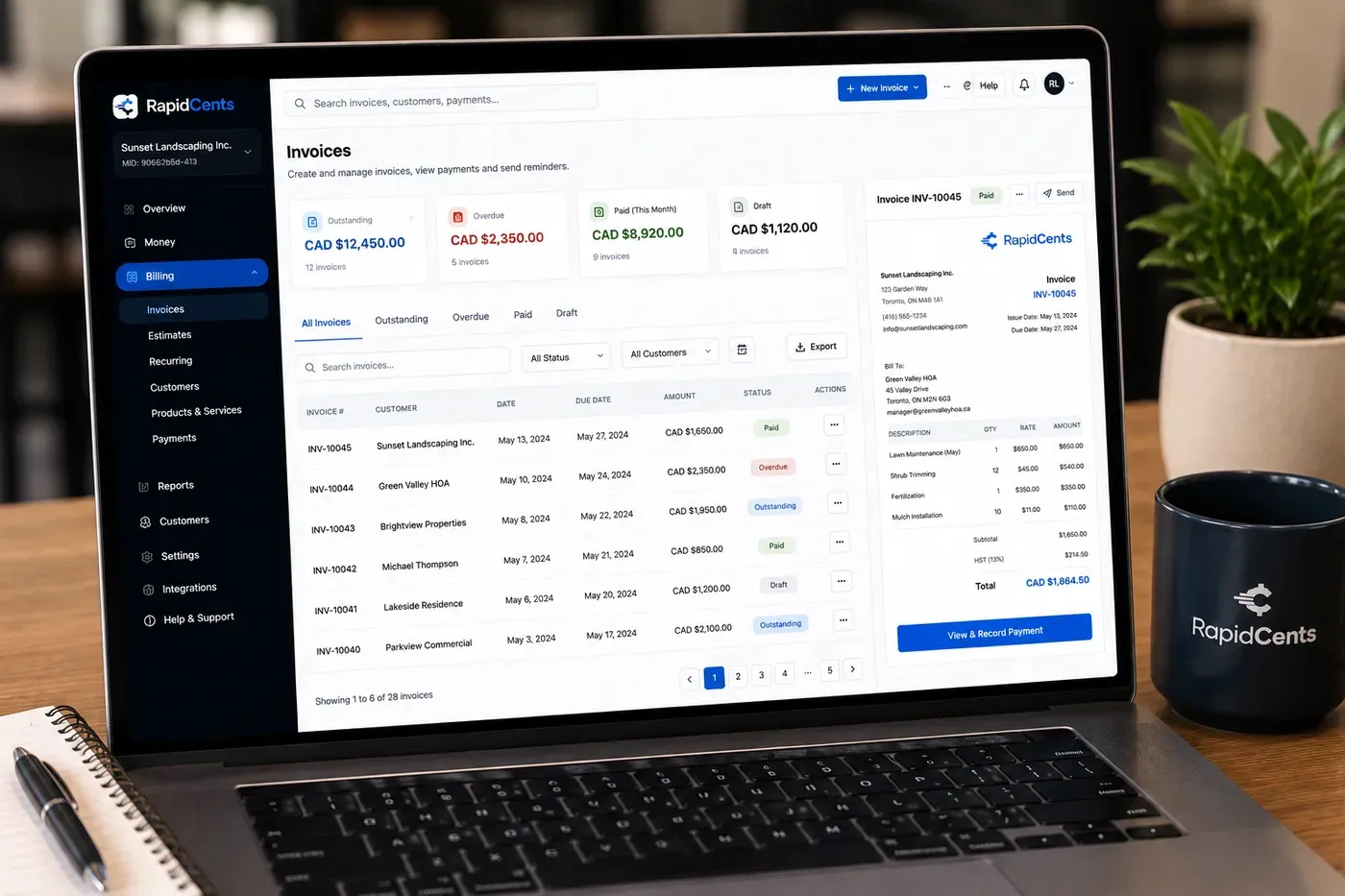
The RapidCents invoices screen: outstanding, overdue, paid and draft totals across the top, the invoice list below them, and a preview of one invoice on the right with its line items and a View & Record Payment button. Invoicing
RapidCents invoicing helps professional services, contractors and B2B suppliers create branded invoices…
Explore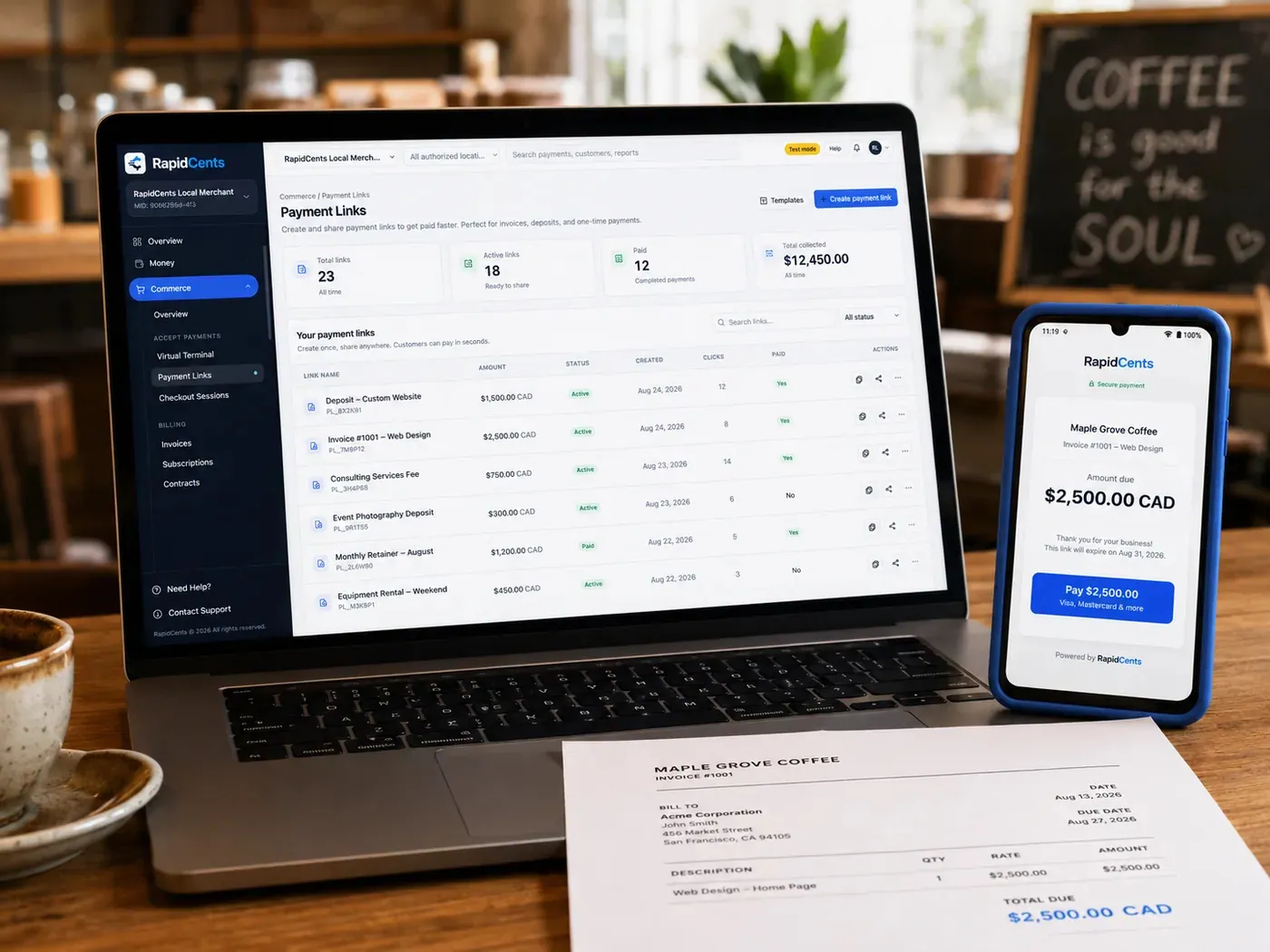
The RapidCents payment links screen listing created links with their amount, status, click count and whether they have been paid, beside a phone showing the branded page a customer opens to pay $2,500.00. Payment Links
RapidCents payment links let staff generate branded pay-by-link URLs for invoices, deposits, balances and…
Explore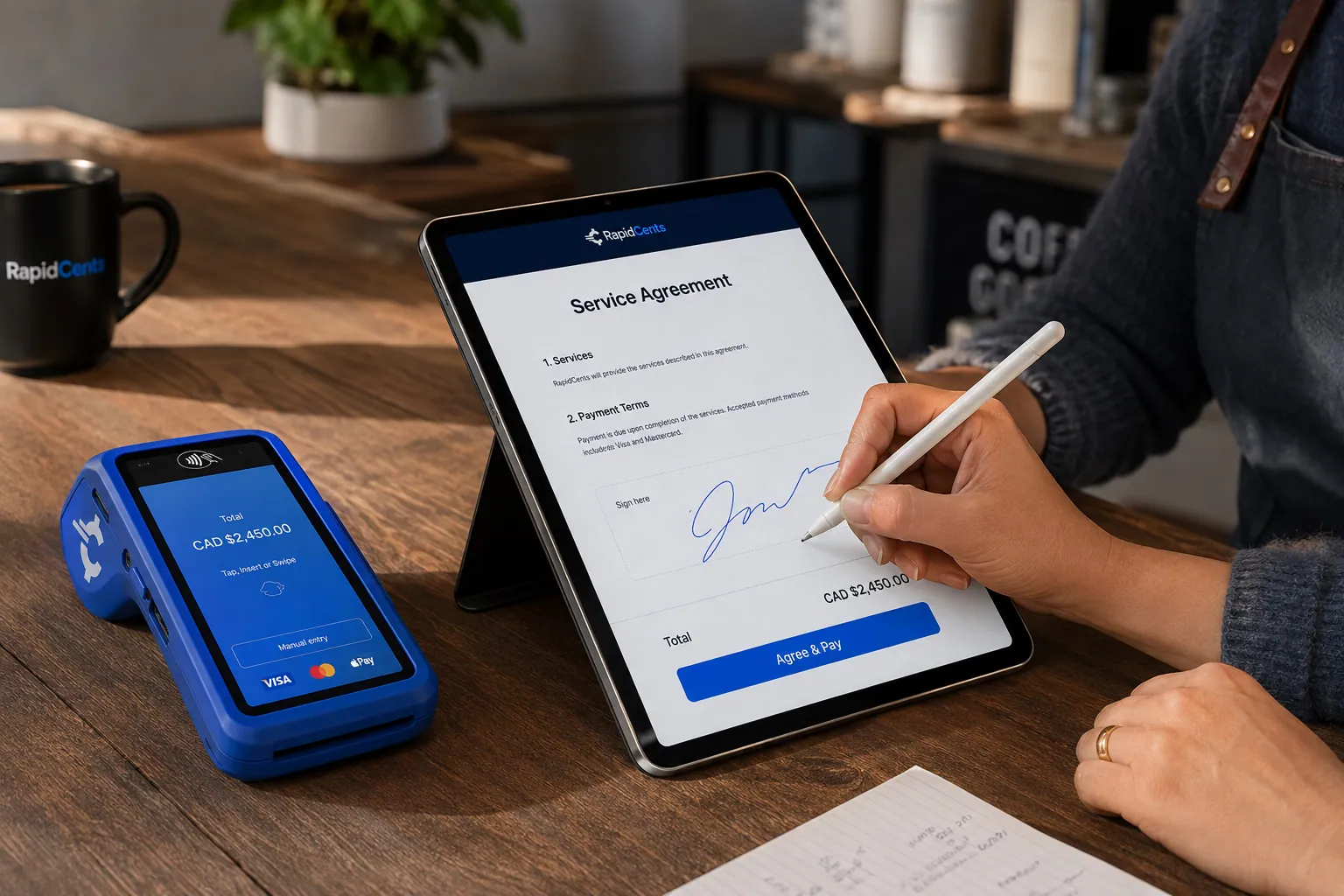
A merchant sends a RapidCents contract for e-signature with payment attached, terminal ready for an in-person counterpart. Contracts & eSignatures
Quotes, service agreements and enrolment forms usually end in a payment. Send the document, capture the…
Explore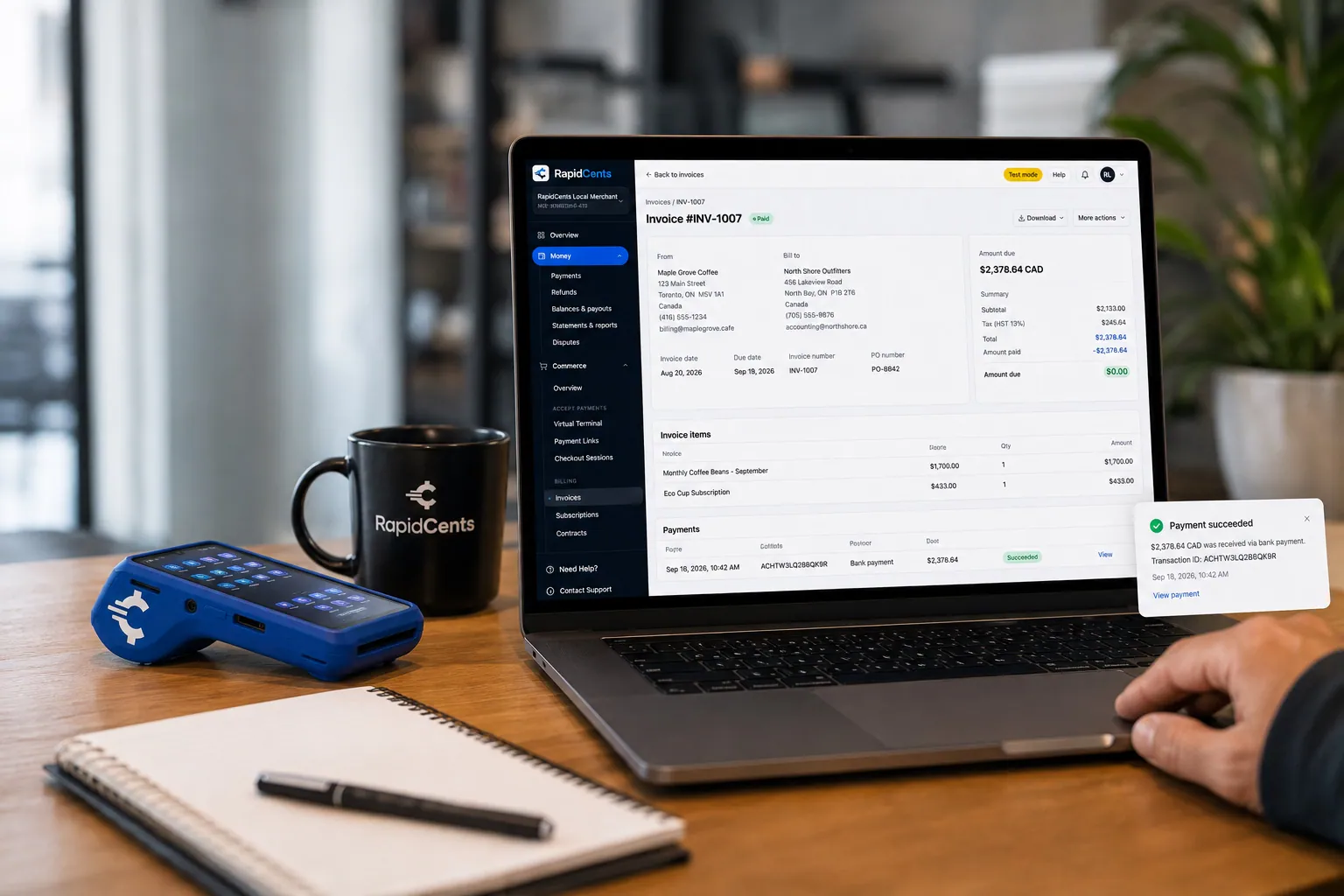
A merchant invoices a customer for bank debit through RapidCents, with card terminal capture available on the same desk. ACH / Bank Payments
Bank payments suit recurring and high-value invoices where card fees are the wrong tool. Collect directly…
Explore


How are repeat orders for stock packaging paid?
Repeat orders for stock cartons, mailers, tape and stretch film can be paid in three ways: a card the buyer has authorized you to keep, an invoice link for buyers on account, or a phone payment through the Virtual Terminal. Charge when the order ships, for the lines that shipped, with the buyer's PO on the payment so receivables can apply it without a follow-up call.
Card on file with a written authorization
Store a buyer's card as a token in the Secure Card Vault only after the buyer signs an authorization listing which orders it covers, any per-order ceiling and how to withdraw it. Staff then charge the token as orders ship without seeing the card number. A standing order with a fixed quantity and schedule can run through Recurring Payments once the amount, timing and cancellation terms are agreed.
Phone orders and head office payers
When a buyer phones in a rush carton order, staff with permission key the card into the Virtual Terminal, where AVS and CVV checks apply and the audit log shows who took it. Answer emailed orders with a payment link, not a request for card numbers. When head office pays for several plants, each invoice carries the plant's ship-to reference so one payment can clear several invoices.
Backorders, price changes and declines
Charge only the lines that ship, and invoice backordered items under the same PO when they follow. If board or resin costs change your price list, tell card-on-file buyers before the next charge so the amount matches what they expect. Account Updater can refresh replaced cards where the issuer takes part; if a charge still declines, send a payment link before releasing the order.
A standing order for a third-party warehouse
Say a third-party warehouse orders stretch film, tape and three carton sizes every two weeks under a standing PO, and the supplier charges the authorized card as each order ships. When the warehouse adds a pallet of a new box size that takes one order past the per-order ceiling in its authorization, the supplier sends a payment link for that invoice instead of charging the card.
How card mix, order size and channel shape your processing costs
Packaging distributor card processing costs depend on your buyers' cards, how each payment is taken and how your volume splits between large production balances and smaller stock reorders. On RapidCents interchange-plus pricing, the interchange on each deposit, balance and reorder is set by the card networks and passes through at cost; you also pay your RapidCents markup, set out in your Fee Schedule, and fees for equipment or services, if applicable. Agreements run month to month, with no fixed term.
Card type: commercial, purchasing and small-business cards
Brand owners and manufacturers may pay with commercial or purchasing cards, while a small online seller ordering its first custom boxes may use a small-business or rewards card. Those cards generally carry higher interchange than a debit card tapped at your will-call door. One large production balance paid by purchasing card can change a month's mix, so compare several months of statements.
Channel: remote orders versus pickup and delivery
Invoice payment links, web store orders and phone orders keyed in the Virtual Terminal are card-not-present payments, which generally carry higher interchange than a chip or contactless card presented at pickup or on delivery. Your split between remote and in-person payments shapes the interchange line on every statement, so measure it before comparing quotes.
Order size, enhanced data and bank payments
Production deposits and balances are few and large; stock reorders are many and smaller. Where supported for your setup, some commercial cards can pass PO, tax and line-item detail as Level 2 or Level 3 data; look at your own statements to see any interchange effect rather than assuming it. For the largest production balances, compare the card cost with a bank payment.
What to bring to Fee Check
Bring two or three recent processing statements, your card-type split, your average deposit, balance and reorder size, your mix of link, phone, web and in-person payments, and your refund and chargeback counts, including reprint and damage disputes. Fee Check reads an uploaded statement and shows interchange separately from markup, so you can set current costs beside an interchange-plus quote.
Will RapidCents work with your ERP, estimating or accounting software?
RapidCents integrates with many major business platforms through APPIE and RapidBridge, and the right route depends on your ERP, estimating or accounting software, its edition and your country: a connector, an API integration, payment links sent from outside the software, or a settlement import. RapidBridge works with Oracle NetSuite, SAP Business One Web Client, Dynamics 365 Business Central, Acumatica, QuickBooks Online and Xero. Your RapidCents representative will walk you through the rest, so test a deposit, a refund and a split-shipment invoice first.
NetSuite and SAP Business One
Packaging distributors on NetSuite or SAP Business One keep sales orders, invoices and incoming payments there. RapidBridge works with Oracle NetSuite and SAP Business One Web Client, so a card payment posts against the invoice you already have open, and settlement import files carry payments, fees and refunds to your ledger. Check that job and release numbers survive the import.
Dynamics 365 Business Central, Acumatica and other ERPs
These ERPs run orders, inventory and receivables for distributors. RapidBridge works with Dynamics 365 Business Central and Acumatica. For Epicor Prophet 21 and other distribution ERPs, RapidCents integrates with many major platforms through APPIE and RapidBridge; the right option depends on your vendor and version, and your RapidCents representative will walk you through it. Payment links carrying the ERP invoice number work in the meantime.
QuickBooks Online and Xero
Packaging suppliers keeping their books in QuickBooks Online or Xero can connect settled transactions, fees and refunds to either one, so the books follow what actually settled. Agree with your accountant how production deposits, tooling charges and reprint credits should be recorded before the first custom job runs.
Estimating software, print MIS and your web store
Job numbers, proof versions and run quantities often live in estimating or print management (MIS) software. RapidCents integrates with many major platforms through APPIE and RapidBridge, and your representative will show you the option that fits your vendor; carry the job number on each payment link and invoice either way. For stock items sold through your web store, Hosted Checkout or the Payment Gateway API can take the card.
Payment options for packaging suppliers in the United States
Packaging suppliers in the United States can collect from business buyers by credit and debit card, including commercial and purchasing cards, and by ACH bank payment, with settlement in USD. Cards suit invoice links, phone orders and payments at will-call or on delivery, while ACH suits large production balances and buyers who pay a monthly statement. Your RapidCents representative sets up the methods that fit your business.
Cards, including PIN debit where supported
Buyers can pay packaging invoices with Visa, Mastercard, American Express and Discover cards by link, by phone through the Virtual Terminal or on a terminal. At your will-call door or on delivery, PIN debit is available where the terminal supports it. Larger buyers may pay with commercial or purchasing cards.
ACH for production balances and statements
An ACH debit does not depend on a card's available credit, which suits production balances and monthly statements. Get the buyer's authorization before initiating a debit, with the amount or how it is calculated and the timing in writing, and keep that authorization with the account record.
USD settlement, sales tax and state rules
Payments settle in USD. Sales tax, which varies by state, is part of the invoice total; the payment collects that total, while tax calculation, exemption certificates and filing stay with you and your advisor. State law and card network rules both govern card surcharges, so check them before adding one to packaging invoices.
How to switch processors with jobs still in production
Switching processors as a packaging supplier starts with a list of what the old account still holds: stored cards and their authorizations, standing orders, open invoices with old payment links, and deposits taken on jobs still in production or waiting in your warehouse. Test the RapidCents account, run both accounts until those jobs close, and reconcile settlements to your ledger daily for the first weeks.
List what the old processor holds
Record which buyers have stored cards and what each authorization covers, which standing orders bill on which dates, which invoices carry the old provider's payment links, which jobs have deposits on the old account and which reprint credits or refunds are still owed. Stored cards may not transfer, since moving card data needs both providers to agree, so plan to ask some buyers for a fresh authorization.
Keep the old account open until jobs ship
Refunds of deposits taken on the old account usually have to go back through it, and chargebacks on old payments land there as well. Keep that account open until every job with a deposit has shipped and been invoiced, and the dispute window on recent payments has passed. Reissue unpaid payment links from RapidCents so no buyer pays the same invoice through two systems.
Test the new flow end to end
Once your account is approved, and before moving live orders, run a deposit through a signed proof approval, a split-shipment invoice paid in part, a refund, a Virtual Terminal phone order and a stored-card charge. Check that the job number, PO and release number arrive on each payment record and in your ERP import or accounting connection, then move one payment route at a time.
Reconcile and brief your buyers
Match each settlement to the deposits, shipment invoices and reorders inside it, using the transaction, settlement and fee reports in RapidCents Reporting, exported as CSV or PDF or in formats for accounting import. Tell each buyer's accounts payable team who new payment links will come from, the business name on their card statements and whether you need a new card authorization.
Payment questions from packaging suppliers
What is the best payment processor for packaging suppliers?
The best processor for a packaging supplier is the one that fits how your buyers pay: deposits on custom runs, balances on split shipments and card-on-file reorders. When you compare packaging supplier merchant services, check whether payment links carry job and PO numbers, how stored-card authorizations are handled, which bank payment options you get, how settlements reach your ERP and how interchange and markup appear on statements. RapidCents covers all of these on interchange-plus, and Fee Check sets your current statement beside our quote.
How much does credit card processing cost for packaging suppliers?
There is no single price: a packaging supplier's cost depends on buyers' cards, how each payment is taken and order size. With RapidCents interchange-plus pricing, the card networks' interchange on every deposit, balance and reorder passes through at cost, plus your RapidCents markup set out in your Fee Schedule and fees for equipment or services, if applicable. Commercial cards and keyed or online payments generally cost more in interchange than debit cards tapped at a terminal. Upload a statement to Fee Check to see your own breakdown.
Can NetSuite or the ERP that runs our packaging orders use a different payment processor?
Yes. RapidCents integrates with many major platforms through APPIE and RapidBridge, and RapidBridge works with Oracle NetSuite, SAP Business One Web Client, Dynamics 365 Business Central and Acumatica, while QuickBooks Online and Xero receive settled transactions, fees and refunds. The right option depends on your ERP vendor and version, and some ERPs steer buyers to their own payment add-on. Tell your RapidCents representative which software you run, and they will walk you through how payments reach it.
How can packaging suppliers switch processors without losing payment history?
Keep the old account open while you move, and export its transaction history before you close it. List stored cards with their authorizations, standing orders, invoices carrying old payment links and deposits on jobs still in production; refunds and disputes on those payments normally run through the old processor. Buyers may need to authorize a card again, since stored cards move only when both providers agree. Test a deposit, a refund and a split-shipment invoice on RapidCents before moving live orders.
Which payment options can a packaging supplier in the United States offer its customers?
A packaging supplier in the United States can offer business buyers card payments and ACH bank payments. Buyers can use Visa, Mastercard, American Express and Discover cards on invoice links, by phone through the Virtual Terminal, or in person at will-call or on delivery, with PIN debit where supported. ACH suits production balances and monthly statements once the buyer authorizes the debit. Payments settle in USD. Your RapidCents representative will walk you through the methods, card types and limits before you print them on quotes.
How are custom packaging deposits tied to artwork approval?
Record the approved proof version, the specification and the deposit as linked milestones on the same job or order. Send the quote and final proof for signature through Contracts & eSignatures, or a payment link carrying the job number and proof version, and start production only once both the sign-off and the deposit are in. If the buyer revises artwork after sign-off, the new proof version needs a fresh approval, and the deposit carries over to the revised quote as your terms set out.
Can customers pay for a partial shipment?
Yes, a customer can pay for each partial shipment, as long as every payment traces to the shipment it covers. Either issue a shipment-specific invoice for each delivery, or bill against the order and show a running partial balance. Payment links can carry the order and release number, and Invoicing applies partial payments to open balances. Test how your ERP or accounting software allocates a partial payment before the first split order, so the remaining balance is right.
How should reprint credits and tooling charges be described?
Give reprint credits and tooling charges their own invoice lines, each backed by documented terms. Show tooling such as cutting dies and printing plates as a one-time charge, with the quote saying who owns the tooling and whether reorders reuse it. Describe a reprint credit by job number and defect, and say whether it is a credit note against the next invoice or a refund to the original payment. A payer who understands each line is less likely to query or dispute it.
How do we bill when a print run ships over or under the ordered quantity?
Bill the quantity you deliver, within the over-run and under-run tolerance your quote sets out. The deposit was based on the ordered quantity, so the balance invoice moves up or down to the delivered count at the quoted unit price. Show ordered quantity, delivered quantity and the deposit on the final invoice so the buyer can check the math. If the order was paid in full upfront and the run comes in under, refund the difference to the original payment or issue a credit note, as your terms say.
Can drivers take card payments when they deliver an order?
Yes, a driver can take a chip or contactless card at the delivery point on a mobile RapidCents terminal, or with Tap to Pay on a supported iPhone or Android phone. Send each delivery with its invoice number so the payment is recorded against that invoice, and the buyer gets a receipt at the dock. Buyers on account terms can keep paying by invoice link, and a decline at the door can be followed by a payment link.
Related supplier pages
Our B2B & Wholesale page covers supplier collections across trades. The pages for janitorial and sanitation suppliers and for paper and disposable suppliers cover similar stock reorders, buyer authorizations and account invoices, without the artwork, tooling and production-deposit stages of custom packaging.
B2B & Wholesale
Collect net-terms invoices by payment link with the PO number attached, take commercial…
Janitorial & Sanitation Suppliers
Bill standing supply orders, collect facility and institutional invoices remotely and…
Paper & Disposable Suppliers
Collect case and pallet invoices from hospitality and facilities accounts with payment…
Dental Suppliers
From monthly consumables reorders to chair and imaging deposits, collect what clinics…
Veterinary Suppliers
Get invoices, standing orders and equipment deposits paid by the veterinary practices…
Medical & Surgical Suppliers
RapidCents helps medical and surgical suppliers collect hospital, clinic and practice…
Laboratory & Scientific Suppliers
Collect on lab purchase orders, instrument deposits and staged deliveries, with the PO…
Pharmaceutical Wholesalers
Collect pharmacy account invoices, balances and deposits with payment links, invoicing…
Take the next step
See what your deposits and reorders cost to process
Upload a recent processing statement to Fee Check and see interchange separated from markup across your production deposits, shipment balances and stock reorders, then compare it with an interchange-plus quote built on your own card mix.
- No obligation
- Payment specialists, not a call centre
- Secure statement upload