


Payment processing for catering businesses: deposit to final balance
Payment processing for catering businesses follows money in stages: a booking deposit, an event balance and extras on the day. RapidCents sends the deposit as a payment link, keys phone payments into the Virtual Terminal, invoices the balance after the final headcount and takes on-site additions with Tap to Pay. It also integrates with your catering software.

- PCI DSS Level 1
- SOC 2 Type II
- All major cards: Visa, Mastercard, Amex, Discover, UnionPay, Diners Club & Interac Debit
- Interchange-plus available
- Canadian support
How catering businesses collect payments
Catering businesses collect payments in stages that follow the event calendar: a deposit at booking, partial payments as the menu firms up, a balance once the headcount is final, and extras on the day. A corporate client adds its own invoice and card habits.
Catering event deposit payments
The host, couple or office manager pays once the proposal is accepted. A Payment Link by SMS or email collects the card, or staff key a card given by phone into the Virtual Terminal. If a card declines, send the link again or ask for another card. Finance gets a transaction tagged with the event number.
Catering invoice payment links
A final menu or a milestone triggers an invoice, and the payer pays by card from the link in the email or SMS. Invoicing tracks status from draft to paid. If an amount changes after the invoice goes out, send a revised invoice for the difference. Finance gets the invoice, payment and reference.
Catering partial payment tracking
A large event is paid in pieces: a deposit, a mid-point payment, the balance, sometimes split across two cards. Each piece is its own card transaction carrying the same event reference, so finance can group them in a transaction report or CSV export. Put the reference on every payment, including the ones keyed by phone.
Catering final balance collection
Once the headcount locks, the balance falls due, often close to the event. The client pays through the invoice link, or staff charge a card kept on file with the client's authorization. On the day, the lead can take added guests or bar service with Tap to Pay. If the headcount moves late, invoice the difference.
Corporate catering credit card payments
An office manager or assistant orders lunch for a team, and the company pays, often with a corporate or purchasing card. Staff send an invoice or payment link to the card holder, or key a number given by phone. Expense processes often need an invoice or purchase order number, so put the buyer's reference on the invoice.
How do you take catering event deposit payments?
You take catering event deposit payments by sending the client a payment link with the proposal or agreement, so the deposit is paid by card before the date is held. A declined card, an event cancellation and a disputed charge each need a planned next step.
From accepted proposal to receipted deposit
The client accepts the menu, signs the agreement and receives a Payment Link by SMS, email or QR code. They pay by card, receive a receipt, and the transaction appears in the Merchant Dashboard. Staff put the event number and date in the payment reference. Contracts & eSignatures can send the agreement, capture the signature and take the deposit.
Set the deposit terms and card permission first
Agree in writing what the deposit is, whether it is refundable, which cancellation dates apply and what it covers, such as the date hold and ordered rentals. If you will keep the card for the balance, the client must authorize that in the agreement before you store it in the Secure Card Vault.
Declines, cancellations and disputed deposits
If a large deposit declines, resend the link, try another card or ask your RapidCents representative about bank payments on your account. For an event cancellation, refund the client's card as your agreement says. If the client disputes the charge, the signed agreement and cancellation terms are your evidence in Disputes and Chargeback Protection.
A $7,500 rehearsal dinner, deposit first
Say a caterer quotes $7,500 for a rehearsal dinner and agrees a $1,500 deposit with the host. The host's first card declines, so the caterer sends the link again and the host pays with a second card. Finance finds the approved payment by the event number in the reference.
How do catering invoice payment links collect partial and final payments?
Catering invoice payment links collect partial and final payments by putting an invoice and a pay-by-card link in the client's inbox, with the event number on every payment. Your catering software or spreadsheet keeps what the event owes; RapidCents records what was paid.
Run the balance from final headcount to paid invoice
When the headcount locks, create the invoice in Invoicing with the final menu, service lines and event number, and send it by email or SMS with its payment link. The status moves from draft to paid as the client pays. Give a standalone Payment Link an expiry date so an outdated total lapses.
Track partial payments against one event reference
Give every event one reference, such as the event number and date, and put it on the deposit, each milestone payment and the balance. Each is a separate card transaction, so finance can group them in a transaction report or CSV export. Restrict who can key payments in the Virtual Terminal with role permissions, and decide who may issue refunds.
Stale amounts, duplicates and failed payments
A headcount change after the invoice goes out is the common error: the client pays the old total or holds a link for it. Send a revised invoice for the difference and say which link to use. Before re-keying a payment that seemed to fail, check the Merchant Dashboard for an approved charge.
An 80-guest holiday lunch that grows twice
Say a holiday lunch for 80 guests is quoted at $4,000 and a $1,000 deposit is paid. The final headcount rises to 92, so the caterer invoices $3,600, the new $4,600 total less the deposit. On the day, six more guests arrive and the lead takes $300 with Tap to Pay.
RapidCents products for catering businesses
These products follow the catering cycle: Payment Links take deposits, Invoicing collects event balances, the Virtual Terminal handles cards given by phone and Tap to Pay takes additions on site. Your RapidCents representative sets up the ones you need.

The RapidCents payment links screen listing created links with their amount, status, click count and whether they have been paid, beside a phone showing the branded page a customer opens to pay $2,500.00. Payment Links
RapidCents payment links let staff generate branded pay-by-link URLs for invoices, deposits, balances and…
Explore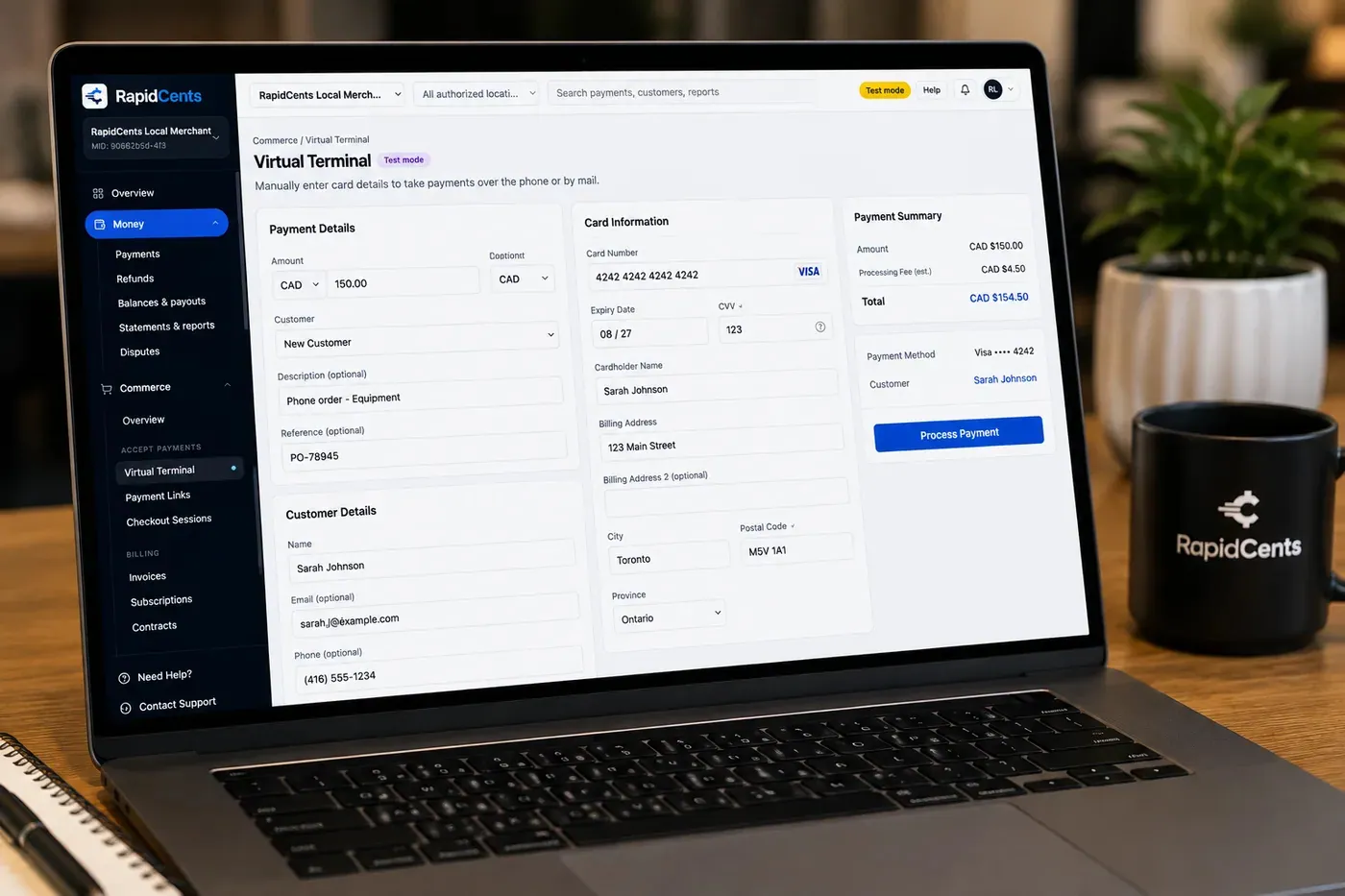
The RapidCents virtual terminal: payment details, card number, expiry and CVV keyed by hand on the left, with a payment summary on the right showing the amount, the estimated processing fee and a Process Payment button. Virtual Terminal
The RapidCents virtual terminal lets authorized staff enter mail-order and telephone-order payments through a…
Explore
A café worker holds a phone running RapidCents Tap to Pay, showing an $18.75 sale and the contactless symbol, while a customer holds a Visa card to the screen. No separate card reader is present. Tap to Pay
RapidCents Tap to Pay turns supported iPhones and Android devices into contactless payment terminals without…
Explore
The RapidCents invoices screen: outstanding, overdue, paid and draft totals across the top, the invoice list below them, and a preview of one invoice on the right with its line items and a View & Record Payment button. Invoicing
RapidCents invoicing helps professional services, contractors and B2B suppliers create branded invoices…
Explore


How do corporate catering credit card payments work?
Corporate catering credit card payments work by invoicing the company or its card holder and collecting by payment link or keyed card, with the buyer's purchase order or cost reference on the record. Standing orders need the client's agreement on amount, timing and cancellation. Corporate and purchasing cards are often commercial cards with their own interchange categories.
Who receives the invoice and who holds the card
The invoice goes to whoever approves spend, who may not be the person who ordered. Send it with a payment link the card holder can open on a phone, or key the card into the Virtual Terminal with AVS and CVV checks when the card holder phones you. Never accept card numbers by email or text.
References, purchase orders and expense reports
Corporate buyers need the invoice to match their records. Put the buyer's purchase order or cost-code number in the invoice description and the event number in your own reference. The receipt then supports the buyer's expense report, and your finance team can find the payment by either number.
Standing orders, split payments and card limits
For a weekly team lunch, Recurring Payments can charge a card on file only after the client agrees the amount, timing and cancellation terms. A corporate card can decline at its limit, so ask for a second card or send the balance as an invoice. A schedule collects agreed payments; it is not financing.
A weekly $600 office lunch on a purchasing card
Say an office manager books a catered lunch every Tuesday for a 30-person team at $600 a delivery. The company's purchasing card is stored in the Secure Card Vault after the manager signs an agreement setting the amount, the weekday and how to cancel. Each Tuesday's charge is a separate transaction.
What do catering credit card processing fees depend on?
Catering credit card processing fees depend on how clients pay and how the card is taken, because keyed deposits, tapped cards and corporate cards sit in different interchange categories. RapidCents prices on interchange-plus: interchange at cost, plus your RapidCents markup set out in your Fee Schedule, plus fees for equipment or services, if applicable. Billing is month to month with no fixed term.
Remote deposits and invoices versus cards tapped on the day
Deposits by link, balances by invoice and numbers keyed by phone are taken without a card present. Networks set interchange for those payments separately from a card tapped or inserted at the event, so compare quotes by channel rather than by one headline number.
Corporate, premium and consumer cards
A corporate lunch is often paid with a commercial or purchasing card, and a gala or wedding host may use a premium rewards card. Card networks place each in its own interchange category, and under interchange-plus that interchange passes through at cost. Ask for your card mix by type before you compare providers.
What to bring to Fee Check and what to ask
Bring recent statements that include a peak month such as wedding or holiday season, plus your card mix, average ticket by event type, the split between remote and tapped payments, and refund and chargeback volume. Ask every provider how refunds and chargebacks are billed and whether a terminal is rented or bought. Fee Check shows interchange separately from markup.
Can you use RapidCents with Tripleseat, Caterease and other catering software?
RapidCents integrates with many major platforms through APPIE and RapidBridge. The right option for Tripleseat, Caterease, CaterZen, Flex Catering or Curate depends on the vendor and version, and your RapidCents representative will walk you through it. Settled transactions, fees and refunds map to QuickBooks Online or Xero.
Tripleseat
If you book events in Tripleseat, the right option depends on your edition and version. Tell your RapidCents representative which one you run, and they will walk you through it. Meanwhile, the deposit step works from a RapidCents payment link with the event number in the reference.
Caterease
With Caterease, the invoice step is the one to line up first. Tell your RapidCents representative which edition you use, and they will show you how payments connect to the event. In the meantime, send the payment link from RapidCents with the event number in the reference.
CaterZen
In CaterZen, partial payments need to land against the right event. Tell your RapidCents representative how you record them today, and they will walk you through the option that fits. Meanwhile, you can reconcile from a RapidCents CSV export that carries the event reference.
Flex Catering
With Flex Catering, the final balance is the step to plan. Your RapidCents representative will walk you through how payments reach the event record for your edition. Until then, invoice the balance from RapidCents and keep the event number in the reference so each payment finds its event.
Curate
If corporate clients order through Curate, your RapidCents representative walks you through how payments, settlement and fees reach your books for your setup. For orders taken outside the platform, use invoices or payment links from RapidCents with the buyer's reference on them.
Payment options for catering businesses in Canada
Catering businesses in Canada can take Visa, Mastercard and American Express credit cards, Interac debit at the terminal and EFT or pre-authorized debit (PAD) bank payments, settled in Canadian dollars. Your RapidCents representative tells you which methods are enabled on your account before you write payment terms into proposals.
Interac debit applies at the terminal
Interac debit is used when a card is inserted or tapped at a terminal, such as at a tasting or for a final payment taken in person. Deposits and invoices paid by link or keyed over the phone run as card payments on the card networks.
EFT and PAD for large corporate balances
A corporate or wedding client with a large balance may prefer a bank payment. EFT and PAD need the account holder's authorization and bank details, and a failed bank payment is handled differently from a card decline. Your RapidCents representative can tell you whether bank payments are enabled on your account.
Canadian dollars, GST/HST lines and provincial rules
Settlement is in Canadian dollars. GST/HST may appear on your invoice and receipt where it applies, but how it is calculated stays in your catering or accounting software. Provincial rules can affect deposit and cancellation terms for private events, so have your own adviser review your agreement.
How do you switch payment processors without disrupting booked events?
You switch without disrupting booked events by listing every event with a deposit paid or a balance due, testing a deposit, a balance and a refund on the new setup, and moving new bookings first while the old setup collects what is already scheduled. Stored cards may not transfer, because both providers must agree.
Inventory events, cards, invoices and contract terms
List every booked event with its deposit status and balance date, every card on file and the authorization behind it, open invoices and pending refunds. Read your current contract for notice and exit terms, and ask that provider in writing whether stored cards can be exported. Where cards cannot move, clients authorize the card again.
Test a deposit, a balance and a refund first
On the new setup, pay a test payment link, key a phone payment in the Virtual Terminal, tap a card on a supported phone or terminal, then refund each. Check that your reference shows in the Merchant Dashboard and a CSV export before the first client pays.
Run both setups side by side for a while
Send new bookings to RapidCents first, and let the old setup collect balances for events already booked. Keep one list showing which setup holds each event so no client is charged by both, and do not move an event halfway through its payment schedule.
Refunds, settlement and reporting after the switch
Refund the card the client paid with, using the permissions you tested. Run the first settlement and fee reports beside your old statements and bank feed until each event's deposits, fees and refunds tie out. Your RapidCents representative will walk you through your settlement timing.
Payment questions from catering businesses
What should catering businesses compare before choosing a payment processor?
Compare how each processor handles the whole catering cycle: a deposit by link, an invoice balance, partial payments, on-site extras and refunds. Then compare fees on your real card mix, how well it works with your catering software, settlement reporting, and support when a payment fails before an event. Ask each provider of catering merchant services for a written quote and test a deposit and a refund first.
How much does payment processing cost for catering businesses?
The cost depends on your card mix, how cards are taken, your average ticket and any equipment or services you add, so no figure can be quoted without your statements. RapidCents prices on interchange-plus: interchange passes through at cost, plus your RapidCents markup set out in your Fee Schedule, plus fees for equipment or services, if applicable. Fee Check shows interchange separated from markup.
Can I use Tripleseat with a different payment processor?
APPIE and RapidBridge connect RapidCents to many major platforms, and the right option for Tripleseat depends on your edition and version; tell your RapidCents representative which one you run and they will walk you through it. A payment link, invoice or Virtual Terminal payment can also run beside Tripleseat with the event number in the reference, and settled transactions map to QuickBooks Online or Xero.
How can my business handle catering event deposit payments?
Send the deposit as a RapidCents payment link with the proposal or agreement, so the client pays by card from a phone or computer and receives a receipt. First agree the deposit amount, refund terms and cancellation dates in writing, and get the client's authorization if a card will be kept for the balance. If the card declines, resend the link or ask for another card.
Which payment options can a catering business in Canada offer?
A catering business in Canada can offer credit cards, Interac debit at the terminal and EFT or PAD bank payments, settled in Canadian dollars, as far as each is enabled on its RapidCents account. Deposits and invoice balances paid by link are card payments; Interac debit applies when a card is inserted or tapped in person.
What setup is needed for catering invoice payment links?
Once your account is approved, setup takes your branding and business details on the invoice, the staff who may send links, and one rule for the reference on every event invoice. Links go out by SMS, email or QR code and can carry an expiry date. No terminal is needed to send a link. Run one test invoice and a refund before a client sees it.
How should we manage catering partial payment tracking?
Use one reference for the whole event, such as the event number and date, on the deposit, every milestone payment and the balance, so finance can match each payment to its event. Keep what the event owes in your catering software, restrict who can key or refund payments, and if a payment fails, contact the client and check for an approved charge before trying again.
Can one platform handle catering final balance collection and corporate catering credit card payments?
Yes. Invoicing, Payment Links, the Virtual Terminal and Tap to Pay all run on one RapidCents account, so final balances and corporate card payments appear together in the Merchant Dashboard and in settlement reports. Your event ledger and client contacts can stay in your catering software, and your RapidCents representative walks you through how the two records connect through APPIE or RapidBridge.
How do we reconcile card payments and bank deposits for catering businesses?
Match each bank deposit to a settlement report, then match the settlement to its transactions, refunds, disputes and fees using the transaction ID and the event reference. Gross sales, refunds, chargebacks and fees are separate lines, and your representative can show whether fees are netted from deposits or billed separately. Settled transactions map to QuickBooks Online or Xero, and a CSV export carries the event reference.
How do we switch payment providers without losing saved cards or disrupting catering event deposit payments?
Switch in stages, and do not assume stored cards will move. List every booked event, card on file and open invoice, test a deposit, a balance and a refund on the new setup, then move new bookings first while the old setup collects what is already scheduled. Stored cards transfer only if both providers agree, so RapidCents cannot promise it; when they stay behind, clients authorize their card again.
What MCC is used for catering businesses?
MCC 5811 is commonly associated with caterers. RapidCents sets the correct merchant category during onboarding, based on what your business actually sells, so describe every revenue line, such as event catering, bar service, rentals, venue fees and any counter or restaurant sales. Onboarding assigns the code, so there is nothing to guess in advance.
Payment workflows shared with food and hospitality
Restaurants and Hotels & Hospitality also take deposits for private events, and Food Trucks share on-site tap payments. Visit those industries where your counter, folio or truck workflow differs from event catering.
Restaurants
Close bills at the table, split them across cards, settle tips before staff clock out and…
Fast Food & QSR
Card payments for fast food and QSR operators: countertop and mobile terminals, Tap to…
Food Trucks
Mobile terminals with LTE and Wi-Fi for the window, Tap to Pay on a phone for the queue…
Cafés & Bakeries
Take tap payments in the morning rush, collect deposits on cake and pickup orders, and…
Hotels & Hospitality
Collect booking deposits, hold a card for incidentals at check-in and capture the final…
Bars & Nightclubs
Open tabs on a held card, take payments on the floor with a handheld, adjust tips at…
Breweries & Wineries
Take cards at the taproom bar, the tasting room and the farmers market, bill wine and…
Ghost Kitchens
Take direct online orders, run several virtual brands off one line and read each brand's…
Take the next step
See what your catering payments cost
Upload a recent processing statement to Fee Check to see interchange separated from markup, then compare deposit, invoice and on-site payments against your real card mix.
- No obligation
- Canadian payment specialists
- Secure statement upload



