


Payment processing for car dealerships: deposits, service and parts
Car dealership payment processing from RapidCents covers vehicle deposits by payment link, card payments at the service drive and parts counter, and fleet invoices. You set how much of a purchase price goes on card. Sales, service and parts report by department and rooftop, and RapidCents integrates with many major platforms through APPIE and RapidBridge.

- PCI DSS Level 1
- SOC 2 Type II
- All major cards: Visa, Mastercard, Amex, Discover, UnionPay, Diners Club & Interac Debit
- Interchange-plus available
- Canadian support
How car dealerships get paid
Car dealerships get paid through four payment jobs: holding deposits, down payments on the purchase, service and parts tickets, and fleet or shop invoices. Each job has a different payer, trigger and record, so each needs its own rules.
Holding deposits to set a vehicle aside
A shopper wants one unit held before visiting. The salesperson sends a payment link by text or email, the buyer pays by card, and the receipt names the stock number and refund terms. Finance books it as a deposit until the deal closes or the refund is issued.
Down payments on the purchase
At signing, the buyer pays part of the price by card, up to the limit your dealership sets, then covers the balance by bank draft, wire or lender funds. The card payment is recorded against the deal number, and refunds return to the same card.
Service and parts tickets
A customer collects a vehicle after a repair order or buys parts at the counter. The advisor takes the card on a countertop or mobile terminal, and the settled amount returns to the repair order or invoice number for the department's daily close.
Fleet, wholesale and body shop accounts
A fleet manager or independent repair shop owes a balance on parts or service. You send an invoice with a payment link, track it from sent to paid, and match each payment to the account and purchase order number.
How do dealerships take refundable vehicle holding deposits?
A dealership takes a refundable vehicle holding deposit by sending the buyer a payment link for one stock number, with the refund terms shown before the card is entered. The receipt and your deal record then name the same unit, amount and date, so a later refund matches the original payment.
How the deposit runs
The salesperson creates a payment link for the deposit amount and sends it by text or email. The buyer pays on a phone, and both sides get a receipt. Put the stock number and salesperson in the reference so these vehicle holding deposit payments are easy to find when the deal is booked.
What to set up first
Write the deposit terms before the first link goes out: whether it is refundable, how long the unit is held, and who may approve a refund. The buyer agrees to those terms when paying. Save the card for later charges only when the buyer authorizes it.
A $500 deposit on a used crossover
Say a buyer two hours away holds a used crossover with a $500 deposit, then the vehicle sells to another customer. Staff refund the deposit to the same card and note the reason. A declined card means no hold, and a disputed deposit is answered with the receipt and terms.
How do purchase payment limits differ from down payments?
A down payment is the part of the price a buyer chooses to pay at signing, while a purchase payment limit is the ceiling your dealership sets on how much of the price it accepts by card. Set the limit as policy, and take the rest by bank draft, wire or lender funds.
Set the limit as a written policy
Decide how much of a purchase price your dealership will take on card, and say so before negotiation starts. Staff then give every buyer the same answer. Check the policy with your controller against your lender's requirements, and your RapidCents representative will walk you through the merchant account side.
Split the payment cleanly
Take the card portion first, on a terminal or by payment link, and record it against the deal number. The remainder arrives by bank draft, wire or lender funds, and lender funds are never part of a card refund.
A $2,000 card portion on a $38,000 vehicle
Say a buyer puts $2,000 on card toward a $38,000 vehicle under your dealership's limit, then pays the balance by bank draft at delivery. If the deal falls through, only the card portion is refunded to the original card. The rest goes back by the method it arrived.
RapidCents products for car dealerships
Payment Terminals cover the cashier window and service lane, Payment Links carry holding deposits to remote buyers, Invoicing handles fleet and shop accounts, and Multi-Location keeps each rooftop and department reporting separate.
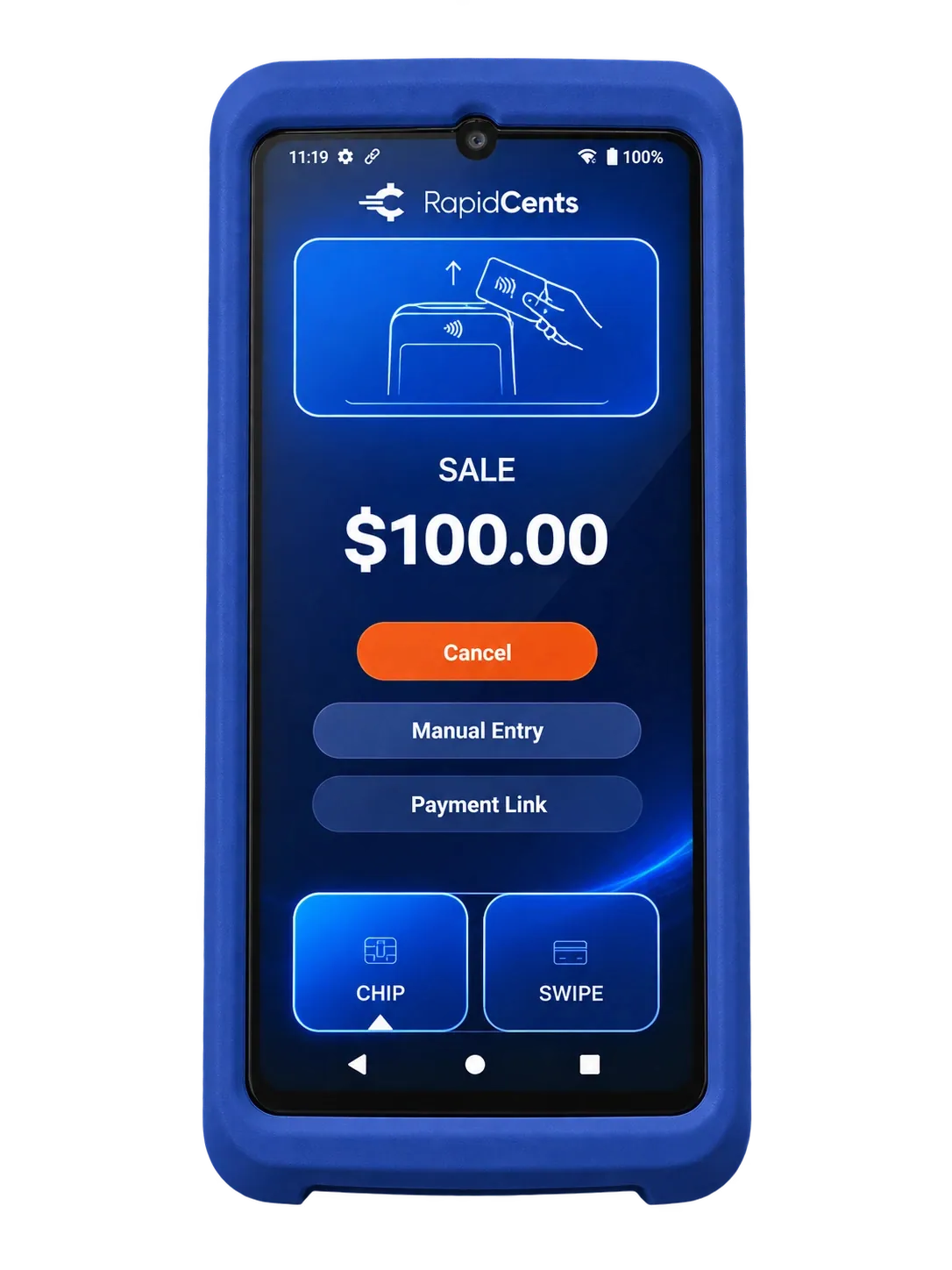
The RapidCents Rivo Go standing upright in its blue silicone case, showing the full-touch sale screen a customer reads across the counter. Payment Terminals
RapidCents payment terminals cover countertop, mobile and smart form factors so you can accept chip…
Explore
The RapidCents payment links screen listing created links with their amount, status, click count and whether they have been paid, beside a phone showing the branded page a customer opens to pay $2,500.00. Payment Links
RapidCents payment links let staff generate branded pay-by-link URLs for invoices, deposits, balances and…
Explore
The RapidCents invoices screen: outstanding, overdue, paid and draft totals across the top, the invoice list below them, and a preview of one invoice on the right with its line items and a View & Record Payment button. Invoicing
RapidCents invoicing helps professional services, contractors and B2B suppliers create branded invoices…
Explore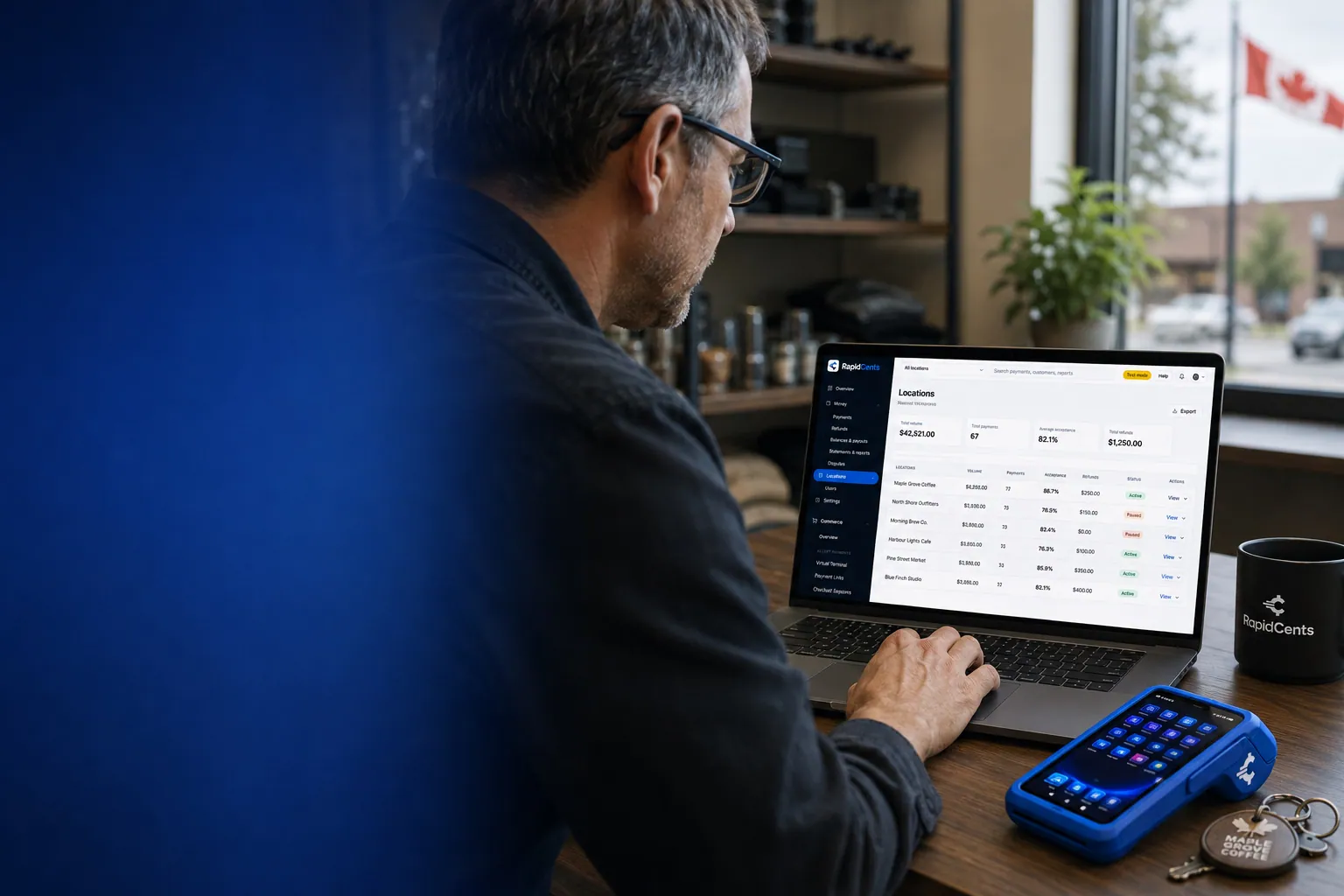
One RapidCents account comparing sales across locations, with a terminal representing the store-level capture. Multi-Location
RapidCents multi-location tools organize stores, franchises and regions in a hierarchy with location-level…
Explore


How does service and parts checkout work at the drive lane?
Dealership service department payments work best when the advisor closes the repair order on a terminal at the drive lane or counter, so the customer pays once and the amount matches the order. Fleet and shop accounts are invoiced instead, with a payment link and a purchase order number.
Drive lane and counter
Use countertop terminals at the cashier window and mobile terminals or Tap to Pay for advisors who close orders beside the vehicle. Customers tap, insert or enter a PIN, and the receipt carries the repair order number for the department's daily close.
Adjustments and exceptions
Final totals often differ from the estimate. Get the customer's approval for added work, then charge the final amount once. If the work is covered by a warranty or paid by the manufacturer, it is billed to the manufacturer, not taken by card. Returned parts are refunded to the original card.
A brake job that goes from $620 to $780
Say a customer approves a brake job quoted at $620, and the technician finds a worn part that lifts the total to $780. The advisor records the approval, takes one card payment for $780, and the repair order closes with the receipt attached.
How should you compare dealership processing fees and total cost?
Dealership credit card processing cost depends on your card mix, ticket size and how cards are taken. We price every account on interchange-plus: interchange at cost, your RapidCents markup in your Fee Schedule, and fees for equipment or services if applicable. It is month to month, with no fixed term.
What moves interchange
Interchange is set by the card networks and varies with debit, credit, premium and commercial cards, and with whether the card is tapped or inserted or keyed in. A service drive full of in-person cards and a deposit desk full of remote cards price differently.
Bring your real mix
Gather recent processing statements, the average ticket for sales, service and parts, the split between in-person and remote payments, and your refund and chargeback volume. Large vehicle deposits and small parts tickets belong in separate comparisons.
Use Fee Check
Upload a processing statement to Fee Check to see interchange separated from markup and from equipment or service fees. Compare that with your Fee Schedule in writing, including terminal costs for each rooftop, and you will know your true cost per department.
Works with PBS Systems, CDK Global and other dealer software
RapidCents integrates with many major platforms through APPIE and RapidBridge, so a dealership keeps the dealer management system it runs today. The right option depends on your software vendor and version, whether that is a direct connection, amount transfer, payment link or file export. Your RapidCents representative will walk you through it.
PBS Systems
PBS Systems runs dealership accounting, deposits and service. Tell your RapidCents representative which edition you use, and they will show you how the amount reaches the terminal and how receipts post back to the deal or repair order.
CDK Global and Reynolds and Reynolds
Both are sold in separate editions, and the right connection depends on the vendor and version you run. Your RapidCents representative will explain whether payments connect directly, go out by payment link, or reconcile from a settlement report.
Dealertrack DMS and Tekion
Dealertrack DMS and Tekion each come in their own versions, so tell your RapidCents representative which one you run. They will show you how the amount reaches the terminal, how receipts post and how refunds are handled. Where a direct connection is not the fit, a payment link or terminal with the deal number as reference plus a settlement report keeps reconciliation clean.
Payment options for car dealerships in Canada
Car dealerships in Canada can offer Interac debit at the terminal, credit cards, EFT or pre-authorized debit (PAD) for bank payments where your account supports them, and settlement in CAD. Your RapidCents representative will list the methods set up on your account.
Debit and credit at the counter
Interac debit by chip and PIN or contactless, plus Visa and Mastercard credit, cover most service and parts tickets. A card limit on a vehicle purchase is your dealership's policy, and the balance can arrive by bank draft or EFT.
Receipts and provincial rules
Receipts for vehicle sales and service often show GST/HST, and provincial rules can affect how deposits and refunds are documented. Ask your accountant how a deposit is recorded in your province before the deal closes.
Setup, switching and reconciliation checklist
Once your account is approved, switching dealership payment providers starts with an inventory and ends with a reconciled test. List open deposits, saved-card arrangements, terminals and software dependencies, then run a sale, refund and deposit through the new setup before moving live traffic.
Inventory first
List open holding deposits, saved cards with their authorizations, terminals at each rooftop and service lane, and any software connection. Saved payment credentials may need a migration controlled by both providers, so do not assume they move.
Test before you move
Run a test deposit by payment link, a service ticket and a refund, then match each to the deal or repair order number and to the settlement report. Run the old and new setups in parallel for a period if your controller wants it.
Reconcile to the ledger
Map payment references to departments and rooftops for dealership payment reconciliation. RapidCents connects settled transactions, fees and refunds to QuickBooks Online and Xero, and SAP and NetSuite import settlement files, so your controller works from one set of records.
Payment questions from car dealerships
How should a car dealership handle refundable vehicle holding deposits?
Take the deposit by payment link tied to one stock number, show the refund terms before the card is entered, and refund to the original card if the deal falls through. Keep the receipt and terms together as evidence. Save the card only with the buyer's authorization, and record the deposit separately until the deal closes.
How should a dealership handle purchase payment limits versus down payments?
Set a written limit on how much of a purchase price you accept by card, and treat any card down payment as a portion within that limit. The balance arrives by bank draft, wire or lender funds. Record the card portion against the deal number, and refund only that portion to the original card.
How should a dealership handle service and parts checkout?
Close the repair order on a countertop or mobile terminal at the drive lane or counter, and charge the approved final amount once. Put the repair order number in the reference so the daily close matches. Warranty work billed to the manufacturer is not a card payment, and parts returns go back to the original card.
How should a dealership secure payments from remote buyers?
Send a payment link instead of asking for card numbers by phone or email, and show the terms on the page the buyer pays from. Limit who can create links and refunds, and keep the receipt for evidence. Store a card for later charges only with the buyer's authorization.
Which payment options can a car dealership in Canada offer?
A car dealership in Canada can offer Interac debit and credit cards at the terminal and by payment link, and EFT or pre-authorized debit (PAD) for bank payments where your account supports them. Settlement is in CAD. Talk to your RapidCents representative about the methods that suit your dealership.
How can a dealership report deposits by department?
Keep sales, service and parts apart by using distinct references, and by using Multi-Location to organize rooftops and departments with their own reporting. Settlement and transaction reports can be exported for your controller. Your RapidCents representative will show you how your departments map to locations.
Which payment processor is best for a car dealership, and what should we compare?
The right processor is the one that fits your deposit, service and parts mix, so compare total cost on your real statements, hardware at each rooftop, settlement reporting, support and software constraints. Ask each provider for a written quote and its Fee Schedule. We price on interchange-plus, month to month.
What fees should a dealership expect for in-person and online card payments?
Expect interchange, which varies by card type and by how the card is taken, plus your RapidCents markup in your Fee Schedule and fees for equipment or services if applicable. Remote payments price differently from tapped or inserted cards. Upload a statement to Fee Check to see interchange separated from markup.
Can we use RapidCents with PBS Systems or CDK Global?
RapidCents integrates with many major platforms through APPIE and RapidBridge, and the right option depends on your software vendor and version: a direct connection, amount transfer, payment link or file export. Tell your RapidCents representative which dealer management system you run, and they will show you how payments, receipts and refunds connect to it.
How can a dealership reduce payment disputes and protect stored card details?
Show clear terms and have the buyer accept them before taking a deposit, send a receipt, and keep it with the deal file. Limit staff access to refunds and stored cards, and never keep card numbers on paper or in email. Good records strengthen your response to a dispute, although the card issuer decides the outcome.
How can a dealership switch payment providers without losing billing records?
List open deposits, saved-card arrangements, terminals and software dependencies, then reconcile a test deposit, refund and settlement before moving live traffic. Export your reports from the old provider first. Saved payment credentials may need a migration controlled by both providers, so plan for that early.
What MCC is used for car dealerships?
MCC 5511 is commonly associated with new and used car dealerships. We set the right merchant category during onboarding, based on what your business actually sells. If your dealership also runs a large service or parts operation, describe it during onboarding so the category reflects the whole business.
Related industries
Automotive shops, powersports and RV dealers, car washes, towing companies and parking operators share deposits, counter tickets and multi-site reporting with car dealerships.
Taxi & Transportation
Take card fares and tips in the vehicle, reconcile each driver's takings by shift and…
Parking
Take cards at booths and event gates, let drivers pay by plate or QR code, and bill…
Towing & Roadside
Take release fees at the yard gate, card payments at the roadside and invoices for…
Automotive
Take the parts deposit, the phone-approved repair, the insurance deductible and the…
Car Wash
Single washes at the pay station, unlimited plans on monthly autopay and the renewals…
Limousine & Charter
Take a booking deposit, adjust for wait time and gratuity, and capture the final fare…
Courier & Delivery
Bill business accounts on terms, take card payments from walk-in senders and collect from…
Driving Schools
RapidCents helps driving schools sell lesson packages online, collect installments and…
Take the next step
Review your dealership's processing costs
Upload a processing statement to Fee Check and see interchange separated from your markup, then compare it with your sales, service and parts mix.
- No obligation
- Canadian payment specialists
- Secure statement upload



