


Payment processing for industrial suppliers and MRO distributors
Payment processing for industrial suppliers means collecting from the plants, mills and maintenance teams that buy your bearings, belts, fasteners and spare parts, in three main situations: breakdown orders picked up at will-call, account orders on plant purchase orders and blanket releases, and storeroom replenishment. Your representative sets up the route into your ERP.

- PCI DSS Level 1
- SOC 2 Type II
- All major cards: Visa, Mastercard, Amex, Discover, UnionPay, Diners Club & PIN Debit
- Interchange-plus available
- Specialist onboarding support
How industrial MRO suppliers get paid
Industrial MRO suppliers get paid by plants, mills, utilities, facility maintenance departments and maintenance contractors through five payment jobs. Breakdown orders are urgent and often paid before pickup, account orders arrive on plant purchase orders, and storeroom replenishment repeats on a set cycle. Repair-shop work and walk-in counter sales add their own payments, and RapidCents handles each one for the distributor collecting from those buyers.
Breakdown and emergency orders
A maintenance supervisor or millwright calls when a conveyor, pump or packaging line stops and a bearing, belt or seal is needed today. The order triggers a payment link tied to the sales order, payment at the will-call counter, or Tap to Pay on a supported phone when your driver delivers. If a caller is not on the buyer list, send the link to a listed contact first. Finance needs the sales order and the confirming PO.
Account orders on plant purchase orders
A plant's storeroom buyer orders fasteners, filters, lubricants and power transmission parts against a PO, often a blanket PO with numbered releases. Shipment triggers the invoice, paid through its payment link, by a card the plant has authorized you to keep, or by bank payment on your agreed terms. If the PO is missing or used up, ask the plant for a new one before you ship. Finance needs the PO, release number and cost code on every invoice.
Storeroom and bin replenishment
Where you run vendor-managed inventory for a plant's storeroom, bins or tool crib, the plant pays for what each visit's count or scan shows was used. The count becomes an invoice, paid by link, by bank payment or by a stored card under the plant's written authorization. If the plant disputes a count, correct the invoice before any charge. Finance needs the visit date, the item list and the replenishment PO.
Repair-shop and hose assembly work
If your branch rebuilds pumps, repairs gearboxes, rewinds motors or makes up hydraulic hose assemblies, the plant pays when the work is done, often after approving a quote issued at teardown. A closed repair order triggers an invoice with a payment link, or payment at pickup. If a unit is found beyond repair, bill the evaluation only, as your written terms allow. Finance matches payments to repair order numbers.
Walk-in counter sales
Maintenance contractors, small machine shops and fleet mechanics without a trade account buy at your counter and pay before they leave, by chip or contactless tap on a countertop terminal. If a part does not fit and comes back unopened, refund it to the card that paid. Finance gets a receipt for each sale and the terminal's end-of-day batch.
How do plants pay for breakdown orders picked up at will-call?
Plants pay for breakdown orders in one of three ways: a payment link tied to the sales order and sent to a buyer already listed on the account, a card read over the phone and keyed into the Virtual Terminal by permitted staff, or a card terminal at will-call when the part is collected. Will-call payments should carry the sales order number, so the confirming PO can be matched later.
How a breakdown order runs
The caller gives a part number, or the make and model of the failed unit, and counter staff confirm stock at the nearest branch. Staff create the sales order, text or email a payment link to the buyer on file, and release the parts once the link shows as paid in the Merchant Dashboard. The collector quotes the order number at will-call; the buyer gets an emailed receipt.
Set up buyers, pickup rules and an after-hours routine first
For each plant account, record who may order, who may pay and who may collect, and whether a PO is needed before release or can follow as a confirming PO. Give on-call staff Virtual Terminal logins whose role permissions allow payments but not refunds, and set a short expiry on emergency payment links. Write down the after-hours steps, including the collector name check, so night calls follow the weekday routine.
Unknown callers, card limits and declines
If a caller is not on the buyer list, send the link only to a listed contact, or call the plant's main number before releasing parts. A purchasing card may decline when the order exceeds its single-purchase limit: the buyer can have the limit raised or pay another way, but never split the order into smaller charges to fit under it. Refuse card numbers sent by text or email.
A seized conveyor bearing on the night shift
Say a bottling plant's conveyor bearing seizes at 2 a.m. The maintenance supervisor, who is on the buyer list, calls the on-call number. The counter rep opens sales order 55210 for two bearings and a seal kit, emails a payment link to the supervisor, and releases the parts at will-call once the purchasing card payment shows as paid. Next morning, the plant's confirming PO is added to the invoice.
How do plant POs and cost codes stay with MRO invoice payments?
Plant POs and cost codes stay with MRO invoice payments when you capture them at order entry, print them on the invoice and carry them in the payment link's reference fields. Plants often charge each purchase to a cost code, work order or asset number, and their accounts payable team may hold payment until those references match. Run a test payment to see which reference fields reach your exports and reconciliation reports before you promise a plant a format.
How an account order is paid
The storeroom buyer orders against the plant's PO, or a numbered blanket-PO release, and names the cost code or work order. You invoice the shipped lines with those references and send a payment link, or charge a card the plant has authorized. Paying by card or link settles the invoice; it does not change your agreed net terms, and RapidCents does not extend credit to the plant.
Agree the reference format with each plant first
Before the first invoice, ask each plant's accounts payable team which references it needs to approve payment: PO, release number, cost code, work order, asset tag or requester. Decide which go on the invoice and which travel in the payment link's reference fields, and keep the plant's exact format. If a corporate accounts payable team pays for several plants, add each plant's ship-to reference to sort payments by site.
Exhausted blanket POs, missing codes and short payments
When a blanket PO runs out of value or passes its end date, ask the plant for a replacement before invoicing further releases, since accounts payable will likely reject invoices against a closed PO. If an order arrives without a cost code, ask before shipping. Invoice backordered lines under the same release when they ship, and apply a short payment to the approved lines, leaving the queried line open.
Three releases on one blanket PO
Say a paper mill issues an annual blanket PO for bearings, V-belts and fasteners. One week it calls off three releases, for the paper machine, the boiler house and wastewater area. The supplier invoices each release with the PO, release number and cost code, and the mill's payables clerk pays all three by link. The export shows each payment by release; the mill allocates costs in its own system.
RapidCents products for industrial MRO suppliers
These products follow how plants pay an MRO supplier: Invoicing and Payment Links for PO-referenced invoices and replenishment, the Virtual Terminal for breakdown orders phoned in by a known buyer, and Countertop Terminals for will-call and walk-in payments at your branch counter. Payment link reference fields can carry the PO and cost code your receivables team reconciles against.

The RapidCents invoices screen: outstanding, overdue, paid and draft totals across the top, the invoice list below them, and a preview of one invoice on the right with its line items and a View & Record Payment button. Invoicing
RapidCents invoicing helps professional services, contractors and B2B suppliers create branded invoices…
Explore
The RapidCents payment links screen listing created links with their amount, status, click count and whether they have been paid, beside a phone showing the branded page a customer opens to pay $2,500.00. Payment Links
RapidCents payment links let staff generate branded pay-by-link URLs for invoices, deposits, balances and…
Explore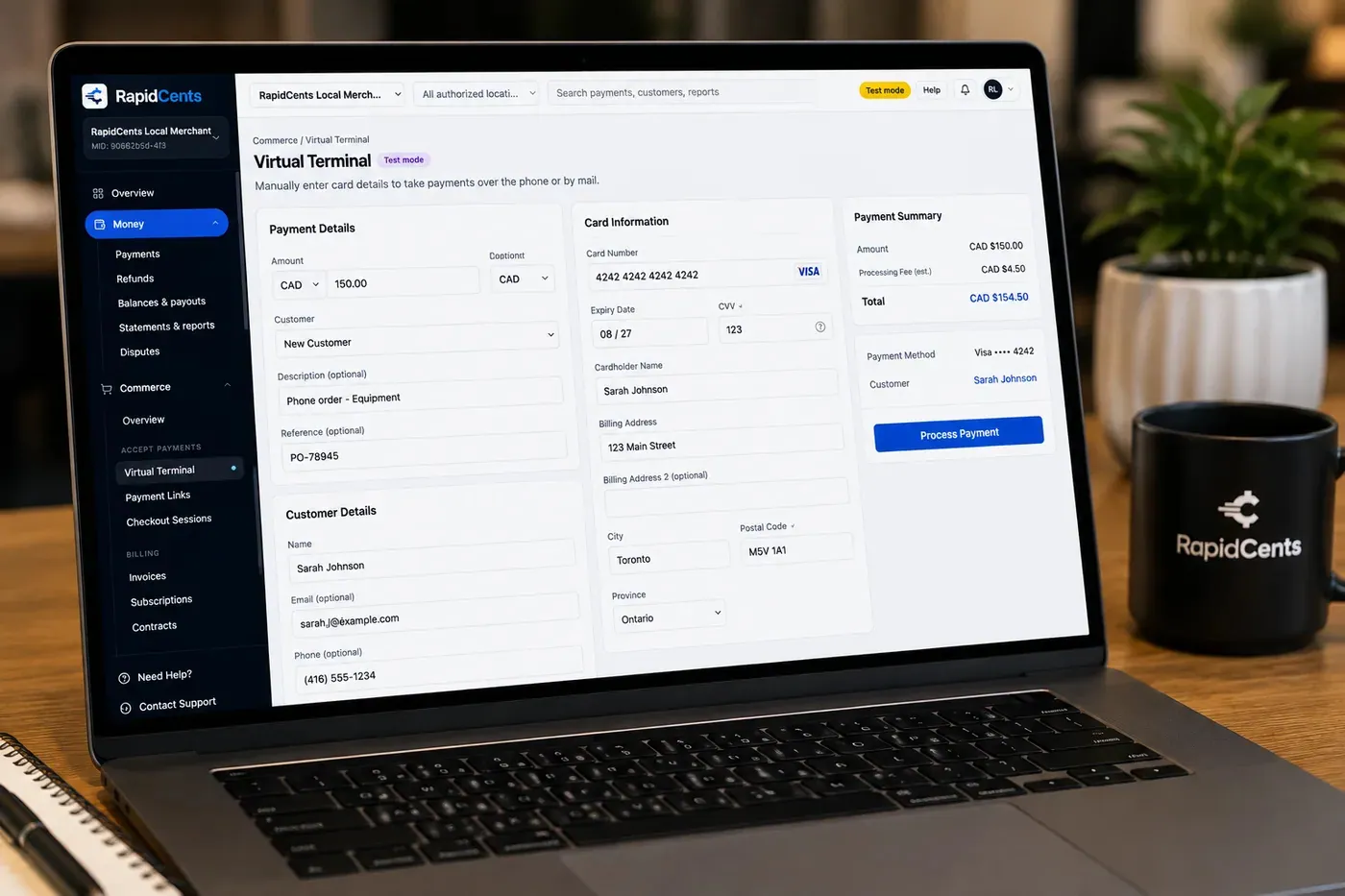
The RapidCents virtual terminal: payment details, card number, expiry and CVV keyed by hand on the left, with a payment summary on the right showing the amount, the estimated processing fee and a Process Payment button. Virtual Terminal
The RapidCents virtual terminal lets authorized staff enter mail-order and telephone-order payments through a…
Explore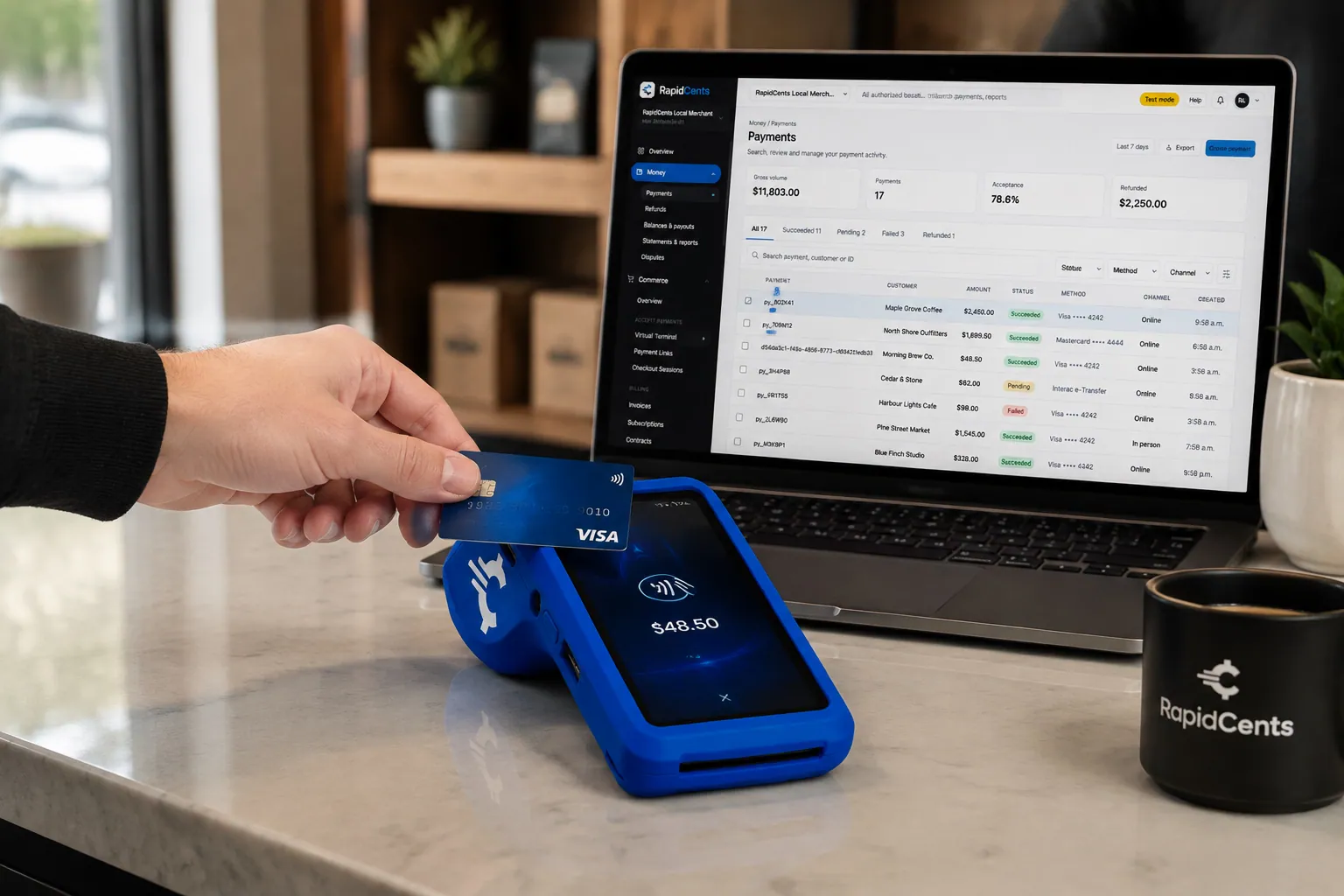
A fixed RapidCents countertop terminal taking card payments at the till, with settlement visible on the dashboard. Countertop Terminals
RapidCents countertop terminals sit at retail counters, restaurant hosts and reception desks where speed and…
Explore


How is storeroom replenishment billed and collected?
Storeroom replenishment is billed after each restocking visit for the items counted or scanned as used, then collected by invoice payment link, bank payment or a card the plant has authorized you to charge for replenishment. Because quantities change from visit to visit, the authorization should explain how each amount is worked out and when the plant sees it. Consigned stock, where you offer it, is invoiced when the plant draws it rather than on delivery.
How a replenishment cycle runs
At each agreed visit, your rep counts or scans what every bin, kanban card or storeroom shelf needs, and restocks it. The restock becomes an invoice listing items, quantities and agreed prices, carrying the visit date, replenishment PO and cost code. You send it with a payment link, or charge the plant's authorized card once its agreed review period has passed.
Set up the authorization for variable amounts
A card stored for replenishment needs the plant's written authorization covering which visits it pays for, how each amount is calculated, how long the plant has to review an invoice, any amount above which you call first, and how the plant cancels. Hold the card only as a Secure Card Vault token, never on a visit sheet, and let Account Updater refresh expired card details where the issuer supports it.
Count disputes, obsolete stock and price changes
If the plant disputes a count before the charge, correct the invoice first; if the card was already charged, refund the difference to that card and reissue the invoice. Agree in writing how slow-moving or obsolete bin stock is returned or bought back, and give notice of price changes before the visit they apply to, so no charge surprises the plant's accounts payable team.
Monthly restocking at a food plant
Say a supplier restocks a food plant's maintenance storeroom on the first Monday of each month. The rep scans 38 bins, and the supplier's system produces an invoice for the parts used since the last visit. The plant has three business days to query it. With no query raised, the supplier charges the stored purchasing card under the plant's signed authorization and matches the payment to the invoice.
What drives MRO distributor credit card processing costs?
MRO distributor credit card processing costs depend on the cards plants pay with, how each payment is taken, and how your orders split between frequent small parts tickets and occasional large repairs. Under RapidCents' interchange-plus pricing, the card networks' interchange on each payment is passed through at cost. On top of that interchange sit your RapidCents markup, as listed in your Fee Schedule, and fees for equipment or services, if applicable. Agreements are month to month, without a fixed term.
Purchasing cards and other commercial cards
Purchasing card acceptance is routine for MRO suppliers, because plants, utilities and facility departments commonly pay with purchasing cards and other commercial cards, which generally carry higher interchange than consumer debit cards. Measure how much of your volume arrives on commercial cards: a month led by plant purchasing cards will look different from one led by walk-in contractors paying with debit at your counter.
Phone and link payments versus the will-call counter
Breakdown orders keyed in the Virtual Terminal and invoices paid through a payment link count as card-not-present, which generally means higher interchange than a chip or contactless payment on a terminal. The same breakdown order paid in person when the millwright collects it is card-present. Your split between phone, link and counter payments is one of the first figures to pull from your statements.
Order size and Level 2 or Level 3 data
Fastener and filter orders are frequent and small, while a motor, gearbox or pump rebuild can be one large ticket. Level 2 and Level 3 data, meaning the PO, tax amount and line items sent with a commercial card payment, applies only where supported and verified for your setup. Measure any interchange difference on your own statements, and offer bank payment for your largest balances.
Refunds, chargebacks and what to bring to Fee Check
Every refund on a returned emergency spare and every chargeback on a disputed order adds cost and staff time, so total both over recent months. For Fee Check, gather recent processing statements, your share of purchasing and other commercial cards, your typical will-call, phone and invoice ticket, and how many refunds and chargebacks you handled. Run one statement through Fee Check and it lays your interchange beside your current markup.
Which ERPs and procurement systems does RapidCents work with?
RapidCents integrates with many major platforms through APPIE and RapidBridge. RapidBridge works with Acumatica, Dynamics 365 Business Central, Oracle NetSuite and SAP Business One Web Client, settled transactions, fees and refunds connect to QuickBooks Online and Xero, and SAP and NetSuite also import settlement files. The right option depends on your ERP vendor and version; your RapidCents representative will walk you through it.
Epicor Prophet 21
Epicor Prophet 21 is a distribution ERP, so it holds your sales orders, invoices and customer records. RapidCents integrates with many major platforms through APPIE and RapidBridge, and the right option for Prophet 21 depends on your version and on whether a bundled payment add-on or required gateway is in place. Your RapidCents representative will walk you through it. Meanwhile, payment links carrying the Prophet 21 invoice number keep every payment traceable.
NetSuite and SAP Business One
RapidBridge works with Oracle NetSuite and SAP Business One Web Client, and settlement import templates bring payments, fees and refunds into either ERP in batches you import. Tell your representative your edition or version and any payment add-on already installed, and they will show you how blanket PO release numbers and cost codes arrive where your team applies cash.
Dynamics 365 Business Central and Acumatica
RapidBridge works with Dynamics 365 Business Central and Acumatica, two ERPs distributors use for receivables, so a card payment posts against the invoice you already have open. Your RapidCents representative will walk you through the setup for your edition. If you keep an existing payment extension, ask your ERP provider whether it can run beside another processor.
QuickBooks Online and Xero
If your business keeps its books in QuickBooks Online or Xero, RapidCents maps settled transactions, fees and refunds there. Agree with your accountant how a returned emergency spare is booked, because a credit note and a card refund for the same return should never both land in the ledger.
Plant procurement portals and maintenance software
Plants may raise requisitions and POs in an e-procurement portal or punchout site and track work orders and asset numbers in maintenance software. Those approvals stay in the plant's systems, and your RapidCents representative can show you where each reference lands. You can copy the PO, work order or asset number into your invoice and payment link, then check it appears in your exports.
Payment options for industrial MRO suppliers in the United States
Industrial MRO suppliers in the United States can collect from plants by credit and debit card, including purchasing and other commercial cards, and by ACH bank payment from the plant's account, all settling in USD. Cards fit breakdown orders, will-call pickups and invoice links, while ACH fits large repair invoices, monthly balances and replenishment billing. Your RapidCents representative sets up the mix that suits your branches.
Card brands, purchasing cards and PIN debit
Visa, Mastercard, American Express and Discover are accepted on invoice links, Virtual Terminal phone orders and countertop terminals. Plant buyers often pay on a purchasing card with its own single-purchase limit, and walk-in customers at the counter can use PIN debit on a countertop terminal.
ACH for large invoices and replenishment
An ACH debit is not bound by a card's single-purchase limit, which suits motor and pump repair invoices, monthly balances and replenishment billing. Before the first debit, get the plant's written authorization showing the amount or how replenishment totals are calculated, when debits will run and how the plant can revoke it.
USD settlement, sales tax and surcharge rules
Payments settle in USD. Whether sales tax applies to an order, including any exemption certificate a plant has on file with you, is decided in your invoicing and tax process; the card or ACH payment simply collects the total. Before adding a card surcharge to plant invoices, check card network rules and the state laws that apply to your sales.
How do you switch processors without disrupting breakdown orders?
You switch without disrupting breakdown orders by listing what the old provider holds, giving branches and on-call staff working access to the new account before cutover, testing every payment route, and running both accounts in parallel until old refunds and disputes close. The list covers stored cards and their authorizations, replenishment charges due, open invoices with old payment links and repair orders still unpaid. Reconcile settlements to your ERP daily for the first weeks.
List what the old processor holds
Inventory every plant with a stored purchasing card and the authorization it signed, every replenishment account and its next visit date, every unpaid invoice carrying an old payment link, and recent repair and replenishment payments that may still need a refund. Cards stored with one provider move to another only when both providers agree to transfer them, so plan for some plants to authorize their card again.
Give branches and on-call staff working access
Once your account is approved, install the new countertop terminals at each will-call counter, create Virtual Terminal users for counter and on-call staff with the right role permissions, and rewrite the after-hours instructions around the new login and payment-link steps. If you run several branches, Multi-Location can give each its own merchant ID and roll-up reporting. Run one practice breakdown order end to end before the first night on the new account.
Test every route, then run both accounts for a period
Before live traffic moves, push one of each payment type through the new account: a counter sale, a refund, a payment link carrying a PO and cost code, and a Virtual Terminal phone payment. Then check that each one lands correctly in your ERP import or accounting connection. Leave the old account open until its last refunds and chargebacks have cleared, and reissue unpaid old links from RapidCents.
Reconcile settlements and tell plants what changes
RapidCents Reporting gives transaction, settlement and fee reports, exportable as CSV or PDF or in formats for accounting import; use them to tie each settlement back to its invoices, counter sales and replenishment charges. Warn each plant's accounts payable team and maintenance supervisors about the new name they will see on card statements and the new sender of payment links, so nobody reports a legitimate charge as fraud.
Payment questions from industrial MRO suppliers
What is the best payment processor for industrial MRO suppliers?
No processor is best for every industrial MRO supplier; the right one handles breakdown orders, plant POs and storeroom replenishment the way your branches already work. When you compare industrial supply merchant services, look for order-linked payment links and Virtual Terminal access for urgent orders, countertop terminals at will-call, stored cards under written authorization, and reference fields for PO, release and cost code. Then check the route into your ERP and whether pricing shows interchange apart from markup, with no fixed term. Compare written quotes on the same statement.
How much does credit card processing cost for MRO distributors?
There is no single figure: on interchange-plus pricing, an MRO distributor's cost depends on which cards plants use, how each payment is taken and ticket size. RapidCents passes interchange through at cost and charges the markup in your Fee Schedule, plus fees for equipment or services, if applicable. A plant's purchasing card generally carries higher interchange than a contractor's debit card, and a breakdown order keyed by phone usually costs more than one paid by chip or tap at will-call. Fee Check splits an uploaded statement into interchange and markup.
Can we keep Epicor Prophet 21 and change payment processors?
In most setups, yes. RapidCents integrates with many major platforms through APPIE and RapidBridge, and the right option for Prophet 21 depends on your version and on whether a bundled payment add-on or required gateway is in place. Payment links carrying the invoice number work alongside it in the meantime. RapidBridge works with Dynamics 365 Business Central, Acumatica, Oracle NetSuite and SAP Business One Web Client, and QuickBooks Online and Xero receive settled transactions, fees and refunds. Your RapidCents representative will walk you through your setup.
How can MRO suppliers switch processors without losing payment history?
Keep the history by exporting it from the old processor and leaving that account open until its last refunds and disputes are resolved; sales orders, invoices, POs and cost codes never leave your ERP. Before cutover, pull transaction, refund and chargeback reports, list each plant with a stored purchasing card and its authorization, and note replenishment and repair payments that might still be refunded through the old account. Stored cards transfer only when both providers agree, so plan for some plants to authorize again.
Which payment options can an industrial MRO supplier in the United States offer plants?
An industrial MRO supplier in the United States can offer plants card and ACH bank payments. Buyers can pay by Visa, Mastercard, American Express or Discover, purchasing cards included, whether they phone in a breakdown order, open an invoice link or collect at will-call, with PIN debit for walk-in customers at the counter. ACH fits large repair invoices, monthly balances and replenishment once the plant authorizes the debit. Payments settle in USD. Your RapidCents representative will show you which methods to put on your invoices.
Can a maintenance team pay for an emergency part remotely?
Yes, through a secure payment link tied to the sales order and sent only to a buyer already listed on the plant's account. If your staff can confirm who is calling, they can also take the card by phone in the Virtual Terminal. Check an unfamiliar caller through the plant's main number before releasing anything. The buyer pays from a phone or computer, the payment keeps the sales order number, and will-call releases the parts to the named collector. Never accept card details by text or email.
How do plant cost codes appear on payments?
Cost codes appear as reference values your team adds: captured with the order, printed on the invoice and entered in the payment link's reference field. A purchasing card payment does not carry the plant's cost code on its own. Agree the exact format with each plant, plus any other references it wants, such as a work order or asset number. Because field names and limits vary by setup, make a test payment and check that each code reaches your export and reconciliation reports before you tell plants what to expect.
Does RapidCents approve a plant's purchase requisitions or budgets?
No. Purchasing sign-off stays in the plant's own procurement system and in your ERP's credit and order controls. A card authorization only means the issuer accepted that payment; it does not tell you the purchase went through the plant's budget or approval chain. If a plant requires a PO before you ship, enforce that in your order process and keep the PO with the invoice and payment.
Can we charge a stored card for storeroom replenishment?
Yes, with the plant's written authorization, and the card stored as a token rather than on paper. Treat it as a charge per invoice, not a fixed subscription: amounts change with each count, so the plant should receive the invoice and have an agreed window to query it before you charge. RapidCents keeps the token in the Secure Card Vault on the plant's customer profile, and role permissions decide which staff can charge or refund it. Otherwise, each invoice goes out with its own payment link.
How should returned or unused emergency parts be refunded?
Refund or credit them under your written return policy, against the original invoice and payment. If the plant paid by card, refund the approved amount to that card, or issue a credit note on the account if the plant prefers, but not both for the same return. Deduct a restocking charge only where your policy and the order terms allow it, and handle special-order or non-returnable items as your policy sets out. Keep the return authorization number with the refund so both sides can reconcile it.
What MCC is used for industrial MRO suppliers?
MCC 5085 (industrial supplies, not elsewhere classified) is commonly associated with industrial MRO distributors. RapidCents sets the category at onboarding by looking at your actual product range and how your branches sell. Plants' purchasing card programs can restrict the merchant categories a card works with, which is one more reason the category should reflect your real business. Mention any repair shop, hose assembly or other service work you run so the review covers it.
Related supplier pages
Tool and hardware suppliers, safety and PPE suppliers and electrical supply wholesalers share the same trade-counter, PO-reference and repeat-order workflows, while the B2B & Wholesale hub explains distributor payments in general. Industrial equipment suppliers have their own page for machine deposits and commissioning balances.
B2B & Wholesale
Collect net-terms invoices by payment link with the PO number attached, take commercial…
Tool & Hardware Suppliers
Take trade-counter sales, contractor account invoices, phone orders and tool returns…
Safety & PPE Suppliers
Collect site-level PPE orders, bulk uniform deposits and repeat replenishment from the…
Plumbing Supply Wholesalers
Collect counter sales, special-order fixture deposits and trade-account statements from…
Electrical Supply Wholesalers
Collect from electrical contractors and facility buyers at the will-call counter, by…
HVAC Supply Distributors
Collect furnace and condenser deposits, trade counter sales and contractor statement…
Dental Suppliers
From monthly consumables reorders to chair and imaging deposits, collect what clinics…
Veterinary Suppliers
Get invoices, standing orders and equipment deposits paid by the veterinary practices…
Take the next step
See what plant card payments cost your branches
Fee Check reads the processing statement you upload and separates interchange from markup, showing what your current provider adds to your will-call, phone and invoice payments. Then bring your purchasing card share, after-hours ordering routine and ERP to a review of how your branches collect from plants.
- No obligation
- Payment specialists, not a call centre
- Secure statement upload



