


Payment processing for plumbing suppliers and wholesalers
Payment processing for plumbing suppliers covers the three ways contractors and builders pay a wholesaler: card sales at the trade counter, deposits and balances on special-order fixtures, and monthly trade-account statements. RapidCents handles them with countertop terminals, Payment Links, Invoicing and the Virtual Terminal for phoned orders, and your ERP stays in the loop.

- PCI DSS Level 1
- SOC 2 Type II
- All major cards: Visa, Mastercard, Amex, Discover, UnionPay, Diners Club & PIN Debit
- Interchange-plus available
- Specialist onboarding support
How plumbing supply wholesalers get paid
Plumbing supply wholesalers get paid by plumbing and mechanical contractors, builders and facilities buyers through five kinds of trade plumbing payments. Counter sales are frequent and small, special-order fixtures bring a deposit and a balance, and trade accounts settle from monthly statements. Phone orders and returns add their own records, and RapidCents gives each one a reference your team can match.
Trade-counter sales
A plumber or apprentice picks up fittings, PEX, valves or a water heater at the counter and pays before leaving, or charges the ticket to the contractor's credit account. Card sales are tapped or inserted on a countertop terminal. If a card declines or does not belong to the account holder, the ticket waits until someone who can pay steps up. Finance gets the counter ticket number on each receipt.
Will-call and job-site delivery orders
A contractor's office phones or emails an order for later pickup or delivery to a job site. Staff key the card into the Virtual Terminal or send a payment link carrying the order number and job name, so the will-call desk or driver releases only paid goods. If a substitution or short shipment changes the total, the order is adjusted. Finance matches each payment to its order and delivery ticket.
Special-order fixture deposits
A contractor, builder or their client choosing a freestanding tub, a designer faucet set or a commercial fixture package pays a deposit when the special order is placed and the balance when it arrives. Payment Links or Invoicing send both requests. If the order is cancelled after it reaches the factory, the terms on the quote decide what happens to the deposit. Finance follows one quote reference from deposit to final invoice.
Contractor trade-account statements
Contractors with a credit account charge counter and delivery purchases to it and pay from a monthly statement on the terms you agreed. The statement goes out with a payment link, or is charged to a card the contractor authorized you to store. If a payment comes in short or a counter ticket is disputed, the open item stays visible. Finance gets the statement number and the invoices each payment clears.
Returned fittings and credits
Plumbers bring back unused fittings, wrong-size valves and surplus pipe after a job. Your return policy decides whether the original card is refunded or a credit note goes on the trade account, and whether a restocking charge applies. If the manufacturer will not take a special-order item back, the terms the buyer accepted decide the outcome. Finance gets the original ticket and the return amount on every refund or credit.
How do plumbers pay at the trade counter or before pickup?
Plumbers pay a plumbing wholesaler at the trade counter by tapping or inserting a card on a countertop terminal, or before pickup through a payment link or a phoned card, so an employee can collect parts that are already paid for. Each remote payment needs an authorized payer, an order number on the receipt and a pickup record at the will-call desk.
How a counter or will-call sale runs
At the counter, staff enter the ticket total on a RapidCents countertop terminal and the plumber taps or inserts a card. For will-call orders, the office manager pays a payment link or phones the desk, where staff key the card in the Virtual Terminal. The payer gets an emailed receipt, and the will-call desk sees the link marked paid in the merchant dashboard before anyone arrives.
Set up authorized payers and pickup evidence first
Agree with each contractor who may pay and who may collect: the owner, the office manager, named apprentices or drivers. Keep that list on the account. At the will-call window, ask for the order number and a name, and keep a signed or photographed pickup slip. Remote card payments should come from the cardholder or someone the account holder authorized, never from a card number read out at the counter.
Declines, wrong parts and disputed pickups
When a remote payment declines, the order stays on hold and the link can be sent again. If the wrong part was picked, put the replacement on the same order instead of taking a fresh charge. A card dispute claiming nobody collected the goods is answered with the receipt, the order and the signed pickup slip, so file all three under the order number.
A 6:40 a.m. pickup before a no-heat call
Say a contractor's office manager pays a link at 6:40 a.m. for a replacement water heater, a gas connector and fittings, so an apprentice can collect them on the way to a no-heat call. The will-call desk sees the link marked paid in the dashboard, matches the apprentice's name to the authorized list and has the slip signed. Finance later matches the payment to the order and the slip.
Collecting deposits and balances on special-order fixtures
Special-order fixture deposits are collected after the buyer accepts a written specification, the deposit amount and the cancellation terms, usually by payment link or at the showroom terminal, and the balance follows when the fixtures arrive. Because special-order tubs, faucets, toilets and commercial fixtures often cannot go back to the manufacturer, the quote should set out what the deposit covers before you take payment.
How a fixture deposit and balance run
Your showroom or inside-sales team builds the quote with model numbers, finishes and quantities. Once the contractor or their client accepts it, Invoicing or a payment link requests the deposit with the quote and job reference attached. When the factory order lands at your branch, a second request collects the balance, or the remaining amount moves onto a trade account under its usual terms.
Put the specification and terms in writing first
Before the deposit, show the buyer the exact fixtures and finishes, the lead time, whether the order can be cancelled once it reaches the manufacturer, and any restocking charge your policy sets. Contracts & eSignatures can send the quote for signature and take the deposit in the same step. A clear written acceptance is what answers a later dispute about a finish or a cancellation.
Changes, delays and cancellations
If the client changes a finish, issue a revised quote and adjust the balance rather than refunding and charging again. A long factory delay may bring a cancellation request; your written terms decide whether the deposit is refunded in full, in part or kept as credit. A refund goes back to the original card, so keep the deposit's transaction reference with the special order.
A bathroom renovation package with a $2,400 deposit
Say a renovation contractor orders a freestanding tub, a thermostatic shower system and a wall-hung toilet with its carrier, all in matte black, with a six-week lead time. The client signs the quote and pays a $2,400 deposit through a payment link. When the fixtures arrive, Invoicing sends the balance under the same quote number, and delivery is booked once it is paid.
RapidCents products for plumbing supply wholesalers
These products follow a plumbing wholesaler's day: countertop terminals for the trade counter, Payment Links and Invoicing for will-call orders, fixture deposits and monthly statements, and the Virtual Terminal for orders phoned in from job sites. Each can carry the order, statement or job reference your branches and receivables team match against.
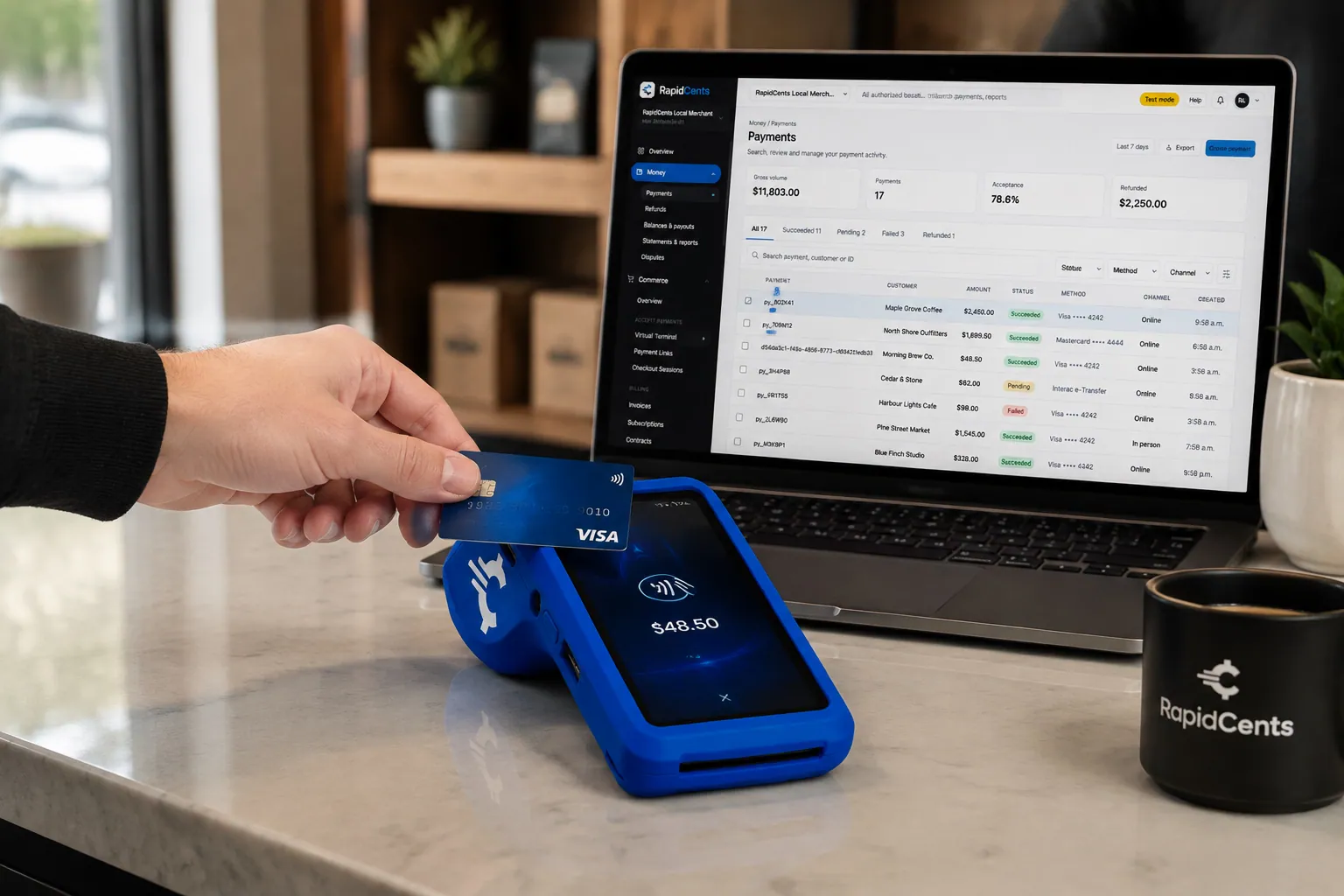
A fixed RapidCents countertop terminal taking card payments at the till, with settlement visible on the dashboard. Countertop Terminals
RapidCents countertop terminals sit at retail counters, restaurant hosts and reception desks where speed and…
Explore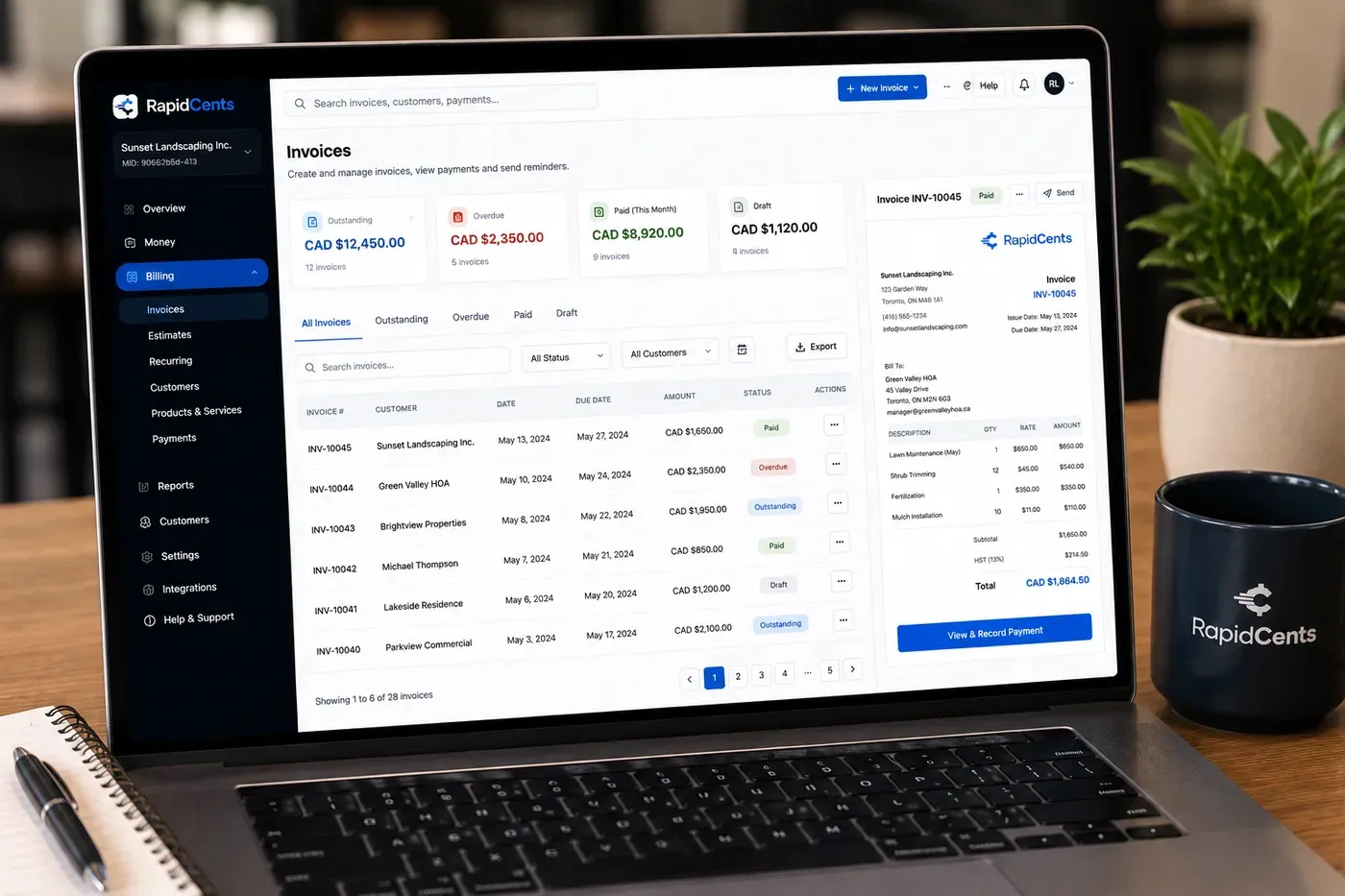
The RapidCents invoices screen: outstanding, overdue, paid and draft totals across the top, the invoice list below them, and a preview of one invoice on the right with its line items and a View & Record Payment button. Invoicing
RapidCents invoicing helps professional services, contractors and B2B suppliers create branded invoices…
Explore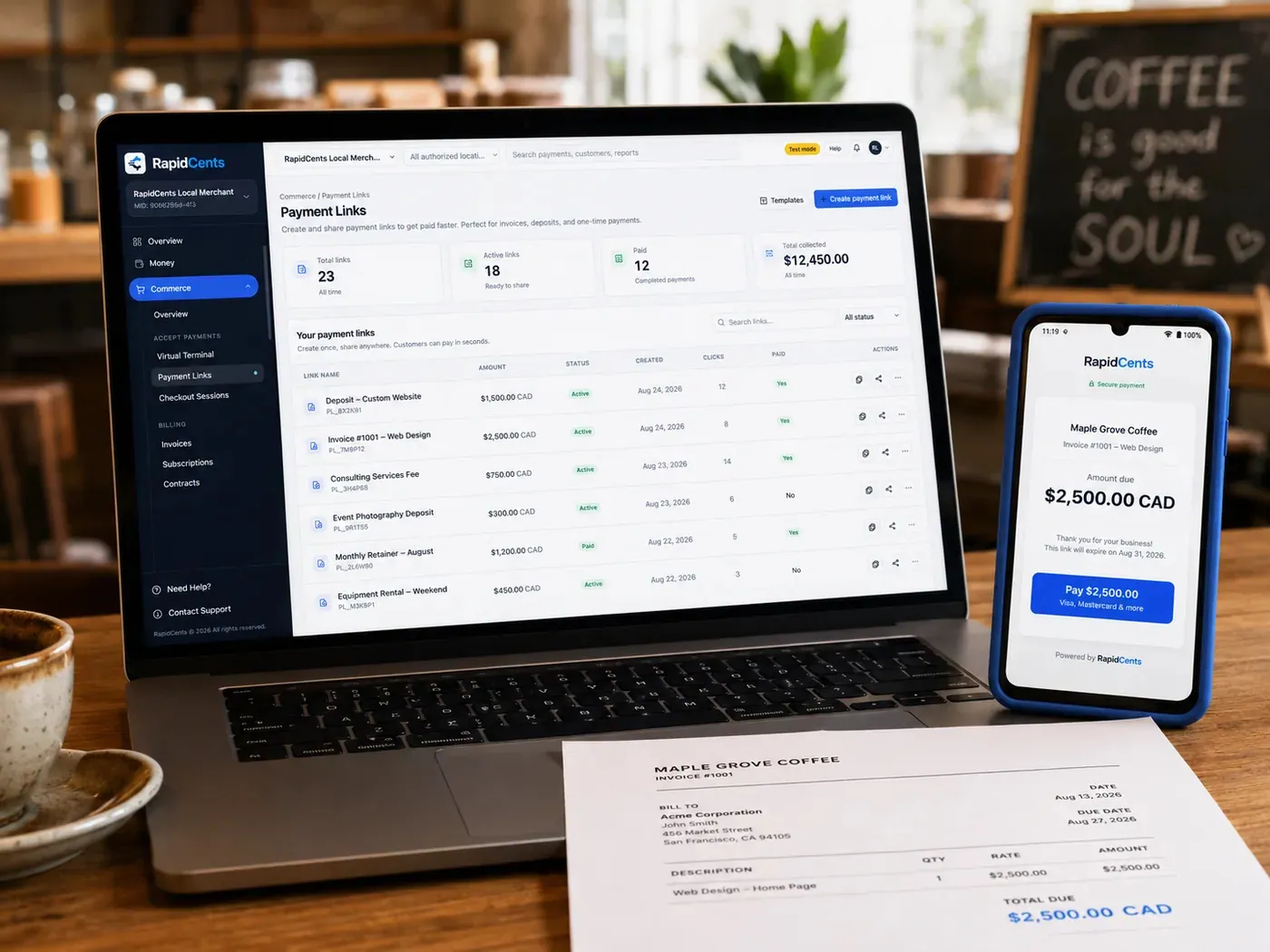
The RapidCents payment links screen listing created links with their amount, status, click count and whether they have been paid, beside a phone showing the branded page a customer opens to pay $2,500.00. Payment Links
RapidCents payment links let staff generate branded pay-by-link URLs for invoices, deposits, balances and…
Explore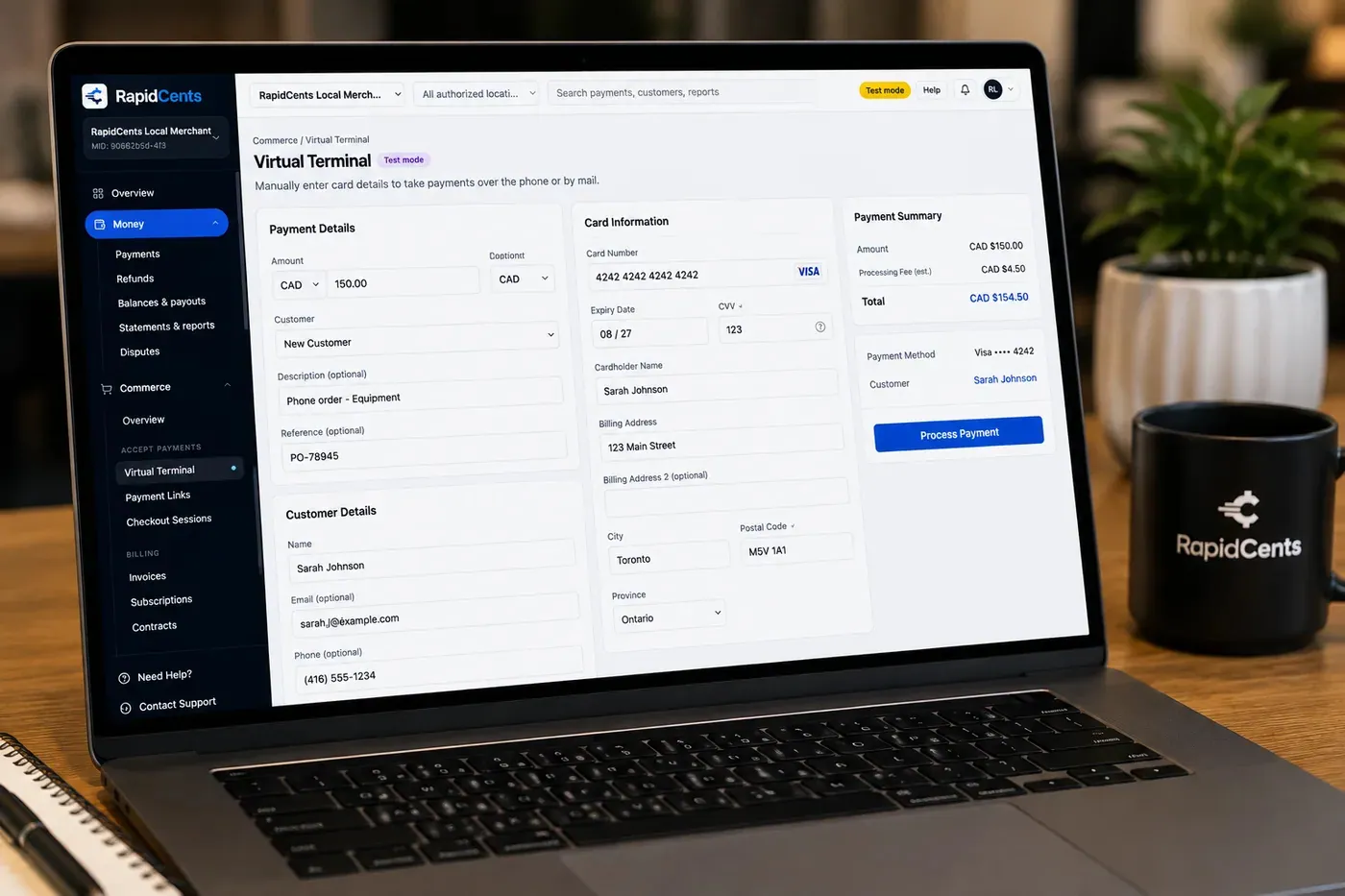
The RapidCents virtual terminal: payment details, card number, expiry and CVV keyed by hand on the left, with a payment summary on the right showing the amount, the estimated processing fee and a Process Payment button. Virtual Terminal
The RapidCents virtual terminal lets authorized staff enter mail-order and telephone-order payments through a…
Explore


How do contractor trade accounts pay monthly statements?
Contractor trade accounts pay a plumbing wholesaler from a monthly statement, on the terms you set, by invoice payment link, by a card the contractor authorized you to store or by bank payment. Counter card sales are already paid, so keep them apart from account receipts with distinct references. Paying a statement by card leaves the agreed terms as they are and is not financing.
How a statement payment runs
At month-end your ERP produces the statement listing charged counter tickets, delivery orders and credit notes. Invoicing or a payment link sends the total, and the contractor's bookkeeper pays all or part of it by card. Partial payments apply to the open balance, automated reminders go out before the due date, and the receipt shows the statement number your receivables team posts against.
Keep counter and account receipts apart
Give each channel its own reference: counter ticket numbers for card sales at the branch, statement or invoice numbers for account payments. Where you run several branches, Multi-Location gives each one its own merchant ID with roll-up reporting. Then run a test month through Reporting and your accounting export to see the two kinds of receipt land in different places.
Stored cards, short payments and credit notes
A contractor who wants the statement charged automatically must authorize you to store the card, with the amount basis, timing and how to cancel agreed in writing. When a payment is short because a ticket is disputed or a return is pending, apply what was paid and leave the open item visible. Credit notes for returned fittings reduce the statement; they are not card refunds.
An October statement with 31 counter tickets and a credit note
Say a mechanical contractor's October statement lists 31 counter tickets charged to the account, two job-site deliveries and a credit note for returned ball valves. The bookkeeper pays the net total through the emailed payment link, with the statement number attached. Your team applies the payment to the open invoices, and the credit note is used up on the same statement rather than refunded to a card.
What drives plumbing wholesaler credit card processing costs?
Plumbing wholesaler credit card processing costs depend on the cards contractors pay with, how each payment is taken and the size of your tickets. RapidCents prices on interchange-plus: interchange, set by the card networks, passes through at cost, plus the RapidCents markup set out in your Fee Schedule and fees for equipment or services, if applicable. Your agreement is month to month, with no fixed term to wait out.
Card mix at the counter and on account
A small contractor may pay a counter ticket by debit or a personal rewards card, while a mechanical firm or facilities buyer may pay its statement with a business, corporate or purchasing card. Business and rewards cards generally carry higher interchange than debit. Look at which cards pay which jobs over several months, because a quiet month of counter sales and a month of big project balances look very different.
Tapped at the branch versus keyed or paid by link
A card tapped or inserted at a countertop terminal is a card-present payment. A phoned will-call order keyed in the Virtual Terminal and a statement paid through a link are card-not-present, which generally carries higher interchange. Your split between branch, phone and link payments is one of the figures that moves your total cost the most.
Large project balances and enhanced data
Commercial project orders for boilers, backflow assemblies or multi-unit fixture packages produce fewer, larger payments. Some commercial and purchasing cards can carry PO, tax and line-item detail as Level 2 or Level 3 data, where your setup supports it. Measure any difference on your own statements instead of assuming one, and compare a bank payment for the largest balances.
Returns, refunds and chargebacks
Refunding returned fittings to a card, and answering disputes about pickups nobody remembers, both add cost and staff time, so count them in your comparison. If you are thinking about surcharging card payments on statements, check the card network rules and the laws that apply to your business before you change your trade-account terms.
What to bring to Fee Check
Bring two or three recent processing statements, your split between counter, phone and link payments, your average counter ticket and statement payment, your card-type mix and your refund and chargeback counts. Fee Check reads the uploaded statement and separates interchange from markup, so you see what counter, phone and statement payments cost you today before you compare an interchange-plus quote.
Can RapidCents work with your distribution ERP?
RapidCents integrates with many major platforms through APPIE and RapidBridge, so a plumbing distributor can keep the ERP or accounting software it runs today. RapidBridge takes card payments inside web-based business software without changing it, APPIE lets point-of-sale software drive RapidCents terminals, and settlement files cover the rest. The right option depends on your vendor and version; your RapidCents representative will walk you through it.
Epicor Prophet 21
Epicor Prophet 21 holds counter tickets, sales orders, trade accounts and receivables for the distributors that run it. RapidCents integrates with many major platforms through APPIE and RapidBridge, and the right option depends on your Prophet 21 version. Tell your RapidCents representative which version you run, and they will show you how counter tickets, order-number payment links and statement receipts connect to it.
NetSuite
Distributors on NetSuite keep customer accounts, sales orders and invoices there. RapidCents settlement files import into NetSuite, so payments, fees and refunds post against the open sales order with the references you set. A fixture deposit, for instance, lands against the special order it belongs to. Your RapidCents representative will walk you through the import for your edition.
SAP Business One
SAP Business One records invoices and incoming payments for the distributors that use it. RapidBridge works with SAP Business One Web Client, so a card payment can post against an invoice you already have open, and settlement files import into SAP with statement and invoice numbers your receivables team posts against. Your representative will walk you through your version.
Dynamics 365 Business Central and Acumatica
RapidBridge works with Dynamics 365 Business Central and Acumatica, so a card payment posts against the sales invoice you already have open, with the receipt recorded in the ERP. If you prefer to stay outside the software, a payment link carrying the ERP invoice number or a scheduled settlement export does the same job. Your RapidCents representative will walk you through the options for your edition.
QuickBooks Online and Xero
For wholesalers whose books sit in QuickBooks Online or Xero, RapidCents connects settled transactions, fees and refunds to either one. Agree with your accountant how special-order deposits are recorded before the fixtures are delivered and invoiced, and your RapidCents representative will set up the mapping with you.
Payment options for plumbing wholesalers in the United States
Plumbing supply wholesalers in the United States can collect from contractors by credit and debit card, including business and purchasing cards, and by ACH bank payment, with settlement in USD. Cards suit counter tickets, will-call links and phone orders, while ACH suits monthly trade-account statements and large project balances.
Cards at the counter, including PIN debit where supported
Visa, Mastercard, American Express and Discover cards can be tapped or inserted on a countertop terminal, and PIN debit works where the terminal supports it. The same cards work on will-call payment links and Virtual Terminal phone orders.
ACH for statements and project balances
An ACH debit is not limited by a card's available credit, which suits monthly statements and large commercial balances. Get the contractor's authorization before you initiate a debit, with the amount or how it is calculated and the timing set out in writing.
USD settlement, sales tax and state rules
Payments settle in USD. Sales tax on your invoices, including how you handle resale or exemption certificates from contractors, stays with your business and your advisor; the payment only collects the invoice total. State law and card network rules both govern surcharges, so check them before adding one to statements.
How to switch processors with open accounts and deposits
Once your account is approved, a plumbing wholesaler switches processors most safely in stages: list stored contractor cards, open special-order deposits, unpaid statements and pending returns, test the new flow, then move branches and channels over one at a time. Stored cards may need to be collected again with each contractor's authorization, because moving card tokens between processors needs both providers to agree.
Inventory what is still in flight
Before you move, list the cards stored for trade accounts and their authorizations, special-order deposits taken on your current processor, unpaid statements, open payment links and returns waiting for a refund. A deposit taken on the old processor is refunded there, so keep that account open until those special orders are delivered or closed.
Test the counter, the link and the refund
Run a counter sale on a countertop terminal, a will-call payment through a link, a phoned order in the Virtual Terminal, a fixture deposit and a refund for returned fittings. Check that each receipt shows the order, statement or job reference, and that Virtual Terminal role permissions match who on your team may issue refunds.
Move one branch or channel at a time
Start with one branch's counter, or with statement payments, and run the old and new setups side by side for one statement cycle. That parallel month shows whether counter receipts and account receipts stay separate in Reporting before every branch moves.
Map references, then reconcile the first deposits
Agree where the account number, statement number, order number and job name sit in a RapidCents payment, using the custom reference fields on payment links, and how each arrives in your ERP or accounting import. For the first few weeks, match each settlement deposit to its receipts, with fees and refunds shown separately, and close any gaps before month-end.
Payment questions from plumbing supply wholesalers
What is the best payment processor for plumbing supply wholesalers?
The best payment processor for a plumbing supply wholesaler is the one that fits how your contractors actually pay, at a cost you can verify. When you compare plumbing supply merchant services, look at counter terminals for the morning rush, payment links and statements that carry order and job references, stored cards with authorization for trade accounts, credits for returned fittings, and how payments reach your ERP. Your RapidCents representative will give you a written interchange-plus quote, and you can test a sale, a deposit and a refund before you decide.
How much does credit card processing cost for plumbing suppliers?
Credit card processing for plumbing suppliers costs interchange plus a markup, and the total depends on your card mix and channels. With RapidCents, interchange passes through at cost, and you pay the RapidCents markup set out in your Fee Schedule plus fees for equipment or services, if applicable, month to month with no fixed term. Business and purchasing cards on statements and keyed phone orders generally cost more than debit tapped at the counter. Upload a recent statement to Fee Check to see your own split.
Can a plumbing distributor's ERP, such as Epicor Prophet 21, use a different payment processor?
Often, yes, though it depends on the ERP, its version and your market. Some distribution ERPs work through their own payment add-on, while others accept payments recorded from outside. RapidCents integrates with many major platforms through APPIE and RapidBridge, works with Acumatica and Dynamics 365 Business Central through RapidBridge, imports settlement files into NetSuite and SAP, and connects to QuickBooks Online and Xero. Tell your RapidCents representative which Epicor Prophet 21 version you run, and they will walk you through the options.
How can a plumbing wholesaler switch processors without losing payment history?
Keep your current processor account open for reporting, refunds and open deposits while RapidCents takes new payments, and export your transaction and settlement history first. Stored contractor cards may need to be collected again with each account holder's authorization, because moving card tokens needs both providers to agree. List special-order deposits, unpaid statements and pending returns, then test a counter sale, a link payment and a refund on RapidCents before you move each branch.
Which payment options can a plumbing wholesaler in the United States offer contractors?
A plumbing wholesaler in the United States can offer contractors card payments and ACH bank payments. Contractors can use Visa, Mastercard, American Express and Discover cards at the counter, on payment links or by phone through the Virtual Terminal, with PIN debit where supported. ACH suits monthly statements and large project balances once the contractor authorizes the debit. Payments settle in USD. Your RapidCents representative will help you decide which methods to list on your statements.
Can a plumber pay remotely while an employee collects parts?
Yes. The contractor or their office manager can pay a payment link or a phoned card before an apprentice or driver collects the order, as long as the payer is authorized and the pickup is recorded. Tie the payment to the order number, keep a list of who may collect for each account, and have the person collecting give the order number and their name and sign a pickup slip. That record is what answers a later dispute about the goods.
How are special-order fixture deposits collected?
Special-order fixture deposits are collected after the buyer has seen and accepted the order specification, the deposit amount and the cancellation terms. Send the quote with model numbers, finishes and lead time, then request the deposit by payment link, by invoice or at the showroom terminal under the quote number. Set out whether the deposit is refundable once the factory order is placed, and any restocking charge. The balance is requested under the same reference when the fixtures arrive.
Can counter and monthly trade-account receipts stay separate?
Yes, if each channel carries its own reference and you check the result in your reports and accounting export. Counter card sales carry ticket numbers, while statement payments carry the account and statement number. Where branches have their own merchant IDs through Multi-Location, reports can roll up or split by branch. Run one test month and check that counter receipts and account receipts post to different places before you rely on the setup.
How are returned fittings refunded when a contractor paid by card?
Returned fittings are refunded to the original card or credited to the trade account, depending on how the sale was paid and what your return policy says. A counter sale paid by card is refunded to that card for the agreed return amount, using the original transaction. A purchase charged to the account gets a credit note on the statement instead. Special-order items the manufacturer will not take back follow the terms the buyer accepted before paying the deposit.
Does paying a trade-account statement by card change the contractor's terms?
No. A card or bank payment is only a way to settle the statement; it does not change the net terms, credit limit or due date you agreed with the contractor, and it is not financing. The contractor's card issuer sets the limits and billing on that card. Any early-payment discount or late charge comes from your trade-account agreement, not from RapidCents, so keep those terms in the agreement itself.
What MCC is used for plumbing supply wholesalers?
MCC 5074, which covers plumbing and heating equipment and supplies, is commonly associated with plumbing supply wholesalers. RapidCents sets the correct merchant category during onboarding, based on what your business actually sells and how it sells it. If you also run a showroom that sells fixtures directly to homeowners, or you sell heating equipment and water treatment systems alongside plumbing stock, mention it so the review reflects your whole business.
Related trade supply pages
Electrical supply wholesalers and HVAC supply distributors share these counter, will-call and trade-account workflows, and the B2B & Wholesale page covers distributor payments across categories. Plumbing contractors collecting from homeowners have their own page, covering service-call payments and job deposits.
B2B & Wholesale
Collect net-terms invoices by payment link with the PO number attached, take commercial…
Tool & Hardware Suppliers
Take trade-counter sales, contractor account invoices, phone orders and tool returns…
Industrial MRO Suppliers
Get paid by the plants, mills and maintenance contractors you supply, from a breakdown…
Safety & PPE Suppliers
Collect site-level PPE orders, bulk uniform deposits and repeat replenishment from the…
Electrical Supply Wholesalers
Collect from electrical contractors and facility buyers at the will-call counter, by…
HVAC Supply Distributors
Collect furnace and condenser deposits, trade counter sales and contractor statement…
Dental Suppliers
From monthly consumables reorders to chair and imaging deposits, collect what clinics…
Veterinary Suppliers
Get invoices, standing orders and equipment deposits paid by the veterinary practices…
Take the next step
Review how contractors pay your branches
Upload a recent processing statement to Fee Check to see interchange separated from markup across counter sales, will-call links and statement payments. Then bring your branch count, ERP and special-order deposit process to your RapidCents representative and build your plumbing supplier payment workflow together.
- No obligation
- Payment specialists, not a call centre
- Secure statement upload



