


Payment processing for chemical suppliers and distributors
Payment processing for chemical suppliers is how a chemical distributor collects from plants, water-treatment operators and contractors by link, phone, terminal or bank payment. RapidCents covers PO-referenced payment links, drum, tote and bulk deposits, container charges and credits, phone orders on the Virtual Terminal and will-call sales. Controlled substances and their precursors are never accepted.

- PCI DSS Level 1
- SOC 2 Type II
- All major cards: Visa, Mastercard, Amex, Discover, UnionPay, Diners Club & Interac Debit
- Interchange-plus available
- Canadian support
How industrial chemical suppliers get paid
Industrial chemical suppliers get paid by the manufacturing plants, water-treatment operators, formulators and contractors they supply, through five payment jobs, all of them set up on your RapidCents account. Most B2B chemical payments arrive on invoices for repeat orders, while drum, tote and bulk orders add deposits and container charges. Suppliers of lab reagents, crop inputs or janitorial products have their own pages.
Repeat plant orders on account
Manufacturing plants, water and wastewater operators, and head offices paying for several plants reorder process chemicals against a blanket purchase order. Each release that ships triggers an invoice, paid on the account's agreed terms by payment link, purchasing card or authorized bank payment. If a release is larger than a purchasing card's limit, the plant pays it by bank payment instead. Finance needs the PO, release number and delivery ticket on every payment.
Deposits on drum, tote and bulk orders
Buyers ordering a custom blend, a product you do not stock or a full bulk load pay a deposit before you buy from the producer, blend the batch or book a carrier. The deposit is collected by payment link or with a signed order, and the balance follows delivery. If the delivered quantity differs from the order, the final invoice follows the delivered amount. Finance applies the deposit to the final invoice.
Container charges and return credits
Accounts that receive product in returnable drums and IBC totes pay a container charge on the invoice and earn a credit when the empties come back in acceptable condition. If containers come back damaged or contaminated, or never come back, your written container policy decides the charge. Finance keeps a container balance for each account, tied to the orders that shipped the containers.
Will-call pickups and prepaid first orders
Contractors, small manufacturers and plant maintenance crews collect pails and drums at your will-call door, and new buyers often prepay a first order or pay on delivery. They pay by tap or chip on a terminal, by phone through the Virtual Terminal, or to a driver with a mobile terminal or Tap to Pay. An order waits until your own customer checks, such as an end-use declaration, are complete. Finance gets the receipt and sales order.
Quality claims, returns and credit memos
A buyer may report off-spec product, a wrong grade or a damaged drum, or ask to return unopened stock under your return policy. Once the claim is checked against the lot number and certificate of analysis, it is settled as a credit memo on the account or a refund to the card that paid. Your policy decides whether opened product can come back. Finance links each claim to the original invoice and payment.
How do plants pay for repeat chemical orders on account?
Plants pay for repeat chemical orders on account by settling each invoice issued against their blanket purchase order, through the invoice's payment link, by purchasing card over the phone, or from a card or bank account they have authorized you to charge. Chemical supplier invoice payments are easiest to match when the PO, release and delivery ticket numbers travel with each payment. A card or link payment does not change the net terms agreed with the account and is not financing.
How a release becomes a paid invoice
When a release ships, send its invoice with a payment link, either from Invoicing or as a Payment Link carrying your ERP invoice number, and put the PO, release number, ship-to plant and delivery ticket number on the invoice and in the link's reference fields. The plant's accounts payable clerk matches it to the receiving record, then pays by card, or by bank payment where your account offers it, and receives an emailed receipt to file with the PO.
Name the buyers and payers first
Record who may place releases, often a plant's utilities or maintenance lead, and who may pay, usually accounts payable or a purchasing cardholder. If a plant wants releases charged automatically, get written authorization naming the card or bank account, saying each charge equals the invoiced release, when it runs and how to cancel. Keep the card in the Secure Card Vault, never written on a purchase order. A fixed monthly fee, such as storage tank rent, can run on Recurring Payments once the plant agrees to its amount, timing and cancellation.
Card limits, short shipments and disputed lines
A purchasing card can decline because a release exceeds the single-purchase limit set by the plant's card program, which only its program administrator can raise. Offer a bank payment where your account allows it, and never split one invoice into several charges to fit under the limit. If a release ships a drum short, invoice what arrived and bill the rest when it ships. A disputed line becomes a credit memo, not a reversed payment.
Weekly releases for a beverage plant
Say a beverage plant holds a blanket PO for clean-in-place detergent, with six drums released every Monday. Each release is invoiced with the PO and release number on its payment link, and the plant's purchasing cardholder pays it within terms. Ahead of its annual maintenance shutdown, the plant orders a much larger release; that invoice exceeds the card's single-purchase limit, so accounts payable pays it by bank payment instead.
How do chemical suppliers take deposits on drum, tote and bulk orders?
Chemical suppliers take a deposit by payment link or with a signed order whenever they must spend money before delivery, such as buying a non-stock product from the producer, blending a batch to the buyer's specification or booking a carrier for a full load, then invoice the balance once the delivered quantity is known. Drum, tote and bulk order deposits should sit against the same order number as the balance invoice, which shows the deposit already paid.
How the deposit and balance run
Send the deposit request as a Payment Link, or send the quote through Contracts & eSignatures so the buyer signs the order terms and pays the deposit in one step. After delivery, invoice the balance under the same sales order number, show the deposit as received and reference the delivery ticket or bill of lading. The buyer gets a receipt for each payment, and both payments carry the same order number in your dashboard.
Write the deposit terms on the quote
Before taking a deposit, set out on the quote what it covers, whether it can be refunded once you have ordered from the producer or blended the batch, and how the final amount is worked out when the delivered quantity differs from the order, for example by scale ticket or meter reading. Terms the buyer signed are also your evidence if the deposit is disputed later.
When the load or the order changes
A bulk delivery often differs slightly from the ordered quantity, so the balance invoice follows the scale ticket, and an overpaid deposit becomes either a credit on the account or a refund to the card that paid, never both. If the buyer cancels before you commit, refund the deposit as your terms allow. If a deposit is disputed, Disputes and Chargeback Protection tracks the response deadline while you submit the signed order as evidence.
A custom blend in totes, half paid up front
Say a metal-finishing shop orders an alkaline cleaner blended to its own specification, delivered in six returnable totes. The supplier sends the quote through Contracts & eSignatures, and the shop signs and pays a deposit of half the order value before the batch is made. On delivery, the balance invoice carries the same order number, deducts the deposit and adds the tote charges, which the shop pays through the invoice's payment link.
RapidCents products for industrial chemical suppliers
Invoicing and Payment Links collect plant-account invoices and order deposits with PO and release numbers, bank payments suit large invoices where your account offers them, and Reporting gives finance the settlement, refund and fee detail needed to post deposits and container credits to the right orders.
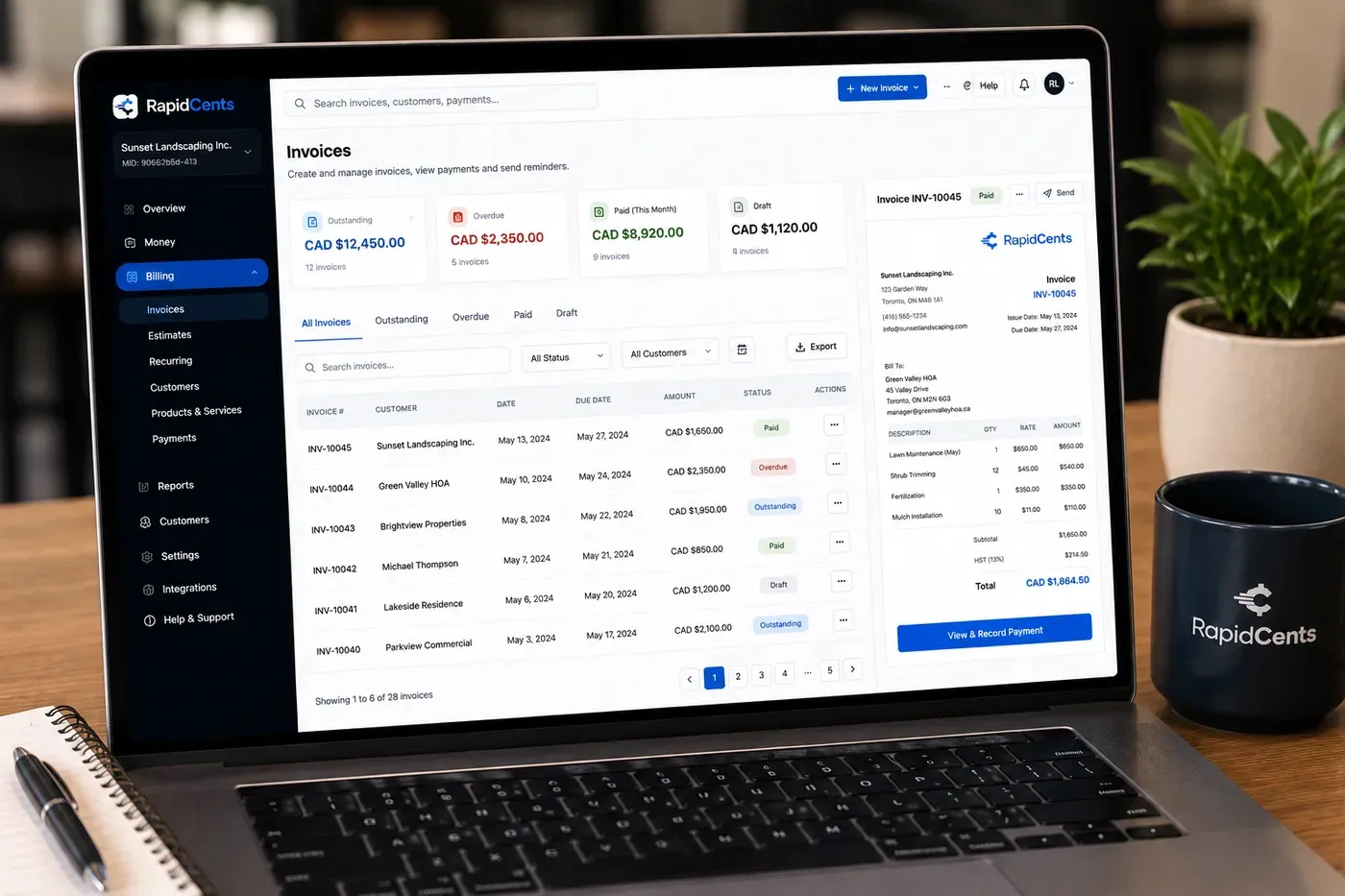
The RapidCents invoices screen: outstanding, overdue, paid and draft totals across the top, the invoice list below them, and a preview of one invoice on the right with its line items and a View & Record Payment button. Invoicing
RapidCents invoicing helps professional services, contractors and B2B suppliers create branded invoices…
Explore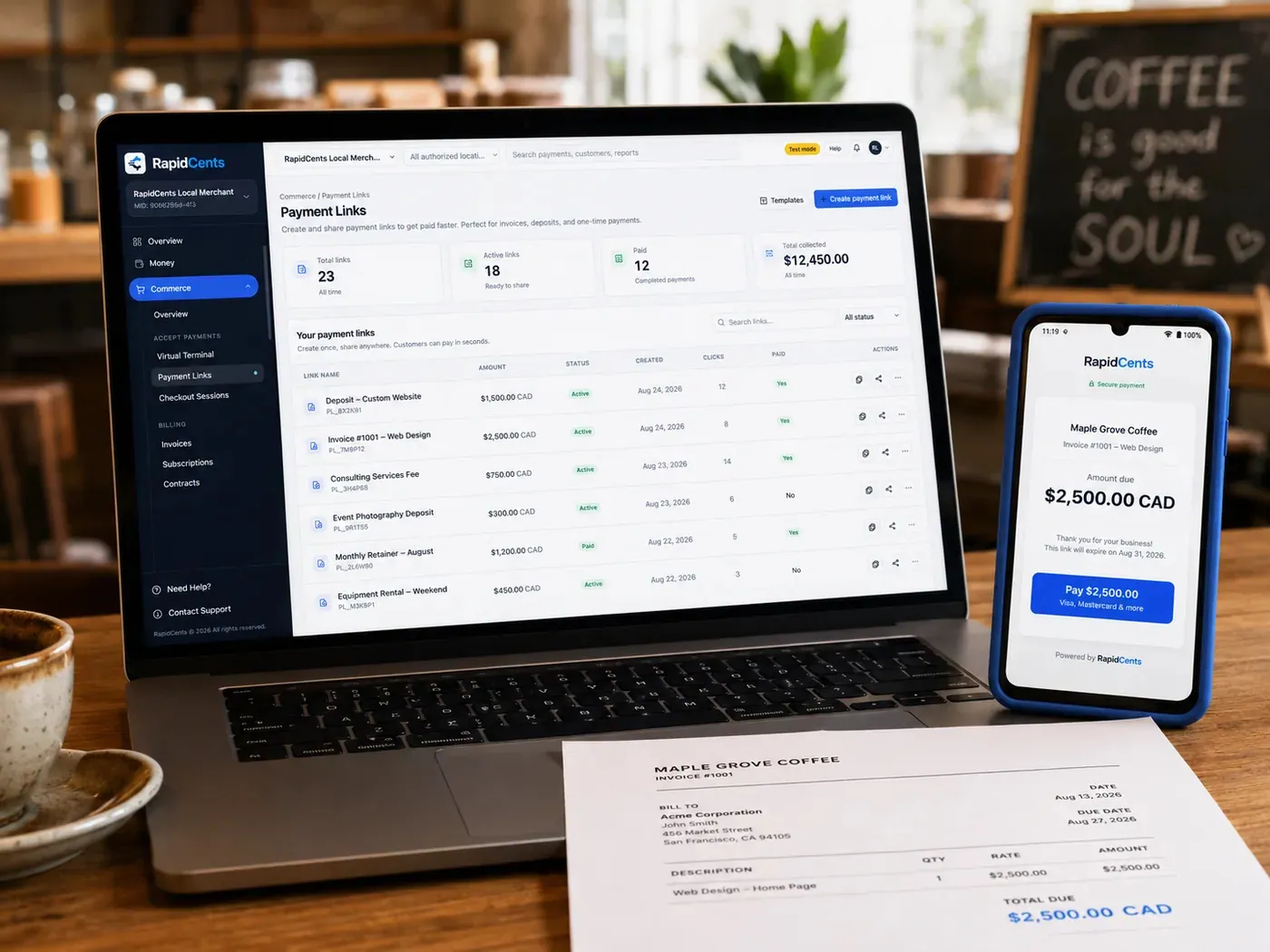
The RapidCents payment links screen listing created links with their amount, status, click count and whether they have been paid, beside a phone showing the branded page a customer opens to pay $2,500.00. Payment Links
RapidCents payment links let staff generate branded pay-by-link URLs for invoices, deposits, balances and…
Explore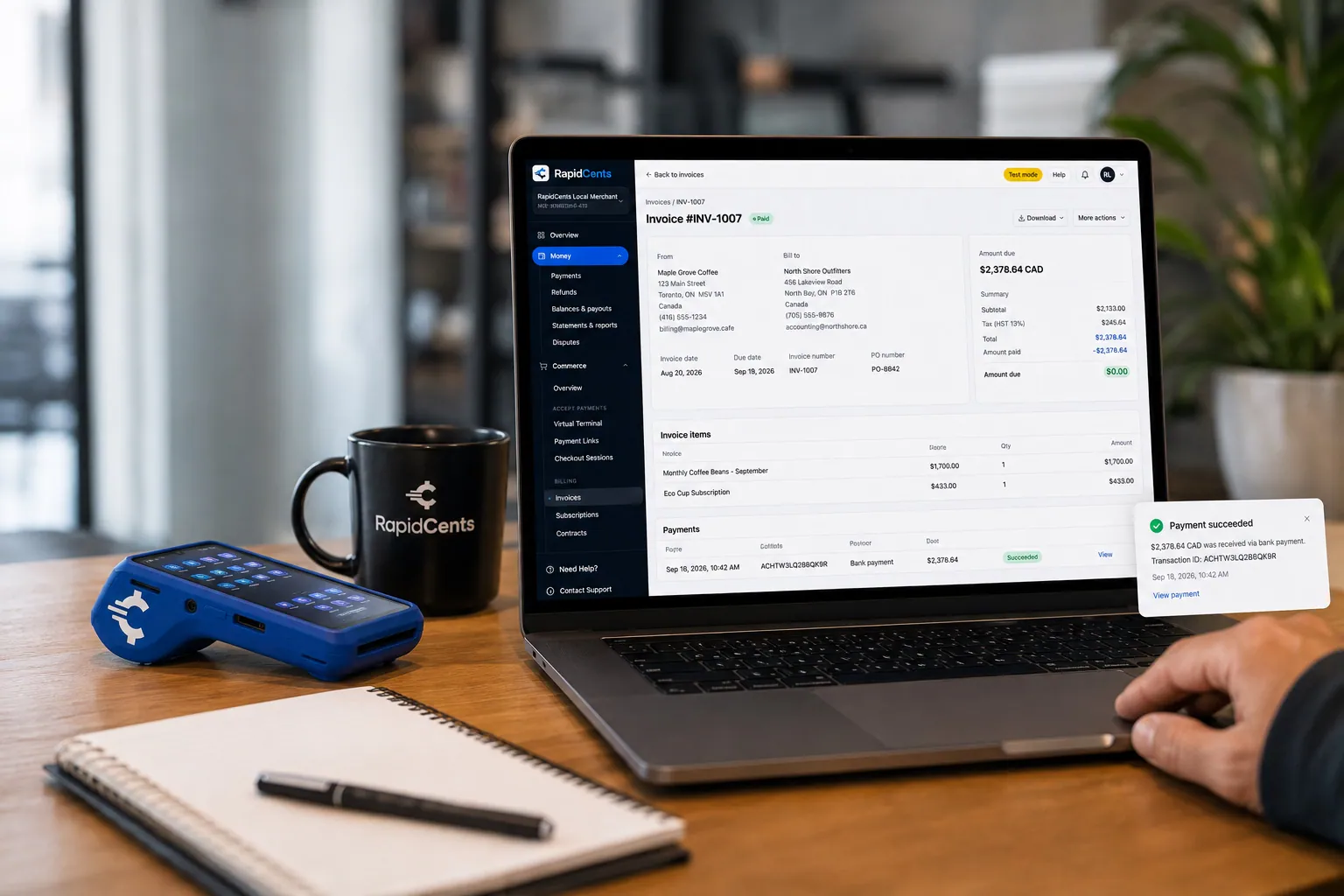
A merchant invoices a customer for bank debit through RapidCents, with card terminal capture available on the same desk. ACH / Bank Payments
Bank payments suit recurring and high-value invoices where card fees are the wrong tool. Collect directly…
Explore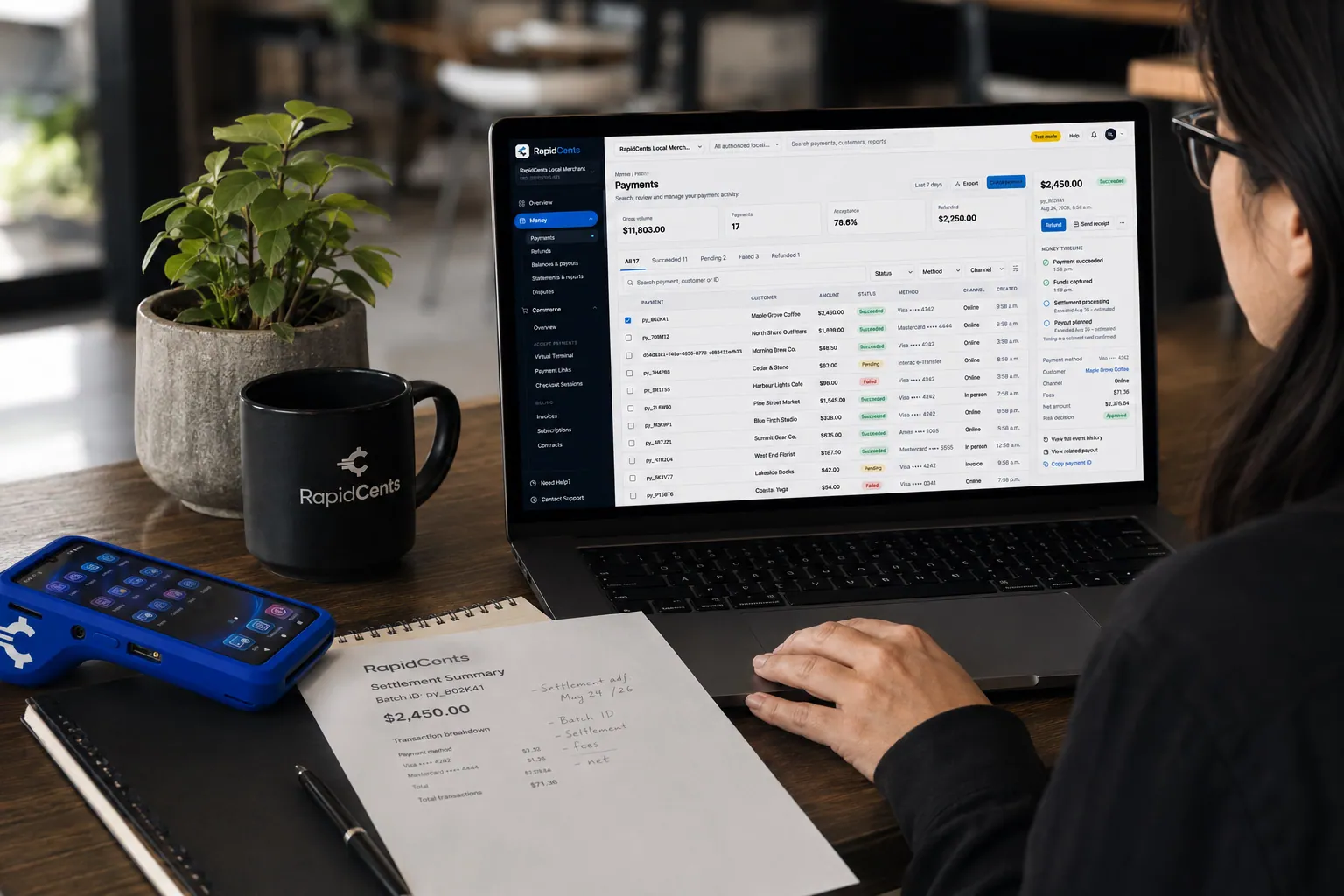
A merchant reviews RapidCents reports for volume, mix and payouts, with the terminal that took the sales on the desk. Reporting
RapidCents reporting delivers customizable transaction, settlement and fee reports with CSV and PDF export…
Explore


How are returnable drums and totes charged and credited?
Returnable drums and totes are charged as a separate invoice line and credited when the empties come back, by adjusting the open invoice, crediting the account's next invoice or refunding the card that paid. Returnable container credits reconcile cleanly when you choose one route per account, apply it every time, and tie each credit to the customer account and the order that shipped the container.
How a container charge and credit run
Each returnable drum or IBC tote appears as its own invoice line, so the buyer pays for the container separately from the product inside it. When empties are collected, the driver's pickup ticket records the count and condition. Accepted containers then become a credit memo against the account in your ERP, or a refund in RapidCents to the card that paid, quoting the original invoice number.
Put the container policy in writing
Your container policy should list which containers you take back, such as your own marked drums and totes that held only your product, the return window, and the charge for containers returned damaged or contaminated, or never returned. Print it on the quote or the account application so the buyer has agreed to it before the first container charge.
Credit or refund, never both
A common reconciliation error is crediting a returned tote on the account and also refunding its charge to the card. Choose one route per account, for example credits for accounts on terms and card refunds for buyers who prepaid, and record the original invoice on every refund. Where a refund to the original card is not possible, settle it as an account credit under your policy. If a buyer disputes a container charge with the card issuer, signed pickup tickets are your evidence.
A quarterly empties collection
Say a water-treatment service company has 30 of a supplier's returnable drums spread across its client sites. At the quarterly collection, the driver picks up 24 empties in good condition and two with damaged bungs, and four drums are still in use. The supplier credits 24 container charges on the company's next invoice, charges for the two damaged drums as its policy sets out, and leaves four open on the container balance.
What does chemical distributor credit card processing cost?
Chemical distributor credit card processing costs the interchange on each payment, plus the RapidCents markup set out in your Fee Schedule and fees for equipment or services, if applicable. Interchange is set by the card networks and passes through at cost; for a chemical supplier it moves with the card types plants pay with, the size of each invoice and whether the card is present. Your interchange-plus agreement is month to month, with no fixed term.
Commercial and purchasing cards from plants
Because your buyers are businesses, many pay with commercial, corporate or purchasing cards, which generally carry higher interchange than the debit cards some will-call buyers tap. Payments on some commercial cards can include Level 2 or Level 3 data, such as the PO number, tax amount and product lines, where supported and verified for your setup; judge any effect on interchange from your own statements, not from a promise.
Bulk loads and other large invoices
Most interchange grows with the payment amount, so a full bulk load or a quarter of releases paid on one card is where card costs add up. Plants paying large invoices may prefer a bank payment, which you can offer where your account allows it, keeping cards for smaller releases, deposits and will-call sales. Compare both methods on a real invoice before you set a policy.
Will-call, delivery and remote payments
Card-present payments, tapped or inserted at the will-call door or on a driver's mobile terminal, generally qualify for lower interchange than card-not-present payments. Plant invoices paid by card are card-not-present, whether through a payment link or a purchasing card keyed into the Virtual Terminal, so know your split between the two before comparing quotes.
Refunds, disputes and what to bring
Deposit refunds, container refunds to cards and chargebacks all appear on your statement and take staff time, so count them. For Fee Check, bring two or three recent processing statements, your share of commercial cards, a typical release and your largest bulk invoice, and your split between link, phone and will-call payments. Fee Check reads an uploaded statement and lists interchange apart from markup, so quotes can be compared on the same basis.
How do RapidCents payments reach your ERP or accounting system?
RapidCents integrates with many major platforms through APPIE and RapidBridge, so plant payments reach your ERP or accounting system in the way that suits your software, its edition and your country: an integration, payment links that carry the ERP invoice number, or a scheduled settlement import. Your RapidCents representative will walk you through the options for your chemical-industry system.
NetSuite
Chemical distributors that run NetSuite keep customer accounts, sales orders and invoices there. RapidBridge works with Oracle NetSuite, and NetSuite also imports RapidCents settlement files, so card and bank payments, deposits, refunds and fees reach the ledger. Tell your RapidCents representative your NetSuite edition, and ask who holds any cards already saved against customer records.
SAP Business One
Where SAP Business One is the system of record, a chemical distributor's deposits, releases and container lines all have to land on the right sales order. RapidBridge works with SAP Business One Web Client, and SAP imports RapidCents settlement files. Your RapidCents representative will test deposits, releases and container credits against your version and localization with you.
Dynamics 365 Business Central
RapidBridge works with Dynamics 365 Business Central, so a card payment posts against the sales order you already have open. Your RapidCents representative will look at your edition and country, and your Business Central partner can tell you whether a payment extension you already use ties you to one processor. A payment link carrying the sales order number works alongside either route.
Acumatica and Epicor Prophet 21
RapidBridge works with Acumatica, so deposits and releases post to the order you already have open. Epicor Prophet 21 is among the many major platforms RapidCents integrates with through APPIE and RapidBridge; the right option depends on your version, and your representative will walk you through it. Ask your ERP reseller whether its payment module holds saved cards you would need to collect again.
Datacor Chempax and other chemical-industry ERPs
Some distributors run an ERP made for the chemical industry, such as Datacor Chempax. RapidCents integrates with many major platforms through APPIE and RapidBridge, and the right option depends on your vendor and version. Tell your RapidCents representative which system you use, and they will show you how a payment reference, a deposit and a container credit reach it, by settlement import or by payment links carrying the ERP order number.
QuickBooks Online and Xero
If your books are in QuickBooks Online or Xero, RapidCents connects settled transactions, fees and refunds to either. Agree with your accountant how deposits on undelivered orders and refundable container charges should be coded before your first plant pays through RapidCents, so every payment lands where finance expects it.
Payment options for chemical suppliers in Canada
Chemical suppliers in Canada can collect from plants, contractors and other industrial buyers by credit card, including commercial and purchasing cards, by Interac debit at the will-call counter, and by bank payment through EFT or pre-authorized debit (PAD), with settlement in CAD. Cards suit invoice links, deposits and phone orders, while PAD suits repeat plant releases paid on a set date. What your account offers follows RapidCents' review of your products and channels.
Cards and Interac debit
Plants and contractors can pay with Visa, Mastercard and American Express, including commercial and purchasing cards, through invoice payment links, the Virtual Terminal or a terminal. Buyers collecting drums at will-call can use Interac debit by chip and PIN or contactless on a supported terminal.
PAD for repeat plant releases
PAD suits plants that pay every release from a business bank account rather than a purchasing card, which also keeps large invoices clear of card limits. Before the first debit, the plant signs a PAD agreement explaining how each amount is set, when debits run and how to cancel. Because releases vary, send each invoice amount ahead of the debit, as the agreement requires.
CAD settlement, GST/HST and buyers outside Canada
Card and PAD payments from plants settle in CAD. The plant pays your invoice total, including GST/HST and any provincial sales tax you charge, and working out and remitting that tax remains your job. If you ship to buyers outside Canada, your RapidCents representative will walk you through which products, channels and countries your account covers, alongside your own export arrangements.
How do you switch processors with deposits and containers still open?
You switch processors with deposits and containers still open by moving in stages and keeping the old account open until refunds and disputes on its deposits and container charges have cleared. Complete the product review first, list what the old processor holds, test a full order cycle, then reconcile settlements to your ledger. Some plants will need to authorize their card or bank account again, because stored credentials move only when both providers agree.
Start with the product review
Send RapidCents your product list with intended uses, the types of buyers you sell to, your sales channels, such as will-call, delivered orders and any online ordering portal, and the countries you ship to. Once your account is approved, it covers the products reviewed, so tell your RapidCents representative before you add a new product line.
List what the old processor holds
Record each plant with a stored card or bank authorization and the blanket PO it pays, every unpaid invoice carrying an old payment link, deposits on orders not yet delivered, and container charges paid by card that may need refunding when the empties return. Note each blanket PO's next release date, so you know which invoice will be the first collected through RapidCents.
Test a full order cycle first
On the new account, run a will-call sale on a terminal, a deposit by payment link followed by its balance invoice, a container credit, a refund and a purchasing card keyed into the Virtual Terminal. Check that PO, release and sales order numbers appear in RapidCents reports and in your ERP import or accounting connection, then move new orders first and existing plant accounts at their next release.
Run in parallel, reconcile and warn accounts payable
Refunds on payments taken by the old processor, including deposits and container charges, normally go back through it, and disputes on those payments arrive there, so keep it open until they clear. Reconcile each RapidCents settlement to its invoices using transaction, settlement and fee reports, and warn each plant's accounts payable team about the new name on card statements and the new sender of payment links, so neither looks like fraud.
Payment questions from chemical suppliers and distributors
What is the best payment processor for chemical suppliers?
The best payment processor for a chemical supplier is one that fits your exact product line and how your plants pay, so judge industrial chemical merchant services on specific criteria. Look for invoice payment links that carry PO and release numbers, a virtual terminal for phoned purchasing cards, deposits and refunds tied to the original order, bank payments for large invoices and cards stored only with the buyer's authorization. Then check the route into your ERP, and compare written quotes that separate interchange from markup against the same statement.
How much does credit card processing cost for chemical suppliers?
Card processing for a chemical supplier costs the interchange on each payment plus the processor's markup, so the total depends on who pays, how and how much. With RapidCents, interchange passes through at cost, and you pay the markup in your Fee Schedule plus fees for equipment or services, if applicable, month to month with no fixed term. Commercial and purchasing cards, card-not-present invoice payments and large bulk invoices all raise the interchange you pay. Upload a recent statement to Fee Check to see interchange and markup separately.
Can NetSuite or a chemical-industry ERP use a different payment processor?
Yes. Your ERP keeps its invoices while RapidCents collects the payments, and how those payments post back depends on the ERP, its edition and your country. RapidBridge works with Oracle NetSuite, Dynamics 365 Business Central and Acumatica, NetSuite and SAP import settlement files, and QuickBooks Online and Xero receive settled transactions, fees and refunds. RapidCents integrates with many major platforms through APPIE and RapidBridge, and your RapidCents representative will walk you through the option for Epicor Prophet 21 or Datacor Chempax. A payment link carrying the ERP invoice number works with any of them.
How can chemical suppliers switch processors without losing payment history?
Export your full transaction history from the old processor before closing it, and keep that account open until its last deposit refunds, container refunds and disputes are settled. Download transaction, refund and chargeback reports, list which plants have a stored card or bank authorization on file, and note open deposits and container charges that may still need refunds. Invoices, lot records and customer history stay in your ERP. Stored cards move only when both processors agree, so some plants will need to authorize again.
Which payment options can a chemical supplier in Canada offer?
A chemical supplier in Canada can offer credit cards, Interac debit and bank payments by EFT or pre-authorized debit (PAD), within the products and limits set on the account. Visa, Mastercard and American Express, including purchasing cards, work through invoice payment links, the Virtual Terminal and terminals, and Interac debit works at your will-call counter by chip and PIN or contactless. PAD suits repeat plant releases once the plant signs a PAD agreement. Card and PAD payments settle in CAD. Your RapidCents representative will list the methods and limits on your account before you print them on invoices.
Does RapidCents accept every chemical distributor?
No. RapidCents reviews each chemical supplier's exact products, their intended uses, its sales channels and the countries it sells into before approving an account, and the review covers the products listed. Controlled substances and the precursor chemicals used to make them are never accepted, and calling a product industrial or selling it only to businesses does not change that. The RapidCents Acceptable Use Policy lists other restricted and prohibited categories. Start the review before telling buyers they can pay you through RapidCents.
Can a plant pay chemical invoices by card?
Yes. A plant can pay an invoice by card through its payment link, or a purchasing cardholder can phone the payment in for entry in the Virtual Terminal. For a large or unusual order, such as a full bulk load or a first order from a new buyer, tell your RapidCents representative the amount you expect, and they will explain the limits on your account. If an order would exceed a limit, arrange a bank payment or a documented deposit and balance in advance, and never split one invoice into several card charges.
Does a payment link replace chemical safety or shipping documentation?
No. A payment link and its receipt record a collection event: who paid, how much, for which invoice and when. Safety data sheets, product labels, certificates of analysis, shipping papers and signed delivery records remain separate records and obligations, kept and sent through your own systems, and RapidCents does not store or send them. What the two should share is a reference, such as the sales order or bill of lading number, so finance and operations can match each payment to the delivery it paid for.
How should returnable drums and totes be credited?
Credit an accepted drum or tote against the customer account and the order that shipped it, using the route your container policy sets. Show the container charge clearly on the original invoice, then treat each accepted return the same way every time: an adjustment while that invoice is open, a credit on the next invoice, or a refund to the paying card. Damaged or contaminated containers follow your written policy, and the driver's pickup ticket supports each credit.
Can the same account accept chemical orders from buyers in other countries?
Not automatically. Before you take payment from a buyer in another country, your RapidCents representative will check that your account's products, channels and countries cover that sale. Your own lawful sales and delivery arrangements, such as export and import permits, carrier requirements and checks on the buyer, remain your responsibility, and a payment does not satisfy any of them. Ask about International Payments and settlement currency before sending a payment link abroad.
What MCC is used for chemical suppliers?
MCC 5169, chemicals and allied products not elsewhere classified, is commonly associated with industrial chemical distributors. RapidCents sets the correct merchant category during onboarding based on what your business actually sells, so a supplier whose sales are mostly cleaning products, lab supplies or crop inputs may be classified differently. The MCC describes your business to the card networks; it does not decide which products are accepted, which is the job of the product review.
Related supplier pages
B2B & Wholesale covers distributor payments across product categories, and the plastics and resin suppliers and steel and metal suppliers pages deal with the same large-order deposits and delivery balances. Suppliers of laboratory reagents or janitorial chemicals have their own pages, because their buyers and product rules differ.
B2B & Wholesale
Collect net-terms invoices by payment link with the PO number attached, take commercial…
Steel & Metal Suppliers
Take deposits on cut-to-size orders, collect delivery balances once the final weight and…
Plastics, Rubber & Resin Suppliers
Collect grade-specific deposits, call-off release invoices and out-of-spec return credits…
Dental Suppliers
From monthly consumables reorders to chair and imaging deposits, collect what clinics…
Veterinary Suppliers
Get invoices, standing orders and equipment deposits paid by the veterinary practices…
Medical & Surgical Suppliers
RapidCents helps medical and surgical suppliers collect hospital, clinic and practice…
Laboratory & Scientific Suppliers
Collect on lab purchase orders, instrument deposits and staged deliveries, with the PO…
Pharmaceutical Wholesalers
Collect pharmacy account invoices, balances and deposits with payment links, invoicing…
Take the next step
See what your plant-account payments cost
Upload a recent processing statement to Fee Check to see interchange separated from markup across your plant invoices, order deposits and will-call sales. Then share your product list, buyer types and sales channels so RapidCents can review eligibility before you plan a switch.
- No obligation
- Canadian payment specialists
- Secure statement upload



