DEVELOPER PLATFORM
APPIE™
APPIE is RapidCents payment interoperability infrastructure. It addresses the thing that quietly locks a business into one processor: terminals are keyed and loaded with an application tied to a specific processor, and integrations are certified against a specific host, so changing provider means replacing hardware, rebuilding software, or both. APPIE works across that boundary. It applies at two layers — the terminal layer, where an existing hardware estate has to keep working, and the host layer, where a platform routes across more than one processor.
- Sandbox with documented test cards
- Signed webhooks
- Typed errors and idempotent retries
- Dedicated developer support

What crosses the wire
Where it sits
At the boundary between a payment application and a processor. Rather than the application speaking one processor’s dialect natively, the interoperability layer stands between them, which is what stops the choice of processor from being baked into the deployment.
What it needs to know
The device estate or the host integration you already have: models, firmware, the software driving them, and which processor they are certified against today. That inventory is the input to the conversation, not a code sample.
What it does not change
The commercial and compliance realities underneath. Card network rules, certification requirements and what a given device is capable of still apply, and an interoperability layer moves work rather than abolishing it.
When to use it
The hardware estate is too large to replace
When swapping every terminal in every location is the reason a processor change never happens, the estate is the constraint and the terminal layer is where to look.
A platform routes to more than one processor
Marketplaces, software platforms and multi-region operators end up with more than one acquiring relationship, and reimplementing against each host separately is the cost APPIE targets.
Certification is the schedule risk
Point-of-sale certification cycles are measured in weeks. Anything that reduces how many of them a change requires moves a project timeline more than any amount of development speed.
How to implement APPIE™
Establish where the lock-in actually is: the devices, the host integration, or both.
Inventory the estate — models, firmware, driving software and current certification.
Decide the layer that applies, terminal or host, with an integration specialist.
Prove the flows in a sandbox and a certification environment before touching a live lane.
Pilot one site or one route, then extend once settlement and reporting reconcile.
What fails, and how you find out
Assuming any terminal can move
Terminals are keyed and loaded for a specific processor, so whether one can be repurposed is a question about that model and that deployment. Ask before you plan a migration around the answer you hoped for.
Scoping from the product name
Two estates running the same terminal model can differ by firmware, by the software driving them and by what they are certified for. The inventory is the scope; the model number is not.
Underestimating certification
Interoperability reduces how much has to be recertified, not whether certification exists. Plan the weeks rather than discovering them halfway through a rollout.
Cutting over everything at once
A payment estate has no partial rollback if every lane moves together. Pilot one site, watch a full settlement cycle, and only then extend.
Sandbox versus production
Two environments, not one
Sandbox proves the payment flows behave as documented. Device and point-of-sale work also passes through a certification path, and the two are sequential rather than interchangeable.
Exercise the operator-facing outcomes
Staff need a clear next step on every issuer response at the lane. Walk documented test cards in sandbox and watch what appears on the device and in the till, because that is the behaviour staff will be trained on.
Reconciliation is the acceptance test
Accelerated sandbox settlement lets a full sale-to-deposit cycle be walked before a pilot, so finance sees the shape of the records ahead of the first real batch.
Questions about APPIE™
What problem does APPIE actually solve?
Processor lock-in. Terminals are keyed to a specific processor and integrations are certified against a specific host, so switching provider normally means replacing hardware or rebuilding software. APPIE lets terminals and hosts work across that boundary instead.
Is APPIE a terminal, a protocol or a service?
It is an interoperability layer rather than a device. It applies at the terminal layer, where an existing estate has to keep working, and at the host layer, where a platform routes across multiple processors; the two pages for those cover each in detail.
Can I keep my existing terminals?
That is the question the terminal-layer case is built around, and the answer depends on the specific models, firmware and certification in your estate. It is confirmed from an inventory rather than assumed from a product name.
Does this remove the need for certification?
No. It reduces how much has to be recertified when a processor relationship changes, which is usually where the schedule risk sits. Certification cycles still exist and still need planning.
How is APPIE different from RapidBridge?
Different boundaries. RapidBridge brings payments into business software that was not built for them. APPIE crosses processor boundaries, so hardware and host integrations survive a provider change rather than anchoring you to one.
What should I bring to the first conversation?
An inventory: terminal models and firmware, the software driving them, how many sites and lanes, which processor everything is certified against today, and what you are trying to change. That determines which layer applies.
Does APPIE change card network rules or what a device can do?
No. Card network rules, certification requirements and the capabilities of a given device all still apply. An interoperability layer moves work rather than abolishing it, so the commercial and compliance realities underneath a payment estate are unchanged by it.
How should an APPIE rollout be sequenced?
Establish where the lock-in actually sits, inventory the estate or the host integration, then prove the flows in a sandbox and a certification environment before touching a live lane. After that, pilot one site or one route and watch a full settlement cycle. A payment estate has no partial rollback if everything moves together.
Continue the integration
APPIE at the terminal layer: processor interoperability without swapping the RapidCents hardware estate. APPIE on Terminal
Enable processor interoperability at the terminal layer, without replacing the hardware estate.
ExploreAPPIE at the host layer, routing RapidCents platform traffic across more than one processor. APPIE on Host
Enable payment interoperability at the host layer for platforms routing across multiple…
Explore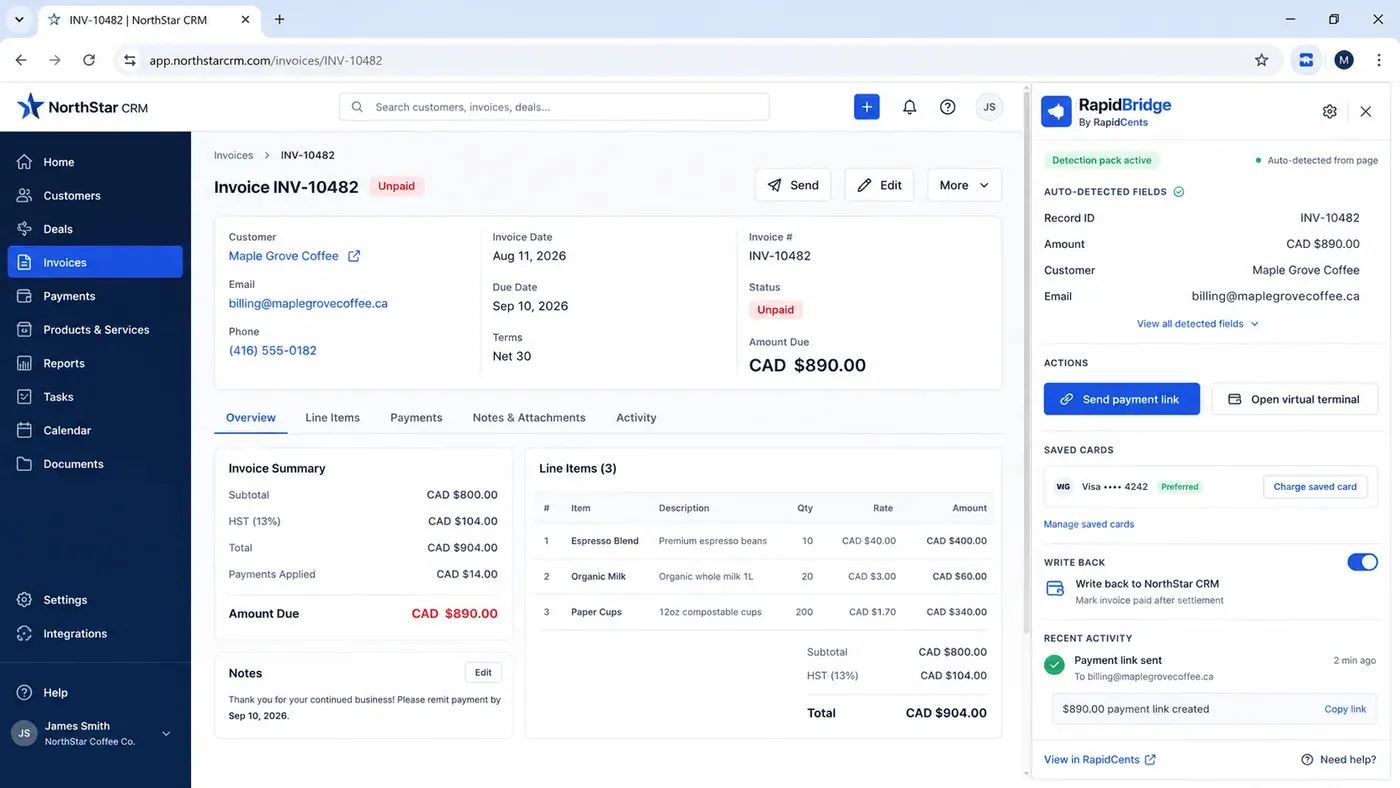
An unpaid invoice open in a third-party CRM with the RapidBridge panel beside it, showing the record number, amount, customer and email it detected from the page on its own, and buttons to send a payment link or charge a saved card. RapidBridge
Automatic payment detection in 178 business applications: RapidBridge takes payments inside…
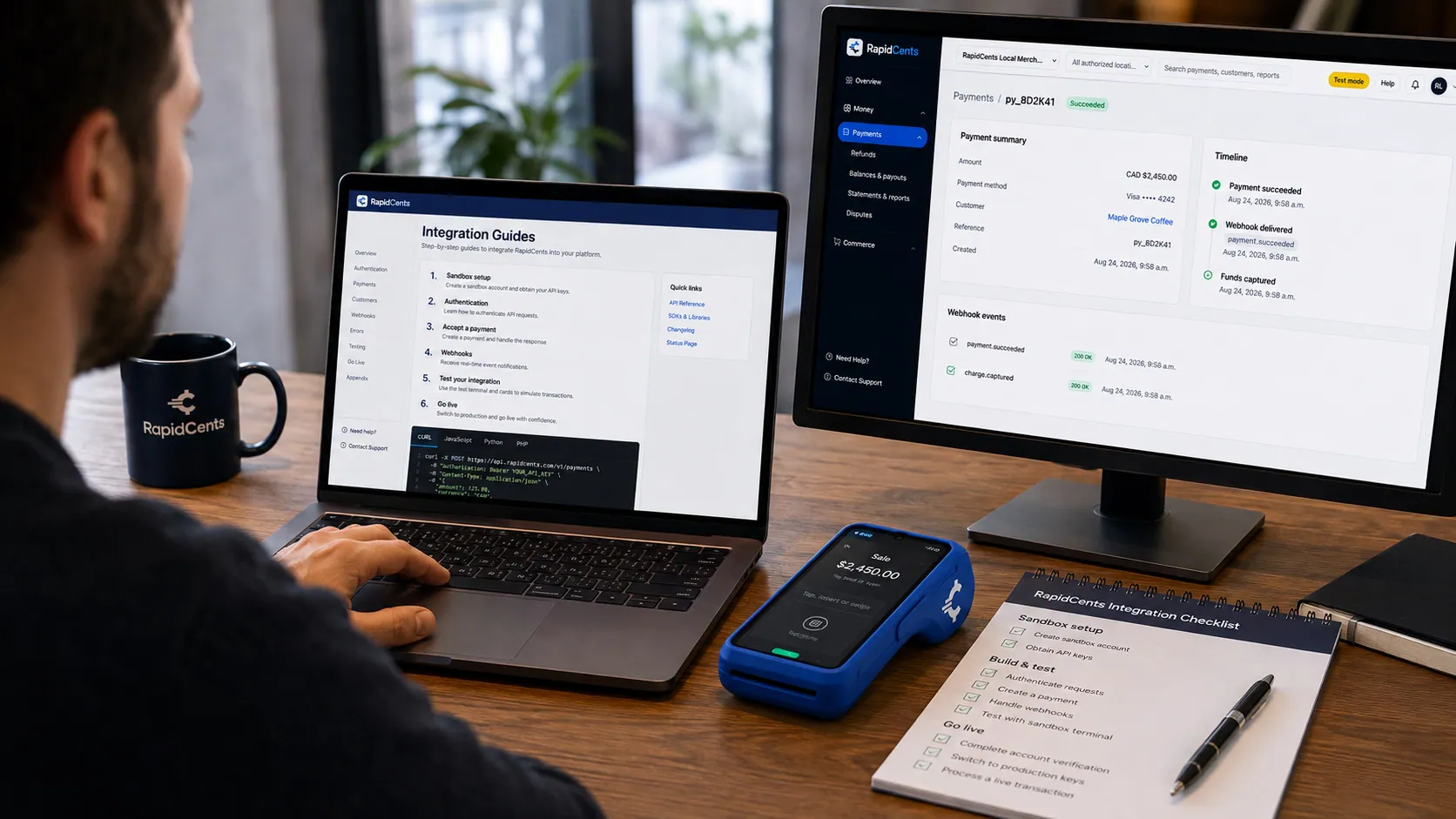
ExploreA developer working through a RapidCents integration guide, sandbox terminal on the desk and a successful test result on screen. Integration Guides
Step-by-step guides for e-commerce, POS, mobile and marketplace integrations.
Explore

Take the next step
Talk to a RapidCents specialist
RapidCents Fee Check reads a processing statement and shows interchange separately from the markup. Upload a statement for an instant breakdown, or open a merchant account and start accepting payments on one account.
- No obligation
- Payment specialists, not a call centre
- Secure statement upload