Put in a point of sale without losing a day of trading
A point of sale is a catalogue, a set of staff permissions and a day-end routine, with a payment device attached. The hardware arrives quickly; the catalogue or menu build, the permissions and the cutover week decide whether the first week costs trading days. RapidCents supplies restaurant, retail and grocery point of sale, each built for its format rather than skinned from one product, plus online ordering. The new system runs a full day end in parallel before cutover in a quiet period.
- Payment specialists
- Interchange-plus available
- Guided migration
- Post-launch support
Who this solution is for
Restaurants
Where service flow, modifiers, splits and tips are the requirement, and the counter is not where the payment happens.
Retailers
Where inventory accuracy and lane speed matter, and a return has to reference the original sale.
Grocery and high-volume counters
Long baskets, weighed items and multiple lanes, where day end is a volume problem rather than a totals problem.
Common challenges
The catalogue is the project
Items, modifiers, variants, weighed goods and tax treatment take longer than the install, and rushing them puts the errors into every subsequent report.
A cutover in the wrong week
Switching a point of sale during a peak period turns a manageable learning curve into lost trading.
Permissions decided after go-live
Who can discount, refund or open the drawer is easier to agree before staff have habits than after.
The RapidCents approach
Choose the point of sale for the format, since restaurant, retail and grocery workflows are genuinely different rather than skins on one product.
Build the catalogue or menu, including modifiers, variants, weighed items and tax treatment.
Set staff roles — discounts, refunds and drawer access — before anyone is trained.
Run parallel: process test transactions and a full day end on the new system while the old one still trades.
Cut over in a quiet period, with training done and the old system available for a short overlap.
Recommended capabilities
Restaurant POS
Order entry with modifiers and courses, tableside payment and tipping on a mobile terminal, split and transfer by item or evenly, and a day end where sales, tips and deposits reconcile.
Retail POS
Scan-and-tender checkout, inventory at item and variant level, returns referencing the original transaction, and an omnichannel view of store and online sales.
Grocery POS
High-speed scanning for long baskets, weighed produce and deli items, multi-lane operation on a shared catalogue, prompts on restricted items and volume reporting against deposits.
Online ordering
Pickup and delivery orders taken on your own page and paid before preparation, routed to the kitchen and reported beside in-room sales rather than through a marketplace.
Staff permissions
Discounts, refunds and drawer access controlled by role, with audit trails behind them.
Related products
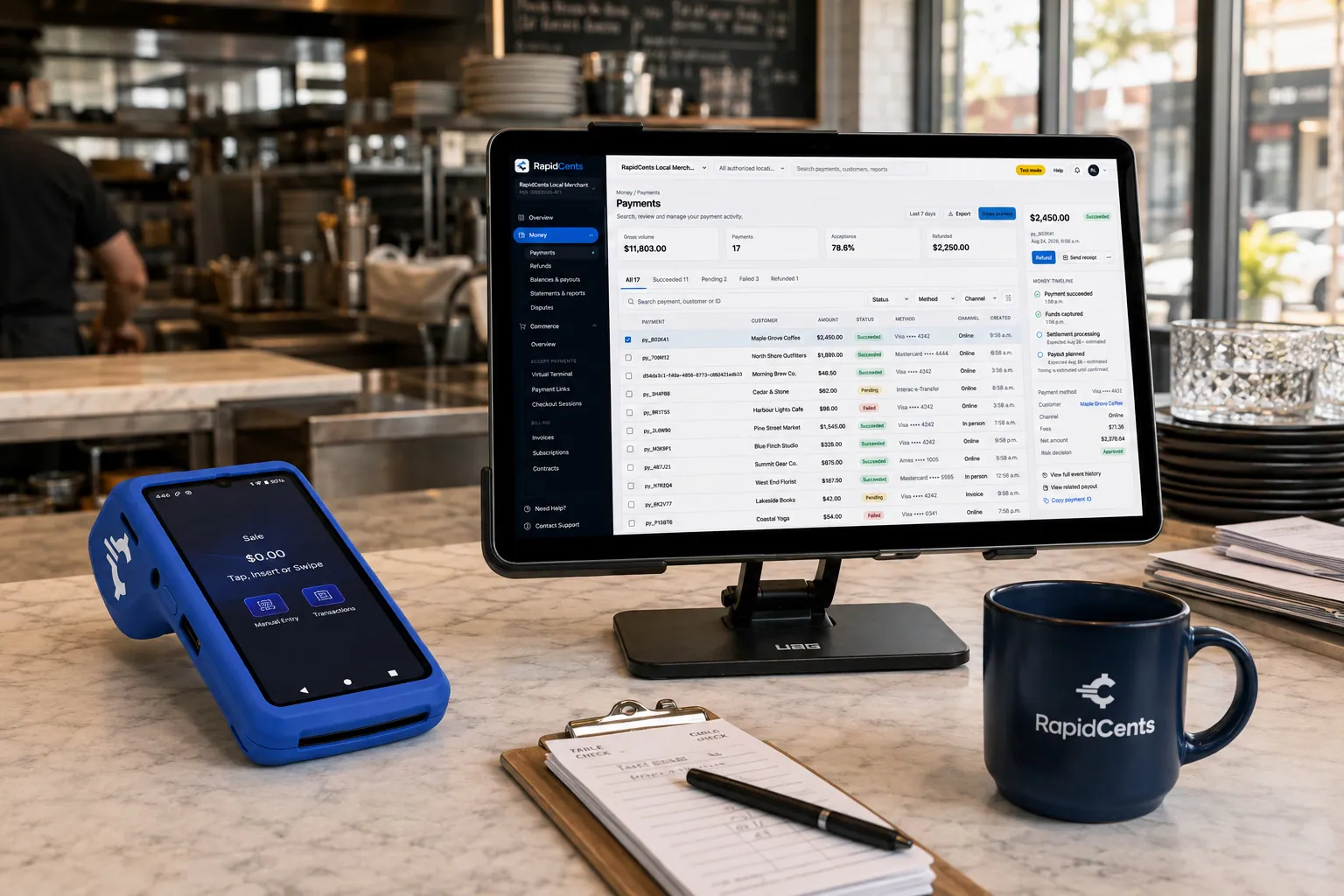
Tableside card capture on a RapidCents terminal in a restaurant, with the POS and payments dashboard on the pass. Restaurant POS
Take orders, split and transfer bills, prompt for tips at the table and close the day with reporting that…
Explore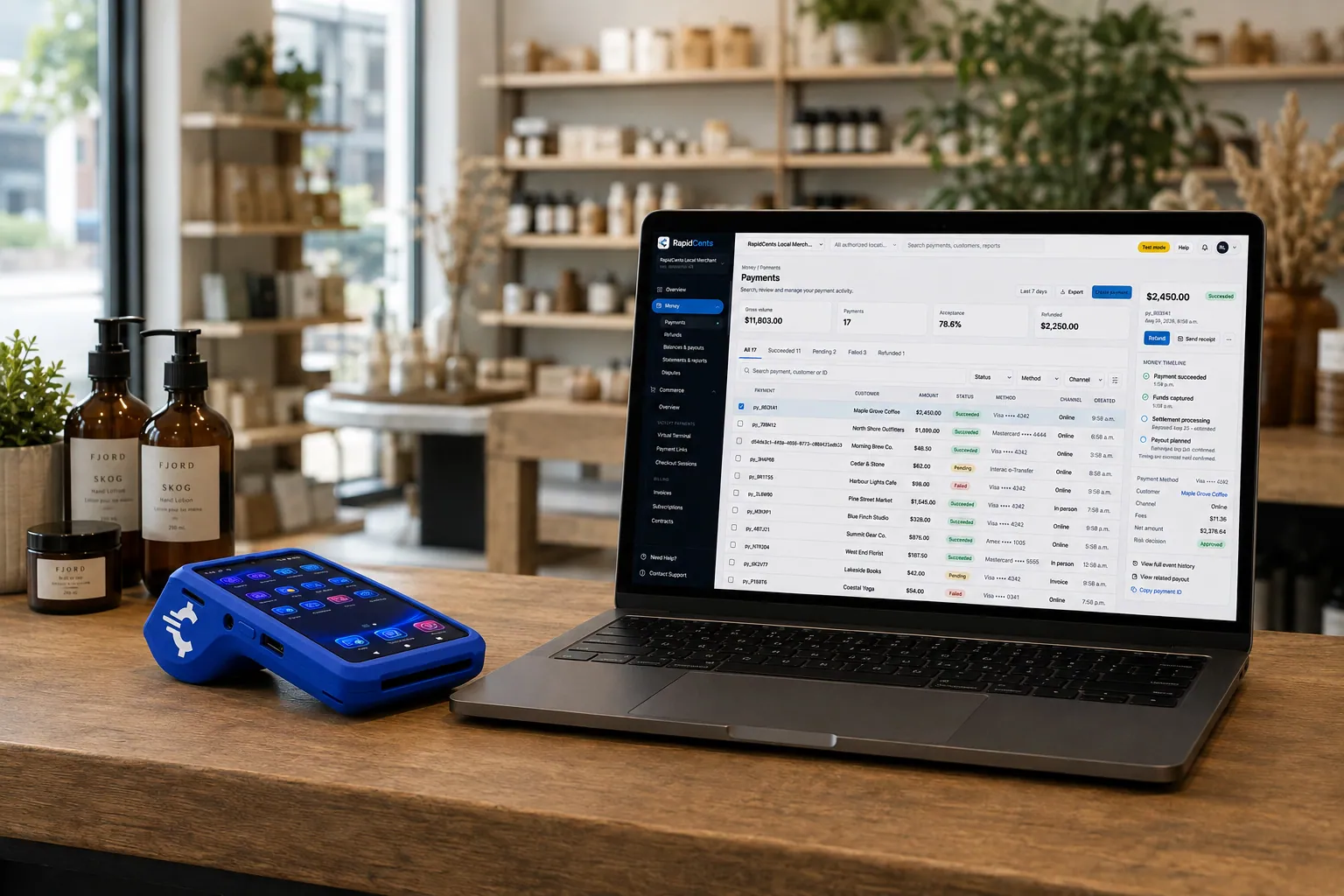
A retail counter ringing a basket on RapidCents POS, terminal taking the card and the dashboard showing the sale. Retail POS
Fast checkout, inventory that reflects what is on the shelf, and reporting that connects in-store and online…
Explore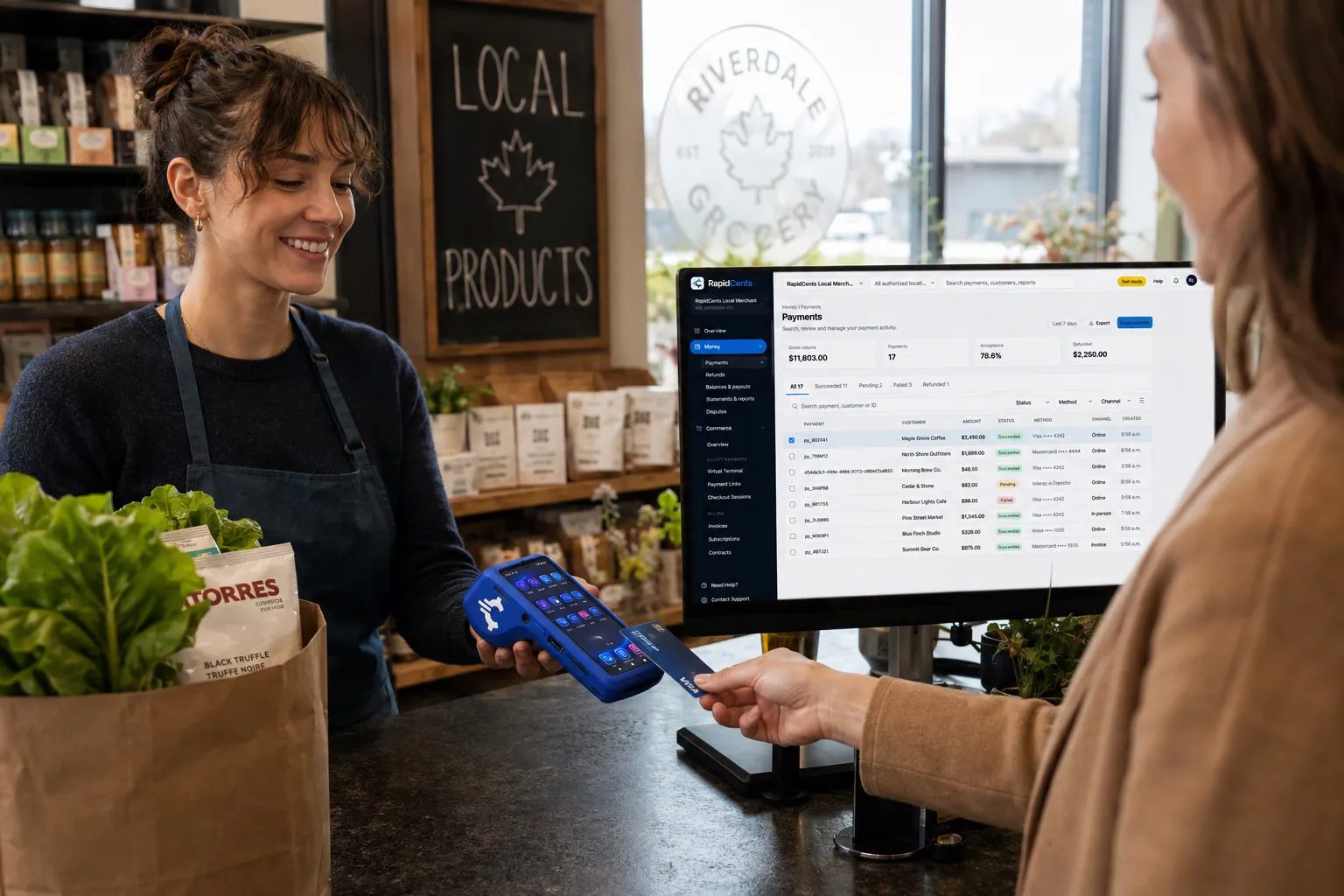
A grocery checkout running RapidCents POS for a high-volume lane, with the terminal capturing debit and credit. Grocery & Supermarket POS
Large baskets, weighed items and busy lanes need a checkout that keeps up.
Explore


Implementation approach
Discovery
Format, lane or table count, the catalogue you have and the day-end routine you run now.
Catalogue and configuration
Items, modifiers, taxes and permissions built and reviewed before hardware is installed.
Parallel testing
Transactions and a complete day end run on the new system while the existing one continues to trade.
Training and cutover
Staff trained on the flows they will actually use, then cutover at a time chosen for quietness, with support through the first day end.
What does not change
Your menu or product range
The point of sale is configured around what you sell. Choosing a system is not an occasion to change the offer unless you want it to be.
Your suppliers and stock process
Receiving and ordering continue as they do. What changes is that sales adjust the count as they happen.
Payment acceptance itself
Tap, chip and PIN debit work as before. The point of sale decides what is being sold; the terminal still takes the card.
Frequently asked questions
How long does the catalogue build take?
It depends on how many items, modifiers and variants you carry and how clean the current data is. A menu with heavy modifier logic takes longer than a larger list of simple products, which is why this is scoped in discovery rather than estimated from item count.
Can we run the old system alongside the new one?
For testing, yes, and that is the point of the parallel period. Running both for live sales for long is a different matter, because two sets of stock counts diverge quickly.
What is the difference between a point of sale and a terminal?
A terminal takes a card payment. A point of sale knows what was sold, adjusts stock, applies staff permissions and produces the day end. If you track inventory or run a menu, the terminal alone leaves that work manual.
How are tips handled?
Prompted at the point of payment, at the table on a mobile terminal in a restaurant, adjustable where permitted, and reported at day end for payout. Tips are also the most common cause of a POS total differing from a batch total, so they are worth checking in the first week.
Can staff be stopped from refunding to the wrong card?
Returns reference the original transaction, so the refund goes back to the card that paid. Permissions decide who can issue one at all.
What happens at day end?
The batch closes, sales and tips are totalled, and the figures reconcile against the deposit that follows. Doing this deliberately on the first day, with someone watching, catches most configuration mistakes while they are still cheap to fix.
Can we take pickup and delivery orders without going through a marketplace?
Yes. Online ordering runs on your own page, with the order paid before preparation, routed to the kitchen and reported beside in-room sales. That keeps the customer relationship and the reporting in one place instead of split across a third-party platform.
Which point of sale suits a counter that weighs product?
The grocery configuration. It handles weighed produce and deli items, high-speed scanning for long baskets, multiple lanes on a shared catalogue and prompts on restricted items. A restaurant or retail build is shaped around different work, which is why the format is chosen before the hardware.
Take the next step
Talk to a RapidCents specialist
RapidCents Fee Check reads a processing statement and shows interchange separately from the markup. Upload a statement for an instant breakdown, or open a merchant account and start accepting payments on one account.
- No obligation
- Payment specialists, not a call centre
- Secure statement upload