DEVELOPER PLATFORM
APPIE on Terminal
APPIE on Terminal applies RapidCents interoperability at the device layer, so an existing hardware estate keeps working across a processor change instead of being replaced. The constraint here is physical: terminals are keyed and loaded with an application tied to one processor, and a business with devices across many locations often stays where it is purely because replacing them all is not realistic. Working at the terminal layer takes the estate out of that decision, and it covers point-of-sale software that has to keep driving those devices.
- Sandbox with documented test cards
- Signed webhooks
- Typed errors and idempotent retries
- Dedicated developer support

What crosses the wire
Where it sits
At the lane. Between the device in a customer’s hand and the processor behind it, and where a till is involved, between the point-of-sale software and the device it drives.
What has to be inventoried
Models, firmware versions, how many lanes per site, the point-of-sale software and version driving them, and what everything is certified against today. Scope comes from that list rather than from the terminal brand.
What the operator sees
Ideally nothing new. The value is in the counter working the way it already does — same prompts, same tipping flow, same refund path — while what sits behind it changes.
When to use it
A multi-site estate
The cost of a processor change scales with the number of lanes, and past a certain count the hardware, not the contract, is what decides whether a change is possible.
Recently purchased hardware
Devices bought within their useful life are capital nobody wants to write off, and that write-off is often the entire argument against moving.
Point-of-sale software that must stay
Where the till drives the lane and recertifying that software is the expensive part, the terminal layer is what keeps the existing integration usable.
How to implement APPIE on Terminal
Inventory every device: model, firmware, site, lane and current certification.
Record the point-of-sale software and version driving each lane.
Confirm with an integration specialist which devices the terminal layer applies to.
Test the counter flows — sale, tip, void, refund and a decline — before any lane moves.
Pilot one site through a full settlement cycle, then schedule the rest.
What fails, and how you find out
Planning around an untested assumption
Whether a specific device can be repurposed is a question with a real answer, and it differs by model and deployment. A rollout plan built on the hoped-for answer fails at the first site.
Forgetting the software above the device
A terminal that works and a till that cannot talk to it produces a counter that is slower than before. The point-of-sale integration is part of the scope, not a follow-up project.
No pilot
Counter behaviour, staff habits and settlement all interact in ways a lab does not reproduce. One site through one full cycle surfaces what a test bench will not.
Training left until after cutover
The screens staff see and the failures they have to handle are the deployment. A lane that works technically and confuses a cashier is a lane that generates support calls.
Sandbox versus production
Sandbox covers the payment, certification covers the device
Documented test cards prove the flows and the error handling. Device-level work runs through a certification path alongside it, and both have to finish before a lane carries real sales.
Rehearse the counter, not just the transaction
Tip prompts, voids, refunds and every documented test-card outcome in front of a queue are what staff will meet. Walking those in sandbox is how the training material gets written.
Settlement records are the finance checkpoint
Accelerated sandbox settlement lets finance see the shape of the batch and deposit records for an integrated lane before the first real close.
Questions about APPIE on Terminal
Can I move my existing terminals to RapidCents?
It depends on the devices. Terminals are keyed and loaded with an application tied to a specific processor, so whether one can be reprogrammed is a question about that model and that deployment rather than about whether it physically works.
What if my estate is too big to replace?
That is precisely the situation terminal-layer interoperability exists for. When replacing every device is what makes a processor change impossible, moving the boundary to the terminal layer takes the estate out of the decision.
Does my point-of-sale software have to be recertified?
Reducing that is part of the point, but certification does not disappear. What has to be recertified depends on your software, its version and how it drives the lane, and it is confirmed during scoping rather than promised in advance.
Will the checkout experience change for staff?
The aim is that it does not. Prompts, tipping, voids and refunds should behave the way the counter already behaves, because a lane that technically works but confuses a cashier costs more in support than it saved in hardware.
How is this different from a semi-integrated POS connection?
A semi-integrated connection is about the till driving the terminal. Terminal-layer interoperability is about the terminal working across a processor boundary. They address different constraints and often appear in the same project.
What happens to reporting during a migration?
Payments taken on migrated lanes land in RapidCents records while the rest stay where they are, so a phased rollout means two sets of reporting for as long as it lasts. Plan the reconciliation for that period explicitly.
What has to be inventoried before scoping?
Every device by model and firmware version, how many lanes at each site, the point-of-sale software and version driving them, and what everything is certified against today. Scope comes from that list, not from the terminal brand: two estates running the same model can differ by firmware, by driving software and by certification.
Which counter flows should be tested before a lane moves?
Sale, tip, void, refund and every documented test-card outcome, walked in sandbox so staff already know the prompts. Those rehearsals are how the training material gets written. A lane that works technically but confuses a cashier costs more in support than it saved in hardware.
Continue the integration
APPIE interoperability on a RapidCents desk: a terminal and host path that can work across processor boundaries. APPIE™
Payment interoperability infrastructure that lets terminals and hosts work across processor…
ExploreAPPIE at the host layer, routing RapidCents platform traffic across more than one processor. APPIE on Host
Enable payment interoperability at the host layer for platforms routing across multiple…
Explore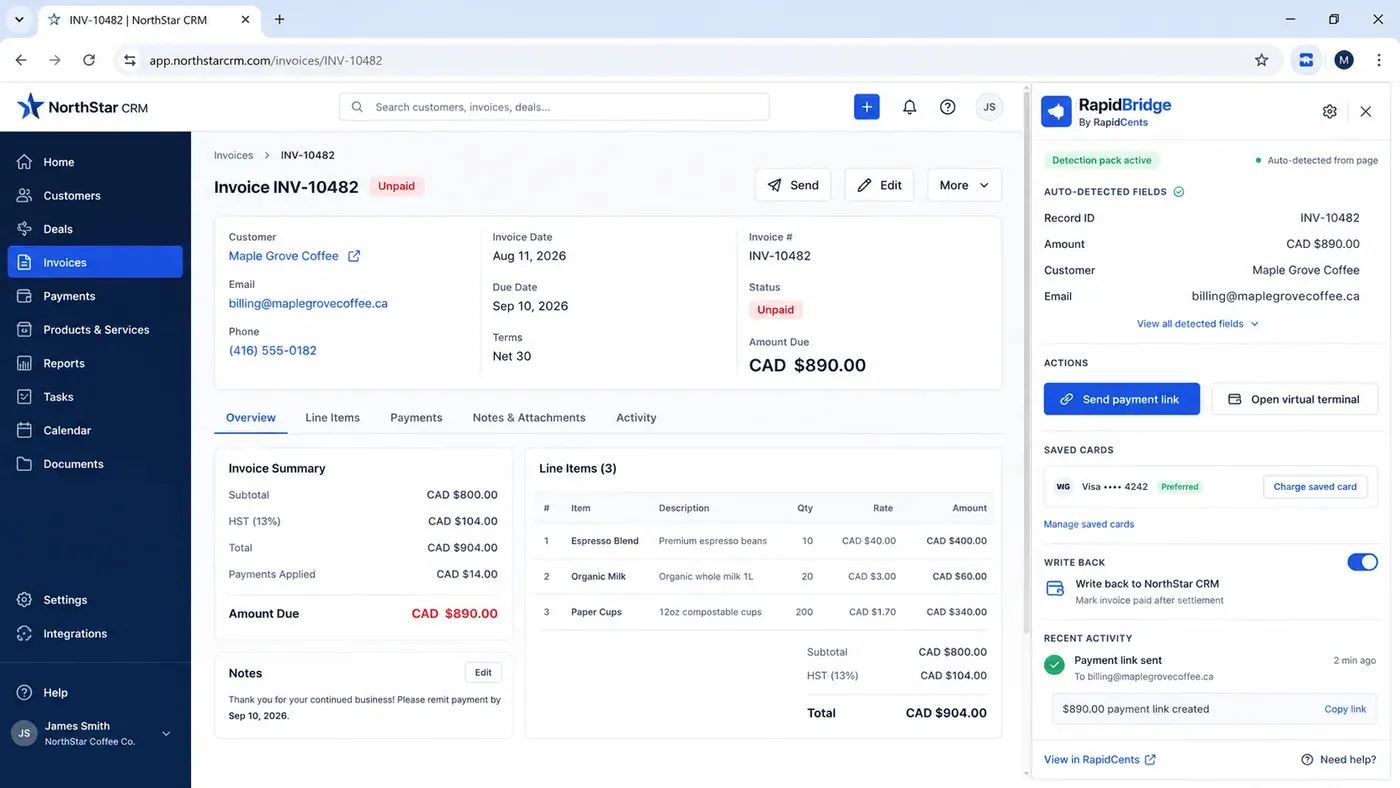
An unpaid invoice open in a third-party CRM with the RapidBridge panel beside it, showing the record number, amount, customer and email it detected from the page on its own, and buttons to send a payment link or charge a saved card. RapidBridge
Automatic payment detection in 178 business applications: RapidBridge takes payments inside…
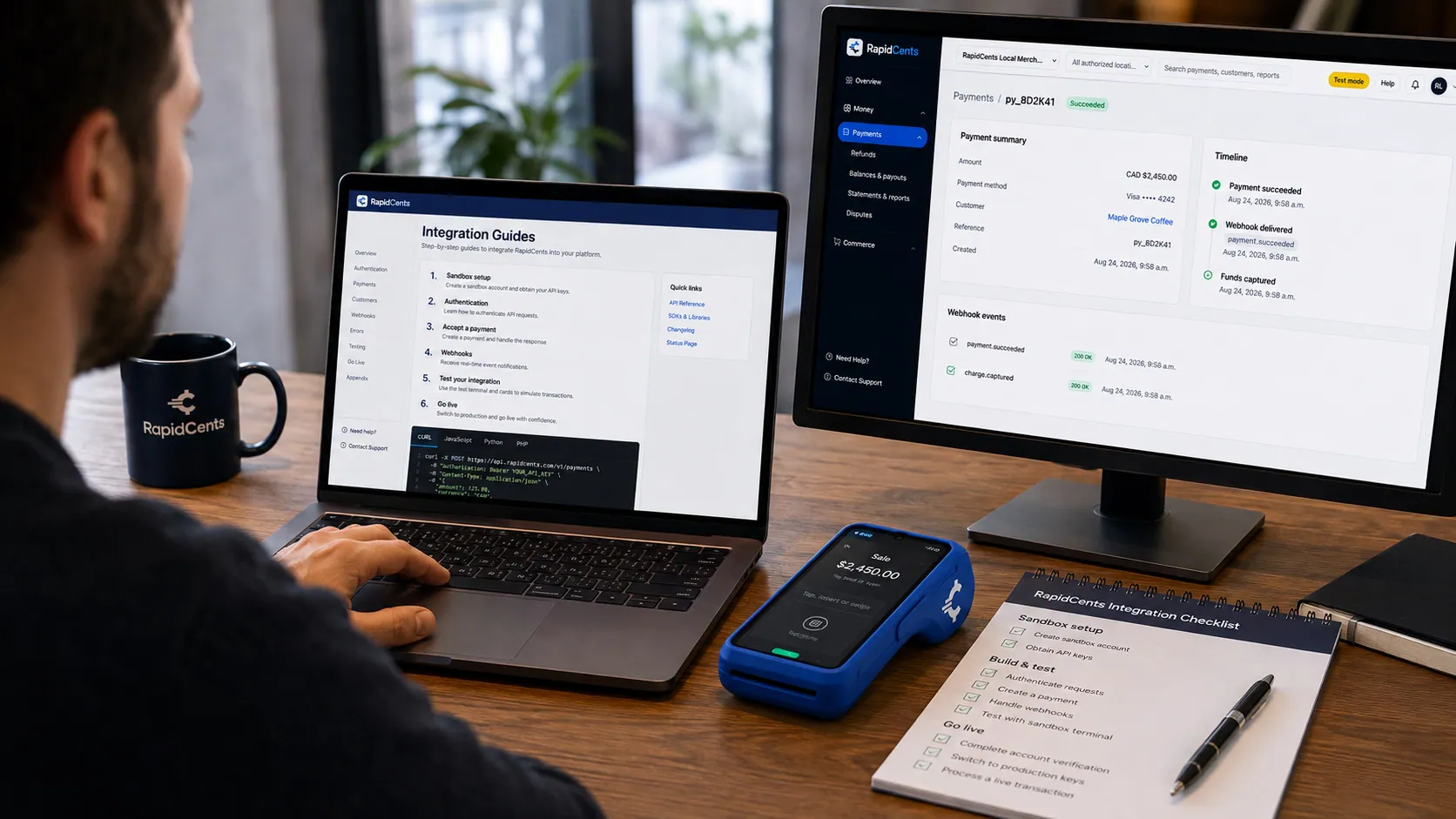
ExploreA developer working through a RapidCents integration guide, sandbox terminal on the desk and a successful test result on screen. Integration Guides
Step-by-step guides for e-commerce, POS, mobile and marketplace integrations.
Explore

Take the next step
Talk to a RapidCents specialist
RapidCents Fee Check reads a processing statement and shows interchange separately from the markup. Upload a statement for an instant breakdown, or open a merchant account and start accepting payments on one account.
- No obligation
- Payment specialists, not a call centre
- Secure statement upload