


Software & ISV Partners
In an ISV partnership your software presents the payment and RapidCents provides the acceptance, the money movement and the merchant account funds settle into. Rapid.js hosted fields, hosted checkout or embedded components keep full card numbers off your servers, which is what keeps an ISV on the short self-assessment questionnaire. Webhooks are the real integration: authorization, capture, refund, dispute and settlement outcomes arrive asynchronously and sometimes twice, so handling must be idempotent. Revenue is shared on processed volume; platform models onboard sub-merchants onto connected accounts.
COMPANY
Software & ISV Partners
In an ISV partnership your software presents the payment and RapidCents provides everything behind it: the acceptance, the money movement and the merchant account the funds settle into. You keep the product, the interface and the customer relationship, and you share in the payment revenue the integration generates.
The integration path is the part worth planning first, because it decides your PCI position. Rapid.js mounts hosted card fields inside your own layout, so the card is posted from the customer’s browser directly to RapidCents and your servers never see a full number; hosted checkout redirects to a RapidCents-hosted page and achieves the same outcome with less front-end work; embedded components give you drop-in card fields, wallet buttons and status widgets styled to your product, emitting events your application handles, including 3-D Secure challenges. Where an existing application cannot reasonably be rewritten, RapidBridge brings payments to software that was not built for them. Whichever surface you choose, webhooks are the real integration: authorization, capture, refund, dispute and settlement outcomes arrive asynchronously, and handling them idempotently is what separates a demo from a production integration. Development happens in the sandbox against documented test cards before certification and go-live.
The commercial shape follows from who onboards the merchant. In the simpler model RapidCents underwrites, prices and supports the merchant directly, and the partner is compensated on the volume their integration produces. Under a platform model your application onboards sub-merchants onto connected accounts, platform fees and split payouts apply per transaction, and RapidCents collects the KYC documents and surfaces verification status while your product controls the experience. Both models need the same thing agreed before launch: who a merchant contacts first when something does not settle.
- Choose the integration surface first
- Hosted fields keep you out of PCI scope
- Webhooks are the real integration
- Sub-merchant onboarding and connected accounts
Try it, edit values and click buttons
API request
POST /v1/payments
{
  "amount": 24900,
  "currency": "USD",
  "capture": true,
  "metadata": { "order_id": "4821" }
}Response
Click "Send request" to see the API response
Processing payment…
201 Created
{ "id": "pay_7xK2m", "status": "approved", "amount": 24900 }
Demonstration data only
In detail
Choose the integration surface first
Rapid.js hosted fields inside your UI, a hosted checkout redirect, embedded components styled to your product, or RapidBridge for software that cannot be rewritten. The choice sets both build effort and PCI scope.
Hosted fields keep you out of PCI scope
The card posts from the customer’s browser to RapidCents, so a full number never reaches your servers, logs or database. That is what keeps an ISV on the short self-assessment questionnaire instead of the long one.
Webhooks are the real integration
Authorization, capture, refund, dispute and settlement outcomes arrive asynchronously and sometimes twice. Idempotent handling and reconciliation against your own records is the work teams most often underestimate.
Sub-merchant onboarding and connected accounts
Under a platform model your application onboards sellers onto connected accounts while RapidCents collects KYC documents and surfaces verification status, so you control the experience without holding the compliance obligation.
Revenue share on processed volume
Payment revenue scales with what flows through the integration, which is why the commercial terms and the integration design should be settled together rather than one after the other.
Sandbox, certification, go-live
Build against documented test cards in the sandbox, work through a test plan that covers refunds, partial refunds and failure paths, then certify and launch with support rather than discovering the edge cases in production.
Related pages
Partners
How the referral, software, technology and enterprise programs differ.
Explore
Card fields hosted by RapidCents sit inside a merchant checkout, with a terminal and the payments dashboard beside them. Embedded payments
Drop-in components that keep checkout inside your interface.
Explore
A software platform routes connected-merchant payments through RapidCents, with terminals and settlement in one view. Platform payments
Sub-merchant onboarding, connected accounts and split payouts.
Explore
Rapid.js hosted card fields on a developer workstation, keeping card entry out of the merchant's PCI scope. Rapid.js
Hosted card fields inside your own layout.
Explore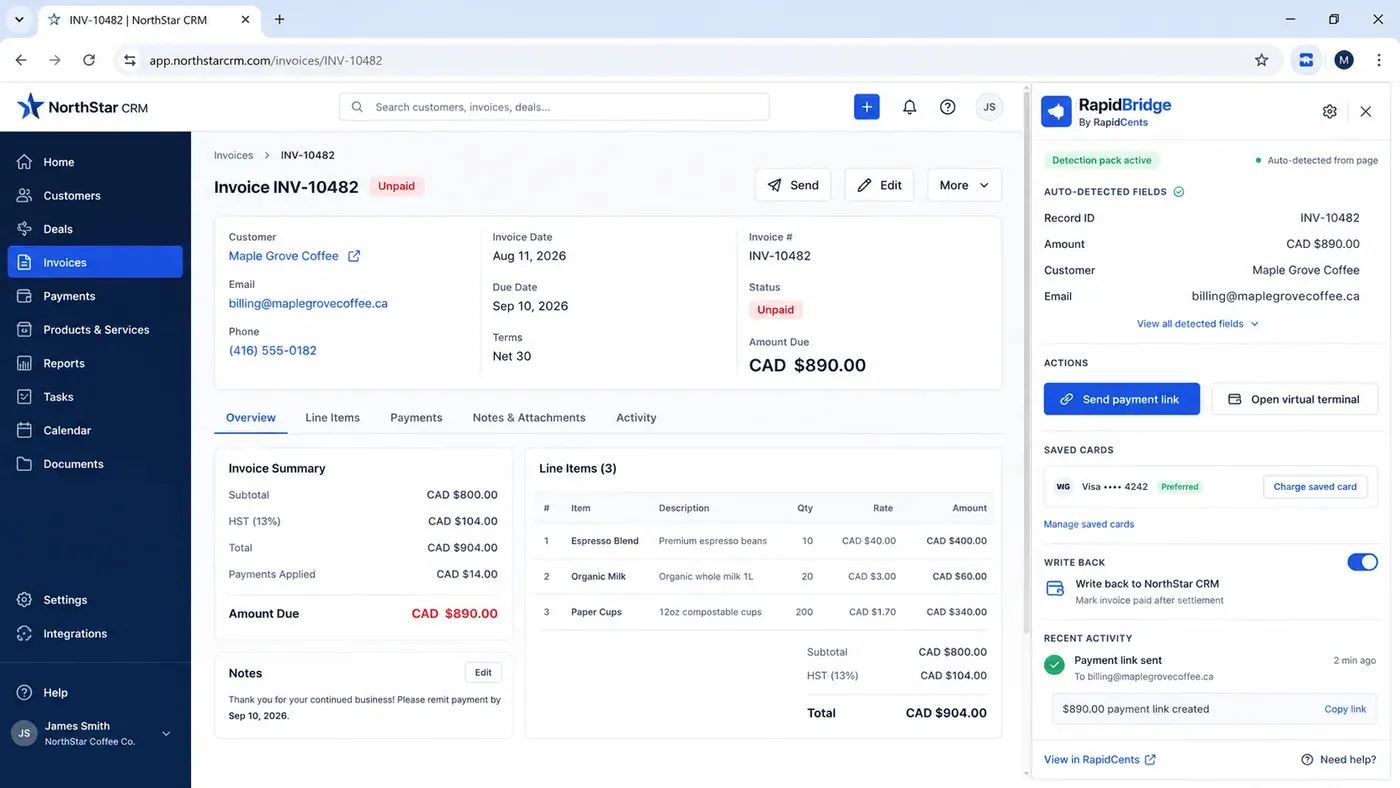
An unpaid invoice open in a third-party CRM with the RapidBridge panel beside it, showing the record number, amount, customer and email it detected from the page on its own, and buttons to send a payment link or charge a saved card. RapidBridge
Payments for software that was not built for them.
Explore
A RapidCents sandbox merchant account running test payments, isolated from production, with a sandbox terminal on the desk. Sandbox
Test cards and a full environment before certification.
Explore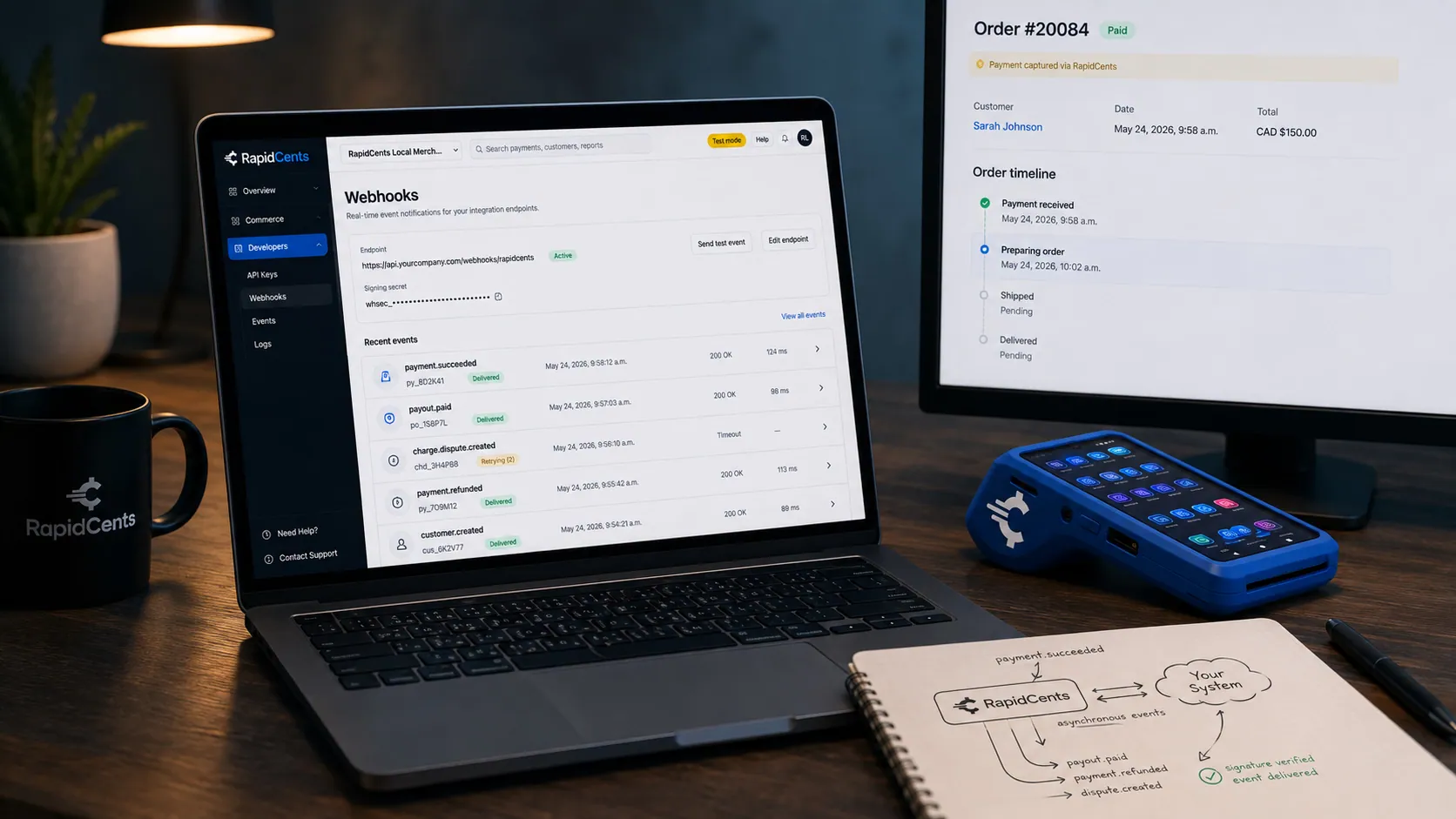
A RapidCents webhook delivery timeline next to the payment that triggered it, with a test terminal on the desk. Webhooks
Asynchronous outcomes and how to handle them idempotently.
Explore


Questions about Software & ISV Partners
Are webhook events signed, and what if the same one arrives twice?
Events are signed, so your endpoint can verify that an event came from RapidCents before acting on it. Assume duplicates: authorization, capture, refund, dispute and settlement outcomes arrive asynchronously and the same event can be delivered more than once. Key your handler on the event or transaction identifier and make the write idempotent, then reconcile against your own records rather than trusting delivery order.
Can a stored card be charged across channels?
Yes. A token can be charged online, in person or through the API, and updated or deleted as the customer record changes. Customer profiles hold contact details, stored credentials and payment history in one record, so a card saved during an online checkout can be charged later at a counter without collecting it again.
Does my application have to handle 3-D Secure?
It has to expect it. Authentication is triggered by rules on amount, geography or risk signal rather than on every transaction, so your payment flow needs a path for a challenge appearing mid-payment. Embedded components emit the events for that, including the 3-D Secure challenge, and your application decides what the interface does around them.
What keeps subscription billing working when cards expire?
Account Updater refreshes stored cards when they expire or are reissued, so a recurring schedule does not start failing on a card the customer never cancelled. It matters most for software billing monthly: the failure it prevents is silent, and it usually surfaces as churn rather than as a payment error.
Can we take bank payments as well as cards?
Yes. Bank payments pull funds directly from a bank account, which suits larger amounts and repeating charges where card economics work against you. It sits alongside card acceptance on the same account rather than as a separate integration to reconcile.
What does the API cover, and how do I avoid double charges?
REST endpoints for authorize, capture, void, refund and tokenize, with idempotency keys, structured error codes and versioned endpoints. Send the idempotency key on every write and reuse it on a retry — that is what makes a timeout safe to retry, and a timeout is the failure your integration will actually meet in production.
Take the next step
Talk to a RapidCents specialist
RapidCents Fee Check reads a processing statement and shows interchange separately from the markup. Upload a statement for an instant breakdown, or open a merchant account and start accepting payments on one account.
- No obligation
- Payment specialists, not a call centre
- Secure statement upload



