


DEVELOPER PLATFORM
Quickstart
The RapidCents quickstart takes an integration from nothing to a verified test payment. It issues sandbox credentials, creates a payment against a documented test card, delivers the resulting signed webhook to your endpoint, and confirms the signature check passes. It is deliberately server-first: the call that authorizes money runs from a backend with a secret key, and the browser is only involved once card entry is added. The same four moves, with the same idempotency and signature handling, are what a production cutover repeats.
- Sandbox with documented test cards
- Signed webhooks
- Typed errors and idempotent retries
- Dedicated developer support

What crosses the wire
You send a payment request from your server
A JSON body carrying the amount, the currency, a reference to the payment method and an idempotency key, authenticated with your sandbox secret key. The API reference names each of those inputs and marks which are optional.
You get back a payment with a state
The response reports whether the payment authorized, was declined or needs further authentication, and carries a request id you should log. State, not the HTTP status alone, is what your application branches on.
The webhook arrives separately
The lifecycle event is delivered to your endpoint out of band, signed, and possibly after your original response has already returned. Treat the two as independent arrivals rather than a single round trip.
When to use it
Evaluating RapidCents
The fastest way to see the request and response shapes against a real environment instead of reading about them.
Onboarding a new developer
A repeatable path that ends in a working payment rather than a page of theory, and that surfaces the webhook step early.
Rehearsing a cutover
The same four moves are what a production switch repeats with live keys, so running them again before go-live is cheap insurance.
How to implement Quickstart
Request sandbox access and store the secret key server-side only.
Create a payment for a small amount using a documented test card.
Point a webhook endpoint at an HTTPS tunnel to localhost and receive the event.
Verify the signature against the raw body, then acknowledge with a 2xx.
Repeat with a declining card and confirm your handler took the decline branch.
What fails, and how you find out
The secret key leaked into the client
If a secret key appears in a browser bundle or a mobile binary, treat it as compromised and rotate it. Browser card entry uses a publishable key, which cannot move money.
Signature check fails on a valid event
Almost always because the body was parsed, re-serialized or trimmed by middleware before verification. Capture the raw bytes first, verify, then parse.
The payment succeeded but your order did not
Your response handler and your webhook handler both ran, or neither did. Key the order update on the event id so a duplicate delivery is a no-op rather than a second fulfilment.
Sandbox versus production
Outcomes are chosen, not risked
In production the issuer decides. In sandbox the card number decides, so an approval is always an approval and a decline is always the same decline, which is what makes the run repeatable in CI.
A tunnel is enough
Sandbox webhooks reach any HTTPS tunnel to localhost. Production needs a routable endpoint with a certificate, so the deployment step is the one thing the quickstart does not rehearse.
Settlement is compressed
The funded event that follows a sandbox capture arrives in minutes. On production it follows your funding schedule, so timing assumptions built during the quickstart need rechecking.
Questions about Quickstart
How long does the RapidCents quickstart take?
A first successful sandbox payment usually takes under an hour, including credential issuance. Webhook verification adds roughly another hour depending on your tunnel setup.
Which test cards should I use?
The testing page documents approval, decline, insufficient funds and 3-D Secure challenge cards so each branch of your error handling can be exercised deliberately.
Can I run the quickstart without a public URL?
Yes. Any HTTPS tunnel to localhost receives sandbox webhooks; a public deployment is only needed for production.
Do I need the webhook step if I already read the payment response?
Yes. The response tells you the outcome at that instant. Later state, including refunds, disputes and funding, only arrives as an event, so an integration that skips webhooks goes stale the moment anything changes after checkout.
What should I build first, the server call or the card fields?
The server call. It is the piece that authorizes money and the piece your error handling hangs off. Rapid.js card fields can be added once a payment already succeeds against a documented test card.
What is left to do after the quickstart passes?
Idempotency on every state-changing call, a retry policy that separates soft from hard declines, reconciliation against settlement records, and secrets moved into a manager. The quickstart proves connectivity, not production readiness.
Can I run the quickstart against production keys instead of sandbox?
You can, and it charges real cards. There is no reason to. The endpoints, request bodies and error codes are identical in both environments, and a documented test card gives you a repeatable decline and a 3-D Secure challenge that no live card will produce on demand.
What is the smallest amount of code the quickstart actually needs?
One server-side payment call and one webhook route. No card fields, no queue and no database are required to see both a payment and its signed event, which is why the sequence fits in an afternoon. Card entry with Rapid.js comes after a payment already succeeds.
Continue the integration
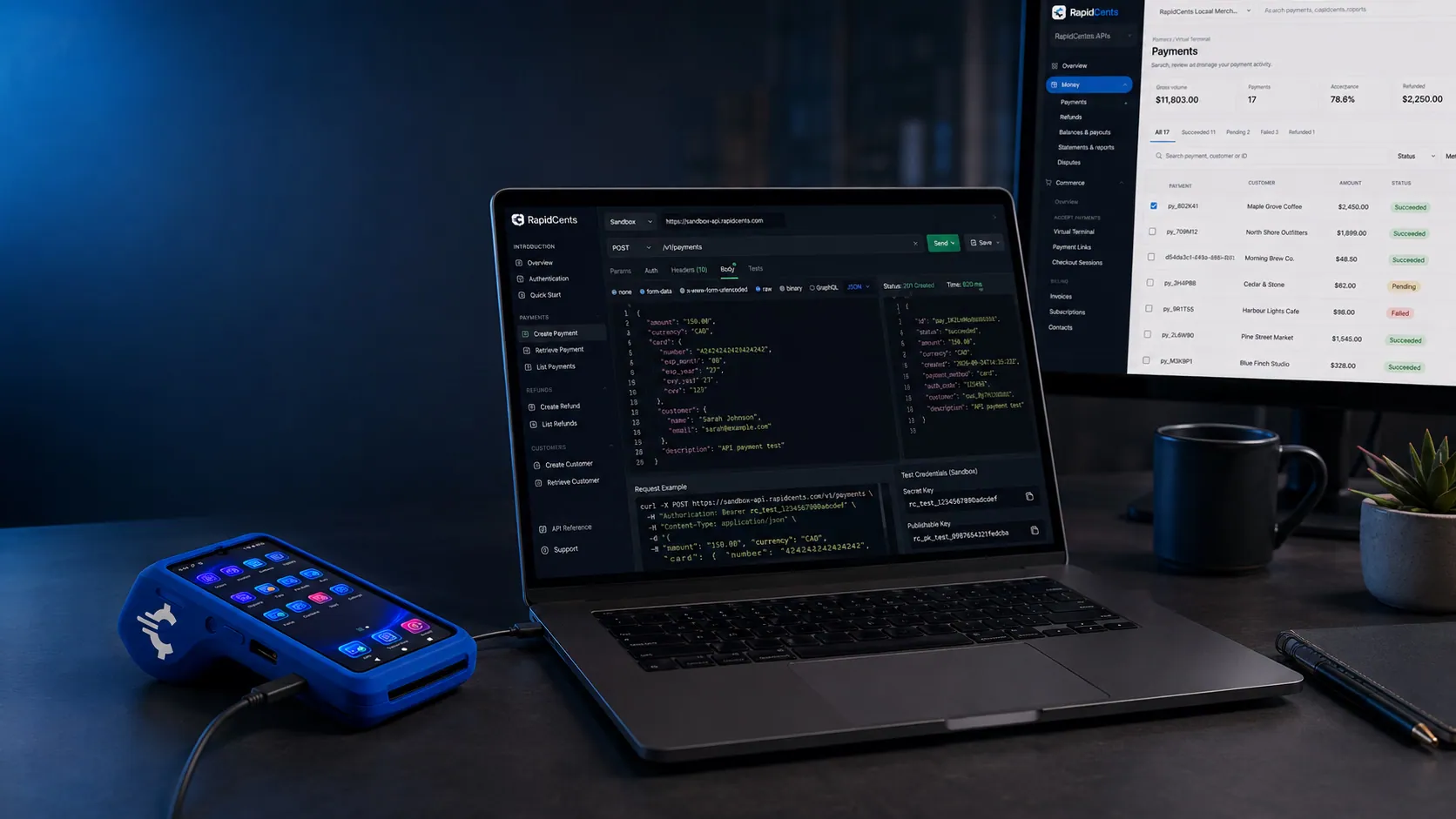
A RapidCents sandbox merchant account running test payments, isolated from production, with a sandbox terminal on the desk. Sandbox
Request sandbox access with test merchant IDs and isolated environment.
ExploreRapidCents sandbox testing: documented test cards, a simulated decline, and a terminal for the in-person cases. Testing
Test card numbers, simulated declines and sandbox settlement events.
Explore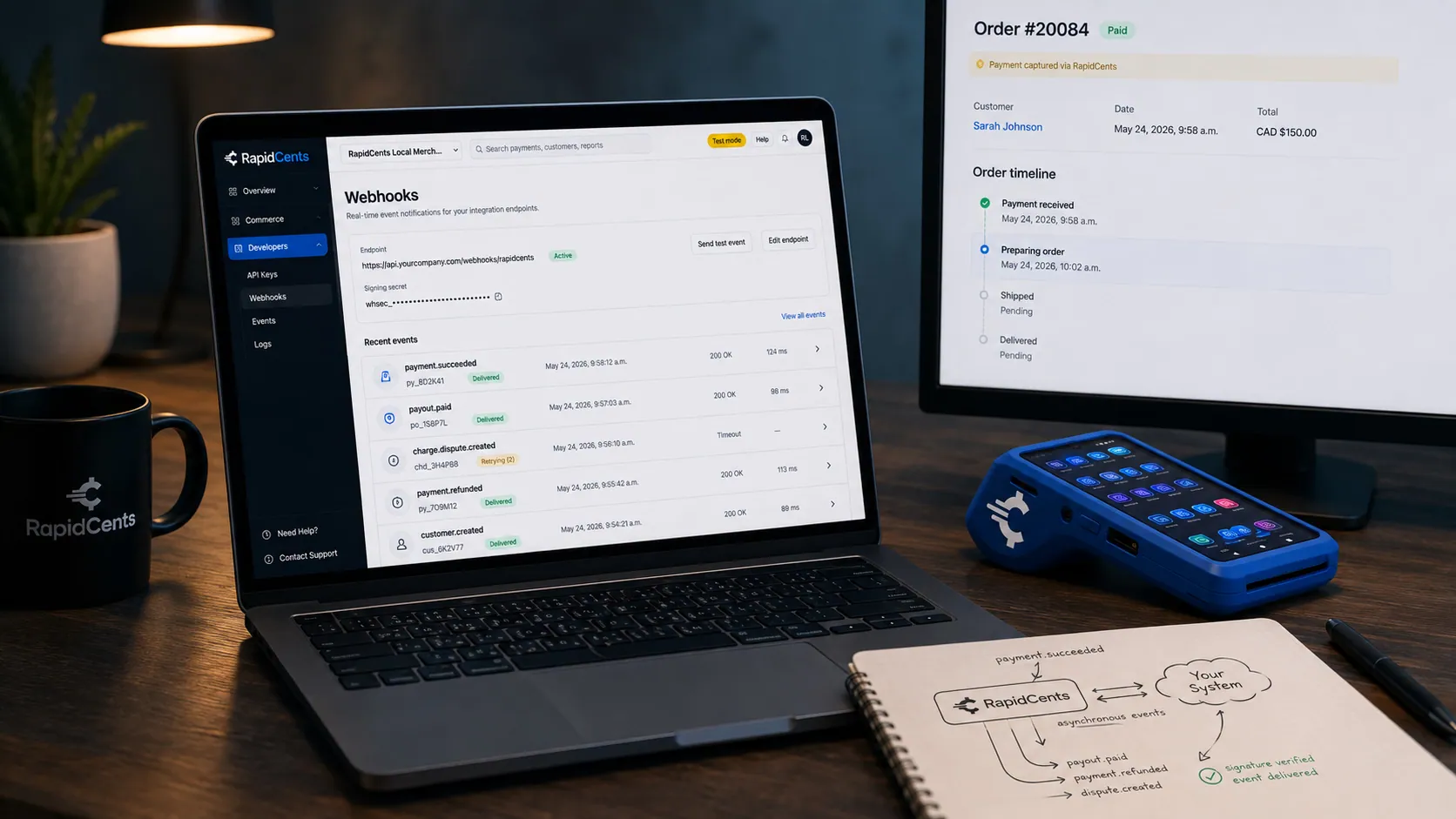
A RapidCents webhook delivery timeline next to the payment that triggered it, with a test terminal on the desk. Webhooks
Signed webhook events for payment lifecycle with idempotent processing guidance.
Explore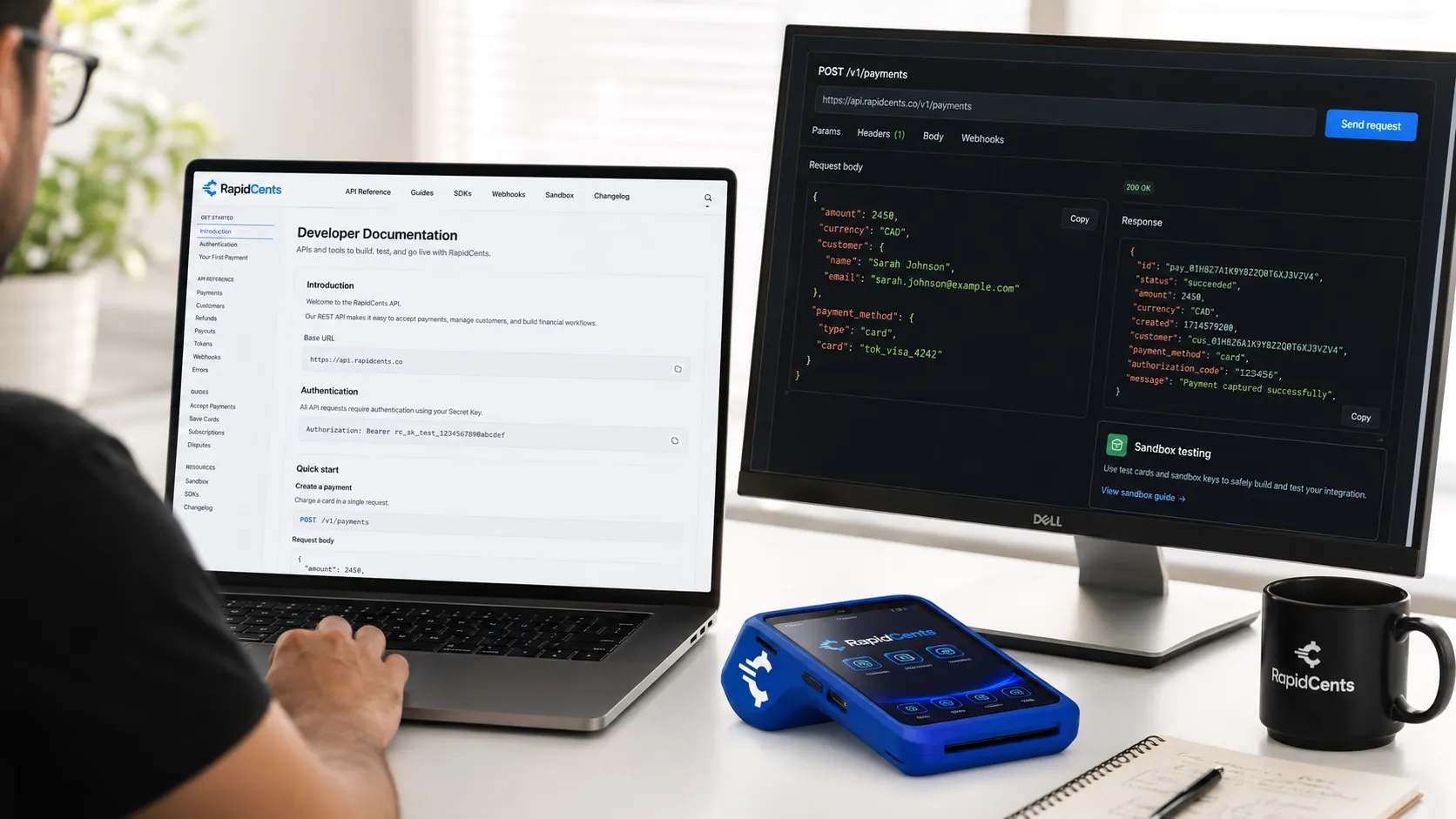
The RapidCents API reference on a workstation, with a sample request, the matching response, and a test terminal. API Reference
REST endpoints for payments, customers, refunds, webhooks and settlements with request and…
Explore


Take the next step
Talk to a RapidCents specialist
RapidCents Fee Check reads a processing statement and shows interchange separately from the markup. Upload a statement for an instant breakdown, or open a merchant account and start accepting payments on one account.
- No obligation
- Payment specialists, not a call centre
- Secure statement upload



