


DEVELOPER PLATFORM
Sandbox
The RapidCents sandbox is a fully isolated environment with its own credentials, test merchant IDs, simulated card networks and accelerated settlement. Nothing in it touches production data or real money. It is not a cut-down mock: the endpoints, request bodies, error codes and webhook payloads are the ones production serves, so work done there transfers rather than being redone. What it cannot stand in for is a real bank account, real funding timing and your actual pricing, all of which come from an approved merchant account.
- Sandbox with documented test cards
- Signed webhooks
- Typed errors and idempotent retries
- Dedicated developer support

What crosses the wire
What you get
A set of credentials, at least one test merchant ID, and access to the documented test cards. The keys are environment-scoped, so they authenticate only against the sandbox and nowhere else.
What it stands in for
The card networks and the issuer decision. Everything upstream of that — your request, the gateway contract, the event stream, the settlement records — behaves as it does on production.
What it cannot stand in for
A real bank account, real funding timing and your actual pricing. Those come from an approved merchant account, and no sandbox response should be read as a quote or a deposit schedule.
When to use it
During evaluation
Prove the integration works before committing to a merchant account, and before anyone signs anything.
For every release
Keep a permanent sandbox account so changes are verified before they reach live traffic, not after.
When onboarding or handing over
A new developer, or a partner agency taking over the integration, can be given sandbox credentials without any access to live money.
How to implement Sandbox
Request sandbox access and receive a test merchant ID.
Build against sandbox keys with webhooks pointed at a tunnel.
Exercise approvals, declines, refunds and one 3-D Secure challenge with documented cards.
Run the same suite from continuous integration with its own sandbox credentials.
Swap to production keys only after the go-live checklist passes, and rotate the signing secret with them.
What fails, and how you find out
The signing secret was not swapped at cutover
Sandbox and production sign with different secrets. A handler that verified correctly all through development rejects every live event, and because rejection looks like a security failure it is often misdiagnosed as an attack.
A sandbox key deployed to production
Every call fails authentication at once. Refusing to boot when the credential does not match the expected environment turns a live outage into a failed deploy.
Timing assumptions carried across
Accelerated settlement in sandbox teaches your code that funding follows capture almost immediately. On production it follows the funding schedule on your account, and jobs built on the sandbox rhythm sit idle.
Sandbox treated as a load test
It is a correctness environment, not a capacity one. Numbers observed there say nothing about production throughput, and using it that way mostly produces throttling responses.
Sandbox versus production
Isolation is by credential, not by convention
The two environments hold separate data and separate keys, and neither key works against the other. There is no configuration mistake that lets a sandbox call reach live funds.
Outcomes are chosen by card number
A production result depends on the issuer. A sandbox result depends on which documented card you sent, which is why the same test can be run a thousand times and mean something each time.
Time is compressed, money is not real
Batches close and deposits fund in minutes so reconciliation can be exercised, and the amounts, fees and schedules involved are illustrative rather than a preview of your account.
Questions about Sandbox
How do I get RapidCents sandbox access?
Request it during evaluation; credentials and a test merchant ID are issued without a signed merchant agreement.
Is sandbox data ever mixed with production?
No. The environments are separate, with separate keys, so a sandbox call cannot reach live funds.
How long does sandbox access last?
It stays available through development and after go-live, so releases can keep being tested against it.
Can I copy sandbox data into production, or the other way round?
No. Tokens, customer records and payments do not cross environments, and a card vaulted in sandbox has no production counterpart. Anything you need on production has to be created there.
What exactly has to change when I move to production?
The secret key, the publishable key, the webhook signing secret and the endpoint your events are delivered to. Treat all four as one change set, because a partial swap fails in a way that looks like something else.
Does sandbox behaviour always match production?
The contract is the same and is versioned the same way. The differences are the ones listed above — simulated networks, deterministic outcomes, compressed settlement — and they are documented rather than incidental.
Can the sandbox be used to load test my integration?
No. It is a correctness environment rather than a capacity one. Throughput observed there says nothing about production, and driving volume through it mostly produces throttling responses with a retry hint instead of useful numbers.
Can I point a sandbox client at a new API version while production stays pinned?
Yes, and that is the intended way to plan a migration. Version pinning is honoured identically in both environments, so running the old and the new version side by side in sandbox produces the actual list of assertions a migration ticket has to cover.
Continue the integration
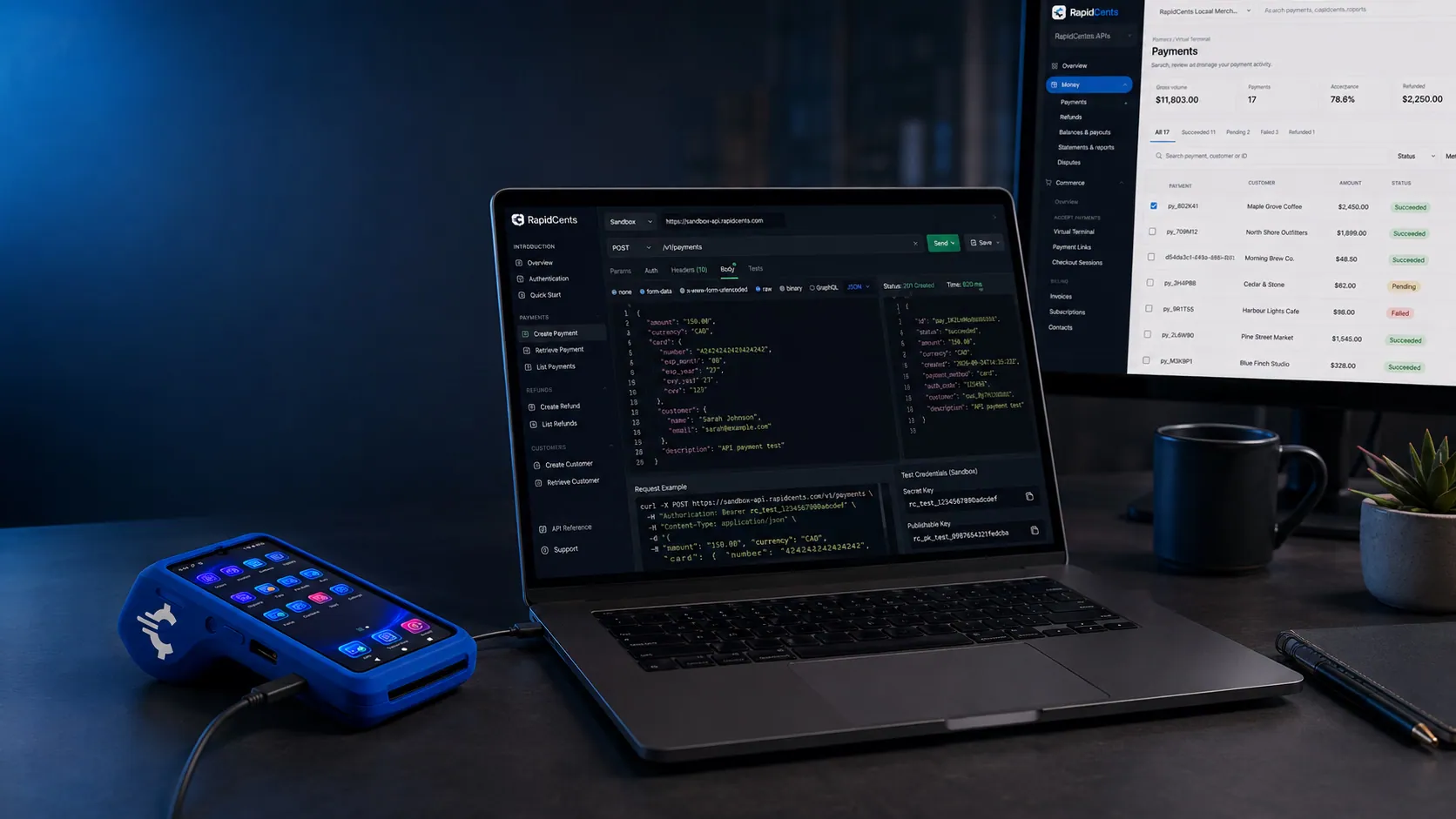
The RapidCents quickstart path: create a test payment, see the response, and confirm it on a sandbox terminal. Quickstart
Get sandbox credentials, create a test payment, receive a webhook and prepare for production in…
ExploreRapidCents sandbox testing: documented test cards, a simulated decline, and a terminal for the in-person cases. Testing
Test card numbers, simulated declines and sandbox settlement events.
Explore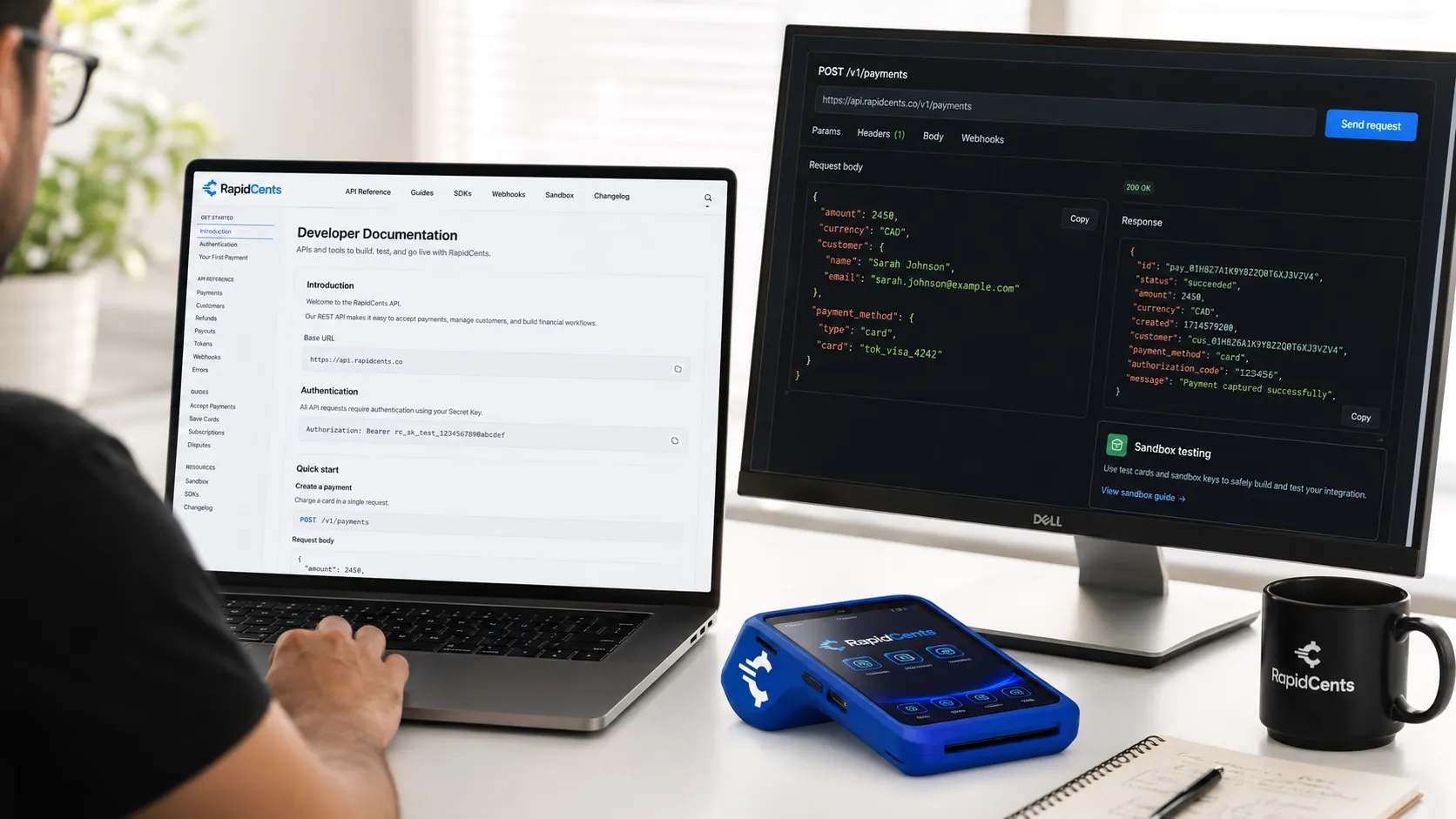
The RapidCents API reference on a workstation, with a sample request, the matching response, and a test terminal. API Reference
REST endpoints for payments, customers, refunds, webhooks and settlements with request and…
Explore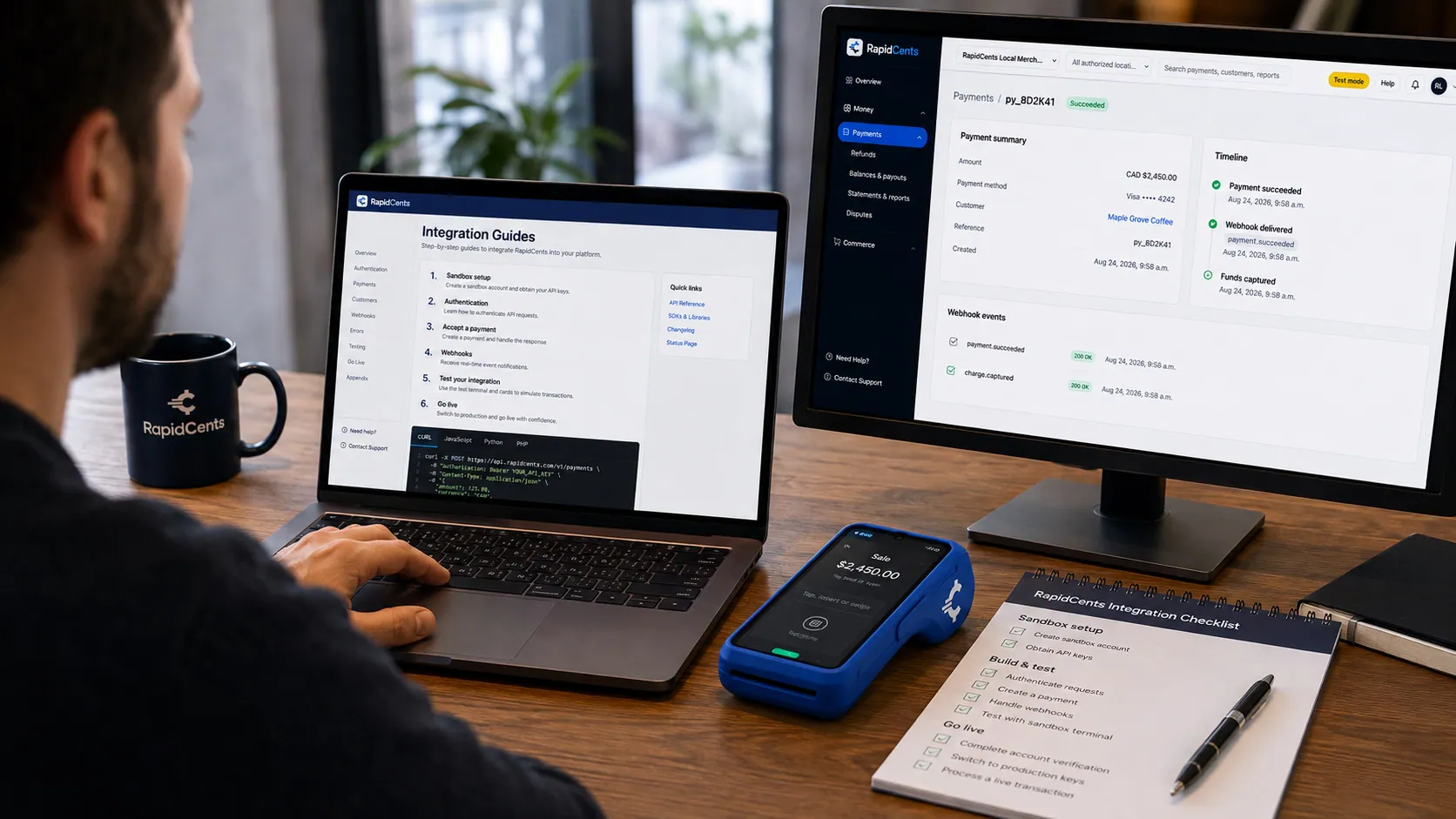
A developer working through a RapidCents integration guide, sandbox terminal on the desk and a successful test result on screen. Integration Guides
Step-by-step guides for e-commerce, POS, mobile and marketplace integrations.
Explore


Take the next step
Talk to a RapidCents specialist
RapidCents Fee Check reads a processing statement and shows interchange separately from the markup. Upload a statement for an instant breakdown, or open a merchant account and start accepting payments on one account.
- No obligation
- Payment specialists, not a call centre
- Secure statement upload



