Marketplace and split payouts
Marketplace payments with sub-merchant onboarding and split payouts
Platform payments let a marketplace, franchise system or software platform onboard sub-merchants and route money to them. RapidCents handles connected-account onboarding with hosted or API-driven KYC, splits each charge between a platform fee and the seller's portion, schedules seller payouts with reserve holds, and exposes verification status and capability flags per account. Prohibited-category screening runs at onboarding, and ledger exports separate platform revenue from seller liability for finance teams.
- Sub-merchant KYC and onboarding APIs
- Split payouts and platform fee collection
- Compliance monitoring for marketplace categories

- Sub-merchant underwriting
- SOC 2 Type II
- Split payout automation
- Prohibited category screening
- Platform ledger exports
Who it's for
Online marketplaces
Collect from buyers and pay sellers minus platform fee.
Franchise systems
Route location revenue to franchisee accounts automatically.
SaaS enabling seller payments
ISVs monetize payments inside vertical software.
Core capabilities
Connected onboarding
Hosted or API-driven KYC for sub-merchants.
Split charges
Define platform fee and seller portion on each transaction.
Payout scheduling
Daily or weekly seller deposits with reserve holds.
Verification dashboard
Track document status and capability flags per seller.
Ledger exports
Platform revenue and seller liability reports for accounting.
How it works
Apply for platform account with business model review.
Integrate onboarding API or hosted seller signup.
Seller completes KYC and receives connected account.
Buyer payment splits on capture per fee rules.
Seller payouts deposit on configured schedule.
Platform payment workflows
Marketplace sale
Buyer pays $100; platform keeps $10; seller receives $90.
Seller onboarding
Upload ID and business docs; account activates in 24-48 hours.
Reserve release
Rolling reserve releases to seller after dispute window.
Franchise royalty
Automatic fee sweep to franchisor on each location sale.
Dashboard and reporting
Transactions, deposits and exceptions visible in the RapidCents merchant dashboard.
Try it, edit values and click buttons
Merchant dashboard
- Today
- $4,218
- Deposits
- $12,482
- Disputes
- 2 open
- In-person
- $842
- Online
- $1,104
- Virtual terminal
- $392
Demonstration data only
Integrations
Onboarding API
REST endpoints for seller verification status.
Connect webhooks
account.updated and payout.paid events.
Embedded onboarding UI
White-label seller signup inside your portal.
Works with Platform Payments
Capabilities on the same account, so the parts below connect without a second integration or a second contract.
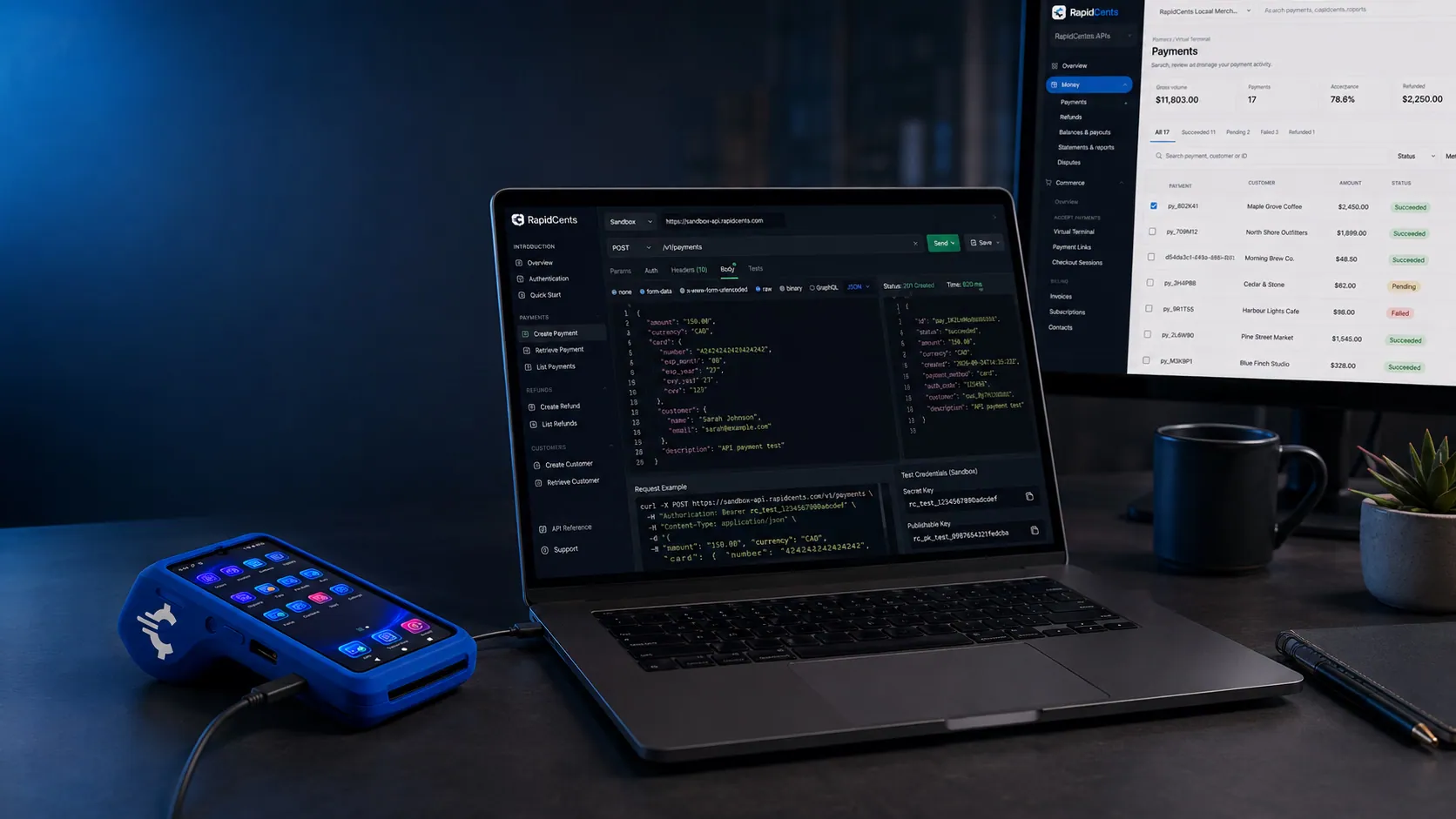
A RapidCents API request and its response on a developer workstation, with the merchant dashboard and a test terminal. RapidCents APIs
REST endpoints for payments, customers, refunds and reporting.
Explore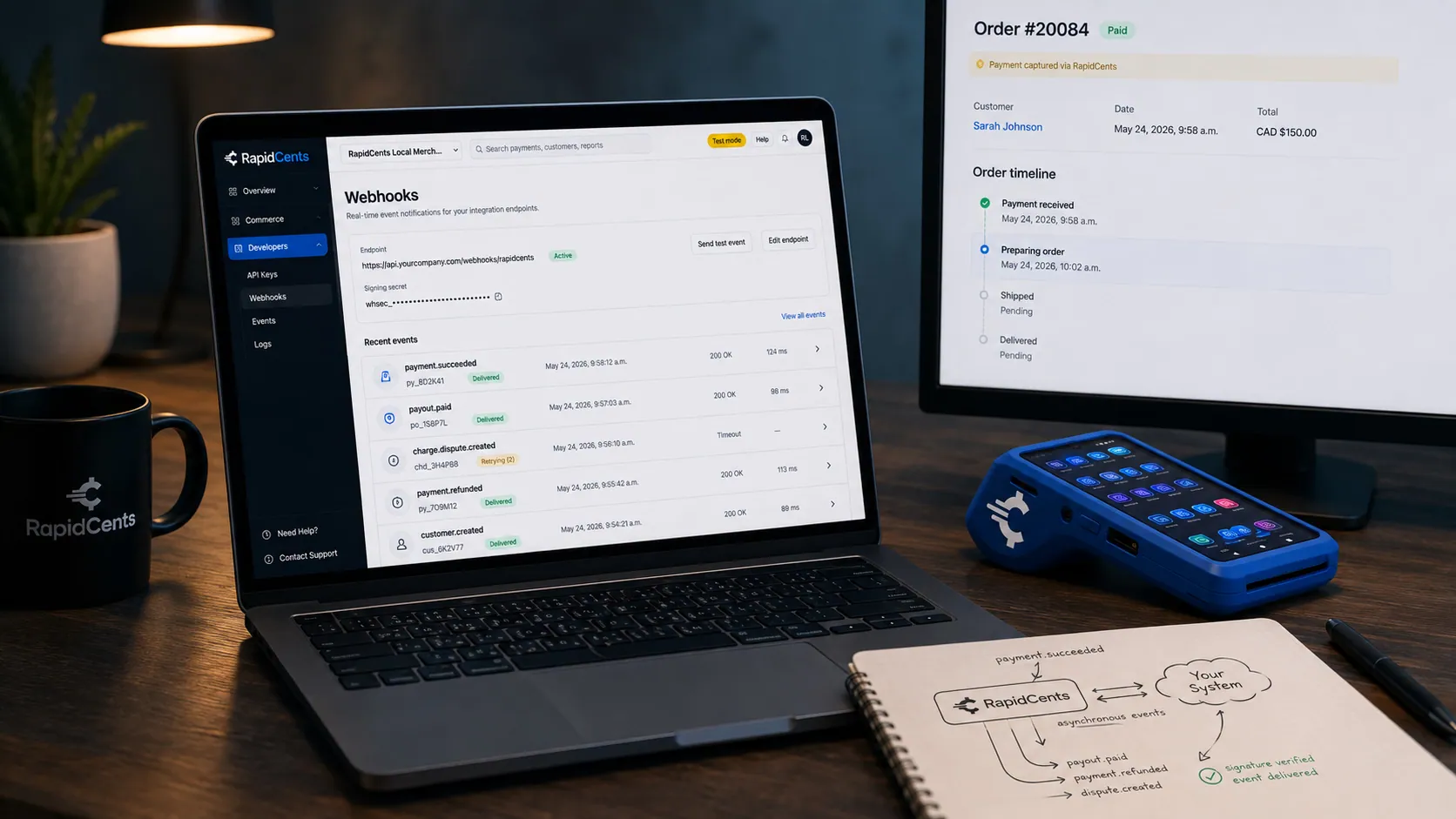
A RapidCents webhook delivery timeline next to the payment that triggered it, with a test terminal on the desk. Webhooks
Signed events your systems can react to the moment a payment settles or fails.
Explore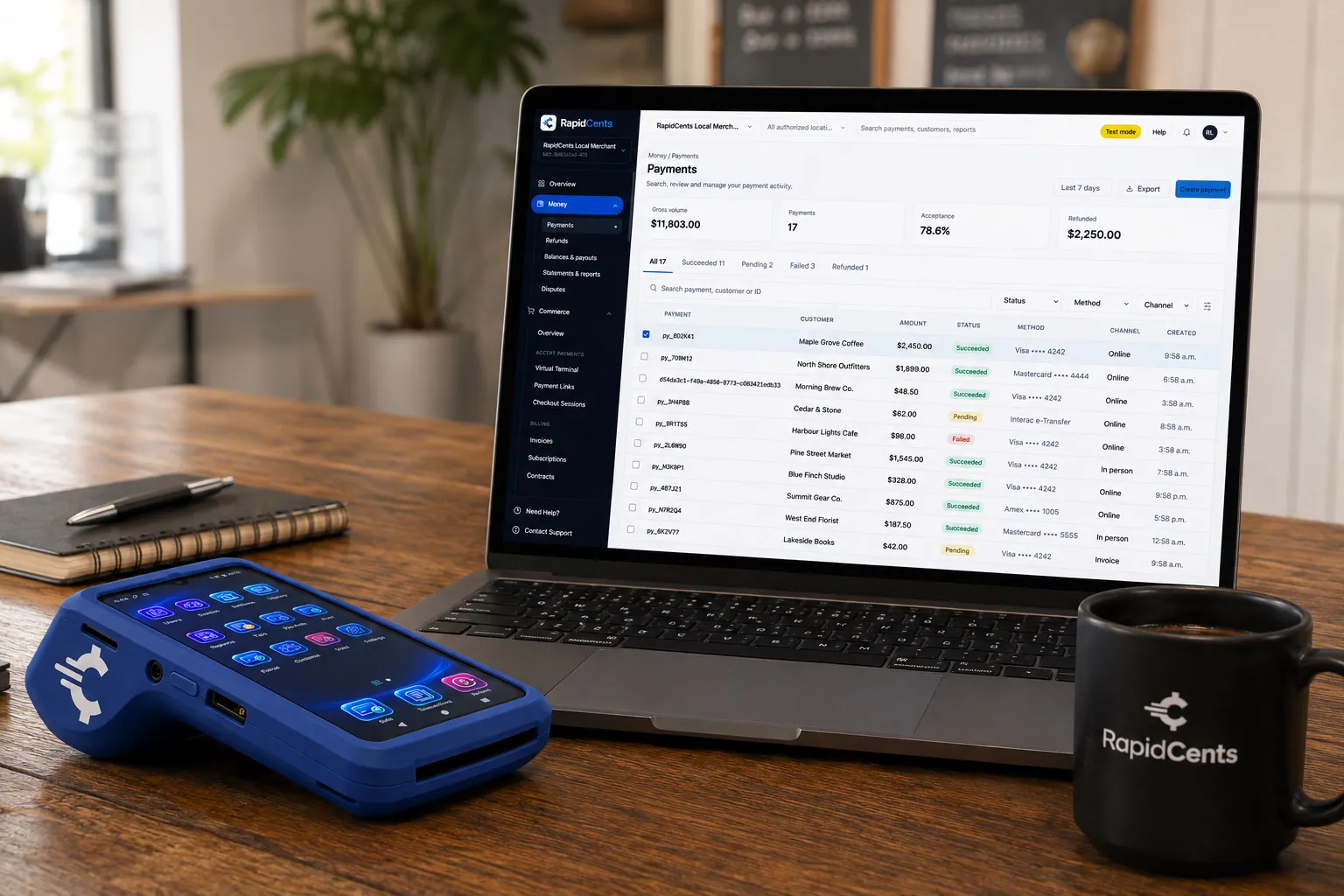
A payment-gateway integration desk: API response on screen, RapidCents terminal ready for a test sale. Payment gateway
The authorization layer every online RapidCents payment runs through.
Explore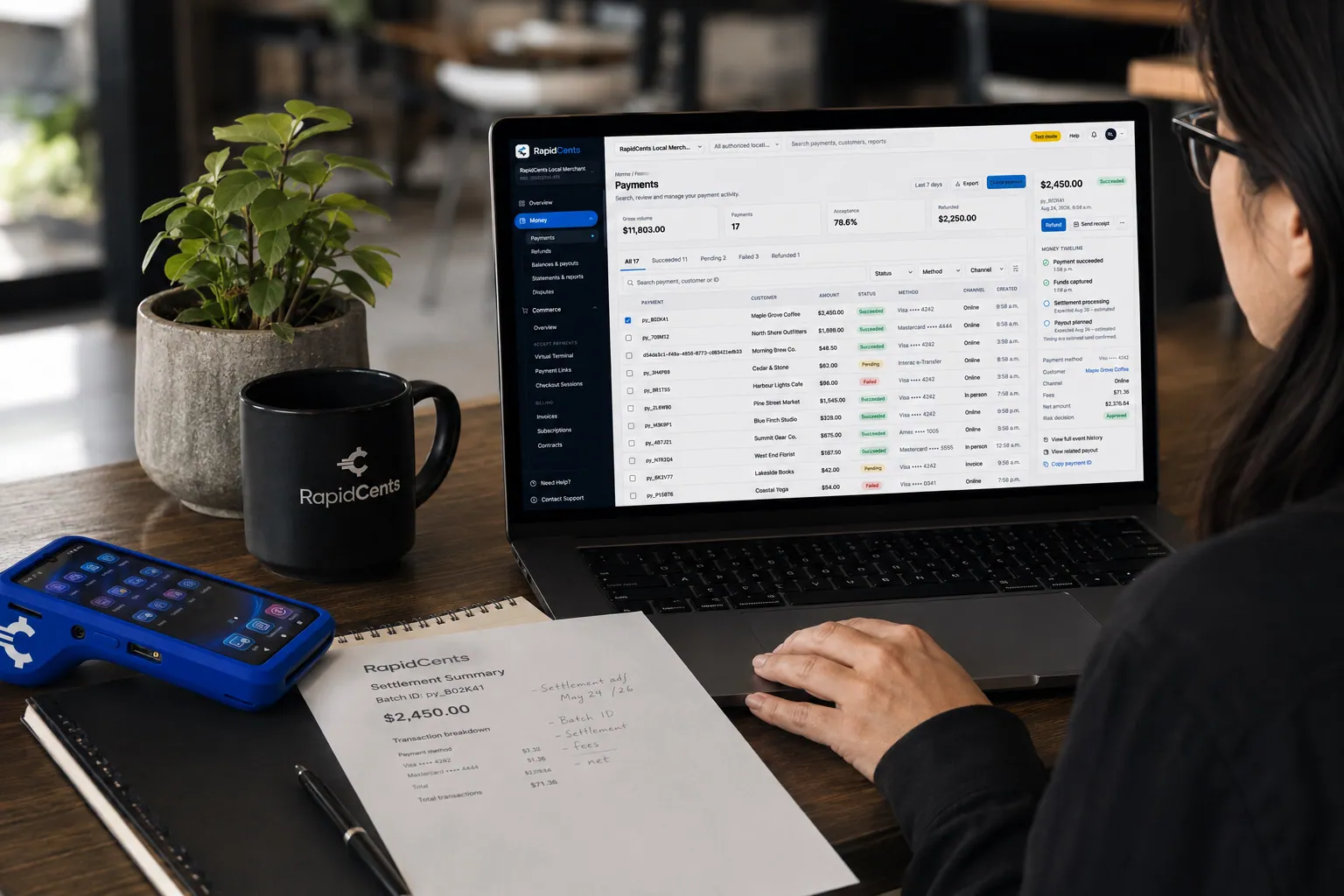
A merchant reviews RapidCents reports for volume, mix and payouts, with the terminal that took the sales on the desk. Reporting and reconciliation
Deposit-level detail that ties settlements back to the transactions behind them.
Explore
One RapidCents account comparing sales across locations, with a terminal representing the store-level capture. Multi-location
Per-site reporting and permissions under one merchant account.
Explore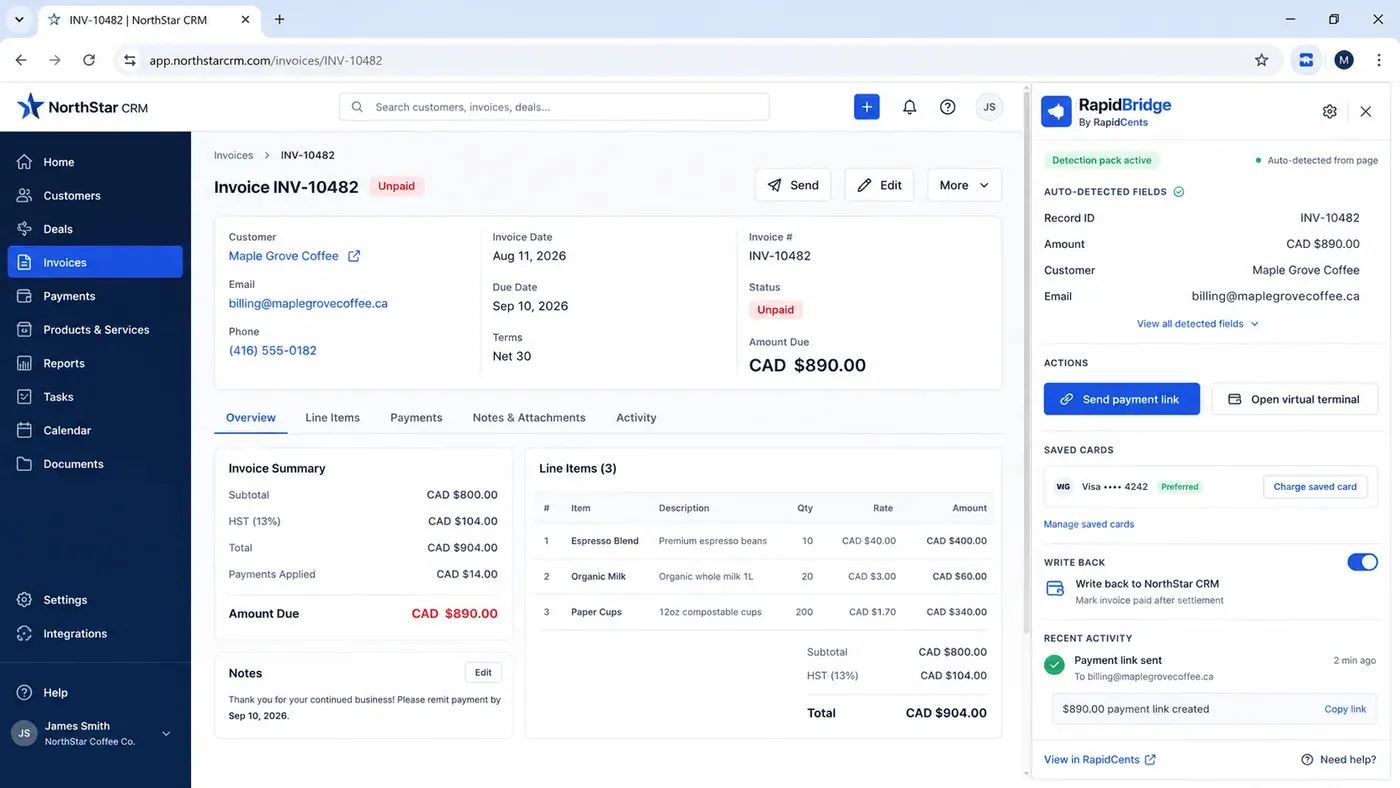
An unpaid invoice open in a third-party CRM with the RapidBridge panel beside it, showing the record number, amount, customer and email it detected from the page on its own, and buttons to send a payment link or charge a saved card. RapidBridge
Connects RapidCents to the software you already run, without rebuilding it.
Explore


Security
KYC document vault
Encrypted storage with retention policies.
Prohibited business screening
Automated category checks at onboarding.
Seller capability flags
Disable payouts until verification complete.
Implementation
Platform review
Describe marketplace model and seller types.
Legal agreements
Platform and connected account terms with sellers.
Sandbox sellers
Create test connected accounts for QA.
Go-live monitoring
Watch first seller payouts and dispute rates.
Pricing
Platform economics
Platform fee plus per-transaction processing. Seller rates may pass through or absorb per your model.
Questions about Platform Payments
Who holds merchant of record?
Structure depends on model. Your advisor explains MOR for your marketplace.
International sellers?
Sub-merchants standard. Cross-border requires additional review.
Chargeback liability?
Allocated per connected account agreement and reserve policy.
Minimum platform volume?
Contact platform sales for eligibility and pricing tiers.
How long does sub-merchant onboarding take?
A seller uploads identification and business documents and the account activates in roughly 24 to 48 hours. Capability flags keep payouts disabled until verification completes, so a seller can exist in your product before it can be paid, which is usually how you want the signup flow to feel.
Who is liable for a chargeback on a marketplace sale?
Liability is allocated per connected account agreement and reserve policy rather than fixed by the platform model. This is the term to settle before launch, because a rolling reserve released after the dispute window is what protects the platform when a seller's liability exceeds their next payout.
Can sellers set their own prices and rates?
Your model decides. Platform fees and seller portions are defined per transaction and can vary by seller tier, and seller processing rates may pass through or be absorbed by the platform. Ledger exports keep platform revenue and seller liability separate whichever way you structure it.
What stops a prohibited business from onboarding as a seller?
Automated category screening runs at onboarding, and the verification dashboard shows document status and capability flags per seller, so nothing activates unnoticed. KYC documents are held in an encrypted vault under retention policies rather than accumulating in your own systems.
Related products

Card fields hosted by RapidCents sit inside a merchant checkout, with a terminal and the payments dashboard beside them. Embedded Payments
RapidCents embedded payments provide drop-in UI components, card fields, wallet buttons and payment…
ExploreA payment-gateway integration desk: API response on screen, RapidCents terminal ready for a test sale. Payment Gateway
The RapidCents payment gateway exposes REST endpoints for authorize, capture, void, refund and…
Explore
A merchant works a RapidCents dispute case on the dashboard, with the original terminal sale still on the desk. Disputes
RapidCents disputes centralizes chargeback notifications, response deadlines and evidence upload in…
Explore


Take the next step
Talk to a RapidCents specialist
RapidCents Fee Check reads a processing statement and shows interchange separately from the markup. Upload a statement for an instant breakdown, or open a merchant account and start accepting payments on one account.
- No obligation
- Payment specialists, not a call centre
- Secure statement upload