Move payment operations without creating unnecessary disruption
Switching payment processors is a period, not a switch: two arrangements are partly true at once. Three things decide how it goes — whether stored card tokens can travel, what the outgoing contract still requires in notice and equipment leases, and what the rollback position is. RapidCents establishes the credential position in discovery, runs both routes in parallel, moves channels or sites in waves with a reconciliation checkpoint on each, and closes old accounts only after a full settlement cycle ties out.
- Payment specialists
- Interchange-plus available
- Guided migration
- Post-launch support
Who this solution is for
Businesses leaving a provider
Where the decision is made and the remaining question is sequence rather than whether.
Operations owners of a live estate
Terminals, integrations and stored cards that cannot all move on the same evening.
Finance teams who own the reconciliation
Whoever has to explain a month spanning two providers needs the parallel period planned for, not discovered.
Common challenges
Token portability is not guaranteed
Stored credentials belong to the vault that holds them. Some token sets can be migrated and some cannot, and the difference decides whether customers have to enter a card again.
Contract terms that outlast the decision
Notice periods, minimum terms and equipment leases keep running after the traffic moves. Reading them changes the sequence.
Reconciliation across a boundary
A month split across two providers has two statements, two fee structures and one set of books. Planning for that beats discovering it at close.
The RapidCents approach
Discovery: document channels, devices, integrations, stored credentials and every contract end date.
Establish the credential position early — what can be migrated, and which customers will need to enter a card again.
Configure and test the new route in full while the old one still carries live volume.
Move in waves, each with a reconciliation checkpoint and the previous route still available.
Close the old accounts only after a full settlement cycle on the new one has tied out.
Recommended capabilities
Migration playbook
A documented sequence covering discovery, credential handling, deployment, testing, training and cutover, so the plan is not reconstructed from a phone call.
Parallel processing period
Both routes live at once, with new volume moving progressively rather than in one step.
Token mapping
Where credential migration is possible, tokens are mapped so stored cards keep working. Where it is not, re-collection is planned as a customer communication rather than an outage.
Pre-provisioned terminals
Devices arrive assigned to the new account and, for multi-site operations, to the right location.
Dedicated implementation contact
A single accountable owner for the sequence, rather than a support queue.
Related products
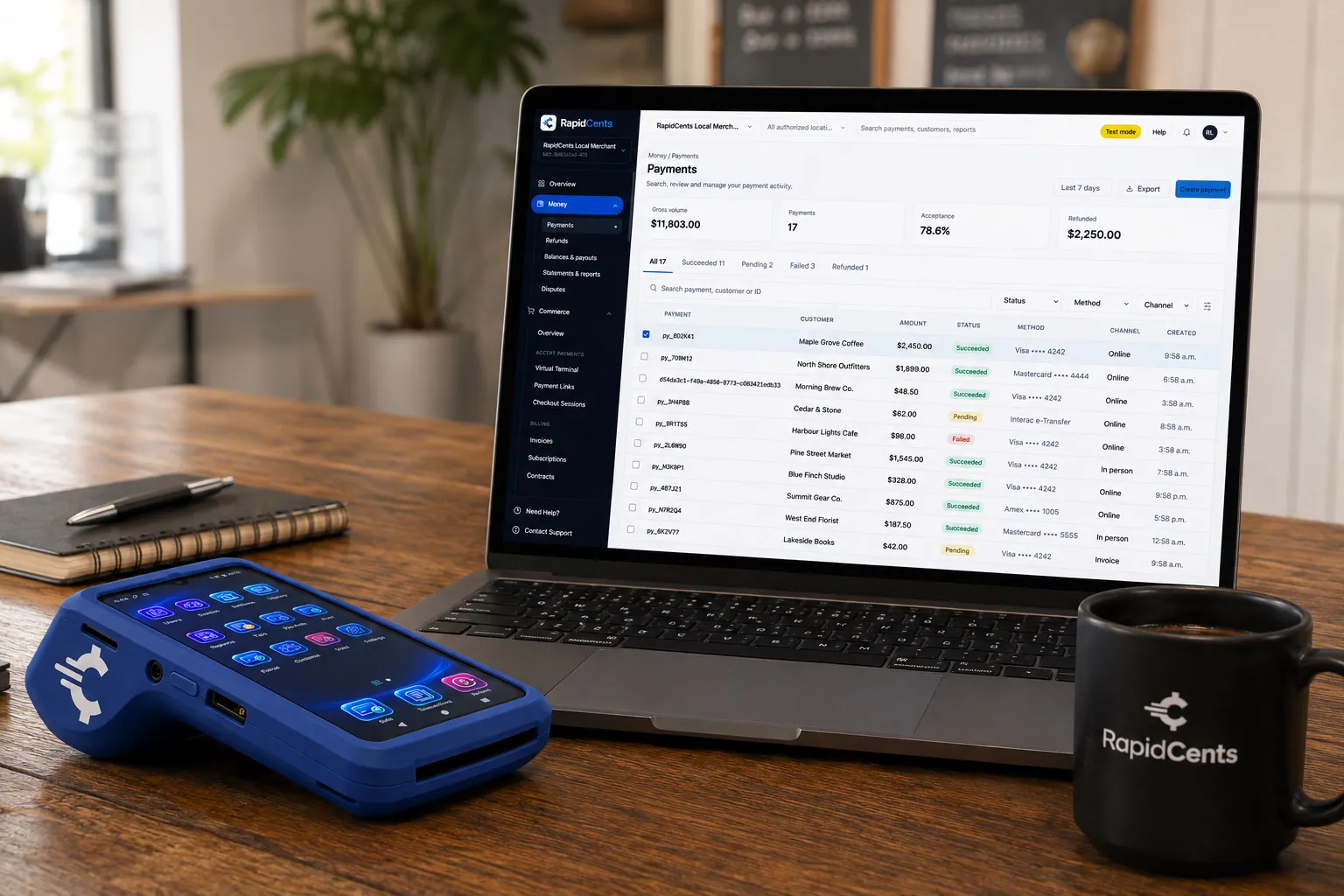
A payment-gateway integration desk: API response on screen, RapidCents terminal ready for a test sale. Payment Gateway
The RapidCents payment gateway exposes REST endpoints for authorize, capture, void, refund and tokenize…
Explore
The RapidCents Rivo Go on a counter, the flagship of the Rivo line of countertop, mobile and compact card terminals. Payment Terminals
RapidCents payment terminals cover countertop, mobile and smart form factors so you can accept chip…
Explore


Implementation approach
Current-state discovery
Every acceptance channel, device, integration and contract documented, including the ones nobody has touched in years, which is where the surprises live.
Configuration and credential planning
The new account, users and integrations built, and the credential position resolved before any traffic moves.
Parallel testing
Real flows tested on the new route while customers continue paying on the old one.
Waved cutover and post-launch support
Channels or sites moved in waves, each reconciled before the next, with support through the first full settlement cycle.
What does not change
Your bank account
Deposits land in the business account you already use. Changing processor does not require changing bank.
Your customers’ experience
For everything except re-collected stored cards, customers pay the way they did before. The change sits behind the counter.
Your historical records
Transactions already settled with the previous provider stay with them. You keep the statements and exports; migration is forward-looking.
Frequently asked questions
Do my customers have to enter their card again?
Only where stored credentials cannot be migrated. Portability depends on the outgoing provider and the networks involved, so establish it in discovery — it is the single item that most changes the shape of a migration.
How long does a migration take?
It is governed by the estate rather than by a standard schedule: number of sites, whether integrations need re-certification, contract notice periods, and how long a parallel period the reconciliation needs. Discovery is what produces a real answer.
What is the rollback position?
The previous route stays available through the parallel period. A wave that does not reconcile can be held or reversed without the business losing the ability to take payments.
What about equipment we are still leasing?
A lease normally continues on its own terms after processing moves. Check the term and the return conditions during discovery, because it affects both sequencing and the real cost of the change.
How do we close a month that spans two providers?
Two statements, reconciled separately, with the cutover date as the boundary. Deposit-level detail on the RapidCents side ties each settlement to its transactions, which makes the second half straightforward.
Can we migrate one channel at a time?
Yes, and it is usually the better plan. Online, in-person and recurring billing have different risk and different rollback characteristics, so moving them together concentrates risk for no benefit.
What happens to our reporting history?
Transactions already settled with the previous provider stay with them, and you keep their statements and exports. Migration is forward-looking: volume from the cutover onward reports in RapidCents, which is also why the cutover date becomes the boundary a split month is reconciled against.
Who runs the migration day to day?
A dedicated implementation contact owns the sequence rather than a support queue, working from a documented playbook covering discovery, credential handling, deployment, testing, training and cutover. That means the plan is not reconstructed over the phone when a wave does not reconcile.
Take the next step
Talk to a RapidCents specialist
RapidCents Fee Check reads a processing statement and shows interchange separately from the markup. Upload a statement for an instant breakdown, or open a merchant account and start accepting payments on one account.
- No obligation
- Payment specialists, not a call centre
- Secure statement upload